
主管:中国科学院
主办:中国优选法统筹法与经济数学研究会
中国科学院科技战略咨询研究院
主办:中国优选法统筹法与经济数学研究会
中国科学院科技战略咨询研究院

Chinese Journal of Management Science ›› 2026, Vol. 34 ›› Issue (11): 231-243.doi: 10.16381/j.cnki.issn1003-207x.2024.2389
Previous Articles Next Articles
Jianhua Xiao1,2, Wenxue Zhang1( ), Wantong Lv1,3, Boquan Gao1
Received:2024-12-31
Revised:2025-04-18
Online:2026-11-25
Published:2026-11-10
Contact:
Wenxue Zhang
E-mail:1120221336@mail.nankai.edu.cn
CLC Number:
Jianhua Xiao,Wenxue Zhang,Wantong Lv, et al. Multi-objective Optimization of Collection Routes for Multi-compartment Vehicles Considering Noise Pollution in Urban Construction Waste Sorted Collection[J]. Chinese Journal of Management Science, 2026, 34(11): 231-243.
"

"
| 符号 | 定义 |
|---|---|
| 建筑垃圾中转站{0}及 | |
| 建筑垃圾点集合, | |
| 非混凝土建筑垃圾种类集合, | |
| 多舱车车型集合, | |
| 多舱车车辆集合, | |
| 表示建筑垃圾中转站或建筑垃圾点, | |
| 表示节点 | |
| 表示节点 | |
| 表示车型 | |
| 表示车型 | |
| 表示车型 | |
| 表示车型 | |
| 表示从节点 | |
| 表示从节点 | |
| 表示滚动噪音回归系数1 | |
| 表示滚动噪音回归系数2 | |
| 表示车辆行驶速度 | |
| 表示模型中采用的参考速度 | |
| 表示车轴数量 | |
| 表示模型中采用的参考轴数 | |
| 表示车型h的多舱车k从节点i行驶至节点j时的总噪声 | |
| 表示车型h的多舱车k从节点i行驶至节点j时的滚动噪声 | |
| 表示车型h的多舱车k从节点i行驶至节点j时的发动机噪声 | |
| 表示最佳发动机转速下的全油门发动机声功率级 | |
| 表示与发动机负荷相关的系数 | |
| 表示标准化发动机负荷 | |
| 表示滚动阻力的静态系数 | |
| 表示滚动阻力的动态系数 | |
| 表示空气密度 | |
| 表示车辆的正面横截面积 | |
| 表示气动阻力系数 | |
| 表示发动机功率 | |
| 表示传动效率系数 | |
| 0-1变量,当使用车型h的多舱车k从节点i行驶至节点j时,取值为1;否则,为0 | |
| 0-1变量,当使用车型h的多舱车k收运节点i的非混凝土建筑垃圾p时,取值为1;否则,为0 | |
| 0-1变量,表示车型h的多舱车k从节点i行驶至节点j时的总载重 | |
| 0-1变量,车型h的多舱车k在节点i收运非混凝土建筑垃圾p的垃圾量 |
"
"
| 建筑垃圾点数 | 非混凝土建筑垃圾种类数 | 算例总数 |
|---|---|---|
| 10 | 2 | 10 |
| 15 | 2 | 10 |
| 20 | 3 | 10 |
| 30 | 3 | 10 |
"
"
| 车辆类型 | 车容 | 车舱数量 | 车舱容量 | 派车成本 | 单位距离 运输成本 |
|---|---|---|---|---|---|
| I | 2.5 | 2 | 1.25+1.25 | 410 | 1.3 |
| II | 3.75 | 3 | 1.25+1.25+1.25 | 550 | 1.5 |
| III | 4.5 | 3 | 1.5+1.5+1.5 | 620 | 1.8 |
"
| 算例编号 | M-IMOEA/D | I-MOEA/D(WM) | I-MOEA/D(PBI) | ||||||
|---|---|---|---|---|---|---|---|---|---|
| Best | Worst | Mean | Best | Worst | Mean | Best | Worst | Mean | |
| 10-2-2 | 1.90×10⁶ | 6.35×10⁵ | 1.04×10⁶ | 8.66×10⁵ | 4.80×10⁵ | 6.69×10⁵ | 1.31×10⁶ | 3.95×10⁵ | 7.99×10⁵ |
| 10-2-4 | 1.41×10⁶ | 5.44×10⁵ | 9.71×10⁵ | 1.03×10⁶ | 5.87×10⁵ | 8.12×10⁵ | 1.35×10⁶ | 4.53×10⁵ | 9.00×10⁵ |
| 10-2-6 | 1.37×10⁶ | 6.60×10⁵ | 1.00×10⁶ | 8.14×10⁵ | 4.45×10⁵ | 6.33×10⁵ | 1.19×10⁶ | 5.56×10⁵ | 7.44×10⁵ |
| 15-2-2 | 3.95×10⁶ | 1.03×10⁶ | 2.41×10⁶ | 2.08×10⁶ | 1.00×10⁶ | 1.49×10⁶ | 2.52×10⁶ | 1.19×10⁵ | 1.83×10⁶ |
| 15-2-4 | 4.75×10⁶ | 1.45×10⁶ | 2.48×10⁶ | 2.34×10⁶ | 1.01×10⁶ | 1.57×10⁶ | 3.59×10⁶ | 1.30×10⁶ | 2.14×10⁶ |
| 15-2-6 | 3.43×10⁶ | 1.39×10⁶ | 2.24×10⁶ | 1.44×10⁶ | 1.01×10⁶ | 1.23×10⁶ | 3.26×10⁵ | 1.28×10⁵ | 2.28×10⁶ |
| 20-3-2 | 5.80×10⁶ | 2.43×10⁶ | 4.25×10⁶ | 3.21×10⁶ | 1.33×10⁶ | 2.36×10⁶ | 6.88×10⁶ | 2.68×10⁶ | 4.28×10⁶ |
| 20-3-4 | 6.38×10⁶ | 3.33×10⁶ | 4.63×10⁶ | 3.36×10⁶ | 1.41×10⁶ | 2.21×10⁶ | 5.54×10⁶ | 3.47×10⁶ | 4.31×10⁶ |
| 20-3-6 | 7.85×10⁶ | 2.79×10⁶ | 4.81×10⁶ | 2.64×10⁶ | 1.54×10⁶ | 2.02×10⁶ | 6.74×10⁶ | 2.63×10⁶ | 4.30×10⁶ |
| 30-3-2 | 8.66×10⁶ | 3.91×10⁶ | 6.21×10⁶ | 5.39×10⁶ | 3.16×10⁶ | 3.97×10⁶ | 7.14×10⁶ | 4.37×10⁶ | 6.35×10⁶ |
| 30-3-4 | 1.05×10⁷ | 4.36×10⁶ | 6.60×10⁶ | 4.10×10⁶ | 2.56×10⁶ | 3.26×10⁶ | 1.15×10⁶ | 4.43×10⁶ | 6.85×10⁶ |
| 30-3-6 | 1.10×10⁷ | 5.56×10⁶ | 7.67×10⁶ | 6.18×10⁶ | 3.05×10⁶ | 4.71×10⁶ | 1.05×10⁶ | 5.75×10⁶ | 7.48×10⁶ |
"
"
"
| 算例编号 | 单目标模型 | 本文模型 | 总成本值Gap | 总噪声值Gap |
|---|---|---|---|---|
| 10-2-3 | (2552.62,864.60) | (2611.09,619.04) | -2.24% | 39.67% |
| 10-2-5 | (2489.65,745.35) | (2607.26,594.89) | -4.51% | 25.29% |
| 10-2-7 | (2462.89,724.17) | (2562.35,560.21) | -3.88% | 32.48% |
| 15-2-3 | (4050.38,1441.92) | (4096.21,1015.06) | -1.12% | 42.05% |
| 15-2-5 | (3428.19,1168.99) | (3665.70,965.16) | -6.48% | 21.12% |
| 15-2-7 | (4618.84,1435.60) | (4827.84,992.89) | -4.33% | 44.59% |
| 20-3-3 | (5428.86,1566.99) | (5833.63,1295.17) | -6.93% | 20.99% |
| 20-3-5 | (6244.33,1620.16) | (6746.53,1241.55) | -7.44% | 30.49% |
| 20-3-7 | (6358.82,1662.23) | (6635.52,1309.04) | -4.17% | 26.98% |
| 30-3-3 | (10415.23,2533.51) | (11000.47,2016.25) | -5.30% | 25.65% |
| 30-3-5 | (8906.57,2524.84) | (9825.02,1936.75) | -9.60% | 30.36% |
| 30-3-7 | (9992.86,2428.13) | (11625.86,1960.76) | -14.05% | 23.84% |
"
| 算例 | 单舱车 | 多舱车 | ||||
|---|---|---|---|---|---|---|
运输 距离 | 总成本 | 总噪声 | 运输 距离 | 总成本 | 总噪声 | |
| 10-2-1 | 1947 | 3761 | 1403 | 858 | 2565 | 595 |
| 10-2-2 | 1727 | 3994 | 1238 | 1333 | 2503 | 595 |
| 10-2-3 | 1774 | 4046 | 1379 | 860 | 2789 | 560 |
| 15-2-1 | 3318 | 6809 | 1859 | 1529 | 4613 | 840 |
| 15-2-2 | 3483 | 6855 | 1900 | 1515 | 4402 | 875 |
| 15-2-3 | 3165 | 7516 | 1860 | 1371 | 4025 | 1048 |
| 20-3-1 | 6872 | 16015 | 3811 | 2496 | 9274 | 1468 |
| 20-3-2 | 6302 | 14525 | 3733 | 2009 | 6433 | 1349 |
| 20-3-3 | 5368 | 11903 | 4117 | 1880 | 6387 | 1235 |
| 30-3-1 | 10000 | 20663 | 5494 | 3809 | 11185 | 2118 |
| 30-3-2 | 9564 | 20287 | 5809 | 4144 | 11157 | 2018 |
| 30-3-3 | 9053 | 20063 | 5510 | 4109 | 12113 | 2236 |
"

"
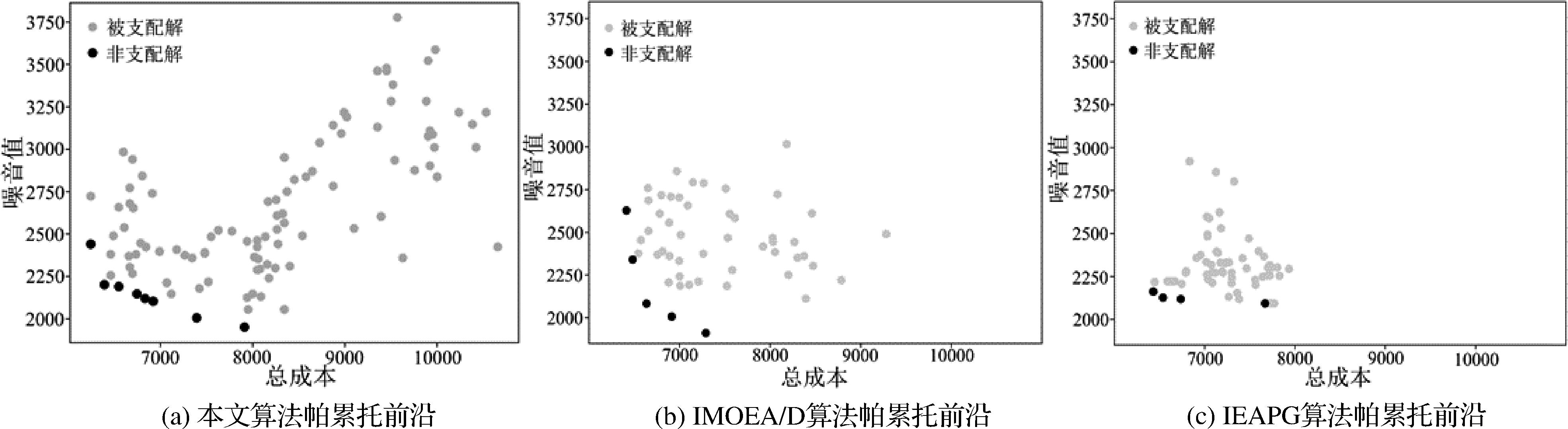
"
| 非支配解编号 | 总成本 | 总噪声污染值 |
|---|---|---|
| 1 | 6241.84 | 2440.14 |
| 2 | 6392.78 | 2202.99 |
| 3 | 6554.35 | 2189.12 |
| 4 | 6747.20 | 2147.50 |
| 5 | 6837.98 | 2118.42 |
| 6 | 6921.65 | 2100.82 |
| 7 | 7391.21 | 2007.45 |
| 8 | 7912.66 | 1948.76 |
"
"
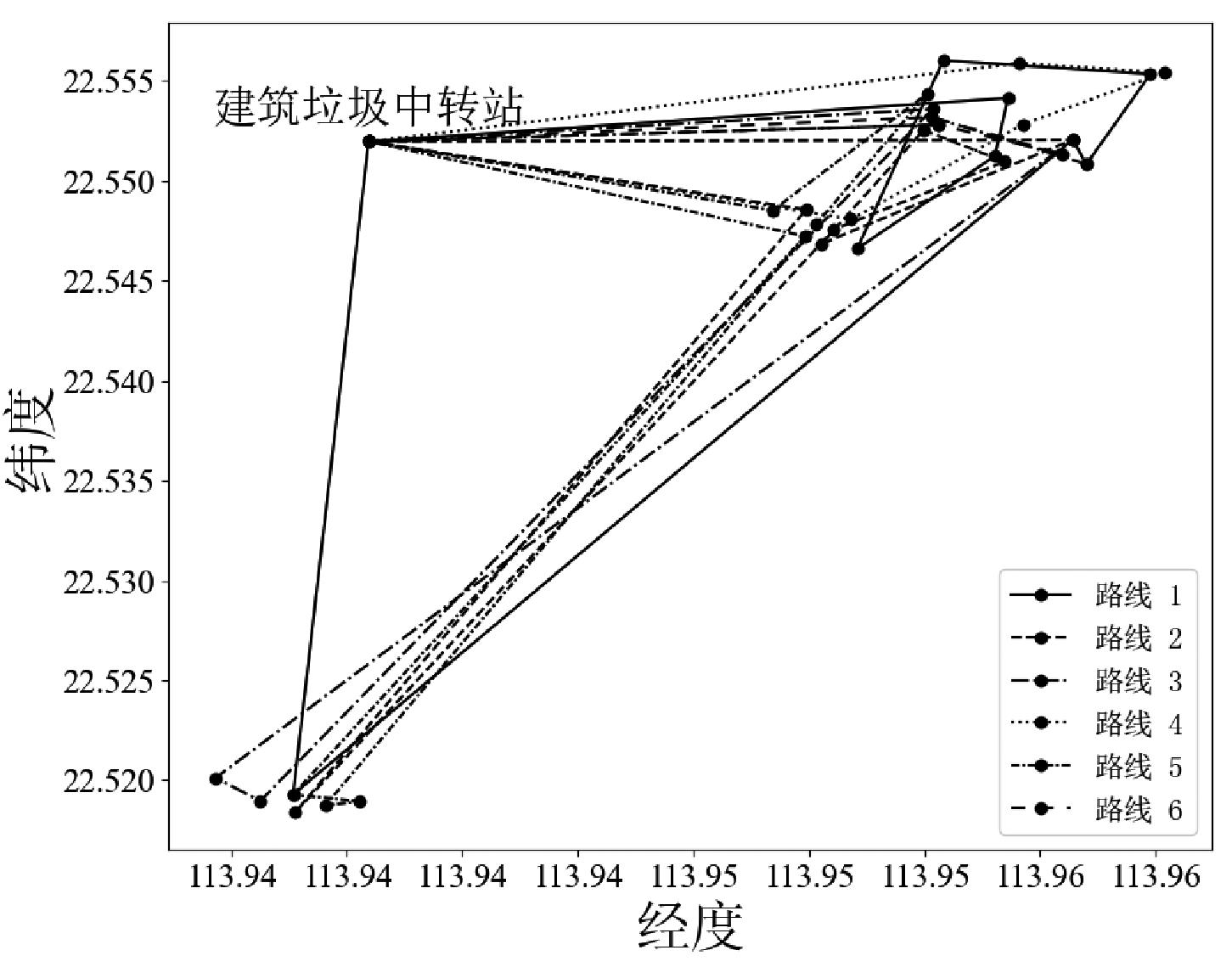
| 车辆类型 | 车辆访问顺序 | 回收非混凝土建筑垃圾种类 | 总噪声污染值 | 总成本 |
|---|---|---|---|---|
| III | 0-26-16-3-1-20-23-2-24-0 | 玻璃、金属、竹木 | 466.84 | 1337.86 |
| III | 0-21-28-7-18-12-10-2-0 | 玻璃、金属、竹木 | 420.16 | 1316.25 |
| III | 0-14-29-30-2-23-4-8-0 | 玻璃、金属、竹木 | 373.47 | 1297.09 |
| III | 0-15-11-9-5-0 | 玻璃、金属、竹木 | 233.42 | 890.33 |
| III | 0-22-19-6-24-25-27-13-0 | 玻璃、金属、竹木 | 420.16 | 1238.11 |
| III | 0-8-17-4-0 | 玻璃、金属、竹木 | 186.73 | 841.98 |
| [1] | 李欣, 郑懿波, 杨柳, 等. 新背景下建筑垃圾处理产业发展思考与探讨[J/OL]. 施工技术(中英文), 2024.. |
| Li X, Zheng Y B, Yang L, et al. Reflections and discussions on the development of construction waste treatment industry under the new background[J/OL]. Construction Technology, 2024.. | |
| [2] | 邵志国, 李梦笛, 韩传峰, 等. 基于演化博弈的建筑垃圾处理协同机制及仿真[J]. 中国管理科学, 2024, 32(7): 324-334. |
| Shao Z G, Li M D, Han C F, et al. Simulation and cooperative mechanism of construction waste disposal based on evolutionary game[J]. Chinese Journal of Management Science, 2024, 32(7): 324-334. | |
| [3] | 陈鑫. 建筑垃圾高值化利用前景探讨[J]. 科技与创新, 2024(21): 194-196. |
| Chen X. Discussion on the prospect of high-value utilization of construction waste[J]. Science and Technology & Innovation, 2024(21): 194-196. | |
| [4] | Chen Q, Liao W. Collaborative routing optimization model for reverse logistics of construction and demolition waste from sustainable perspective[J]. International Journal of Environmental Research and Public Health, 2022, 19(12): 7366. |
| [5] | Wang H, Yi W, Liu Y. Optimal route design for construction waste transportation systems: Mathematical models and solution algorithms[J]. Mathematics, 2022, 10(22): 4340. |
| [6] | Erdem M. Optimisation of sustainable urban recycling waste collection and routing with heterogeneous electric vehicles[J]. Sustainable Cities and Society, 2022, 80: 103785. |
| [7] | Elbek M, Wøhlk S. A variable neighborhood search for the multi-period collection of recyclable materials[J]. European Journal of Operational Research, 2016, 249(2): 540-550. |
| [8] | Hong Y, Yan W, Ge Q. Designing sustainable logistics networks for classified municipal solid wastes collection and transferring with multi-compartment vehicles[J]. Sustainable Cities and Society, 2023, 99: 104921. |
| [9] | Mohammadi M, Rahmanifar G, Hajiaghaei-Keshteli M, et al. A dynamic approach for the multi-compartment vehicle routing problem in waste management[J]. Renewable and Sustainable Energy Reviews, 2023, 184: 113526. |
| [10] | Shang C, Ma L, Liu Y. Green location routing problem with flexible multi-compartment for source-separated waste: A Q-learning and multi-strategy-based hyper-heuristic algorithm[J]. Engineering Applications of Artificial Intelligence, 2023, 121: 105954. |
| [11] | Amine Masmoudi M, Baldacci R, Mancini S, et al. Multi-compartment waste collection vehicle routing problem with Bin washer[J]. Transportation Research Part E: Logistics and Transportation Review, 2024, 189: 103681. |
| [12] | Ben-Romdhane H, Ouertani N, Krichen S, et al. On optimizing healthcare waste routing systems using waste separation policies: A case study[J]. Applied Soft Computing, 2023, 146: 110615. |
| [13] | 肖建华, 张文雪, 潘钰雅, 等. 基于分类垃圾收运时效性的多周期多车舱路径优化研究[J]. 中国管理科学, 2025, 33(10): 86-97. |
| Xiao J H, Zhang W X, Pan Y Y, et al. A multi-period multi-compartment vehicle routing problem for sorted-waste collection with timeliness[J]. Chinese Journal of Management Science, 2025, 33(10): 86-97. | |
| [14] | 孙丽君, 周雅娴, 滕玥, 等. 多车舱车辆路径问题的研究现状与发展[J]. 系统工程理论与实践, 2021, 41(6): 1535-1546. |
| Sun L J, Zhou Y X, Teng Y, et al. Multi-compartment vehicle routing problem: Status and perspectives[J]. Systems Engineering —Theory & Practice, 2021, 41(6): 1535-1546. | |
| [15] | Anderluh A, Nolz P C, Hemmelmayr V C, et al. Multi-objective optimization of a two-echelon vehicle routing problem with vehicle synchronization and ‘grey zone’ customers arising in urban logistics[J]. European Journal of Operational Research, 2021, 289(3): 940-958. |
| [16] | Sawik B, Faulin J, Pérez-Bernabeu E. A multicriteria analysis for the green VRP: A case discussion for the distribution problem of a Spanish retailer[J]. Transportation Research Procedia, 2017, 22: 305-313. |
| [17] | Sawik B, Faulin J, Pérez-Bernabeu E. Multi-criteria optimization for fleet size with environmental aspects[J]. Transportation Research Procedia, 2017, 27: 61-68. |
| [18] | Shahmoradi-Moghadam H, Samani O, Schönberger J. A hybrid robust-stochastic optimization approach for the noise pollution routing problem with a heterogeneous vehicle fleet[M]//Freitag M,Haasis H D,Pannek J.Dynamics in Logistics. Cham: Springer,2020: 124-134. |
| [19] | Tan Q, Hou J, Li Y, et al. Exploring noise reduction strategies: Optimizing drone station placement for last-mile delivery[J]. Transportation Research Part D: Transport and Environment, 2024, 133: 104306. |
| [20] | Zhang Q, Li H. MOEA/D: A multiobjective evolutionary algorithm based on decomposition[J]. IEEE Transactions on Evolutionary Computation, 2007, 11(6): 712-731. |
| [21] | Lai C M, Chiu C C, Chen T L. A nondominated sorting simplified swarm optimization with local search mechanisms for multi-objective vehicle routing problems with time windows[J]. Applied Soft Computing, 2025, 174: 112989. |
| [22] | Lin Q, Tang C, Ma Y, et al. A novel adaptive control strategy for decomposition-based multiobjective algorithm[J]. Computers & Operations Research, 2017, 78: 94-107. |
| [23] | He L, Shang K, Ishibuchi H. Simultaneous use of two normalization methods in decomposition-based multi-objective evolutionary algorithms[J]. Applied Soft Computing, 2020, 92: 106316. |
| [24] | Zhu Y, Qin Y, Yang D, et al. An enhanced decomposition-based multi-objective evolutionary algorithm with a self-organizing collaborative scheme[J]. Expert Systems with Applications, 2023, 213: 118915. |
| [25] | Xue F, Chen Y, Dong T, et al. MOEA/D with adaptive weight vector adjustment and parameter selection based on Q-learning[J]. Applied Intelligence, 2025, 55(6): 399. |
| [26] | Nishida T Y. An application of P-systems: A new algorithm for NP-complete optimization problems[C]. The 8th World Multi-Conference on Systems, Cybernetics and Informatics, 2004, 109-112. |
| [27] | Cong D, Shi C, Cui Y, et al. Novel competing evolutionary membrane algorithm based on multiple reference points for multi-objective optimization of ethylene cracking processes[J]. Chemometrics and Intelligent Laboratory Systems, 2021, 217: 104389. |
| [28] | Niu Y, Zhang Y, Cao Z, et al. MIMOA: A membrane-inspired multi-objective algorithm for green vehicle routing problem with stochastic demands[J]. Swarm and Evolutionary Computation, 2021, 60: 100767. |
| [29] | Lai W, Zheng X, Song Q, et al. Multi-objective membrane search algorithm: A new solution for economic emission dispatch[J]. Applied Energy, 2022, 326: 119969. |
| [30] | Lai W, Song Q, Zheng X, et al. A new version of membrane search algorithm for hybrid renewable energy systems dynamic scheduling[J]. Renewable Energy, 2023, 209: 262-276. |
| [31] | Das S, Mullick S S, Suganthan P N. Recent advances in differential evolution-An updated survey[J]. Swarm and Evolutionary Computation, 2016, 27: 1-30. |
| [32] | Qin Y, Ren J, Yang D, et al. Decomposition-based multiobjective evolutionary algorithm with density estimation-based dynamical neighborhood strategy[J]. Applied Intelligence, 2023, 53(24): 29863-29901. |
| [33] | Zheng W, Tan Y, Meng L, et al. An improved MOEA/D design for many-objective optimization problems[J]. Applied Intelligence, 2018, 48(10): 3839-3861. |
| [34] | Yuan J, Liu H L, Yang S. An adaptive parental guidance strategy and its derived indicator-based evolutionary algorithm for multi- and many-objective optimization[J]. Swarm and Evolutionary Computation, 2024, 84: 101449. |
| [35] | 王丽萍, 任宇, 邱启仓, 等. 多目标进化算法性能评价指标研究综述[J]. 计算机学报, 2021, 44(8): 1590-1619. |
| Wang L P, Ren Y, Qiu Q C, et al. Survey on performance indicators for multi-objective evolutionary algorithms[J]. Chinese Journal of Computers, 2021, 44(8): 1590-1619. |
| [1] | Hao Xiong, Xiaodie Chen, Huili Yan. Multi-Objective Routing Optimization of Takeout Delivery Considering Rider Rewards and Penalties of Distribution Timeliness [J]. Chinese Journal of Management Science, 2026, 34(9): 209-224. |
| [2] | Huali Sun, Yixiang Zhang, Shuo Liu. Affine Adjustable Robust Optimization Strategy of Emergency Facility Location and Multi-period Allocation for Supplies [J]. Chinese Journal of Management Science, 2026, 34(9): 142-152. |
| [3] | Ru Yu, Xiaoli Wang, Xiaojun Xu, Lu Wang. Research on the Development Path of BEVs in China Based on Multi-objective Optimization [J]. Chinese Journal of Management Science, 2026, 34(8): 345-355. |
| [4] | Yamin Ji, Feng Gao, Mingliang Qi, Hong Chi. Optimizing Tourism Development Scale around Nuclear Power Plants: A Trade-off between Safety Margin and Comprehensive Benefits [J]. Chinese Journal of Management Science, 2026, 34(8): 104-114. |
| [5] | Yong Wang, Tingting Shi, Mengyuan Gou, Qiong Jiang, Maozeng Xu. Multi-center CloseOpen Mixed Vehicle Routing Problem with Time Window Assignment [J]. Chinese Journal of Management Science, 2026, 34(7): 189-205. |
| [6] | Liping Liu, Rui Wang, Shilei Sun, Xiaofeng Gan, Tijun Fan. Transportation Network Optimization of Hazardous Chemicals Considering Risk Equity under Depot Disruptions [J]. Chinese Journal of Management Science, 2026, 34(6): 66-76. |
| [7] | Jun Zhang, Huiqing Yang, Lingkun Tian. Research on Storage Assignment Problem in Replenishment Phase of Robotic Mobile Fulfilment Systems Considering Picking Aisles' Workload Balance [J]. Chinese Journal of Management Science, 2026, 34(5): 184-194. |
| [8] | Wenhe Chen, Zhipeng Chang, Hanting Zhou, Longsheng Cheng, Buyu Wen. A Deep Transfer Learning Evaluation Method for Community Resilience Governance Capacity under Major Epidemics [J]. Chinese Journal of Management Science, 2025, 33(8): 100-111. |
| [9] | Song Xue, Xu Chen, Chao Li, Jingchun Feng. Research on Miniature Multi-Project Scheduling of Service Project Enterprises Considering the Evolution of Human Resources Skills [J]. Chinese Journal of Management Science, 2025, 33(6): 96-104. |
| [10] | Guobin Wu, Yaqing Sun, Yulong Li. Research on Optimization of Tunnel Spoil Comprehensive Utilization of Mega Project Based on ESG Framework [J]. Chinese Journal of Management Science, 2025, 33(3): 174-185. |
| [11] | Xiqiang Xia, Jiangwen Li, Qinghua Zhu, Ruiyao Ma. The Development Trends and Future Prospects on Remanufacturing [J]. Chinese Journal of Management Science, 2025, 33(1): 287-296. |
| [12] | Tieke Li,Yixuan Su,Wenxin Zhang,Bailin Wang. Interval Multi-objective Optimal Scheduling for Steelmaking-continuous Casting with Processing Time Uncertainty [J]. Chinese Journal of Management Science, 2024, 32(8): 95-106. |
| [13] | Fuyu Wang,Haoxuan Xie,Zhonggao Lin,Jun Wang. Multi-objective Optimization Model and Adaptive Quantum Ant Colony Algorithm for Emergency Evacuation of High-speed Railway Stations under Emergencies [J]. Chinese Journal of Management Science, 2024, 32(3): 188-197. |
| [14] | Xuelong Chen,Zhong Zhang,Yue Li. Generation of Emergency Response Plan for Unconventional Emergencies from the Perspective of Improvisational Decision-Making [J]. Chinese Journal of Management Science, 2024, 32(10): 109-122. |
| [15] | Hui Li,Xi Wang,Zhiya Zuo. Multi-objective Integrated Optimization of Flexible Resource Allocation and Scheduling in the Aerospace Production Workshop [J]. Chinese Journal of Management Science, 2024, 32(10): 146-155. |
| Viewed | ||||||
|
Full text |
|
|||||
|
Abstract |
|
|||||
|
||
