
主管:中国科学院
主办:中国优选法统筹法与经济数学研究会
中国科学院科技战略咨询研究院
主办:中国优选法统筹法与经济数学研究会
中国科学院科技战略咨询研究院

Chinese Journal of Management Science ›› 2026, Vol. 34 ›› Issue (11): 219-230.doi: 10.16381/j.cnki.issn1003-207x.2025.0337
Previous Articles Next Articles
Xueyi Ai1, Tongtong Zhang1, Haoxuan Xu2( )
Received:2025-03-03
Revised:2025-06-18
Online:2026-11-25
Published:2026-11-10
Contact:
Haoxuan Xu
E-mail:haoxuanxu@zuel.edu.cn
CLC Number:
Xueyi Ai,Tongtong Zhang,Haoxuan Xu. Routing Optimization of Hybrid Electric Vehicles in Electric Road Systems[J]. Chinese Journal of Management Science, 2026, 34(11): 219-230.
"

"
| 参数 | 释义 |
|---|---|
| N={N1,N2…} | 所有节点集合 |
| 所有路径弧集合 | |
| C={C1,C2…Cn} | 所有客户节点集合 |
| O={O1,O2…On} | 所有起始点集合 |
| 节点i与节点j之间的距离(千米) | |
| 邻接矩阵δ中包含的元素 | |
| C | 客户点数量 |
| 车辆电池容量(千瓦时) | |
| v | 车辆行驶速度(千米/小时) |
| 理想状态下沿充电路段 | |
| 穿越弧 | |
| 实际情况下沿充电路段 | |
| 每千瓦时的电能成本(元) | |
| 每升的油耗成本(元) | |
| T | 路线选择次数 |
| k | 非起始客户点数量 |
| 变量 | |
| 车辆在第t次移动结束时的电池水平(千瓦时) | |
| 当 | |
| 当 | |
| 二进制变量,若车辆在第t次移动时处于节点i,则为1,否则等于0 | |
| 二进制变量,若车辆在第t次移动结束时从i过渡到j,则为1,否则等于0 |
"
"
| 序号 | 起始位置 | 客户点 |
|---|---|---|
| 1 | 7 | 4,13,14,17 |
| 2 | 8 | 2,5,15,20 |
| 3 | 1 | 5,17,18,22 |
| 4 | 16 | 3,9,11,22 |
| 5 | 20 | 6,12,18,19 |
| 6 | 13 | 4,16,21 |
| 7 | 11 | 8,17,21 |
| 8 | 14 | 5,19 |
| 9 | 3 | 11,22 |
| 10 | 4 | 7, 16 |

"
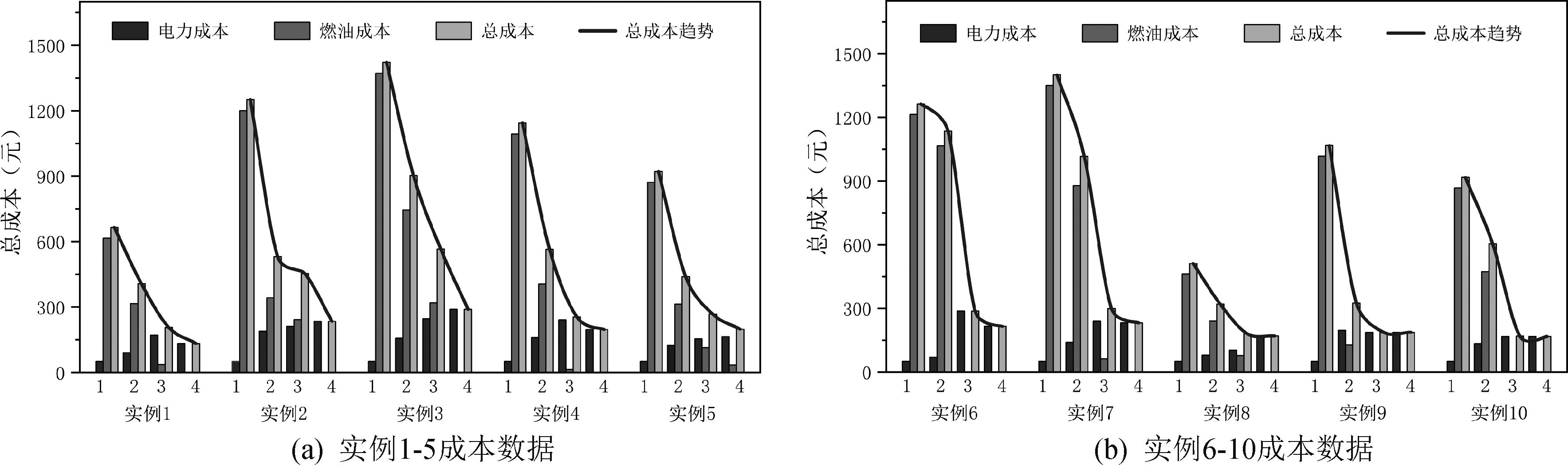
"
| 序号 | 第一阶段 | 第二阶段 | 第三阶段 | 第四阶段 | ||||
|---|---|---|---|---|---|---|---|---|
| 距离/千米 | ERS充电 路段比重/% | 距离/千米 | ERS充电 路段比重/% | 距离/千米 | ERS充电 路段比重/% | 距离/千米 | ERS充电 路段比重/% | |
| 5 | 291 | 0 | 291 | 44.67 | 294 | 60.88 | 294 | 67.69 |
| 6 | 371 | 0 | 371 | 9.16 | 498 | 83.53 | 373 | 100.00 |
| 9 | 300 | 0 | 272 | 64.29 | 300 | 88.33 | 300 | 88.33 |
"
| 路段数量n | 算法/ 求解器 | 总成本 /元 | 平均运行 时间/秒 |
|---|---|---|---|
| n=32 | GA | 21785.47 | 28.08 |
| MPA | 21957.15 | 2.56 | |
| CPLEX | 21566.37 | 167.33 | |
| IMPA | 21688.80 | 13.40 | |
| n=100 | GA | 35221.10 | 38.51 |
| MPA | 35735.17 | 3.11 | |
| CPLEX | 163388.80 | 787.11 | |
| IMPA | 34475.48 | 22.33 |
"
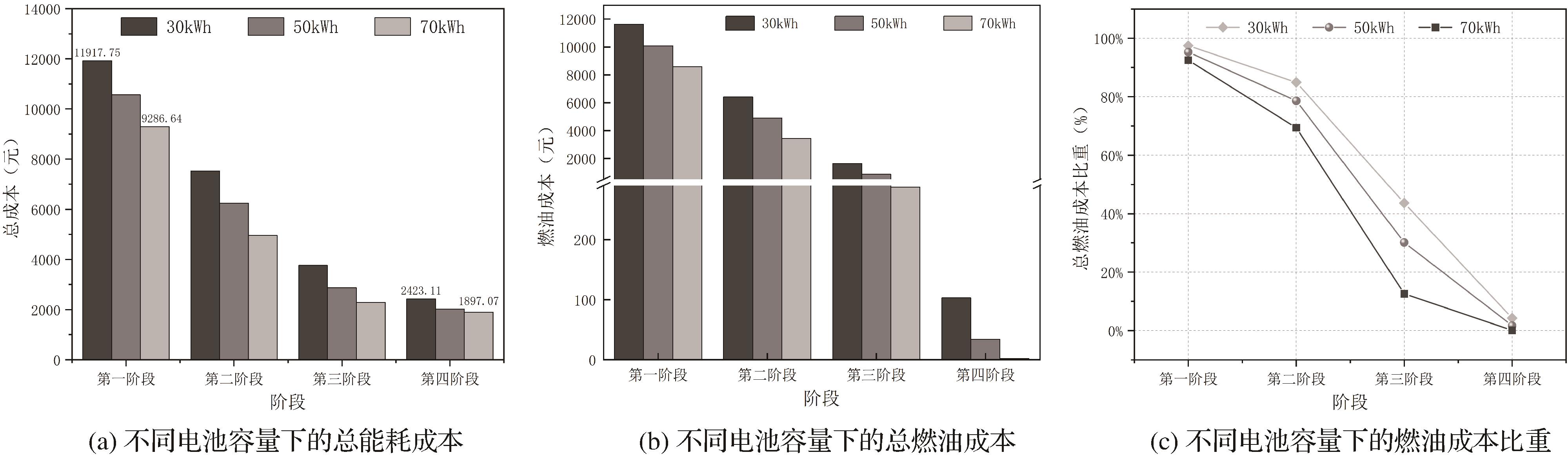
"
| 电池容量 | 第一阶段 | 第二阶段 | 第三阶段 | 第四阶段 | ||||
|---|---|---|---|---|---|---|---|---|
| 电力成本/元 | 燃油成本/元 | 电力成本/元 | 燃油成本/元 | 电力成本/元 | 燃油成本/元 | 电力成本/元 | 燃油成本/元 | |
| 30 kWh | 30 | 1520.30 | 136.61 | 893.88 | 226.63 | 467.85 | 342.94 | 0.00 |
| 总成本/元 | 1550.30 | 1030.49 | 694.47 | 342.94 | ||||
| 50 kWh | 50.00 | 1157.86 | 156.61 | 745.10 | 239.82 | 241.46 | 289.52 | 0.00 |
| 总成本/元 | 1207.86 | 901.71 | 481.28 | 289.52 | ||||
| 70 kWh | 70.00 | 1009.08 | 176.61 | 596.32 | 259.82 | 92.68 | 204.58 | 7.93 |
| 总成本/元 | 1079.08 | 772.93 | 352.50 | 212.51 | ||||
"
| 序号 | 第一阶段 | 第二阶段 | 第三阶段 | 第四阶段 | ||||
|---|---|---|---|---|---|---|---|---|
| 电力成本/元 | 燃油成本/元 | 电力成本/元 | 燃油成本/元 | 电力成本/元 | 燃油成本/元 | 电力成本/元 | 燃油成本/元 | |
| 实例1 | 30.00 | 763.94 | 70.21 | 464.81 | 236.90 | 32.44 | 174.03 | 8.75 |
| 总成本/元 | 793.94 | 535.03 | 269.34 | 182.77 | ||||
| 总成本增幅/% | 19.36 | 31.70 | 30.16 | 37.73 | ||||
| 实例2 | 30.00 | 1349.37 | 168.29 | 491.60 | 191.00 | 390.98 | 225.32 | 67.34 |
| 总成本/元 | 1379.37 | 659.89 | 581.98 | 292.66 | ||||
| 总成本增幅/% | 5.60 | 24.25 | 28.42 | 24.87 | ||||
| 实例7 | 30.00 | 1498.93 | 118.18 | 1026.71 | 218.86 | 209.41 | 229.69 | 13.46 |
| 总成本/元 | 1528.93 | 1144.89 | 428.27 | 243.15 | ||||
| 总成本增幅/% | 9.20 | 12.67 | 43.00 | 5.03 | ||||
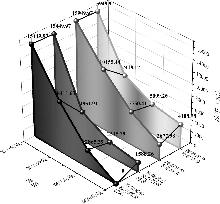
"
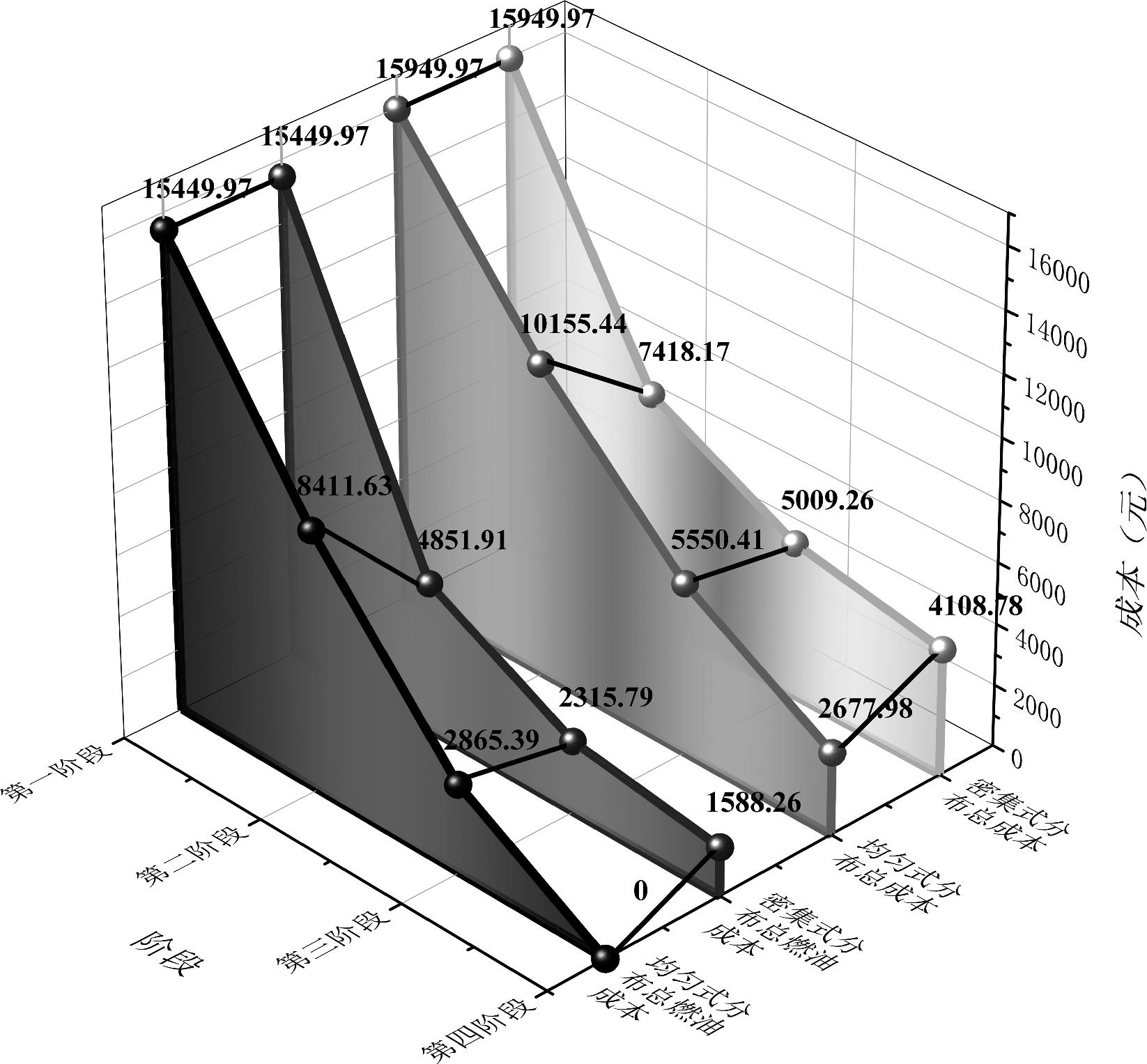
"
| 序号 | 第一阶段 | 第二阶段 | 第三阶段 | 第四阶段 | ||||
|---|---|---|---|---|---|---|---|---|
| 电力成本/元 | 燃油成本/元 | 电力成本/元 | 燃油成本/元 | 电力成本/元 | 燃油成本/元 | 电力成本/元 | 燃油成本/元 | |
| 2 | 50.00 | 1841.77 | 237.93 | 509.04 | 323.58 | 0.00 | 323.58 | 0.00 |
| 6 | 50.00 | 1527.06 | 301.54 | 0.00 | 301.54 | 0.00 | 301.54 | 0.00 |
| 7 | 50.00 | 1587.30 | 342.39 | 71.32 | 347.20 | 0.00 | 263.38 | 0.00 |
| 9 | 50.00 | 1641.50 | 267.23 | 438.54 | 392.16 | 0.00 | 274.98 | 0.00 |
| 燃油占比/% | 97.08 | 63.22 | 23.16 | 4.06 | ||||
| 燃油比重降幅/% | - | 33.86 | 40.06 | 19.10 | ||||
"
| 序号 | 第一阶段 | 第二阶段 | 第三阶段 | 第四阶段 | ||||
|---|---|---|---|---|---|---|---|---|
| 电力成本/元 | 燃油成本/元 | 电力成本/元 | 燃油成本/元 | 电力成本/元 | 燃油成本/元 | 电力成本/元 | 燃油成本/元 | |
| 5 | 50.00 | 1623.58 | 203.15 | 484.30 | 268.25 | 0.00 | 268.25 | 0.00 |
| 燃油占比/% | 97.66 | 81.12 | 37.06 | 0.31 | ||||
| 燃油比重降幅/% | - | 16.53 | 44.06 | 36.75 | ||||
"
| 序号 | 第一阶段 | 第二阶段 | 第三阶段 | 第四阶段 | ||||
|---|---|---|---|---|---|---|---|---|
| 电力成本/元 | 燃油成本/元 | 电力成本/元 | 燃油成本/元 | 电力成本/元 | 燃油成本/元 | 电力成本/元 | 燃油成本/元 | |
| 4 | 50.00 | 1436.55 | 257.34 | 153.64 | 278.00 | 0.00 | 253.24 | 0.00 |
| 8 | 50.00 | 3294.32 | 652.80 | 310.50 | 615.65 | 0.00 | 594.39 | 0.00 |
| 9 | 50.00 | 1286.72 | 150.29 | 540.70 | 217.06 | 43.98 | 222.97 | 0.00 |
| 燃油占比/% | 97.63 | 68.65 | 24.74 | 2.79 | ||||
| 燃油比重降幅/% | - | 28.97 | 43.92 | 21.95 | ||||
| [1] | 高咏玲, 乔源, 徐猛. 考虑电动车配置与路径优化的城市配送车队更新政策效应研究[J]. 中国管理科学, 2025, 33(8): 156-165. |
| Gao Y L, Qiao Y, Xu M. Effects analyses of delivery fleet renewal policies considering electric vehicle deployment and routing optimization[J]. Chinese Journal of Management Science, 2025, 33(8): 156-165. | |
| [2] | 黄志红, 黄卫来, 郭放. 考虑电池损耗的电动物流汽车充电设施选址与充电策略协同优化研究[J]. 中国管理科学, 2024, 32(6): 68-78. |
| Huang Z H, Huang W L, Guo F. Collaborative optimization of charging network and charging strategy with practical battery wear model[J]. Chinese Journal of Management Science, 2024, 32(6): 68-78. | |
| [3] | Gutierrez-Alcoba A, Rossi R, Martin-Barragan B, et al. The stochastic inventory routing problem on electric roads[J]. European Journal of Operational Research, 2023, 310(1): 156-167. |
| [4] | 郭放, 杨珺, 杨超. 考虑充电策略与电池损耗的电动汽车路径优化问题研究[J]. 中国管理科学, 2018, 26(9): 106-118. |
| Guo F, Yang J, Yang C. Study on the electric vehicle routing problem in the present of charging strategy and battery consumption[J]. Chinese Journal of Management Science, 2018, 26(9): 106-118. | |
| [5] | 张浩然, 刘宇, 谭秀杰, 等. 新能源汽车跨越式发展对城市交通拥堵的影响研究[J]. 中国管理科学, 2024, DOI:10.16381/j.cnki.issn1003-207x.2024.0110 . |
| Zhang H R, Liu Y, Tan X J, et al. Research on the impact of leap-forward development of new energy vehicles on urban traffic congestion[J]. Chinese Journal of Management Science, 2024, DOI:10.16381/j.cnki.issn1003-207x.2024.0110 . | |
| [6] | Akbari V, Çatay B, Sadati İ. Route optimization of battery electric vehicles using dynamic charging on electrified roads[J]. Sustainable Cities and Society, 2024, 109: 105532. |
| [7] | Jang Y J, Jeong S, Ko Y D. System optimization of the On-Line Electric Vehicle operating in a closed environment[J]. Computers & Industrial Engineering, 2015, 80: 222-235. |
| [8] | Majhi R C, Ranjitkar P, Sheng M. Assessment of dynamic wireless charging based electric road system: A case study of Auckland motorway[J]. Sustainable Cities and Society, 2022, 84: 104039. |
| [9] | de Saxe C, Ainalis D, Miles J, et al. An electric road system or big batteries: Implications for UK road freight[J]. Transportation Engineering, 2023, 14: 100210. |
| [10] | Taljegard M, Thorson L, Odenberger M, et al. Large-scale implementation of electric road systems: Associated costs and the impact on CO2 emissions[J]. International Journal of Sustainable Transportation, 2020, 14(8): 606-619. |
| [11] | Ainalis D, Thorne C, Cebon D. Technoeconomic comparison of an electric road system and hydrogen for decarbonising the UK’s long-haul road freight[J]. Research in Transportation Business & Management, 2023, 48: 100914. |
| [12] | Börjesson M, Johansson M, Kågeson P. The economics of electric roads[R]. Working Papers, Research Programme in Transport Economics, 2020. |
| [13] | Perdu F, Chaniot P, Raynal M, et al. The electric road system: Technical, economic and environmental study carried out in France. Part 2. Economic and environmental aspects[J]. Transportation Research Procedia, 2023, 72: 3785-3792. |
| [14] | Aronietis R, Vanelslander T. Economic impacts of the catenary electric road system implementation in Flanders[J]. International Journal of Sustainable Transportation, 2024, 18(1): 46-61. |
| [15] | Deshpande P, de Saxe C, Ainalis D, et al. A breakeven cost analysis framework for electric road systems[J]. Transportation Research Part D: Transport and Environment, 2023, 122: 103870. |
| [16] | Gutierrez-Alcoba A, Rossi R, Martin-Barragan B, et al. Routing decisions of a hybrid vehicle on electric road networks[J]. IFAC-PapersOnLine, 2022, 55(10): 227-232. |
| [17] | Zuo W, Li K. Reliability assessment of integrated power and road system for decarbonizing heavy-duty vehicles[J]. Energies, 2024, 17(4): 934. |
| [18] | Amine Masmoudi M, Coelho L C, Demir E. Plug-in hybrid electric refuse vehicle routing problem for waste collection[J]. Transportation Research Part E: Logistics and Transportation Review, 2022, 166: 102875. |
| [19] | Seyfi M, Alinaghian M, Ghorbani E, et al. Multi-mode hybrid electric vehicle routing problem[J]. Transportation Research Part E: Logistics and Transportation Review, 2022, 166: 102882. |
| [20] | Doppstadt C, Koberstein A, Vigo D. The hybrid electric vehicle–traveling salesman problem[J]. European Journal of Operational Research, 2016, 253(3): 825-842. |
| [21] | Doppstadt C, Koberstein A, Vigo D. The hybrid electric vehicle—Traveling salesman problem with time windows[J]. European Journal of Operational Research, 2020, 284(2): 675-692. |
| [22] | Mancini S. The hybrid vehicle routing problem[J]. Transportation Research Part C: Emerging Technologies, 2017, 78: 1-12. |
| [23] | Bahrami S, Nourinejad M, Amirjamshidi G, et al. The Plugin Hybrid Electric Vehicle routing problem: A power-management strategy model[J]. Transportation Research Part C: Emerging Technologies, 2020, 111: 318-333. |
| [24] | Yin F, Zhao Y. Distributionally robust equilibrious hybrid vehicle routing problem under twofold uncertainty[J]. Information Sciences, 2022, 609: 1239-1255. |
| [25] | Yu V F, Redi A A N P, Hidayat Y A, et al. A simulated annealing heuristic for the hybrid vehicle routing problem[J]. Applied Soft Computing, 2017, 53: 119-132. |
| [26] | Strehler M, Merting S, Schwan C. Energy-efficient shortest routes for electric and hybrid vehicles[J]. Transportation Research Part B: Methodological, 2017, 103: 111-135. |
| [27] | Mubarak M, Üster H, Abdelghany K, et al. Strategic network design and analysis for in-motion wireless charging of electric vehicles[J]. Transportation Research Part E: Logistics and Transportation Review, 2021, 145: 102179. |
| [28] | Goeke D, Schneider M. Routing a mixed fleet of electric and conventional vehicles[J]. European Journal of Operational Research, 2015, 245(1): 81-99. |
| [29] | Scora G, Barth M. Comprehensive modal emissions model (CMEM), version 3.01 [R].Working Paper, Centre for Environmental Research and Technology, University of California, Riverside, 2006. |
| [30] | Barth M, Scora G, Younglove T. Modal emissions model for heavy-duty diesel vehicles[J]. Transportation Research Record: Journal of the Transportation Research Board, 2004, 1880(1): 10-20. |
| [31] | 黄岩松, 姚锡凡, 景轩, 等. 基于深度Q网络的多起点多终点AGV路径规划[J]. 计算机集成制造系统, 2023, 29(8): 2550-2562. |
| Huang Y S, Yao X F, Jing X, et al. DQN-based AGV path planning for situations with multi-starts and multi-targets[J]. Computer Integrated Manufacturing Systems, 2023, 29(8): 2550-2562. | |
| [32] | Lyu L, Yang F. MMPA: A modified marine predator algorithm for 3D UAV path planning in complex environments with multiple threats[J]. Expert Systems with Applications, 2024, 257: 124955. |
| [33] | Tu B, Wang F, Han X. 3D path planning for UAV based on A hybrid algorithm of marine predators algorithm with quasi-oppositional learning and differential evolution[J]. Egyptian Informatics Journal, 2024, 28: 100556. |
| [1] | Jianhua Xiao, Liang Chen, Liujiang Kang, Xujiang Lou. Autonomous Vehicle Assisted Delivery Problem with Dynamic Resupply in Same-Day Delivery [J]. Chinese Journal of Management Science, 2026, 34(9): 184-196. |
| [2] | LI Wen-li, LI Kun-peng, TIAN Qian-nan, LI Xue-song. The Research on Retail Logistics Distribution Routing Optimization Considering Order Release Dates in Epidemic Outbreak Environment [J]. Chinese Journal of Management Science, 2022, 30(9): 195-205. |
| [3] | ZHAO Jin-lou, HUANG Jin-hu, LIU Xin. Two-stage Optimization for Yard Trailers Routing In Container Terminals [J]. Chinese Journal of Management Science, 2017, 25(4): 152-157. |
| Viewed | ||||||
|
Full text |
|
|||||
|
Abstract |
|
|||||
|
||
