
主管:中国科学院
主办:中国优选法统筹法与经济数学研究会
中国科学院科技战略咨询研究院
主办:中国优选法统筹法与经济数学研究会
中国科学院科技战略咨询研究院

Chinese Journal of Management Science ›› 2026, Vol. 34 ›› Issue (10): 386-396.doi: 10.16381/j.cnki.issn1003-207x.2023.1457
Hao He1, Jian Zhou2, Lei Zhu1( )
)
Received:2023-09-05
Revised:2024-06-04
Online:2026-10-25
Published:2026-10-09
Contact:
Lei Zhu
E-mail:leizhu@buaa.edu.cn
CLC Number:
Hao He,Jian Zhou,Lei Zhu. Comparative Study on Coal Consumption Prediction Models of Thermal Power Units Based on Feature Selection[J]. Chinese Journal of Management Science, 2026, 34(10): 386-396.
"
"
"
"
"
"
"


"
| 工况 | 样本点数量 | 煤耗量 | 负荷 |
|---|---|---|---|
| 工况一 | 25806(32.26%) | 29.85(5.61) | 111.07(16.64) |
| 工况二 | 25908(32.39%) | 6.262(0.01) | 0.16(0.03) |
| 工况三 | 10894(13.62%) | 30.21(3.89) | 114.84(18.34) |
| 工况四 | 17370(21.72%) | 24.48(12.29) | 72.81(81.21) |
"
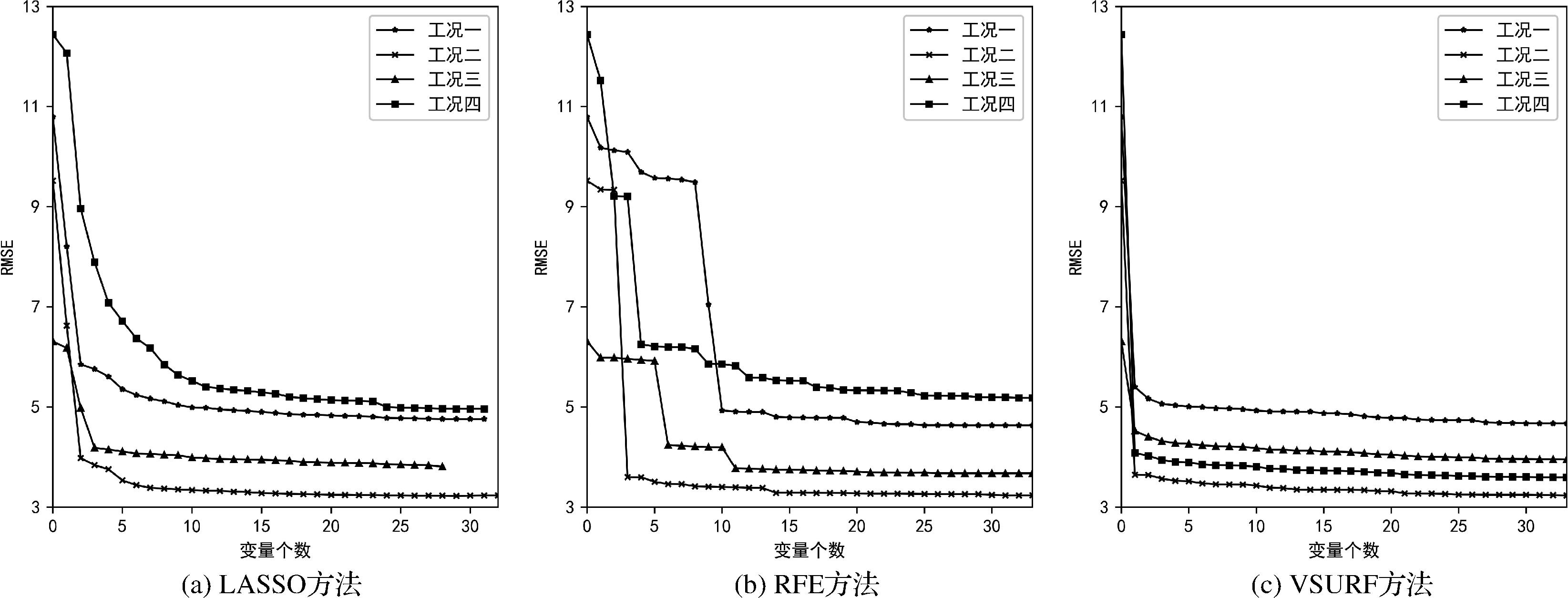
"
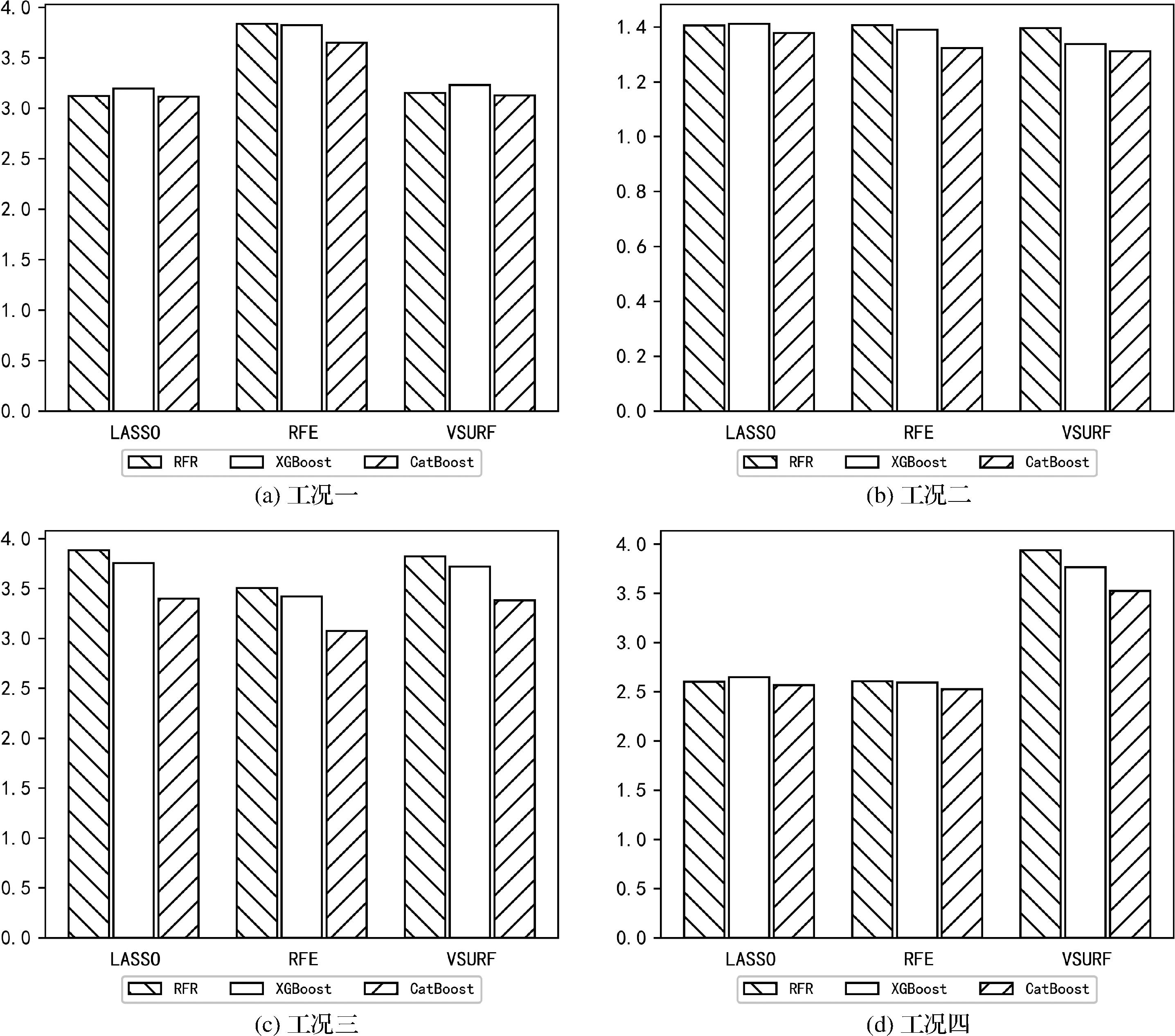
| 工况 | 特征选择 | RMSE | ||
|---|---|---|---|---|
| RFR | XGBoost | CatBoost | ||
| 工况一 | LASSO | 3.1233 | 3.1978 | |
| RFE | 3.8387 | 3.8255 | ||
| VSURF | 3.1547 | 3.2342 | ||
| 工况二 | LASSO | 1.4059 | 1.4121 | |
| RFE | 1.4075 | 1.3902 | ||
| VSURF | 1.3967 | 1.3385 | ||
| 工况三 | LASSO | 3.8851 | 3.7551 | |
| RFE | 3.5045 | 3.4225 | ||
| VSURF | 3.8228 | 3.7202 | ||
| 工况四 | LASSO | 2.6032 | 2.6481 | |
| RFE | 2.6078 | 2.5943 | ||
| VSURF | 3.9402 | 3.7658 | ||
"
| 工况 | 特征选择 | |||
|---|---|---|---|---|
| RFR | XGBoost | CatBoost | ||
| 工况一 | LASSO | 0.9098 | 0.9141 | |
| RFE | 0.8745 | 0.8753 | ||
| VSURF | 0.9129 | 0.9073 | ||
| 工况二 | LASSO | 0.9751 | 0.9749 | |
| RFE | 0.9752 | 0.9756 | ||
| VSURF | 0.9752 | 0.9768 | ||
| 工况三 | LASSO | 0.6099 | 0.6251 | |
| RFE | 0.6753 | 0.6771 | ||
| VSURF | 0.6235 | 0.6318 | ||
| 工况四 | LASSO | 0.9578 | 0.9562 | |
| RFE | 0.9576 | 0.9579 | ||
| VSURF | 0.8937 | 0.9035 | ||
"

"
| [1] | Lin B Q, Li Z. Towards world’s low carbon development: The role of clean energy[J]. Applied Energy, 2022, 307: 118160. |
| [2] | Zhang W, Li B S, Xue R, et al. A systematic bibliometric review of clean energy transition: Implications for low-carbon development[J]. PLoS One, 2021, 16(12): e0261091. |
| [3] | 韩建国. 能源结构调整“软着陆”的路径探析——发展煤炭清洁利用、破解能源困局、践行能源革命[J]. 管理世界, 2016, 32(2): 3-7. |
| Han J G. Analysis on the path of “soft landing” of energy structure adjustment: Developing clean utilization of coal, solving energy dilemma and practicing energy revolution[J]. Journal of Management World, 2016, 32(2): 3-7. | |
| [4] | Wang X B, Chang J X, Meng X J, et al. Hydro-thermal-wind-photovoltaic coordinated operation considering the comprehensive utilization of reservoirs[J]. Energy Conversion and Management,2019,198: 111824. |
| [5] | 杨洪明, 刘俊鹏, 梁芮, 等. 考虑动态功率调节裕度的高比例风电系统水-火-荷分布鲁棒优化调度[J]. 系统工程理论与实践, 2021, 41(9): 2327-2337. |
| Yang H M, Liu J P, Liang R, et al. Distributionally robust optimal dispatching of hydro-thermal-load resources for high penetration of wind system with dynamic power regulation margin[J].Systems Engineering- Theory & Practice, 2021, 41(9): 2327-2337. | |
| [6] | Gu Y J, Xu J, Chen D C, et al. Overall review of peak shaving for coal-fired power units in China[J].Renewable and Sustainable Energy Reviews,2016,54: 723-731. |
| [7] | 章良利, 李敏, 周晓蒙, 等. 深度调峰下燃煤机组运行方式对能耗的影响[J].中国电力,2017, 50(7): 85-89. |
| Zhang L L, Li M, Zhou X M, et al. Impact of the running modes of coal-fired units on energy consumption in in-depth peak load cycling[J]. Electric Power, 2017, 50(7): 85-89. | |
| [8] | Zhu W Q. Intelligent construction and management of thermal power plant based on Internet+ mode[C]//Proceedings of 4th International Conference on Environmental Science and Material Application (ESMA), Xi’an, China, December 15-16 ,IOP Publishing, 2018: 032068. |
| [9] | 周志华. 机器学习[M]. 北京: 清华大学出版社, 2016. |
| Zhou Z H. Machine learning[M]. Beijing: Tsinghua University Press, 2016. | |
| [10] | 牛东晓, 斯琴卓娅, 王董禹, 等. 基于数据挖掘的电力装备企业多价值链协同数据预处理方法研究及应用[J]. 中国管理科学, 2023, 31(11): 321-331. |
| Niu D X, Siqin Z Y, Wang D Y, et al. Method and application of multi-value chain collaborative data mining in power equipment enterprises based on deep learning[J]. Chinese Journal of Management Science, 2023, 31(11): 321-331. | |
| [11] | Lv Y, Liu J Z, Yang T T, et al. A novel least squares support vector machine ensemble model for NO x emission prediction of a coal-fired boiler[J]. Energy, 2013, 55: 319-329. |
| [12] | Cai J J, Ma X Q, Li Q. On-line monitoring the performance of coal-fired power unit: A method based on support vector machine[J]. Applied Thermal Engineering, 2009, 29(11-12): 2308-2319. |
| [13] | Li G Q, Niu P F, Wang H B, et al. Least Square Fast Learning Network for modeling the combustion efficiency of a 300WM coal-fired boiler[J]. Neural Networks, 2014, 51: 57-66. |
| [14] | 文雯, 刘文哲, 肖祥武, 等. 基于大数据和并行随机森林算法火电机组供电煤耗计算模型[J]. 热力发电, 2018, 47(9): 9-14. |
| Wen W, Liu W Z, Xiao X W, et al. Calculation model of coal consumption for thermal power units based on big date and random forest algorithm[J]. Thermal Power Generation, 2018, 47(9): 9-14. | |
| [15] | 郑伟, 姚远, 代邦武, 等. 基于数据挖掘的燃煤机组厂级负荷经济调度[J]. 热力发电, 2021, 50(7): 78-83. |
| Zheng W, Yao Y, Dai B W, et al. Economic load dispatch of coal-fired power plant based on data mining technology[J]. Thermal Power Generation, 2021, 50(7): 78-83. | |
| [16] | 刘文礼, 马金虎, 徐彬, 等. 基于煤质与供电煤耗的火电厂配煤优化模型研究[J]. 煤炭工程, 2021, 53(11): 158-163. |
| Liu W L, Ma J H, Xu B, et al. Coal blending optimization model for thermal power plant based on coal quality and power supply coal consumption[J]. Coal Engineering, 2021, 53(11): 158-163. | |
| [17] | Zhang L, Zhou L S, Zhang Y T, et al. Coal consumption prediction based on least squares support vector machine[J]. IOP Conference Series: Earth and Environmental Science, 2019, 227: 032007. |
| [18] | 李航. 机器学习方法[M]. 北京: 清华大学出版社, 2022. |
| Li H. Machine learning method[M]. Beijing: Tsinghua University Press, 2022. | |
| [19] | 雷明. 机器学习——原理、算法与应用[M]. 北京: 清华大学出版社, 2019. |
| Lei M. Machine learning: Principles, algorithms and applications[M]. Beijing: Tsinghua University Press, 2019. | |
| [20] | 闫泓序, 余顺坤, 林依青. 我国工业电力用户价值画像模型构建与应用研究[J]. 中国管理科学, 2021, 29(10): 224-235. |
| Yan H X, Yu S K, Lin Y Q. Research on the construction and application of the customer value portrait model of industrial power enterprise in China[J]. Chinese Journal of Management Science, 2021, 29(10): 224-235. | |
| [21] | Chandrashekar G, Sahin F. A survey on feature selection methods[J]. Computers & Electrical Engineering, 2014, 40(1): 16-28. |
| [22] | Li Y, Li T, Liu H. Recent advances in feature selection and its applications[J]. Knowledge and Information Systems, 2017, 53(3): 551-577. |
| [23] | Tibshirani R. Regression shrinkage and selection via the Lasso[J]. Journal of the Royal Statistical Society Series B: Statistical Methodology, 1996, 58(1): 267-288. |
| [24] | 张立军, 谭冰洁. 基于迹lasso模型的变量筛选方法[J]. 系统工程, 2018, 36(12): 127-134. |
| Zhang L J, Tan B J. Variable selection method based on trace Lasso model[J]. Systems Engineering, 2018, 36(12): 127-134. | |
| [25] | Guyon I, Weston J, Barnhill S, et al. Gene selection for cancer classification using support vector machines[J]. Machine Learning, 2002, 46(1-3): 389-422. |
| [26] | Genuer R, Poggi J M, Tuleau-Malot C. Variable selection using random forests[J]. Pattern Recognition Letters, 2010, 31(14): 2225-2236. |
| [27] | Sun L, You F Q. Machine learning and data-driven techniques for the control of smart power generation systems: An uncertainty handling perspective[J]. Engineering, 2021, 7(9): 1239-1247. |
| [28] | Kusiak A, Zhang Z. Control of wind turbine power and vibration with a data-driven approach[J]. Renewable Energy, 2012, 43: 73-82. |
| [29] | Ren Y, Zhang L, Suganthan P N. Ensemble classification and regression-recent developments, applications and future directions[J]. IEEE Computational Intelligence Magazine, 2016, 11(1): 41-53. |
| [30] | Sagi O, Rokach L. Ensemble learning: A survey[J]. WIREs Data Mining and Knowledge Discovery, 2018, 8(4): e1249. |
| [31] | Zhang D H, Qian L Y, Mao B J, et al. A data-driven design for fault detection of wind turbines using random forests and XGboost[J]. IEEE Access, 2018, 6: 21020-21031. |
| [32] | 黄国兴, 曹先怀, 钱晓飞. 一种基于随机森林的备件预测模型研究[J].运筹与管理,2021, 30(10): 165-168. |
| Huang G X, Cao X H, Qian X F. Research on spare parts prediction model based on random forest[J]. Operations Research and Management Science, 2021, 30(10): 165-168. | |
| [33] | 高晓辉, 周坤, 李廉水. 基于XGBOOST和ELM的混合空气质量预警系统: 以南京为例[J]. 中国管理科学, 2023, 31(5): 269-278. |
| Gao X H, Zhou K, Li L S. Hybrid air quality early warning system based on XGBoost and ELM: A case study of Nanjing[J]. Chinese Journal of Management Science, 2023, 31(5): 269-278. | |
| [34] | Hussain S, Mustafa M W, Jumani T A, et al. A novel feature engineered-CatBoost-based supervised machine learning framework for electricity theft detection[J]. Energy Reports, 2021, 7: 4425-4436. |
| [1] | Aihua Li, Wanxin Liu, Sifan Chen, Yong Shi. Research on SMOTE-BO-XGBoost Ensemble Credit Scoring Model for Unbalanced Data [J]. Chinese Journal of Management Science, 2026, 34(9): 21-28. |
| [2] | Xi Chen, Youqi Dou, Wenbo Zhang. An Intelligent Auxiliary Diagnosis Method for Diseases Integrating Preference Learning and Evidential Reasoning [J]. Chinese Journal of Management Science, 2026, 34(7): 177-188. |
| [3] | Zhengyang Song, Zhongbao Zhou, Lean Yu, Tiantian Ren. Portfolio Optimization Strategy with a Hybrid Ensemble Forecasting Algorithm and Black-Litterman Model [J]. Chinese Journal of Management Science, 2026, 34(5): 72-85. |
| [4] | Xiaofan Lai, Zeyu Zhang, Xiutian Shi, Weiguo Zhang. Prediction Method of Industrial Carbon Emissions under Multiple Driving Factors and Small Samples [J]. Chinese Journal of Management Science, 2026, 34(10): 372-385. |
| [5] | Yuxuan Kou, Sihan Li, Dunhu Liu, Ruoyi Li, Jing Huang, Jin Xiao. A DKELM-based Selective Deep-ensemble Model for Container Throughput Forecasting [J]. Chinese Journal of Management Science, 2025, 33(10): 24-35. |
| [6] | Hongxu Yan,Shunkun Yu. Research on Employee Turnover Prediction Model Based on the Portrait [J]. Chinese Journal of Management Science, 2024, 32(9): 303-312. |
| [7] | Shuliang Li,Shuangyi Yang,Bo Zeng,Wei Meng,Yun Bai. Unbiased and Adaptive of Discrete Grey Prediction Model and Its Application [J]. Chinese Journal of Management Science, 2024, 32(8): 149-158. |
| [8] | Yi FENG,Du-juan WANG,Zhi-neng HU,Shao-ze CUI. Prediction Method for Gastric Cancer Survivability Based on an Improved LightGBM Ensemble Model [J]. Chinese Journal of Management Science, 2023, 31(10): 234-244. |
| [9] | ZENG Bo, GOU Xiao-yi, ZHANG Zhi-wei. Research on the Non-Uniqueness of Solutions of the Mean Difference GM(1,1) Model Based on Interval Grey Interaction [J]. Chinese Journal of Management Science, 2022, 30(10): 247-255. |
| [10] | FENG Xiao-bin, TANG Yi-bin, WU Zeng-yuan, XU Ming-jiang. Process Manufacturing Product Quality Status Monitoring Based on SRFML-Lift [J]. Chinese Journal of Management Science, 2021, 29(12): 227-236. |
| [11] | XIONG Yi-peng, XIONG Zheng-de, YAO Zhu. Under the Macroscopic Stress Test Commercial Bank Retail Credit Products PD Model Prediction Research [J]. Chinese Journal of Management Science, 2020, 28(7): 13-22. |
| [12] | SONG Peng, LIANG Ji-ye, QIAN Yu-hua, LI Chang-hong. Research on Feature Selection Method for Interval Sorting Decision [J]. Chinese Journal of Management Science, 2017, 25(7): 141-152. |
| [13] | ZENG Bo, LIU Si-feng, QU Xue-xin. Researching on A Grey Common Prediction Modeling with Strong Compatibility and Its Properties [J]. Chinese Journal of Management Science, 2017, 25(5): 150-156. |
| [14] | HUANG Xing, YUN Ming, WANG Shao-yu. The Survival Amount Model Based on Mexican Wavelet Nuclear-SVM in Earthquake Disaster [J]. Chinese Journal of Management Science, 2016, 24(9): 140-146. |
| [15] | ZENG Bo, MENG Wei, LIU Si-feng, LI Chuan, CUI Jie. Prediction Modeling Method of Grey Isomerism Data for Calamity Emergency Material Demand [J]. Chinese Journal of Management Science, 2015, 23(8): 84-91. |
| Viewed | ||||||
|
Full text |
|
|||||
|
Abstract |
|
|||||
|
||
