
主管:中国科学院
主办:中国优选法统筹法与经济数学研究会
中国科学院科技战略咨询研究院
主办:中国优选法统筹法与经济数学研究会
中国科学院科技战略咨询研究院

Chinese Journal of Management Science ›› 2026, Vol. 34 ›› Issue (10): 372-385.doi: 10.16381/j.cnki.issn1003-207x.2024.2065
Xiaofan Lai1, Zeyu Zhang1, Xiutian Shi2( ), Weiguo Zhang1
Received:2024-11-13
Revised:2025-04-03
Online:2026-10-25
Published:2026-10-09
Contact:
Xiutian Shi
E-mail:xtshi@njust.edu.cn
CLC Number:
Xiaofan Lai,Zeyu Zhang,Xiutian Shi, et al. Prediction Method of Industrial Carbon Emissions under Multiple Driving Factors and Small Samples[J]. Chinese Journal of Management Science, 2026, 34(10): 372-385.
"

"
| 碳排放来源阶段 | 驱动因素 |
|---|---|
| 建材生产阶段 | 钢材生产量( |
| 建筑施工阶段 | 煤炭消耗量( |
| 建筑运行阶段 | 公共建筑能耗( |
"
| 因素类别 | 驱动因素 |
|---|---|
| 行业规模 | 就业人员数( |
| 能源消费 | 煤炭消耗量( |
| 运输总量 | 旅客运输总量( |

"

"
"
| 数据集 | 步长 | 评价 指标 | 预测模型 | |||||||
|---|---|---|---|---|---|---|---|---|---|---|
| DQN-SSA-SVR | SVR | LSTM | GRU | ELM | BP | GM | ARIMA | |||
| 建筑业 | 2步 | RMSE | 0.627 | 2.808 | 5.498 | 4.429 | 7.433 | 18.469 | 6.353 | 4.502 |
| MAE | 0.522 | 2.599 | 5.082 | 4.114 | 6.718 | 18.061 | 6.087 | 4.487 | ||
| 3步 | RMSE | 0.216 | 4.057 | 3.914 | 1.666 | 4.169 | 15.082 | 10.943 | 3.700 | |
| MAE | 0.192 | 3.525 | 3.805 | 1.477 | 4.096 | 14.350 | 10.546 | 3.245 | ||
| 5步 | RMSE | 0.396 | 2.612 | 1.090 | 3.424 | 4.260 | 6.986 | 2.517 | 1.733 | |
| MAE | 0.333 | 2.004 | 0.997 | 2.679 | 3.440 | 7.556 | 1.784 | 1.120 | ||
| 交通运输业 | 2步 | RMSE | 0.044 | 0.175 | 0.407 | 0.378 | 1.200 | 1.536 | 0.328 | 0.339 |
| MAE | 0.036 | 0.155 | 0.383 | 0.341 | 0.930 | 1.434 | 0.294 | 0.311 | ||
| 3步 | RMSE | 0.042 | 0.226 | 0.388 | 0.455 | 0.871 | 1.178 | 0.910 | 0.431 | |
| MAE | 0.040 | 0.165 | 0.372 | 0.404 | 0.605 | 0.910 | 0.803 | 0.341 | ||
| 5步 | RMSE | 0.042 | 0.433 | 0.374 | 0.257 | 1.223 | 0.243 | 0.524 | 0.254 | |
| MAE | 0.037 | 0.376 | 0.327 | 0.181 | 1.101 | 0.158 | 0.424 | 0.243 | ||
"
| 模型 | 建筑业 | 交通运输业 | ||||
|---|---|---|---|---|---|---|
| 2步实验 | 3步实验 | 5步实验 | 2步实验 | 3步实验 | 5步实验 | |
| SVR | -2.913*** | -3.252*** | -3.512*** | -3.374*** | -1.674* | -3.280*** |
| LSTM | -3.090*** | -5.722*** | -2.251** | -5.501*** | -4.812*** | -2.858*** |
| GRU | -3.537*** | -3.781*** | -4.591*** | -4.273*** | -3.221*** | -1.747* |
| ELM | -4.227*** | -2.453** | -4.983*** | -1.584 | -1.937* | -2.749*** |
| BP | -4.708*** | -4.627*** | -9.778*** | -4.642*** | -1.759* | -1.453 |
| GM | -2.773*** | -3.787*** | -3.186*** | -3.396*** | -2.917*** | -2.694*** |
| ARIMA | -3.531*** | -2.839*** | -1.961** | -5.142*** | -2.412** | -2.873*** |
"
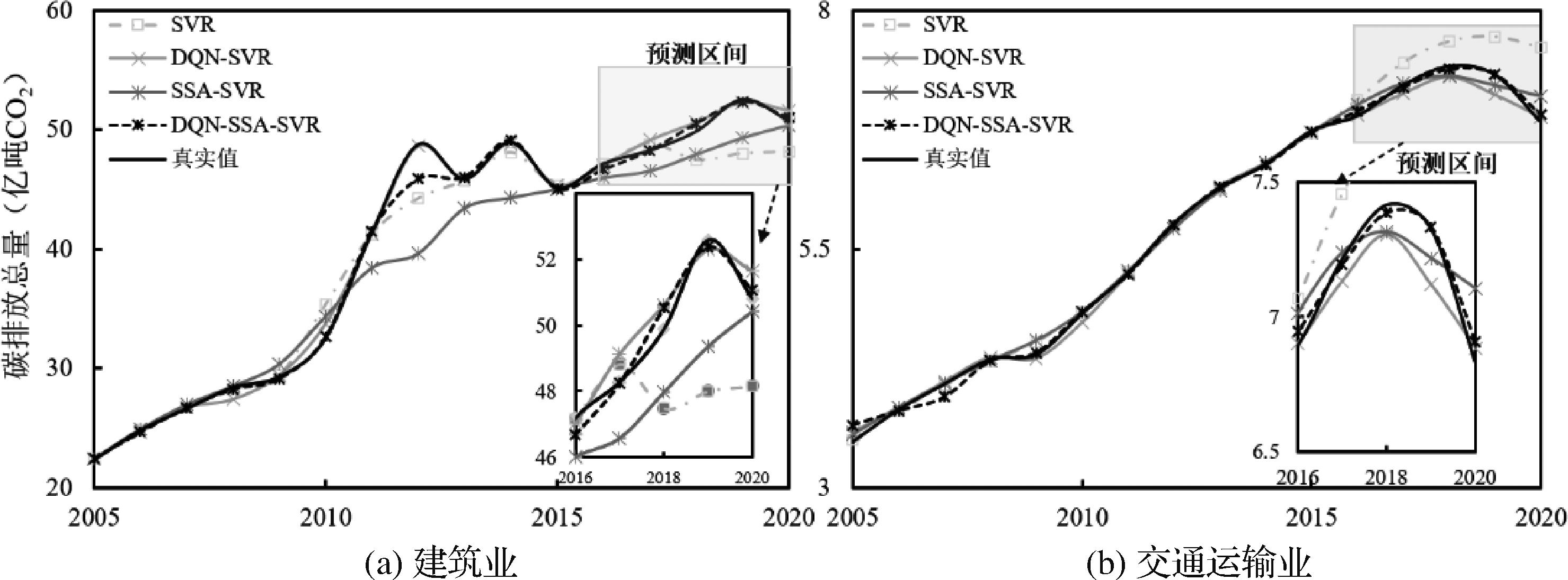

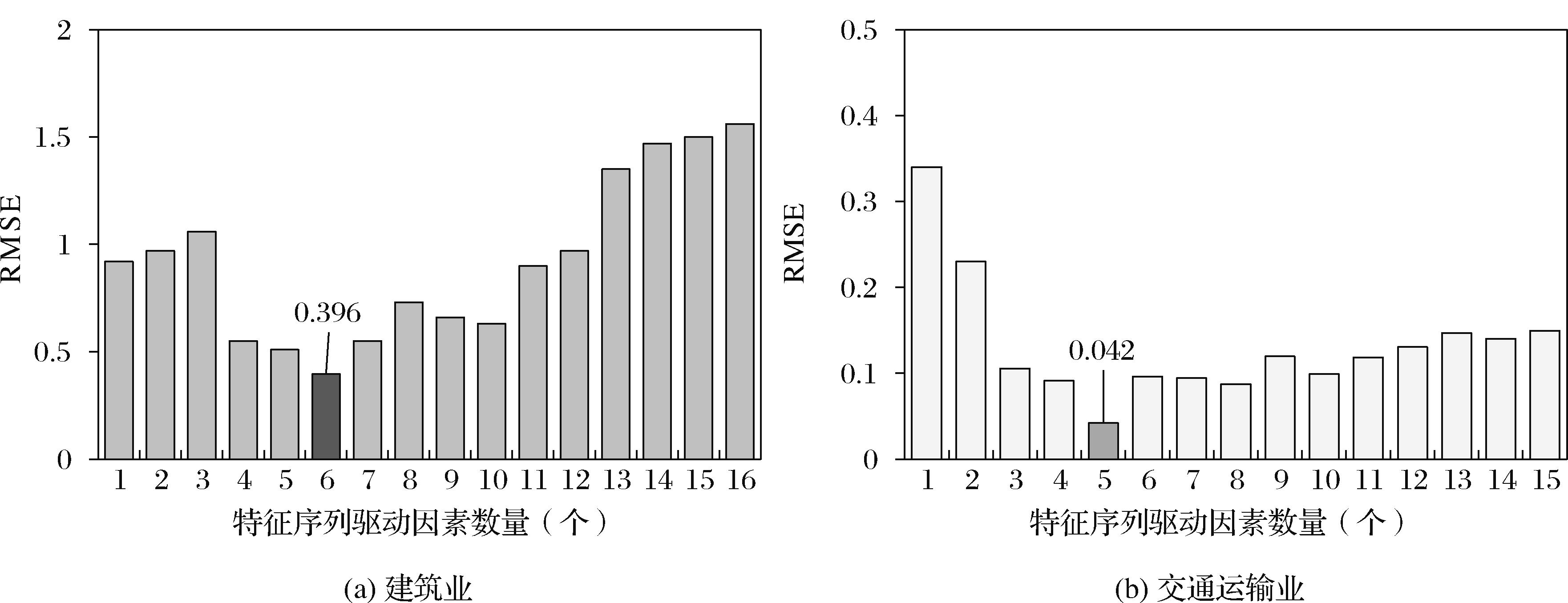
"
"
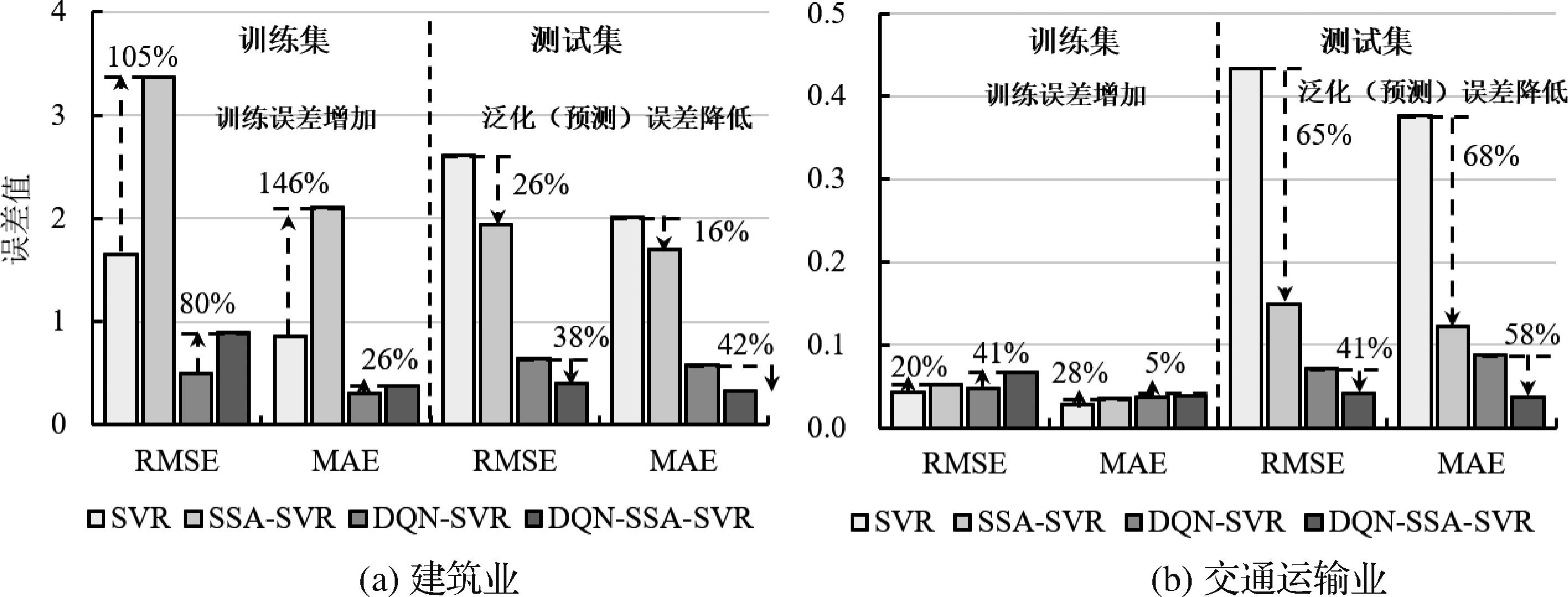
"
| 数据集 | 步长 | 评价 指标 | 预测模型 | |||
|---|---|---|---|---|---|---|
| DQN-SSA-SVR | DQN-SVR | SSA-SVR | SVR | |||
| 建筑业 | 2步 | RMSE | 0.627 | 1.596 | 2.116 | 2.808 |
| MAE | 0.522 | 1.493 | 2.000 | 2.599 | ||
| 3步 | RMSE | 0.216 | 0.723 | 0.864 | 4.057 | |
| MAE | 0.192 | 0.606 | 0.829 | 3.525 | ||
| 5步 | RMSE | 0.396 | 0.642 | 1.936 | 2.612 | |
| MAE | 0.333 | 0.574 | 1.692 | 2.004 | ||
| 交通运输业 | 2步 | RMSE | 0.044 | 0.071 | 0.120 | 0.175 |
| MAE | 0.036 | 0.063 | 0.109 | 0.155 | ||
| 3步 | RMSE | 0.042 | 0.079 | 0.086 | 0.226 | |
| MAE | 0.040 | 0.065 | 0.068 | 0.165 | ||
| 5步 | RMSE | 0.042 | 0.072 | 0.148 | 0.433 | |
| MAE | 0.037 | 0.088 | 0.122 | 0.376 | ||
"
| 数据集 | 步长 | DQN-SVR | SSA-SVR |
|---|---|---|---|
| 建筑业 | 2步 | -2.061** | -2.110** |
| 3步 | -2.273** | -3.281*** | |
| 5步 | -1.032 | -3.582*** | |
| 交通运输业 | 2步 | -1.963* | -2.543*** |
| 3步 | -1.192 | -0.923 | |
| 5步 | -1.278 | -2.797*** |
"
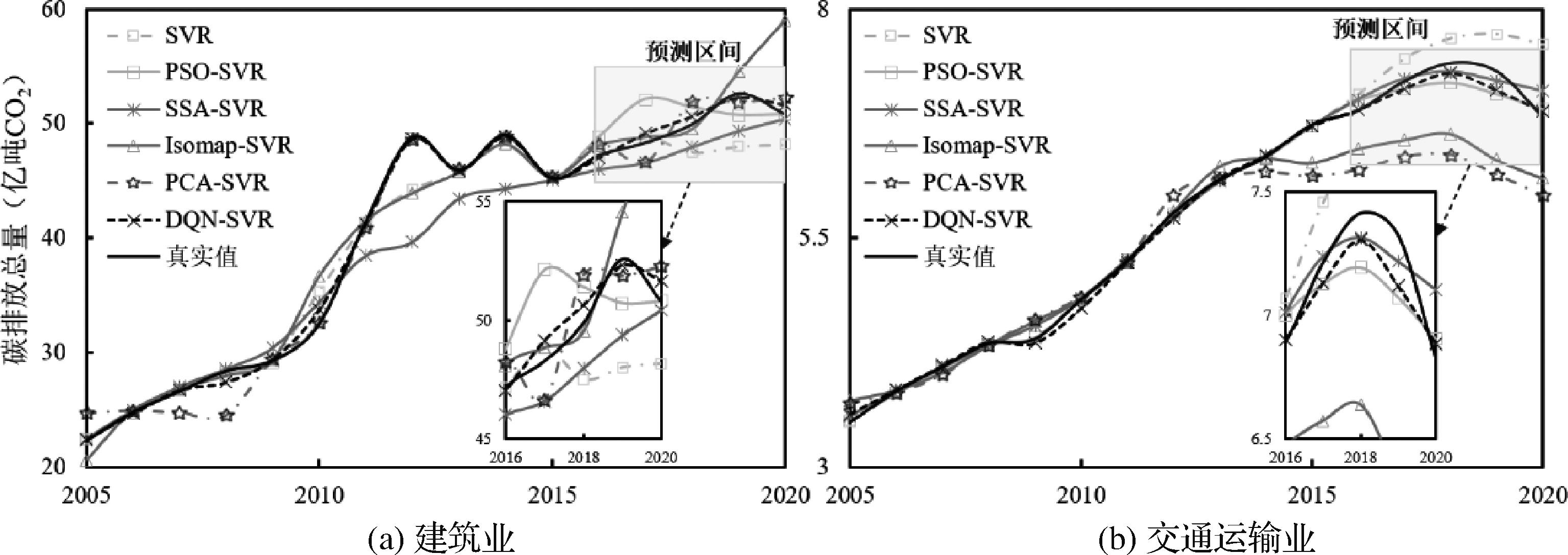
"
| 数据集 | 步长 | 评价 指标 | 预测模型 | |||||
|---|---|---|---|---|---|---|---|---|
| 不同特征工程模型 | 不同参数优化模型 | SVR | ||||||
| DQN-SVR | PCA-SVR | Isomap-SVR | SSA-SVR | PSO-SVR | ||||
| 建筑业 | 2步 | RMSE | 1.596 | 5.466 | 4.436 | 2.116 | 5.468 | 2.808 |
| MAE | 1.493 | 5.104 | 4.056 | 2.000 | 5.217 | 2.599 | ||
| 3步 | RMSE | 0.723 | 2.353 | 4.428 | 0.864 | 1.733 | 4.057 | |
| MAE | 0.606 | 1.846 | 3.974 | 0.829 | 1.608 | 3.525 | ||
| 5步 | RMSE | 0.642 | 1.460 | 3.831 | 1.936 | 2.148 | 2.612 | |
| MAE | 0.574 | 1.382 | 2.404 | 1.692 | 1.768 | 2.004 | ||
| 交通运输业 | 2步 | RMSE | 0.071 | 0.464 | 0.821 | 0.120 | 0.543 | 0.175 |
| MAE | 0.063 | 0.437 | 0.801 | 0.109 | 0.529 | 0.155 | ||
| 3步 | RMSE | 0.079 | 0.445 | 0.536 | 0.086 | 0.178 | 0.226 | |
| MAE | 0.065 | 0.417 | 0.518 | 0.068 | 0.145 | 0.165 | ||
| 5步 | RMSE | 0.072 | 0.912 | 0.722 | 0.148 | 0.166 | 0.433 | |
| MAE | 0.088 | 0.897 | 0.699 | 0.122 | 0.148 | 0.376 | ||
"
| 数据集 | 步长 | 预测模型 | ||||
|---|---|---|---|---|---|---|
| 特征工程模块 | 参数优化模块 | |||||
| Isomap-SVR | PCA-SVR | SVR | PSO-SVR | SVR | ||
| 建筑业 | 2步 | -2.819*** | -4.103*** | -3.660*** | -3.001*** | -2.368*** |
| 3步 | -3.683*** | -1.395 | -2.814*** | -1.888* | -2.633*** | |
| 5步 | -6.050*** | -4.020*** | -5.415*** | -1.234 | -2.638*** | |
| 交通运输业 | 2步 | -5.395*** | -3.635*** | -2.988*** | -3.934*** | -2.301** |
| 3步 | -5.610*** | -4.221*** | -1.649* | -1.351 | -1.871* | |
| 5步 | -10.389*** | -15.838*** | -2.503** | -0.365 | -3.259*** | |
| [1] | 国务院新闻办公室. 中国应对气候变化的政策与行动[EB/OL].(2021-10-27)[2025-03-26].. |
| The State Council Information Office. Responding to climate change: China’s policies and actions[EB/OL]. (2021-10-27)[2025-03-26].. | |
| [2] | 吕康娟, 胡颖. 灰色量子粒子群优化通用向量机的中国行业间碳排放转移网络预测研究[J]. 中国管理科学, 2020, 28(8): 196-208. |
| Lv K J, Hu Y. Prediction of inter-industry carbon emissions transfer network in China based on grey quantum particle swarm optimizing general vector machine[J]. Chinese Journal of Management Science, 2020, 28(8): 196-208. | |
| [3] | 俞春华, 佘程熙, 李金霞, 等. 基于LSTM的供应链全生命周期碳足迹测度与预测研究[J]. 工业工程, 2024, 27(5): 161-171. |
| Yu C H, She C X, Li J X, et al. Research on measuring and predicting the carbon footprint of supply chain throughout its life cycle based on LSTM[J]. Industrial Engineering Journal, 2024, 27(5): 161-171. | |
| [4] | 吴振信, 石佳. 基于STIRPAT和GM(1, 1)模型的北京能源碳排放影响因素分析及趋势预测[J]. 中国管理科学, 2012, 20(S2): 803-809. |
| Wu Z X, Shi J. The influencing factor analysis and trend forecasting of Beijing energy carbon emission based on STIRPAT and GM(1, 1)model’s[J]. Chinese Journal of Management Science, 2012, 20(S2): 803-809. | |
| [5] | 鲁万波, 仇婷婷, 杜磊. 中国不同经济增长阶段碳排放影响因素研究[J]. 经济研究, 2013, 48(4): 106-118. |
| Lu W B, Qiu T T, Du L. A study on influence factors of carbon emissions under different economic growth stages in China[J]. Economic Research Journal, 2013, 48(4): 106-118. | |
| [6] | Shan Y L, Guan D B, Zheng H R, et al. China CO2 emission accounts 1997-2015[J]. Scientific Data, 2018, 5: 170201. |
| [7] | Shan Y L, Huang Q, Guan D B, et al. China CO2 emission accounts 2016-2017[J]. Scientific Data, 2020, 7: 54. |
| [8] | Guan Y R, Shan Y L, Huang Q, et al. Assessment to China’s recent emission pattern shifts[J]. Earth’s Future, 2021, 9(11): e2021EF002241. |
| [9] | Xu J H, Guan Y R, Oldfield J, et al. China carbon emission accounts 2020-2021[J]. Applied Energy, 2024, 360: 122837. |
| [10] | 中国建筑节能协会. 中国建筑能耗研究报告 [R]. 研究报告, 中国建筑节能协会, 2022. |
| China Building Energy Conservation Association. China building energy consumption research report[R]. Discussion Paper, China Building Energy Conservation Association, 2022. | |
| [11] | Pao H T, Fu H C, Tseng C L. Forecasting of CO2 emissions, energy consumption and economic growth in China using an improved grey model[J]. Energy, 2012, 40(1): 400-409. |
| [12] | Zhao X B, Du D. Forecasting carbon dioxide emissions[J]. Journal of Environmental Management, 2015, 160: 39-44. |
| [13] | 张国兴, 苏钊贤. 黄河流域交通运输碳排放的影响因素分解与情景预测[J]. 管理评论, 2020, 32(12): 283-294. |
| Zhang G X, Su Z X. Analysis of influencing factors and scenario prediction of transportation carbon emissions in the Yellow River Basin[J]. Management Review, 2020, 32(12): 283-294. | |
| [14] | 朱长征, 杨莎, 刘鹏博, 等. 中国交通运输业碳达峰时间预测研究[J]. 交通运输系统工程与信息, 2022, 22(6): 291-299. |
| Zhu C Z, Yang S, Liu P B, et al. Carbon dioxide emission peak study of transportation industry in China[J]. Journal of Transportation Systems Engineering and Information Technology, 2022, 22(6): 291-299. | |
| [15] | 张志捷. 碳达峰约束下中国交通运输行业碳排放预测研究[D]. 西安: 长安大学, 2023. |
| Zhang Z J. Carbon emission forecasting in China’s transportation industry under carbon peaking constraints[D]. Xi’an: Changan University, 2023. | |
| [16] | 章高敏, 王腾, 娄渊雨, 等. 基于LSTM神经网络的中国省级碳达峰路径分析[J]. 中国管理科学, 2025, 33(3): 339-350. |
| Zhang G M, Wang T, Lou Y Y, et al. Research on China’s provincial carbon emission peak path based on a LSTM neural network approach[J]. Chinese Journal of Management Science, 2025, 33(3): 339-350. | |
| [17] | Sun W, Ren C M. Short-term prediction of carbon emissions based on the EEMD-PSOBP model[J]. Environmental Science and Pollution Research, 2021, 28(40): 56580-56594. |
| [18] | Lu C, Li W, Gao S B. Driving determinants and prospective prediction simulations on carbon emissions peak for China’s heavy chemical industry[J]. Journal of Cleaner Production, 2020, 251: 119642. |
| [19] | Li Y M, Dong H K, Lu S S. Research on application of a hybrid heuristic algorithm in transportation carbon emission[J]. Environmental Science and Pollution Research, 2021, 28(35): 48610-48627. |
| [20] | 徐勇戈, 宋伟雪. 基于FCS-SVM的建筑业碳排放预测研究[J]. 生态经济, 2019, 35(11): 37-41. |
| Xu Y G, Song W X. Carbon emission prediction of construction industry based on FCS-SVM[J]. Ecological Economy, 2019, 35(11): 37-41. | |
| [21] | Dong J, Li C B. Scenario prediction and decoupling analysis of carbon emission in Jiangsu Province, China[J]. Technological Forecasting and Social Change, 2022, 185: 122074. |
| [22] | Zhang Y D, Li X, Zhang Y W. A novel integrated optimization model for carbon emission prediction: A case study on the group of 20[J]. Journal of Environmental Management, 2023, 344: 118422. |
| [23] | 贺昊, 周健, 朱磊. 基于特征选择的火电机组燃煤量预测模型比较研究[J]. 中国管理科学, 2024, DOI:10.16381/j.cnki.issn1003-207x.2023.1457 . |
| He H, Zhou J, Zhu L. Comparative study on coal consumption prediction models of thermal power units based on feature selection[J]. Chinese Journal of Management Science, 2024, DOI: 10. 16381 /j.cnki.issn1003-207x.2023.1457 . | |
| [24] | 朱晓峰, 徐曼菲, 刘治红, 等. 集成主成分分析与随机森林模型的关键工装寿命预测方法[J]. 工业工程, 2023, 26(5): 149-158. |
| Zhu X F, Xu M F, Liu Z H, et al. Life span prediction of key fixtures integrating principal component analysis and random forest model[J]. Industrial Engineering Journal, 2023, 26(5): 149-158. | |
| [25] | 冯易, 王杜娟, 胡知能, 等. 基于改进LightGBM集成模型的胃癌存活性预测方法[J]. 中国管理科学, 2023, 31(10): 234-244. |
| Feng Y, Wang D J, Hu Z N, et al. Prediction method for gastric cancer survivability based on an improved LightGBM ensemble model[J]. Chinese Journal of Management Science, 2023, 31(10): 234-244. | |
| [26] | Huang Y S, Shen L, Liu H. Grey relational analysis, principal component analysis and forecasting of carbon emissions based on long short-term memory in China[J]. Journal of Cleaner Production, 2019, 209: 415-423. |
| [27] | 符川川. 基于PCA-SVR的中国省际碳排放量预测与时空演化研究[D]. 天津: 天津理工大学, 2019. |
| Fu C C. Research on China’s interprovincial carbon emission forecast and spatio-temporal evolution based on PCA-SVR[D]. Tianjin: Tianjin University of Technology, 2019. | |
| [28] | Qi Y W, Liu H L, Zhao J B. Prediction model and demonstration of regional agricultural carbon emissions based on Isomap-ACO-ET: A case study of Guangdong Province, China[J]. Scientific Reports, 2023, 13: 12688. |
| [29] | 李欣倩,唐丽娟,任佳.一种基于深度强化学习的特征选择方法:中国专利,202011369962[P],2021.03.12. . |
| Li X Q, Tang L J, Ren J. A feature selection method based on deep reinforcement learning: China, CN202011369962[P],2021.03.12.. | |
| [30] | 张鹏, 张瑞. 基于强化学习的特征选择方法及材料学应用[J]. 上海大学学报(自然科学版), 2022, 28(3): 463-475. |
| Zhang P, Zhang R. Feature selection based on reinforcement learning and its application in material informatics[J]. Journal of Shanghai University (Natural Science Edition), 2022, 28(3): 463-475. | |
| [31] | Mu T Y, Wang H Z, Wang C N, et al. Auto-CASH: A meta-learning embedding approach for autonomous classification algorithm selection[J]. Information Sciences, 2022, 591: 344-364. |
| [32] | Mnih V, Kavukcuoglu K, Silver D, et al. Human-level control through deep reinforcement learning[J]. Nature, 2015, 518(7540): 529-533. |
| [33] | Xue J J, Shen B. A novel swarm intelligence optimization approach: Sparrow search algorithm[J]. Systems Science & Control Engineering, 2020, 8(1): 22-34. |
| [34] | 段玉先, 刘昌云. 基于Sobol序列和纵横交叉策略的麻雀搜索算法[J]. 计算机应用, 2022, 42(1): 36-43. |
| Duan Y X, Liu C Y. Sparrow search algorithm based on Sobol sequence and crisscross strategy[J]. Journal of Computer Applications, 2022, 42(1): 36-43. | |
| [35] | 丁世飞, 齐丙娟, 谭红艳. 支持向量机理论与算法研究综述[J]. 电子科技大学学报, 2011, 40(1): 1-10. |
| Ding S F, Qi B J, Tan H Y. An overview on theory and algorithm of support vector machines[J]. Journal of University of Electronic Science and Technology of China, 2011, 40(1): 2-10. | |
| [36] | 孙涵, 杨普容, 成金华. 基于Matlab支持向量回归机的能源需求预测模型[J]. 系统工程理论与实践, 2011, 31(10): 2001-2007. |
| Sun H, Yang P R, Cheng J H. Forecasting model of energy demand based on Matlab support vector regression[J]. Systems Engineering-Theory & Practice, 2011, 31(10): 2001-2007. | |
| [37] | 陈垚, 毛保华, 柏赟, 等. 基于支持向量回归的地铁牵引能耗预测[J]. 系统工程理论与实践, 2016, 36(8): 2101-2107. |
| Chen Y, Mao B H, Bai Y, et al. Forecasting traction energy consumption of metro based on support vector regression[J]. Systems Engineering-Theory & Practice, 2016, 36(8): 2101-2107. | |
| [38] | 张晨, 杨仙子. 基于多频组合模型的中国区域碳市场价格预测[J]. 系统工程理论与实践, 2016, 36(12): 3017-3025. |
| Zhang C, Yang X Z. Forecasting of China’s regional carbon market price based on multi-frequency combined model[J]. Systems Engineering —Theory & Practice, 2016, 36(12): 3017-3025. | |
| [39] | 范丽伟, 董欢欢, 渐令. 基于滚动时间窗的碳市场价格分解集成预测研究[J]. 中国管理科学, 2023, 31(1): 277-286. |
| Fan L W, Dong H H, Jian L. A decomposition ensemble model with sliding time window for forecasting carbon market prices[J]. Chinese Journal of Management Science, 2023, 31(1): 277-286. | |
| [40] | Diebold F X, Mariano R S. Comparing predictive accuracy[J]. Journal of Business & Economic Statistics, 1995, 13(3): 253-263. |
| [41] | 王方, 余乐安, 查锐. 季节性数据特征驱动的电子废弃物回收规模分解集成预测建模研究[J]. 中国管理科学, 2022, 30(3): 199-210. |
| Wang F, Yu L A, Zha R. Research on decomposition-ensemble approach for predicting E-waste recovery scale driven by seasonal data characteristics[J]. Chinese Journal of Management Science,2022,30(3): 199-210. | |
| [42] | 尚春静, 张智慧. 建筑生命周期碳排放核算[J]. 工程管理学报, 2010, 24(1): 7-12. |
| Shang C J, Zhang Z H. Assessment of life-cycle carbon emission for buildings[J]. Construction Management Modernization, 2010, 24(1): 7-12. | |
| [43] | 卢建锋, 傅惠, 王小霞. 区域交通运输业碳排放效率影响因素研究[J]. 交通运输系统工程与信息, 2016, 16(2): 25-30. |
| Lu J F, Fu H, Wang X X. Research on the impact of regional transportation emissions efficiency factors[J]. Journal of Transportation Systems Engineering and Information Technology, 2016, 16(2): 25-30. | |
| [44] | 李宁海, 陈硕, 梁肖, 等. 我国交通运输业碳达峰时间预测[J]. 交通运输系统工程与信息, 2024, 24(1): 2-13+54. |
| Li N H, Chen S, Liang X, et al. Prediction of transportation industry carbon peak in China[J]. Journal of Transportation Systems Engineering and Information Technology, 2024, 24(1): 2-13+54. | |
| [45] | 陆文星, 任环宇, 梁昌勇, 等. 基于小波分解和ARIMA-GARCH-GRU组合模型的制造业PMI预测[J]. 工业工程, 2024, 27(1): 86-95+127. |
| Lu W X, Ren H Y, Liang C Y, et al. Manufacturing PMI forecasting based on wavelet decomposition and a ARMA-GARCH-GRU combination model[J]. Industrial Engineering Journal, 2024, 27(1): 86-95+127. |
| [1] | Xi Chen, Youqi Dou, Wenbo Zhang. An Intelligent Auxiliary Diagnosis Method for Diseases Integrating Preference Learning and Evidential Reasoning [J]. Chinese Journal of Management Science, 2026, 34(7): 177-188. |
| [2] | OUYANG Lin-han, TAO Bao-ping, MA Yan. Research on Quality Prediction Based on Gaussian Process Model with Selective Ensemble Kernel [J]. Chinese Journal of Management Science, 2023, 31(3): 69-80. |
| [3] | Yi FENG,Du-juan WANG,Zhi-neng HU,Shao-ze CUI. Prediction Method for Gastric Cancer Survivability Based on an Improved LightGBM Ensemble Model [J]. Chinese Journal of Management Science, 2023, 31(10): 234-244. |
| [4] | FENG Xiao-bin, TANG Yi-bin, WU Zeng-yuan, XU Ming-jiang. Process Manufacturing Product Quality Status Monitoring Based on SRFML-Lift [J]. Chinese Journal of Management Science, 2021, 29(12): 227-236. |
| [5] | SONG Peng, LIANG Ji-ye, QIAN Yu-hua, LI Chang-hong. Research on Feature Selection Method for Interval Sorting Decision [J]. Chinese Journal of Management Science, 2017, 25(7): 141-152. |
| [6] | XIAO Jin, TANG Jing, LIU Dun-hu, XIE Ling, WANG Shou-yang. Customer Targeting Model Based on Improved GMDH [J]. Chinese Journal of Management Science, 2015, 23(10): 162-169. |
| [7] | ZHAO Yu, HUANG Si-ming, CHEN Rui. Research on Feature Selection Methods of Data Classification [J]. Chinese Journal of Management Science, 2013, 21(6): 38-46. |
| [8] | WANG Ying, SUN Lin-yan, LI Tian-fei. Prameter Optimization of Production-Distribution Integrated System Based on Genetic Algorithm [J]. Chinese Journal of Management Science, 2004, (1): 51-56. |
| Viewed | ||||||
|
Full text |
|
|||||
|
Abstract |
|
|||||
|
||
