
主管:中国科学院
主办:中国优选法统筹法与经济数学研究会
中国科学院科技战略咨询研究院
主办:中国优选法统筹法与经济数学研究会
中国科学院科技战略咨询研究院

中国管理科学 ›› 2026, Vol. 34 ›› Issue (7): 1-11.doi: 10.16381/j.cnki.issn1003-207x.2024.0406
• •
郭启明1,2, 赖丹2, 吴一丁1,2,3( )
)
收稿日期:2024-03-19
修回日期:2025-03-06
出版日期:2026-07-25
发布日期:2026-06-18
通讯作者:
吴一丁
E-mail:781731974@qq.com
基金资助:
Qiming Guo1,2, Dan Lai2, Yiding Wu1,2,3()
Received:2024-03-19
Revised:2025-03-06
Online:2026-07-25
Published:2026-06-18
Contact:
Yiding Wu
E-mail:781731974@qq.com
摘要:
在市场竞争加剧和制度环境日益复杂化情境下,产业链纵向整合已成为企业提升韧性的重要战略选择。本文以2015—2023年沪深A股有色金属—新能源产业链上市企业为样本,采用分行业营业收入占比的方法测算有色金属企业和新能源企业的纵向整合程度,实证检验纵向整合对企业韧性的影响。研究结果表明,在考察期内,有色金属与新能源企业的纵向整合程度显著提升,大规模企业和非国有企业的整合程度更高,且纵向整合企业的韧性明显强于未整合企业。有色金属—新能源产业链纵向整合能显著提升企业韧性,稳健性检验后结果依然成立。异质性分析表明,产业链上大规模企业和非国有企业纵向整合对韧性提升的促进作用更为显著。纵向整合对企业韧性的影响中存在资本结构门槛效应,当资本结构处于低杠杆区间时,纵向整合显著提升企业韧性;而当资本结构处于高杠杆区间时,有色金属企业后向整合削弱其韧性,新能源企业前向整合对韧性的正向影响不再显著。研究为推动产业链上、下游企业在逆境中化危为机,实现高韧性发展提供了重要理论和实践依据。
中图分类号:
郭启明,赖丹,吴一丁. 有色金属—新能源产业链纵向整合与企业韧性[J]. 中国管理科学, 2026, 34(7): 1-11.
Qiming Guo,Dan Lai,Yiding Wu. Vertical Integration in the Nonferrous Metal—New Energy Industry Chain and Corporate Resilience[J]. Chinese Journal of Management Science, 2026, 34(7): 1-11.

表1
控制变量定义及描述性统计"
| 变量名称 | 变量符号 | 变量定义 | 均值 | 标准差 | 最小值 | 最大值 |
|---|---|---|---|---|---|---|
| 企业规模 | Size | 总资产的自然对数 | 22.964 | 1.318 | 20.091 | 26.412 |
| 企业年龄 | Age | 观测年份-成立年份+1 | 20.561 | 5.415 | 8.000 | 34.000 |
| 现金比率 | Cash | 现金及现金等价物/流动负债 | 0.453 | 0.439 | 0.040 | 2.360 |
| 净资产收益率 | Roe | 净利润/净资产 | 4.992 | 17.135 | -59.587 | 62.191 |
| 股权集中度 | Oc | 前五大股东持股比例 | 50.279 | 14.672 | 14.160 | 84.710 |
| 独董占比 | Indep | 独董人数/董事人数 | 0.375 | 0.055 | 0.333 | 0.600 |
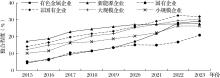
图1
2015—2023年有色金属—新能源产业链纵向整合程度变化趋势"
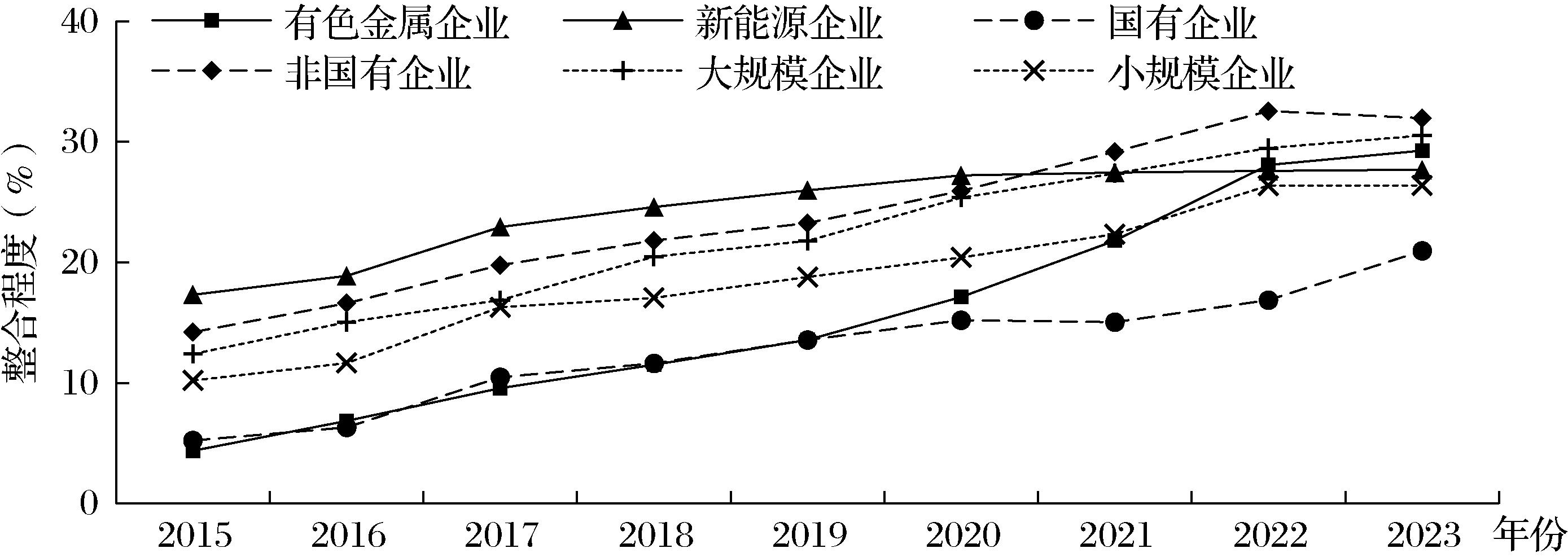
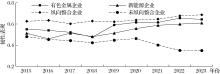
图2
2015—2023年有色金属—新能源产业链企业韧性表现变化趋势"

表2
基准回归结果"
| 变量 | Res | |||
|---|---|---|---|---|
| (1) | (2) | (3) | (4) | |
| BVI | 0.0714** (1.99) | — | 0.0942** (2.28) | — |
| FVI | — | 0.1198* (1.78) | — | 0.1039* (1.73) |
| 常数项 | 0.5082*** (17.32) | 0.6092*** (17.44) | 0.7183** (2.37) | 1.7423* (1.68) |
| 控制变量 | No | No | Yes | Yes |
| 年份/个体固定效应 | Yes | Yes | Yes | Yes |
| 观测值 | 261 | 306 | 261 | 306 |
| 调整后R2 | 0.3789 | 0.5107 | 0.4370 | 0.5824 |
表3
稳健性检验回归结果"
| 变量 | Res | |||||
|---|---|---|---|---|---|---|
| 滞后一期解释变量 | 替换被解释变量 | 剔除新冠疫情 | ||||
| (1) | (2) | (3) | (4) | (5) | (6) | |
| BVI | 0.0842* (1.85) | — | 9.2595*** (2.79) | — | 0.0657* (1.75) | — |
| FVI | — | 0.0816* (1.92) | — | 6.8399*** (2.67) | — | 0.1006* (1.72) |
| 常数项 | 0.7813** (2.52) | 2.9264* (1.81) | 7.2389* (1.85) | 56.2160*** (2.60) | 0.9457* (1.88) | 4.6664* (1.68) |
| 控制变量 | Yes | Yes | Yes | Yes | Yes | Yes |
| 年份/个体固定效应 | Yes | Yes | Yes | Yes | Yes | Yes |
| 观测值 | 232 | 272 | 261 | 306 | 145 | 170 |
| 调整后R2 | 0.3062 | 0.5313 | 0.2925 | 0.2981 | 0.2062 | 0.5740 |
表4
异质性分析回归结果"
| 变量 | Res | |||
|---|---|---|---|---|
| 大规模企业(1) | 小规模企业(2) | 国有企业(3) | 非国有企业(4) | |
| VI | 0.1816** (2.48) | 0.1776 (1.63) | 0.0154 (1.11) | 0.0711** (2.26) |
| 常数项 | 0.0866*** (3.86) | 1.4723 (1.08) | 2.4144*** (2.60) | 0.9681*** (3.00) |
| 控制变量 | Yes | Yes | Yes | Yes |
| 年份/个体固定效应 | Yes | Yes | Yes | Yes |
| 观测值 | 297 | 270 | 180 | 387 |
| 调整后R2 | 0.3639 | 0.6321 | 0.5544 | 0.4466 |
表5
门槛效应检验结果"
| 变量 | 门槛变量:资本结构 | |||||
|---|---|---|---|---|---|---|
| BVI | FVI | |||||
| 模型 | F值 | P值 | 门槛估计值 | F值 | P值 | 门槛估计值 |
| 单一门槛 | 6.095* | 0.063 | 0.397 | 10.725*** | 0.000 | 0.434 |
| 双重门槛 | 11.964*** | 0.003 | 0.522 | 7.613 | 0.257 | 不存在 |
| 三重门槛 | 11.780 | 0.637 | 不存在 | — | — | — |
表6
门槛模型回归结果"
| 变量 | Res | |||||
|---|---|---|---|---|---|---|
| 系数值 | T值 | P值 | 系数值 | T值 | P值 | |
| BVI(Lev≤0.397) | 0.4731*** | 2.62 | 0.009 | — | — | — |
| BVI(0.397<Lev≤0.522) | 0.1846** | 2.31 | 0.022 | — | — | — |
| BVI(Lev>0.522) | -0.0491* | -1.69 | 0.093 | — | — | — |
| FVI(Lev≤0.434) | — | — | — | 0.1432** | 1.98 | 0.048 |
| FVI(Lev>0.434) | — | — | — | 0.0974 | 1.53 | 0.126 |
| 常数项 | 1.7284*** | 2.83 | 0.005 | 0.0511** | 2.31 | 0.022 |
| 控制变量 | Yes | Yes | ||||
| 年份/个体固定效应 | Yes | Yes | ||||
| 观测值 | 261 | 306 | ||||
| 调整后R2 | 0.2917 | 0.2413 | ||||
| [1] | 刘强. 从新能源产业发展看未来产业生态圈建设[J]. 人民论坛·学术前沿, 2025(4): 98-107. |
| Liu Q. From the perspective of the development of the new energy industry to the construction of the future industrial ecosystem[J]. Frontiers, 2025(4): 98-107. | |
| [2] | 刘新建, 宋中炜, 吴洁. 碳中和目标下能源经济系统转型: 碳定价与可再生能源政策作用有多大?[J]. 中国管理科学, 2024, 32(11): 325-334. |
| Liu X J, Song Z W, Wu J. Transforming the energy economic system with the carbon neutrality goal: How much can the carbon pricing and renewable energy policy contribute?[J]. Chinese Journal of Management Science, 2024, 32(11): 325-334. | |
| [3] | 吕朝凤, 朱丹丹. 中国垂直一体化生产模式的决定因素——基于金融发展和不完全契约视角的实证分析[J]. 中国工业经济, 2016(3): 68-82. |
| Lv C F, Zhu D D. Determinants of vertical integration in China industry: An empirical study from financial development and incomplete contract[J]. China Industrial Economics, 2016(3): 68-82. | |
| [4] | 袁淳, 耿春晓, 孙健, 等. 不确定性冲击下纵向一体化与企业价值——来自新冠疫情的自然实验证据[J]. 经济学(季刊), 2022, 22(2): 633-652. |
| Yuan C, Geng C X, Sun J, et al. Vertical integration and corporate value under the uncertainty shock: Natural experiment evidence from the COVID-19 pandemic[J].China Economic Quarterly,2022,22(2): 633-652. | |
| [5] | 赖新峰, 王鑫, 陈志祥, 等. 不同垂直一体化模式下出口导向型制造企业生产仿真研究——关税和劳动力成本影响分析[J]. 管理评论, 2022, 34(6): 280-291. |
| Lai X F, Wang X, Chen Z X, et al. Production simulation research of export-oriented manufacturing enterprises under different vertical integration modes: Analysis of the impact of tariffs and labor costs[J]. Management Review, 2022, 34(6): 280-291. | |
| [6] | Baake P, Kamecke U, Normann H T. Vertical integration and market foreclosure with convex downstream costs[J].Journal of Economics, 2002,75(2): 125-135. |
| [7] | Smith A. The wealth of nations[M].Chicago:University of Chicago Press,1776. |
| [8] | Coase R H. The nature of the firm[J]. Economica, 1937, 4(16): 386-405. |
| [9] | Williamson O E. The economic institutions of capitalism[M].New York: Free Press, 1985. |
| [10] | 石大千, 李雪琴, 李丹丹. 智慧供应链建设如何提升企业绩效?——基于供应链韧性优化视角的分析[J]. 中国管理科学, 2025, 33(4): 325-334. |
| Shi D Q, Li X Q, Li D D. How can intelligent supply chain improve enterprise performance: Study on supply chain optimization resilience perspective[J]. Chinese Journal of Management Science, 2025, 33(4): 325-334. | |
| [11] | Zhang D. The revival of vertical integration: Strategic choice and performance influences[J]. Journal of Management and Strategy, 2013, 4(1): 1-14. |
| [12] | 李青原, 唐建新. 企业纵向一体化的决定因素与生产效率——来自我国制造业企业的经验证据[J]. 南开管理评论, 2010, 13(3): 60-69. |
| Li Q Y, Tang J X. Determinants and productivity of vertical integration: Empirical evidence from Chinese manufacturing firms[J]. Nankai Business Review, 2010, 13(3): 60-69. | |
| [13] | 郭佼佼, 陈实, 荣昭. 垂直一体化对企业创新的非线性影响[J]. 科研管理, 2020, 41(5): 111-121. |
| Guo J J, Chen S, Rong Z. Nonlinear effects of vertical integration on firm innovation[J]. Science Research Management, 2020, 41(5): 111-121. | |
| [14] | 吴一丁, 郭启明, 赖丹, 等. 有色金属-新能源产业链企业垂直一体化对其竞争力的影响研究[J]. 工业技术经济, 2025, 44(2): 119-128. |
| Wu Y D, Guo Q M, Lai D, et al. Research on the impact of vertical integration of nonferrous metal-new energy industry chain enterprises on their competitiveness[J].Journal of Industrial Technology and Economy, 2025, 44(2): 119-128. | |
| [15] | 刘志高, 陈煜明. 统一大市场背景下物流业纵向一体化对研发投入影响实证分析[J]. 商业经济研究, 2025(4): 86-90. |
| Liu Z G, Chen Y M. Empirical analysis on the influence of vertical integration of logistics industry on R&D investment under the background of unified big market[J]. Journal of Commercial Economics, 2025(4): 86-90. | |
| [16] | 张祥, 王经亚, 周敏. 光伏企业纵向一体化的水平测度及对经营绩效的影响[J]. 华东经济管理, 2016, 30(8): 167-172. |
| Zhang X, Wang J Y, Zhou M. Measurement of the level of vertical integration of PV enterprises and its impact on business performance[J]. East China Economic Management, 2016, 30(8): 167-172. | |
| [17] | 冯梅, 相晨曦, 杨佳琳. 钢铁产业去产能、纵向一体化与竞争力[J]. 经济问题, 2016(8): 68-73. |
| Feng M, Xiang C X, Yang J L. Elimination backward production capacity of iron and steel enterprises, vertical integration and competitiveness[J]. On Economic Problems, 2016(8): 68-73. | |
| [18] | 汪勇,郑世林,邢剑炜.纵向一体化抑或专业化?——来自中国电力行业市场化改革的证据[J].经济科学,2023(3):117—132. |
| Wang Y, Zheng S L, Xing J W. Vertical integration or specialization? Evidence from market-oriented reform of the Chinese electricity industry[J].Economic Science,2023(3):117—132. | |
| [19] | 王雨佳. 能源产业链整合与企业生产效率——以煤电纵向一体化为例[J]. 北京理工大学学报(社会科学版), 2019, 21(4): 29-38. |
| Wang Y J. Energy industrial chain integration and production efficiency: Taking vertical integration of coal and electricity as an example[J]. Journal of Beijing Institute of Technology (Social Sciences Edition), 2019, 21(4): 29-38. | |
| [20] | 罗良文, 张琳琳, 王晨. 数字化转型与企业韧性——来自中国A股上市企业的证据[J].改革, 2024(5): 64-79. |
| Luo L W, Zhang L L, Wang C. Digital transformation and corporate resilience: Empirical evidence from Chinese A-share listed corporations[J]. Reform, 2024(5): 64-79. | |
| [21] | 范合君, 潘宁宁. 数字化转型、敏捷响应度与企业韧性[J]. 经济管理, 2024, 46(7): 36-54. |
| Fan H J, Pan N N. Digital transformation, agile responsiveness and enterprise resilience[J]. Business and Management Journal, 2024, 46(7): 36-54. | |
| [22] | 张杰, 范雨婷. 创新投入与企业韧性: 内在机制与产业链协同[J]. 经济管理, 2024, 46(5): 51-71. |
| Zhang J, Fan Y T. Innovation input and enterprise resilience: Internal mechanism and industrial chain cooperation[J]. Business and Management Journal, 2024, 46(5): 51-71. | |
| [23] | 陈银娥, 李春燕, 谭欢, 等. 企业ESG表现对企业韧性的影响研究[J]. 财经理论与实践, 2024, 45(2): 128-135. |
| Chen Y E, Li C Y, Tan H, et al. Research on the impact of enterprise ESG performance on enterprise resilience[J]. The Theory and Practice of Finance and Economics, 2024, 45(2): 128-135. | |
| [24] | Sincorá L A, de Oliveira M P V, Zanquetto-Filho H, et al. Business analytics leveraging resilience in organizational processes[J]. RAUSP Management Journal, 2018, 53(3): 385-403. |
| [25] | Buyl T, Boone C, Wade J B. CEO narcissism, risk-taking, and resilience: An empirical analysis in U.S. commercial banks[J]. Journal of Management, 2019, 45(4): 1372-1400. |
| [26] | Tsiapa M, Batsiolas I. Firm resilience in regions of Eastern Europe during the period 2007–2011[J]. Post-Communist Economies, 2019, 31(1): 19-35. |
| [27] | 熊永莲, 张誉夫. 产业链“链主”培育对本地企业韧性的影响研究[J]. 财经论丛, 2025(2): 18-28. |
| Xiong Y L, Zhang Y F. Research on the impact of the cultivation of“industry chain leaders”on the resilience of local enterprises[J]. Collected Essays on Finance and Economics, 2025(2): 18-28. | |
| [28] | 王淑瑶, 汤吉军. 数字经济核心产业集聚与企业韧性[J]. 财经论丛(浙江财经学院学报),2025(5): 28-40. |
| Wang S Y, Tang J J. Agglomeration of core industries in the digital economy and enterprise resilience[J]. Collected Essays on Finance and Economics, 2025(5): 28-40. | |
| [29] | 冯挺, 祝志勇. 异质性政府补助对企业韧性的影响研究[J]. 西南大学学报(社会科学版), 2024, 50(1): 144-155. |
| Feng T, Zhu Z Y. A study on the impact of heterogeneous government grants on firm resilience[J]. Journal of Southwest University (Social Sciences Edition), 2024, 50(1): 144-155. | |
| [30] | 魏玖长, 刘源, 周磊. 新冠肺炎疫情背景下母子公司空间布局对企业韧性能力的影响分析[J]. 工程管理科技前沿, 2023, 42(5): 75-81. |
| Wei J C, Liu Y, Zhou L. Analysis of the impact of parent-subsidiary company spatial layout on corporate resilience in the context of COVID-19[J]. Frontiers of Science and Technology of Engineering Management, 2023, 42(5): 75-81. | |
| [31] | 徐示波, 仲伟俊. 危机情境下双元创新模式如何赋能组织韧性重塑: 基于美国实体清单情境的探索性研究[J]. 中国软科学, 2024(3): 26-36. |
| Xu S B, Zhong W J. How to empower organizational resilience and reshape the dual innovation model in crisis situations: Exploratory research based on the context of the US entity list[J]. China Soft Science, 2024(3): 26-36. | |
| [32] | 王斌, 王乐锦. 纵向一体化、行业异质性与企业盈利能力——基于中加澳林工上市公司的比较分析[J]. 会计研究, 2016(4): 70-76+96. |
| Wang B, Wang L J. Vertical integration, industry heterogeneity and profitability: A comparative analysis of forest-industrial listed companies among Canada, Australia and China[J]. Accounting Research, 2016(4): 70-76+96. | |
| [33] | 张学伟, 王玺杰. 内部资本市场跨期配置下最优分部相关性匹配研究——对多元化企业并购整合内在逻辑的诠释[J]. 中国管理科学, 2021, 29(9): 25-35. |
| Zhang X W, Wang X J. Study on the matching of best division’s relatedness under internal capital market inter-temporal allocation: An interpretation of the internal logic of the merger and acquisition integration of diversified enterprises[J]. Chinese Journal of Management Science, 2021, 29(9): 25-35. | |
| [34] | 王红伟. 纵向一体化、研发投资与企业绩效分析[J]. 统计与决策, 2015, 31(16): 175-177. |
| Wang H W. Vertical integration, R&D investment and enterprise performance analysis[J]. Statistics & Decision, 2015, 31(16): 175-177. | |
| [35] | 吴一丁, 郭启明, 马浩轩. 知识产权密集型企业金融化对研发效率的影响——基于杠杆率的门槛效应[J]. 会计之友, 2022(19): 38-44. |
| Wu Y D, Guo Q M, Ma H X. The influence of financialization of intellectual property intensive enterprises on R&D efficiency: Based on the threshold effect of leverage ratio[J]. Friends of Accounting, 2022(19): 38-44. | |
| [36] | 陈俊华, 郝书雅, 易成. 数字化转型、破产风险与企业韧性[J]. 经济管理, 2023, 45(8): 26-44. |
| Chen J H, Hao S Y, Yi C. Digital transformation, bankruptcy risk and enterprise resilience[J]. Business and Management Journal, 2023, 45(8): 26-44. | |
| [37] | 赵炎, 齐念念. 中心性、技术影响力与企业持续性创新——环境责任和企业韧性的调节作用[J]. 管理评论, 2023, 35(10): 105-117. |
| Zhao Y, Qi N N. Centrality, technical influence and firms’ sustainable innovation: The moderating role of environmental responsibility and corporate resilience[J]. Management Review, 2023, 35(10): 105-117. | |
| [38] | 樊利, 李忠鹏. 政府补贴促进制造业企业研发投入了吗?——基于资本结构的门槛效应研究[J]. 经济体制改革, 2020(2): 112-119. |
| Fan L, Li Z P. Has government subsidies promoted R & D investment in manufacturing companies? Based on the threshold effect of capital structure[J]. Reform of Economic System, 2020(2): 112-119. | |
| [39] | 史丹, 李少林. 新冠肺炎疫情冲击下企业生存韧性研究——来自中国上市公司的证据[J]. 经济管理, 2022, 44(1): 5-26. |
| Shi D, Li S L. Research on enterprise survival resilience under the impact of COVID-19: Evidence from Chinese listed companies[J]. Economic Management Journal, 2022, 44(1): 5-26. | |
| [40] | 肖小虹, 林宇豪. ESG表现与企业韧性: 效应与机制[J]. 产业经济评论, 2024(3): 116-134. |
| Xiao X H, Lin Y H. ESG performance and corporate resilience: Effects and mechanisms[J]. Review of Industrial Economics, 2024(3): 116-134. | |
| [41] | Hansen B E. Threshold effects in non-dynamic panels: Estimation, testing, and inference[J]. Journal of Econometrics, 1999, 93(2): 345-368. |
| [1] | 胡梦瑶, 李登峰. 双积分政策下汽车制造商的产量与充电基础设施投资联合决策研究[J]. 中国管理科学, 2026, 34(6): 103-116. |
| [2] | 任广乾, 景曼, 焦豪, 薛坤坤. “链主”国有企业能引领链上民营企业创新能力提升吗?——基于产业链溢出效应的视角[J]. 中国管理科学, 2026, 34(4): 63-76. |
| [3] | 林帅成, 张桂涛. “双积分”政策下考虑新能源汽车续航和广告宣传的微分策略研究[J]. 中国管理科学, 2026, 34(4): 319-329. |
| [4] | 邹宗保, 陈力豪, 梁强, 周少锐. 集中还是分离:车电运营策略对竞争对手电池供应商选择的影响研究[J]. 中国管理科学, 2026, 34(3): 309-319. |
| [5] | 张芸荣, 陈志祥, 洪兆富. 考虑新能源供能波动的电力需求响应机制设计研究[J]. 中国管理科学, 2026, 34(2): 250-262. |
| [6] | 朱庆缘, 刘畅, 潘应浩, 吴杰, 周德群. “双积分”政策下考虑碳减排研发的汽车市场主体均衡分析[J]. 中国管理科学, 2026, 34(2): 357-368. |
| [7] | 李冬冬, 林雯窈, 高伟伟, 商辰宣. 政企合作视角下新能源汽车充电基础设施最优投资模式研究[J]. 中国管理科学, 2026, 34(1): 342-352. |
| [8] | 饶卫振, 常悦, 刘鹏. 新能源汽车动力电池协作回收模式及运营方法研究[J]. 中国管理科学, 2025, 33(9): 325-338. |
| [9] | 冯章伟, 杜碧升, 于志勇, 牟善栋. 区块链驱动的新能源汽车动力电池回收与溯源技术投入策略研究[J]. 中国管理科学, 2025, 33(4): 313-324. |
| [10] | 熊勇清, 舒楠茜. 新能源汽车负面口碑、干预措施与消费者购买意愿[J]. 中国管理科学, 2025, 33(4): 335-344. |
| [11] | 黎继子, 张国盼, 刘春玲, 孙彪, 王勇. 基于低碳和智能广告定位的新能源汽车企业最优控制决策分析[J]. 中国管理科学, 2025, 33(10): 159-165. |
| [12] | 王凤娟, 徐玖平. 多能互补发电系统:概念框架、知识图谱与集成优化[J]. 中国管理科学, 2025, 33(1): 62-75. |
| [13] | 李树良,杨爽艺,曾波,孟伟,白云. 离散型灰色预测模型的无偏性与自适应性及其应用[J]. 中国管理科学, 2024, 32(8): 149-158. |
| [14] | 李冬冬,商辰宣,吕宏军,杨晶玉,张岭. “后补贴”时代考虑消费者需求异质性的新能源汽车推广政策研究[J]. 中国管理科学, 2024, 32(4): 141-152. |
| [15] | 杨增科,樊瑞果,黄炜,石世英. 政府干预下装配式建筑产业链核心企业协作策略研究[J]. 中国管理科学, 2024, 32(3): 28-39. |
| 阅读次数 | ||||||
|
全文 |
|
|||||
|
摘要 |
|
|||||
|
||
