
主管:中国科学院
主办:中国优选法统筹法与经济数学研究会
中国科学院科技战略咨询研究院
主办:中国优选法统筹法与经济数学研究会
中国科学院科技战略咨询研究院

Chinese Journal of Management Science ›› 2026, Vol. 34 ›› Issue (11): 210-218.doi: 10.16381/j.cnki.issn1003-207x.2023.1833
Previous Articles Next Articles
Jian Chen( ), Qiang Xue, Hong Zhou, Wenjing Ma
Received:2023-11-03
Revised:2024-05-01
Online:2026-11-25
Published:2026-11-10
Contact:
Jian Chen
E-mail:jchen@nuaa.edu.cn
CLC Number:
Jian Chen,Qiang Xue,Hong Zhou, et al. Multi-trip Automotive Parts Inbound Logistics Optimization Based on Synchronous Milk-run Pickup[J]. Chinese Journal of Management Science, 2026, 34(11): 210-218.
"
"
"

"
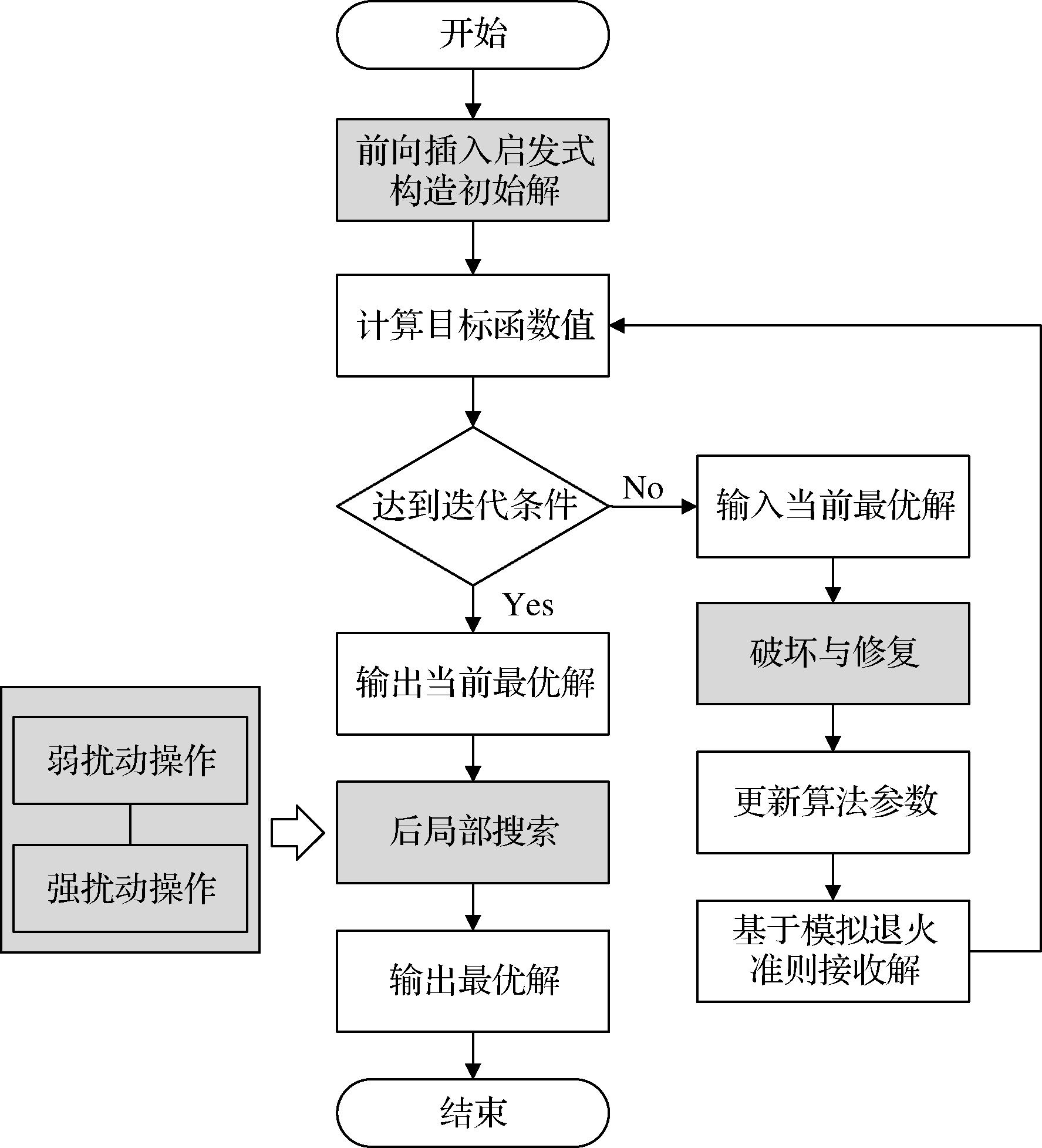
| 算法:后局部搜索算法 |
|---|
输入:ALNS算法迭代后解 步骤1:当未满足局部搜索次数时 步骤1.1:当未满足弱扰动迭代次数时 步骤1.1.1:执行Or-opt算子 步骤1.1.2:执行Exchange算子 步骤1.1.3:执行2-opt算子 步骤1.2:执行强2-opt算子 输出:后局部搜索优化后解 |
"
"
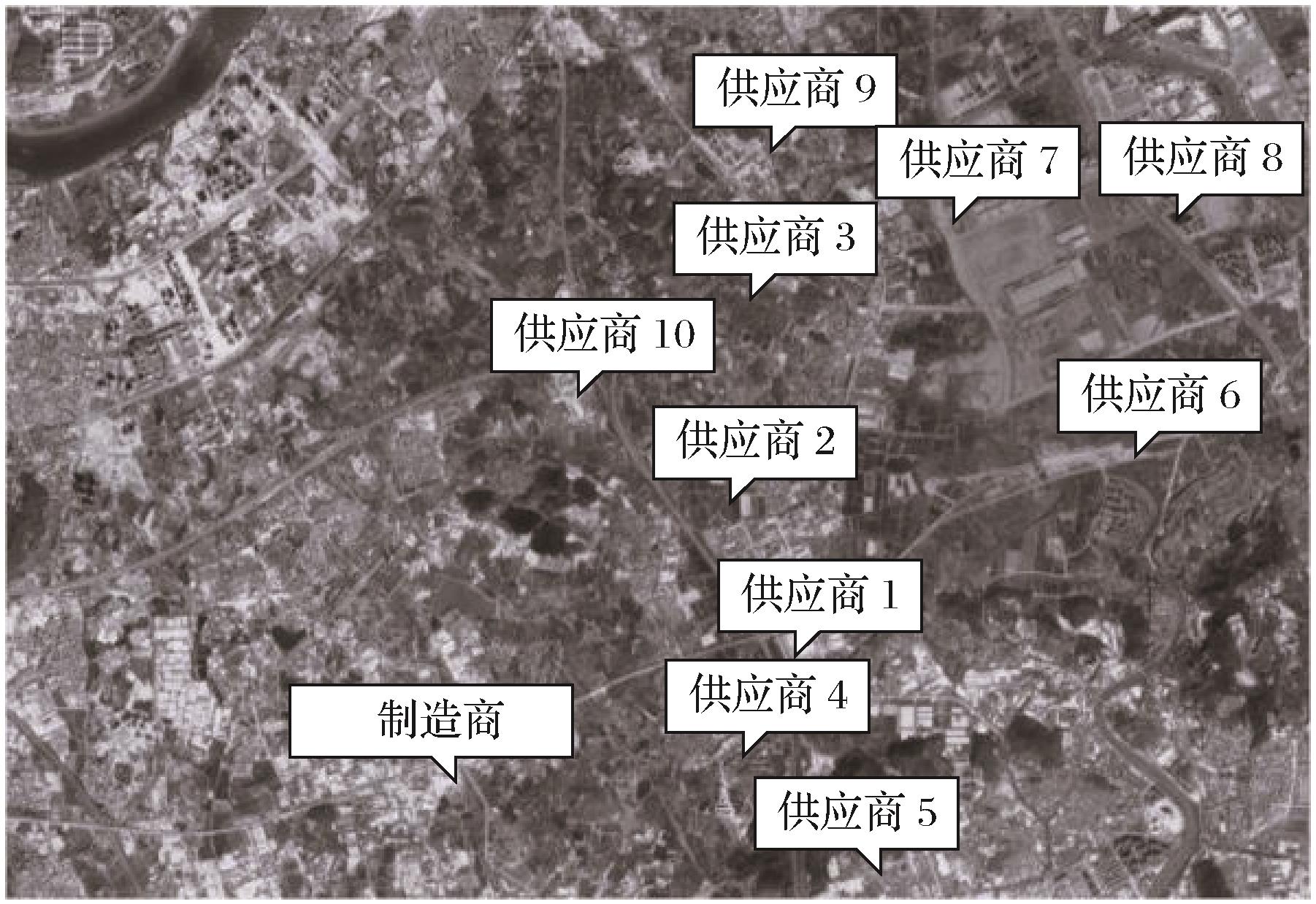
| 序号 | X坐标 | Y坐标 |
|---|---|---|
| 0 | 25 | 25 |
| 1 | 33 | 27 |
| 2 | 32 | 31 |
| 3 | 32 | 35 |
| 4 | 31 | 26 |
| 5 | 33 | 25 |
| 6 | 42 | 31 |
| 7 | 37 | 38 |
| 8 | 41 | 38 |
| 9 | 36 | 41 |
| 10 | 31 | 32 |
"
| 数值算例 | 车辆数 | 零部件数量 |
|---|---|---|
| 小规模 | 1,2,3 | 5,10,15 |
| 中规模 | 5,6,7 | 50,75,100,125 |
| 大规模 | 10,12,15 | 150,200,250,300 |
"
| 算例 | Gurobi | IALNS | |||
|---|---|---|---|---|---|
| Cost | Time | Cost | Time | Gap | |
| 1-5 | 76.7 | 3.7 | 76.7 | 0.9 | 0.0 |
| 2-5 | 75.8 | 3.5 | 75.8 | 0.6 | 0.0 |
| 3-5 | 75.5 | 2.3 | 75.5 | 0.5 | 0.0 |
| 1-10 | 142.7 | 99.7 | 143.0 | 2.0 | 0.2 |
| 2-10 | 143.0 | 88.4 | 143.0 | 1.5 | 0.0 |
| 3-10 | 143.0 | 56.4 | 143.0 | 1.3 | 0.0 |
| 1-15 | 191.2 | 1563.5 | 193.2 | 3.4 | 1.0 |
| 2-15 | 186.7 | 1378.3 | 187.7 | 3.0 | 0.5 |
| 3-15 | 184.9 | 2041.1 | 185.9 | 2.9 | 0.5 |
| 平均 | 135.5 | 581.9 | 136.0 | 1.8 | 0.3 |
"
| 算法 | 参数设置 |
|---|---|
| IALNS | |
| VNS | |
| GA |
"
| 实例 | IALNS | VNS | GA | |||||
|---|---|---|---|---|---|---|---|---|
| Cost | Time | Cost | Time | Gap | Cost | Time | Gap | |
| 5-50 | 620.0 | 12.5 | 658.0 | 25.2 | 6.1 | 712.7 | 43.1 | 15.0 |
| 5-75 | 938.1 | 31.1 | 967.7 | 69.7 | 3.2 | 1058.0 | 73.2 | 12.8 |
| 5-100 | 1229.6 | 75.7 | 1290.4 | 121.4 | 4.9 | 1335.9 | 122.8 | 8.6 |
| 5-125 | 1406.2 | 140.5 | 1465.4 | 190.3 | 4.2 | 1488.6 | 147.5 | 5.9 |
| 6-50 | 621.9 | 13.1 | 647.8 | 30.9 | 4.2 | 702.6 | 43.2 | 13.0 |
| 6-75 | 968.1 | 25.8 | 935.2 | 69.6 | -3.4 | 1024.2 | 74.3 | 5.8 |
| 6-100 | 1262.1 | 58.1 | 1313.0 | 105.8 | 4.0 | 1311.6 | 117.4 | 3.9 |
| 6-125 | 1394.0 | 104.6 | 1458.3 | 153.2 | 4.6 | 1516.2 | 175.8 | 8.8 |
| 7-50 | 617.0 | 13.9 | 644.9 | 31.1 | 4.5 | 698.7 | 41.0 | 13.2 |
| 7-75 | 929.0 | 32.9 | 973.0 | 67.2 | 4.7 | 1014.4 | 80.4 | 9.2 |
| 7-100 | 1263.1 | 74.7 | 1322.8 | 111.6 | 4.7 | 1338.2 | 117.6 | 5.9 |
| 7-125 | 1414.4 | 199.3 | 1478.9 | 175.5 | 4.6 | 1522.2 | 174.9 | 7.6 |
| 平均 | 1055.3 | 65.2 | 1096.3 | 96.0 | 3.9 | 1143.6 | 100.9 | 9.1 |
"
| 实例 | IALNS | VNS | GA | |||||
|---|---|---|---|---|---|---|---|---|
| Cost | Time | Cost | Time | Gap | Cost | Time | Gap | |
| 10-150 | 1670.3 | 115.7 | 1814.0 | 279.6 | 8.6 | 1954.0 | 320.0 | 17.0 |
| 10-200 | 2256.9 | 253.8 | 2349.9 | 419.4 | 4.1 | 2532.2 | 684.4 | 12.2 |
| 10-250 | 2961.5 | 339.9 | 2941.5 | 625.8 | -0.7 | 3177.4 | 884.1 | 7.3 |
| 10-300 | 3392.8 | 747.4 | 3536.7 | 890.5 | 4.2 | 3641.4 | 1227.2 | 7.3 |
| 12-150 | 1680.5 | 106.3 | 1772.8 | 254.0 | 5.5 | 1833.9 | 447.8 | 9.1 |
| 12-200 | 2280.4 | 317.1 | 2396.4 | 500.3 | 5.1 | 2522.9 | 735.2 | 10.6 |
| 12-250 | 3029.0 | 389.5 | 3045.24 | 629.9 | 0.5 | 3217.7 | 991.9 | 6.2 |
| 12-300 | 3429.6 | 727.1 | 3544.3 | 970.3 | 3.3 | 3674.8 | 1308.8 | 7.1 |
| 15-150 | 1679.2 | 236.4 | 1766.5 | 298.2 | 5.2 | 1855.3 | 552.3 | 10.5 |
| 15-200 | 2240.3 | 313.6 | 2360.8 | 485.9 | 5.4 | 2438.8 | 933.1 | 8.9 |
| 15-250 | 2932.8 | 413.2 | 3105.5 | 652.0 | 5.9 | 3367.0 | 1247.7 | 14.8 |
| 15-300 | 3413.5 | 685.6 | 3572.5 | 1179.8 | 4.7 | 3622.0 | 1577.9 | 6.1 |
| 平均 | 2580.5 | 387.1 | 2683.9 | 598.8 | 4.3 | 2819.8 | 909.2 | 9.8 |
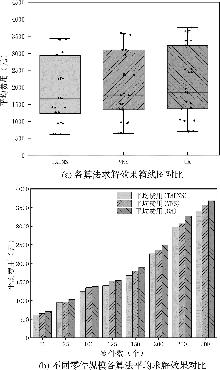
"
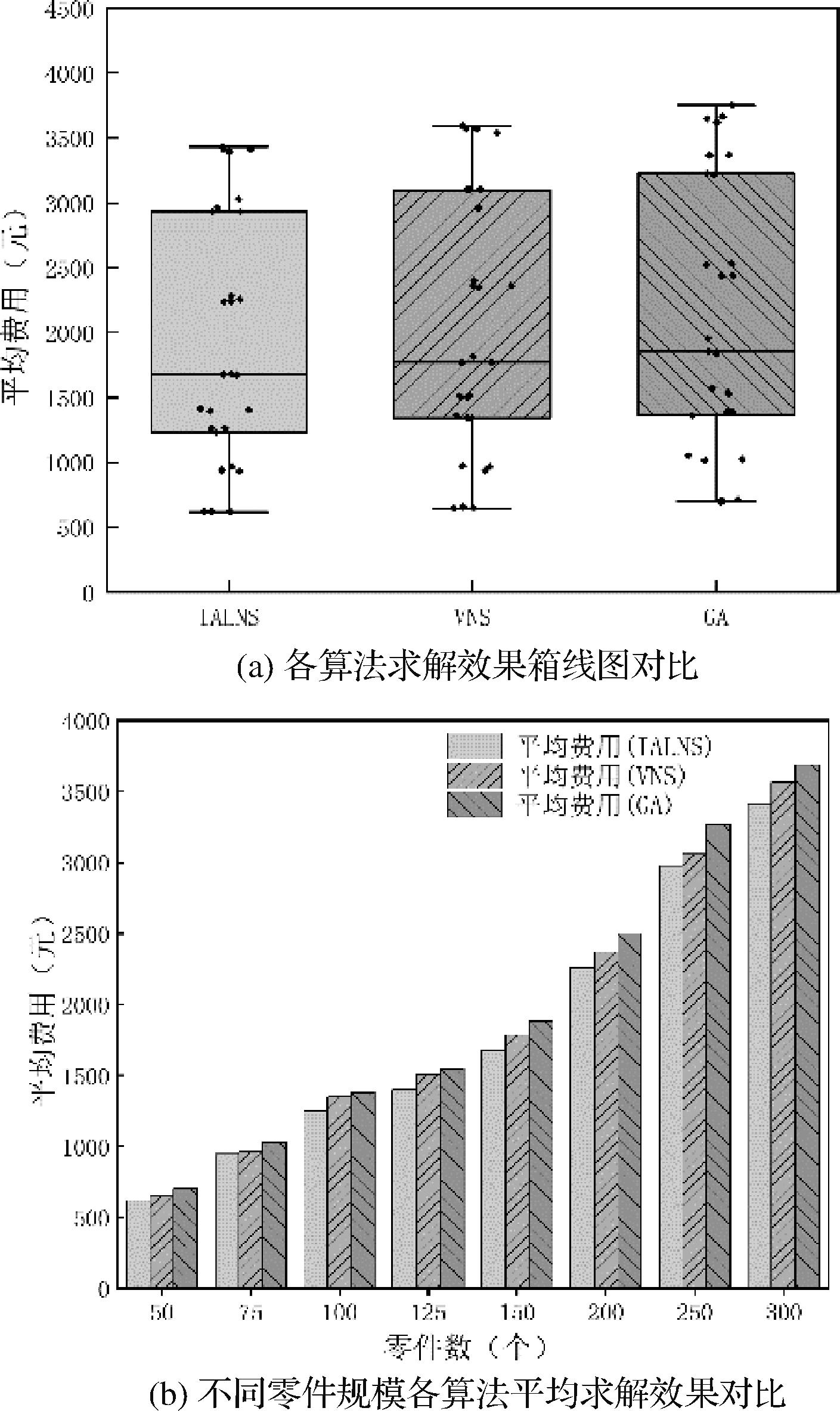
"
| 零部件数量 | 小零部件 | 中零部件 | 大零部件 | |||
|---|---|---|---|---|---|---|
运输 费用 | 所需车辆数 | 运输 费用 | 所需车辆数 | 运输 费用 | 所需车辆数 | |
| 10 | 143.0 | 1 | 190.6 | 1 | 251.1 | 1 |
| 20 | 210.7 | 1 | 339.7 | 2 | 494.6 | 2 |
| 30 | 305.1 | 2 | 472.1 | 2 | 650.8 | 3 |
| 40 | 397.9 | 2 | 536.7 | 2 | 1055.3 | 4 |
| 50 | 458.6 | 2 | 734.2 | 3 | 1228.0 | 4 |
| 75 | 703.4 | 3 | 927.1 | 4 | 1686.7 | 6 |
| 100 | 914.3 | 3 | 1495.1 | 6 | 2327.3 | 8 |
| 125 | 1061.6 | 4 | 1824.4 | 6 | 2750.7 | 9 |
| 150 | 1378.0 | 4 | 2164.6 | 7 | 3520.2 | 10 |
| 200 | 1698.3 | 6 | 2864.8 | 9 | 4433.1 | 13 |
| 250 | 2150.6 | 7 | 3622.6 | 11 | 5532.1 | 15 |
| 300 | 2582.0 | 8 | 4270.0 | 12 | 6456.1 | 17 |
"
| 运输费用 | 行程数 | 运输费用 | 行程数 | 运输费用 | 行程数 | 运输费用 | 行程数 | ||
|---|---|---|---|---|---|---|---|---|---|
| 30 | 0.25 | 623.8 | 1.4 | 1318.2 | 2.4 | 2299.0 | 2.8 | 3528.6 | 3.2 |
| 30 | 0.5 | 622.1 | 1.8 | 1283.5 | 2.6 | 2269.9 | 3.2 | 3485.3 | 3.4 |
| 30 | 0.75 | 621.5 | 1.8 | 1267.5 | 3.0 | 2258.0 | 3.2 | 3468.4 | 3.8 |
| 80 | 1 | 618.7 | 5.5 | 1258.3 | 4.6 | 2255.4 | 6.8 | 3463.3 | 9.0 |
| 80 | 1.25 | 617.2 | 5.5 | 1248.2 | 4.6 | 2240.2 | 8.4 | 3455.2 | 9.0 |
| 80 | 1.5 | 614.4 | 5.5 | 1255.6 | 5.8 | 2237.6 | 6.8 | 3425.6 | 9.0 |
| 130 | 1.75 | 608.4 | 10.0 | 1236.3 | 7.3 | 2237.0 | 10.3 | 3413.8 | 12.4 |
| 130 | 2 | 606.3 | 10.0 | 1232.8 | 7.3 | 2233.4 | 11.5 | 3411.8 | 15.5 |
| 130 | 2.25 | 604.8 | 10.0 | 1231.3 | 11.0 | 2231.4 | 13.7 | 3397.9 | 15.5 |
| 180 | 2.5 | 603.0 | 10.0 | 1229.5 | 11.0 | 2231.1 | 13.7 | 3382.1 | 20.3 |
| 180 | 2.75 | 599.5 | 10.0 | 1227.7 | 11.0 | 2230.1 | 13.7 | 3378.9 | 20.7 |
| 180 | 3 | 596.4 | 10.0 | 1226.9 | 11.0 | 2229.1 | 13.7 | 3370.0 | 20.7 |
| [1] | 施文, 刘志学, 杨威. 零部件循环取货越库物流系统仿真优化[J]. 计算机集成制造系统, 2012, 18(12): 2765-2776. |
| Shi W, Liu Z X, Yang W. Milk-run and cross-docking parts logistics system simulation optimization[J]. Computer Integrated Manufacturing Systems, 2012, 18(12): 2765-2776. | |
| [2] | 于辉, 陈飞平. 基于供应链协同的汽车制造企业入厂物流模式选择[J]. 系统工程理论与实践, 2011, 31(7): 1230-1239. |
| Yu H, Chen F P. Operation mode selection of automotive inbound logistics based onsupply chain collaboration[J]. Systems Engineering-Theory & Practice, 2011, 31(7): 1230-1239. | |
| [3] | Meyer A, Amberg B. Transport concept selection considering supplier milk runs-An integrated model and a case study from the automotive industry[J]. Transportation Research Part E: Logistics and Transportation Review, 2018, 113: 147-169. |
| [4] | 王旭, 陈栋, 王振锋. 汽车零部件Milk-run车辆调度优化模型和算法[J]. 计算机应用, 2011, 31(4): 1125-1128+1132. |
| Wang X, Chen D, Wang Z F. Scheduling optimization model and algorithm for Milk-run auto parts[J]. Journal of Computer Applications, 2011, 31(4): 1125-1128+1132. | |
| [5] | 符卓, 刘文, 邱萌. 带软时间窗的需求依订单拆分车辆路径问题及其禁忌搜索算法[J]. 中国管理科学, 2017, 25(5): 78-86. |
| Fu Z, Liu W, Qiu M. A tabu search algorithm for the vehicle routing problem with soft time windows and split deliveries by order[J]. Chinese Journal of Management Science, 2017, 25(5): 78-86. | |
| [6] | 黄肖玲, 陈焕平, 高晓楠, 等. 需求可拆分Milk-run与Supply-hub协同的汽车零部件入厂物流优化[J]. 中国管理科学, 2022, 30(7): 59-68. |
| Huang X L, Chen H P, Gao X N, et al. Delivery-split milk-run and supply-hub collaborate to optimize automobiles parts inbound logistics[J]. Chinese Journal of Management Science, 2022, 30(7): 59-68. | |
| [7] | Huang N, Li J, Zhu W, et al. The multi-trip vehicle routing problem with time windows and unloading queue at depot[J]. Transportation Research Part E: Logistics and Transportation Review, 2021, 152: 102370. |
| [8] | Fazi S, Choudhary S K, Dong J X. The multi-trip container drayage problem with synchronization for efficient empty containers re-usage[J]. European Journal of Operational Research, 2023, 310(1): 343-359. |
| [9] | Zhen L, Ma C, Wang K, et al. Multi-depot multi-trip vehicle routing problem with time windows and release dates[J]. Transportation Research Part E: Logistics and Transportation Review, 2020, 135: 101866. |
| [10] | Emde S, Zehtabian S, Disser Y. Point-to-point and milk run delivery scheduling: Models, complexity results, and algorithms based on Benders decomposition[J]. Annals of Operations Research, 2023, 322(1): 467-496. |
| [11] | Emde S, Zehtabian S. Scheduling direct deliveries with time windows to minimise truck fleet size and customer waiting times[J]. International Journal of Production Research, 2019, 57(5): 1315-1330. |
| [12] | 关旭, 马士华, 应丹丰. 随机需求下基于库存责任期的装配系统准时供货模型[J]. 系统工程理论与实践, 2013, 33(9): 2220-2228. |
| Guan X, Ma S H, Ying D F. On time delivery model with vendor inventory liability period in assembly system with random demand time[J]. Systems Engineering —Theory & Practice, 2013, 33(9): 2220-2228. | |
| [13] | 吕飞, 马士华. 供应商成本信息不对称下装配系统协同问题研究[J]. 运筹与管理, 2017, 26(2): 57-67. |
| Lv F, Ma S H. Research on coordination problem of assembly systemwith asymmetric supplier’s cost information[J]. Operations Research and Management Science, 2017, 26(2): 57-67. | |
| [14] | Boysen N, Emde S, Hoeck M, et al. Part logistics in the automotive industry: Decision problems, literature review and research agenda[J]. European Journal of Operational Research, 2015, 242(1): 107-120. |
| [15] | Moshref-Javadi M, Lee S, Winkenbach M. Design and evaluation of a multi-trip delivery model with truck and drones[J]. Transportation Research Part E: Logistics and Transportation Review, 2020, 136: 101887. |
| [16] | Wang Y, Lei L, Zhang D, et al. Towards delivery-as-a-service: Effective neighborhood search strategies for integrated delivery optimization of E-commerce and static O2O parcels[J]. Transportation Research Part B: Methodological, 2020, 139: 38-63. |
| [17] | Zhang Z, Che Y, Liang Z. Split-demand multi-trip vehicle routing problem with simultaneous pickup and delivery in airport baggage transit[J]. European Journal of Operational Research, 2024, 312(3): 996-1010. |
| [18] | Keskin M, Çatay B. Partial recharge strategies for the electric vehicle routing problem with time windows[J]. Transportation Research Part C: Emerging Technologies, 2016, 65: 111-127. |
| [19] | Solomon M M. Algorithms for the vehicle routing and scheduling problems with time window constraints[J]. Operations Research, 1987, 35(2): 254-265. |
| [20] | 张建同, 丁烨. 变邻域模拟退火算法求解速度时变的VRPTW问题[J].运筹与管理,2019,28(11): 77-84. |
| Zhang J T, Ding Y. Simulated annealing with variable neighborhood for time-dependent vehicle routing problem with time window[J]. Operations Research and Management Science, 2019, 28(11): 77-84. | |
| [21] | François V, Arda Y, Crama Y, et al. Large neighborhood search for multi-trip vehicle routing[J]. European Journal of Operational Research, 2016, 255(2): 422-441. |
| [22] | Pan B, Zhang Z, Lim A. Multi-trip time-dependent vehicle routing problem with time windows[J]. European Journal of Operational Research, 2021, 291(1): 218-231. |
| [23] | Ropke S, Pisinger D. An adaptive large neighborhood search heuristic for the pickup and delivery problem with time windows[J]. Transportation Science, 2006, 40(4): 455-472. |
| [24] | Wassan N, Wassan N, Nagy G, et al. The multiple trip vehicle routing problem with backhauls: Formulation and a two-level variable neighbourhood search[J]. Computers & Operations Research, 2017, 78: 454-467. |
| [25] | Zhang J, Zhang X. A multi-trip electric bus routing model considering equity during short-notice evacuations[J]. Transportation Research Part D: Transport and Environment, 2022, 110: 103397. |
| [1] | Jie Zhou, Kai Wang. Home Health Care Scheduling for Clustered Residents [J]. Chinese Journal of Management Science, 2026, 34(9): 197-208. |
| [2] | Tingying Wu, Bingbing Liu, Yugang Yu. An Adaptive Large Neighborhood Search Algorithm for Electric Vehicle Pickup-and-Delivery Routing Problem with Pickup-Points Selection [J]. Chinese Journal of Management Science, 2026, 34(4): 144-155. |
| [3] | Peng Wu, Shujie Ji, Lijun Tian. Optimal Dedicated Automated Truck Network Design under Time-varying Road Conditions [J]. Chinese Journal of Management Science, 2026, 34(10): 94-106. |
| [4] | Shuai Zhang, Siliang Liu, Wenyu Zhang. Vehicle Routing Problems with Time Windows under the Collaborative Delivery Mode of Electric Vehicle-drone [J]. Chinese Journal of Management Science, 2025, 33(4): 131-141. |
| [5] | Jianhua Xiao, Wenxue Zhang, Yuya Pan, Jiuhong Xiao, Yunyun Niu. A Multi-period Multi-compartment Vehicle Routing Problem for Sorted-waste Collection with Timeliness [J]. Chinese Journal of Management Science, 2025, 33(10): 86-97. |
| [6] | HU Xue-jun, ZHAO Yan, SHAN Mi-yuan, WANG Jian-jiang, BIE Li. An Adaptive Large Neighborhood Search Metaheuristic for Robust Multi-project Scheduling [J]. Chinese Journal of Management Science, 2022, 30(9): 217-231. |
| [7] | GUO Fang, YANG Jun, YANG Chao. Study on the Electric Vehicle Routing Problem in the Present of Charging Strategy and Battery Consumption [J]. Chinese Journal of Management Science, 2018, 26(9): 106-118. |
| Viewed | ||||||
|
Full text |
|
|||||
|
Abstract |
|
|||||
|
||
