
主管:中国科学院
主办:中国优选法统筹法与经济数学研究会
中国科学院科技战略咨询研究院
主办:中国优选法统筹法与经济数学研究会
中国科学院科技战略咨询研究院

Chinese Journal of Management Science ›› 2026, Vol. 34 ›› Issue (11): 244-253.doi: 10.16381/j.cnki.issn1003-207x.2024.0352
Previous Articles Next Articles
Junguang Zhang( ), Chenyu Si, Qing Han
Received:2024-03-13
Revised:2024-05-29
Online:2026-11-25
Published:2026-11-10
Contact:
Junguang Zhang
E-mail:zhangjg_ustb@163.com
CLC Number:
Junguang Zhang,Chenyu Si,Qing Han. Research on Capacity Constraint Buffer Setting Based on Social Network Analysis[J]. Chinese Journal of Management Science, 2026, 34(11): 244-253.
"

"
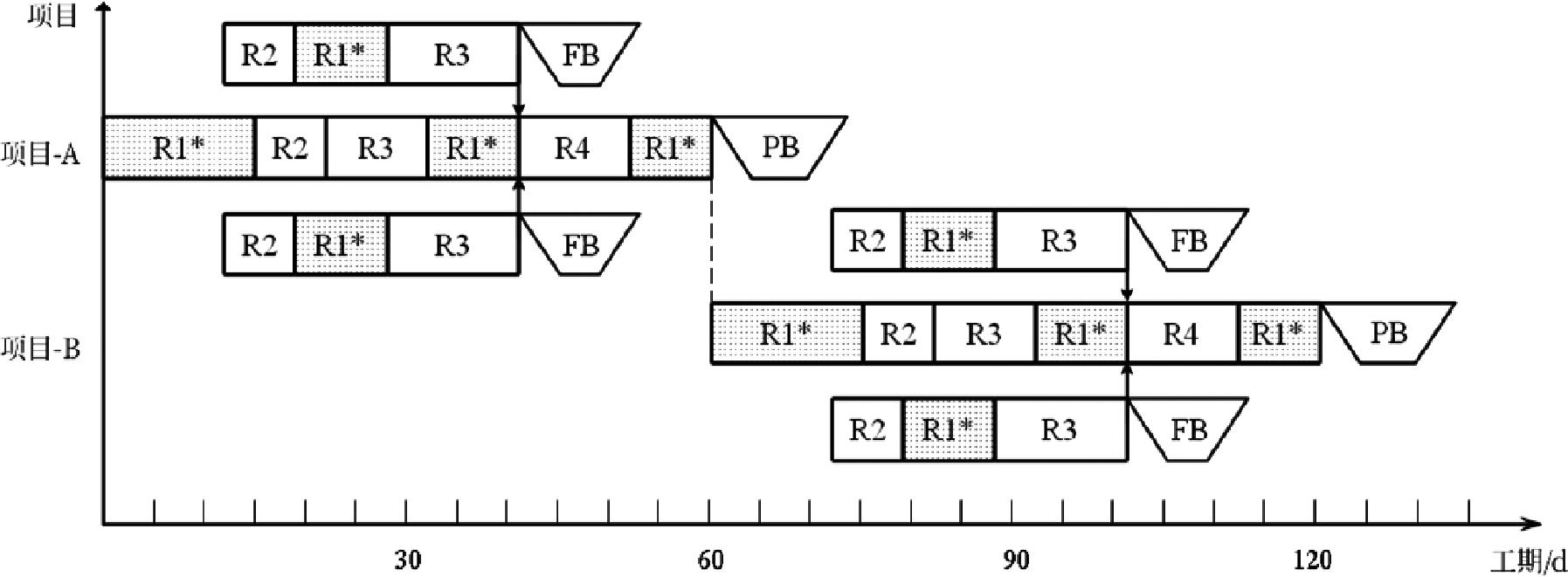
| 活动代号 | 紧前活动 | 活动时间/d | 所需资源种类 | 所用资源数量 | 可用资源量 |
|---|---|---|---|---|---|
| A1 | — | 15 | R1 | 9 | 10 |
| A2 | A1 | 7 | R2 | 5 | 8 |
| A3 | A2 | 10 | R3 | 6 | 10 |
| A4 | A3 | 9 | R1 | 7 | 10 |
| A5 | A4 | 11 | R4 | 4 | 5 |
| A6 | A5 | 8 | R1 | 7 | 10 |
| B1 | — | 7 | R2 | 6 | 8 |
| B2 | B1 | 9 | R1 | 10 | 10 |
| B3 | B2 | 13 | R3 | 3 | 5 |
| C1 | — | 7 | R2 | 6 | 8 |
| C2 | C1 | 9 | R1 | 10 | 10 |
| C3 | C2 | 13 | R3 | 3 | 5 |
"
"

"
| 鼓活动 | 鼓资源紧张度 | 鼓网络复杂度 | 鼓活动间隙度 | 鼓活动节点脆弱性 | 鼓活动风险属性值 | 鼓活动前序链灵活度 | 主管决策系数 |
|---|---|---|---|---|---|---|---|
| A1 | 0.27 | 0.55 | 0.07 | 0.15 | 0.41 | 0.27 | 0.91 |
| A4 | 0.13 | 0.71 | 0.44 | 1.85 | 0.15 | 0.22 | 0.91 |
| A6 | 0.11 | 0.52 | 0.00 | 1.00 | 0.36 | 0.13 | 0.95 |
| B2 | 0.18 | 0.52 | 0.11 | 0.58 | 0.24 | 0.13 | 0.95 |
| C2 | 0.18 | 0.52 | 0.11 | 0.58 | 0.21 | 0.13 | 0.95 |
"
| 鼓活动 | A1 | A4 | A6 | B2 | C2 |
|---|---|---|---|---|---|
| 灰色关联相对贴近度 | 0.49 | 0.52 | 0.35 | 0.37 | 0.30 |
| 安全时间 | 7.28 | 4.69 | 2.87 | 3.40 | 2.78 |
"
| 鼓活动 | A1 | A4 | A6 | B2 | C2 |
|---|---|---|---|---|---|
| 初始缓冲量 | 2.67 | 1.72 | 1.05 | 1.25 | 1.02 |
| 缓冲调整量 | 1.67 | 3.64 | - | 2.92 | 2.69 |
| 最终缓冲量 | 1 | 3.64 | 1.05 | 1 | 1 |
"
| 鼓活动 | 50% | CCB | DCCB | TCCB | 本文(SNA-CCB) | ||
|---|---|---|---|---|---|---|---|
| 集中式 | 集中式 | 分散式 | 集中式 | 分散式 | 集中式 | 分散式 | |
| 最终缓冲量 | 20.50 | 12.23 | 1 | 11.39 | 1 | 7.69 | 1 |
| 1 | 1 | 1 | |||||
| 1 | 1 | 1 | |||||
| 11 | 8.11 | 3.64 | |||||
| 14 | 1.50 | 1.05 | |||||
| 计划完工期/d | 170.50 | 162.23 | 164 | 161.39 | 151.50 | 157.69 | 151.05 |
| 缓冲平均利用率/% | 13.08 | 21.92 | 23.99 | 27.64 | 32.52 | 34.82 | 34.86 |
| 按时完工率/% | 99.7 | 99.0 | 99.0 | 98.5 | 96.6 | 98.1 | 96.6 |
| [1] | Hermans B, Leus R, Van Looy B. Deciding on scheduling, secrecy, and patenting during the new product development process: The relevance of project planning models[J]. Omega, 2023, 116: 102814. |
| [2] | Chen B, Hall N G. Incentive schemes for resolving Parkinson’s law in project management[J]. European Journal of Operational Research, 2021, 288(2): 666-681. |
| [3] | Goldratt E M. Critical chain: A business novel[M]. Great Barrington: The North River Press, 1997. |
| [4] | 马国丰, 尤建新. 关键链项目群进度管理的定量分析[J]. 系统工程理论与实践, 2007, 27(9): 54-60. |
| Ma G F, You J X. Quantitative analysis of critical chain multiple project scheduling management[J]. Systems Engineering-Theory & Practice, 2007,27(9): 54-60. | |
| [5] | 汪小金. 项目管理的第一性原理[J]. 项目管理评论, 2022(6): 12-19. |
| Wang X J. First principles of project management[J]. Project Management Review, 2022(6): 12-19. | |
| [6] | Brass D J. New developments in social network analysis[J]. Annual Review of Organizational Psychology and Organizational Behavior, 2022, 9: 225-246. |
| [7] | Cohen I, Mandelbaum A, Shtub A. Multi-project scheduling and control: A process-based comparative study of the critical chain methodology and some alternatives[J]. Project Management Journal, 2004, 35(2): 39-50. |
| [8] | Leach L P. Critical chain project management improves project performance[J]. Project Management Journal, 1999, 30(2): 39-51. |
| [9] | Truc N T N, Goto H, Takahashi H, et al. Critical chain project management based on a max-plus linear representation for determining time buffers in multiple projects[J]. Journal of Advanced Mechanical Design, Systems, and Manufacturing, 2012, 6(5): 715-727. |
| [10] | 别黎, 崔南方. 关键链多项目管理中能力约束缓冲大小研究[J]. 计算机集成制造系统, 2011, 17(7): 1534-1540. |
| Bie L, Cui N F. Capacity constraint buffer sizing method for critical chain multi-project scheduling[J]. Computer Integrated Manufacturing Systems, 2011, 17(7): 1534-1540. | |
| [11] | 张光军, 姚泽坤, 刘人境, 等. 风险导向下的关键链多项目能力约束缓冲设置方法[J]. 科技管理研究, 2018, 38(23): 198-203. |
| Zhang G J, Yao Z K, Liu R J, et al. A method for setting critical chain multi-project capacity constraint buffer under risk orientation[J]. Science and Technology Management Research, 2018, 38(23): 198-203. | |
| [12] | 张俊光, 季飞. 基于开工柔韧性的关键链项目缓冲分配方法[J]. 中国管理科学, 2021, 29(8): 126-135. |
| Zhang J G, Ji F. Project buffer allocation method based on activity flexibility[J]. Chinese Journal of Management Science, 2021, 29(8): 126-135. | |
| [13] | 别黎, 崔南方, 赵雁, 等. 关键链多项目调度中分散式能力约束缓冲设置法[J]. 管理工程学报, 2013, 27(2): 148-153. |
| Bie L, Cui N F, Zhao Y, et al. Setting distributed capacity constraint buffer in critical chain multi-project scheduling[J]. Journal of Industrial Engineering and Engineering Management, 2013, 27(2): 148-153. | |
| [14] | 张俊光, 韩晴. 基于灰色TOPSIS的多项目分散式能力约束缓冲设置[J]. 计算机集成制造系统, 2023, 29(5): 1758-1767. |
| Zhang J G, Han Q. Decentralized capacity constraint buffer sizing method for multiple projects based on gray TOPSIS[J]. Computer Integrated Manufacturing Systems, 2023, 29(5): 1758-1767. | |
| [15] | Zhang J, Han Q. Adaptive capacity constraint buffer monitoring of the multi-project system based on the relevance of drum activities[J]. Kybernetes, 2023, 52(10): 4668-4685. |
| [16] | 聂如欣, 田章朋, 梁鹤鸣. 社会网络环境下基于行为管理的大群体共识决策方法[J]. 中国管理科学, 2024, 32(9): 35-47. |
| Nie R X, Tian Z P, Liang H M. A consensus method for large-scale group decision-making based on behavior management under social network environments[J]. Chinese Journal of Management Science, 2024, 32(9): 35-47. | |
| [17] | 鲁英杰, 张应龙. 基于社会网络的结构多样性研究综述[J]. 数据分析与知识发现, 2022, 6(8): 1-11. |
| Lu Y J, Zhang Y L. Review of structural diversity studies on social networks[J]. Data Analysis and Knowledge Discovery, 2022, 6(8): 1-11. | |
| [18] | Clifton A, Webster G D. An introduction to social network analysis for personality and social psychologists[J]. Social Psychological and Personality Science, 2017, 8(4): 442-453. |
| [19] | 谢雪梅, 童钰辉. 社会资本对制造企业数字化转型的影响研究[J]. 科技与管理, 2022, 24(5): 36-46. |
| Xie X M, Tong Y H. Research on the impact of social capital on manufacturing enterprises digital transformation[J]. Science-Technology and Management, 2022, 24(5): 36-46. | |
| [20] | Wang H C, He J, Mahoney J T. Firm-specific knowledge resources and competitive advantage: The roles of economic- and relationship-based employee governance mechanisms[J]. Strategic Management Journal, 2009, 30(12): 1265-1285. |
| [21] | 赵树宽, 岳振明. 网络惯例、知识转移与创新绩效的关系——以合作公平、吸收能力为调节变量[J]. 科技管理研究, 2023, 43(24): 151-163. |
| Zhao S K, Yue Z M. Relationship between network routines, knowledge transfer and innovation performance: Taking cooperative fairness and absorptive capacity as moderator variables[J]. Science and Technology Management Research, 2023, 43(24): 151-163. | |
| [22] | 田立法, 苏中兴. 竞争驱动战略转型的人力资本视线研究——以天津中小制造业企业为例[J]. 中国管理科学, 2020, 28(5): 200-211. |
| Tian L F, Su Z X. Line of sights of competition driving strategic transformation by human capital: Evidence from small and medium-sized manufacturing firms in Tianjin[J]. Chinese Journal of Management Science, 2020, 28(5): 200-211. | |
| [23] | Kraft P S, Bausch A. Managerial social networks and innovation: A meta-analysis of bonding and bridging effects across institutional environments[J]. Journal of Product Innovation Management, 2018, 35(6): 865-889. |
| [24] | 苏敬勤, 林海芬. 管理者社会网络、知识获取与管理创新引进水平[J]. 研究与发展管理, 2011, 23(6): 25-34. |
| Su J Q, Lin H F. Managers' social network, knowledge acquirement and management innovation introduction level[J]. R&D Management, 2011, 23(6): 25-34. | |
| [25] | 牟娟, 叶满成. 管理型社会网络、战略柔性与企业绩效关系的实证研究[J]. 工程管理科技前沿, 2022, 41(4): 90-96. |
| Mou J, Ye M C. An empirical study on the relationship among managerial social network, strategic flexibility and firm performance[J]. Frontiers of Science & Technology of Engineering Management, 2022, 41(4): 90-96. | |
| [26] | 何晓兵, 何杨平, 王雅丽. 网络营销——基础、策略与工具[M]. 北京: 人民邮电出版社, 2017. |
| He X B, He Y P, Wang Y L. Network marketing[M]. Beijing: Posts & Telecom Press, 2017. | |
| [27] | Brahma A, Wynn D C. Concepts of change propagation analysis in engineering design[J]. Research in Engineering Design, 2023, 34(1): 117-151. |
| [28] | 邹星琪, 杨青. 基于项目网络支配和扩散关系的研发项目组合选择[J].中国管理科学,2019, 27(4): 198-209. |
| Zou X Q, Yang Q. R & D project portfolio selection based on domination and diffusion relationship in the project network[J]. Chinese Journal of Management Science, 2019, 27(4): 198-209. | |
| [29] | National Research Council, Committee on Risk Perception, Communication. Improving Risk Communication[M]. Washington: The National Academies Press, 1989. |
| [30] | Miller D J, Fern M J, Cardinal L B. The use of knowledge for technological innovation within diversified firms[J]. Academy of Management Journal, 2007, 50(2): 307-325. |
| [31] | 刘丝雨, 吴志岩, 许庆瑞. 基于绩效反馈机制的组织能力重构研究[J]. 系统工程理论与实践, 2016, 36(11): 2853-2866. |
| Liu S Y, Wu Z Y, Xu Q R. Mechanism of performance feedback on capability reconfiguration[J]. Systems Engineering —Theory & Practice, 2016, 36(11): 2853-2866. | |
| [32] | 马志强, 管秀. 面向多维关联的社会认知网络分析——协作学习交互研究的新进展[J]. 远程教育杂志, 2020, 38(6): 96-103. |
| Ma Z Q, Guan X. Social epistemic network analysis of multidimensional association: New development of collaborative learning interaction research[J]. Journal of Distance Education, 2020, 38(6): 96-103. | |
| [33] | Burt R S. Structural holes and good ideas[J]. American Journal of Sociology, 2004, 110(2): 349-399. |
| [34] | 王巍, 孙笑明, 崔文田, 等. 关系强度和结构洞 对关键研发者知识扩散的影响: 成长阶段的调节效应[J]. 管理科学, 2019, 32(4): 105-116. |
| Wang W, Sun X M, Cui W T, et al. Impact of Tie strength and structural holes on knowledge transfer of key inventors: The moderating effect of growth stage[J]. Journal of Management Science, 2019, 32(4): 105-116. |
| [1] | Xiao Tan, Jiaqi Cai, Zaiwu Gong. Group Intelligence Consensus Decision Modeling Based on Reinforcement Learning with the “Structure-Information” Coupled Network [J]. Chinese Journal of Management Science, 2026, 34(3): 357-368. |
| [2] | Faming Zhang, Jiangtao Han, Linqian Zhang, Shuqi Zhu. Multi-Attribute Large Group Decision Making Method Based on T2PLD Operator in Social Trust Network [J]. Chinese Journal of Management Science, 2025, 33(9): 177-188. |
| [3] | Ruxin Nie,Zhangpeng Tian,Heming Liang. A Consensus Method for Large-Scale Group Decision-Making Based on Behavior Management under Social Network Environments [J]. Chinese Journal of Management Science, 2024, 32(9): 35-47. |
| [4] | Mengqi Li, Gaofeng Liu, Yejun Xu, Xia Liu, Huimin Wang. Research on Consensus of Social Network Group Decision Making Considering Experts' Trust Risk Behaviors Mining and Dynamic Management [J]. Chinese Journal of Management Science, 2024, 32(11): 144-156. |
| [5] | WENG Ke-rui, ZHOU Jing. Study on Updated Products Launch Timing and Seed Optimization under a Non-Delisting Strategy [J]. Chinese Journal of Management Science, 2023, 31(2): 226-234. |
| [6] | HU Xue-jun, ZHAO Yan, SHAN Mi-yuan, WANG Jian-jiang, BIE Li. An Adaptive Large Neighborhood Search Metaheuristic for Robust Multi-project Scheduling [J]. Chinese Journal of Management Science, 2022, 30(9): 217-231. |
| [7] | YAO Sheng-bao, GU Miao. A Consensus Model for Group Decision Making under the Influence of Empathy [J]. Chinese Journal of Management Science, 2021, 29(11): 203-214. |
| [8] | JIN Feifei, LIU Jinpei, CHEN Huayou, DU Pengcheng. Social Network Group Decision-Making Model Based on Trust Relationship and Information Measures with Probabilistic Linguistic Information [J]. Chinese Journal of Management Science, 2021, 29(10): 178-190. |
| [9] | WU Deng-sheng, LI Ruo-yun. The Structure and Evolution of Institution Collaboration Network on Management Sciences in China [J]. Chinese Journal of Management Science, 2017, 25(9): 168-177. |
| [10] | LIU De-hai, WANG Wei-guo. Co-evolutionary Mechanism of Social Network Structure and Strategy in Mass Emergency with Maintain Legal Rights [J]. Chinese Journal of Management Science, 2012, (3): 185-192. |
| [11] | CHEN Ning, ZHANG Xue-yan, WU Zhen-ye, CHEN Shi. Research on Model and Application of Resource Allocation in Multi-project Management Based on Stochastic Theory [J]. Chinese Journal of Management Science, 2006, (4): 75-80. |
| Viewed | ||||||
|
Full text |
|
|||||
|
Abstract |
|
|||||
|
||
