
主管:中国科学院
主办:中国优选法统筹法与经济数学研究会
中国科学院科技战略咨询研究院
主办:中国优选法统筹法与经济数学研究会
中国科学院科技战略咨询研究院

Chinese Journal of Management Science ›› 2026, Vol. 34 ›› Issue (11): 130-141.doi: 10.16381/j.cnki.issn1003-207x.2025.0498
Previous Articles Next Articles
Longtao Qin1,2, Jiayi Huang3, Mingliang Qi1,2( )
Received:2025-03-29
Revised:2025-05-12
Online:2026-11-25
Published:2026-11-10
Contact:
Mingliang Qi
E-mail:mlqi@casisd.cn
CLC Number:
Longtao Qin,Jiayi Huang,Mingliang Qi. Research on the Evolution Mechanism of Weibo User Discussion Heat for Public Demand Response Policies——A Case Based on Weibo Users Data[J]. Chinese Journal of Management Science, 2026, 34(11): 130-141.
"
"

"
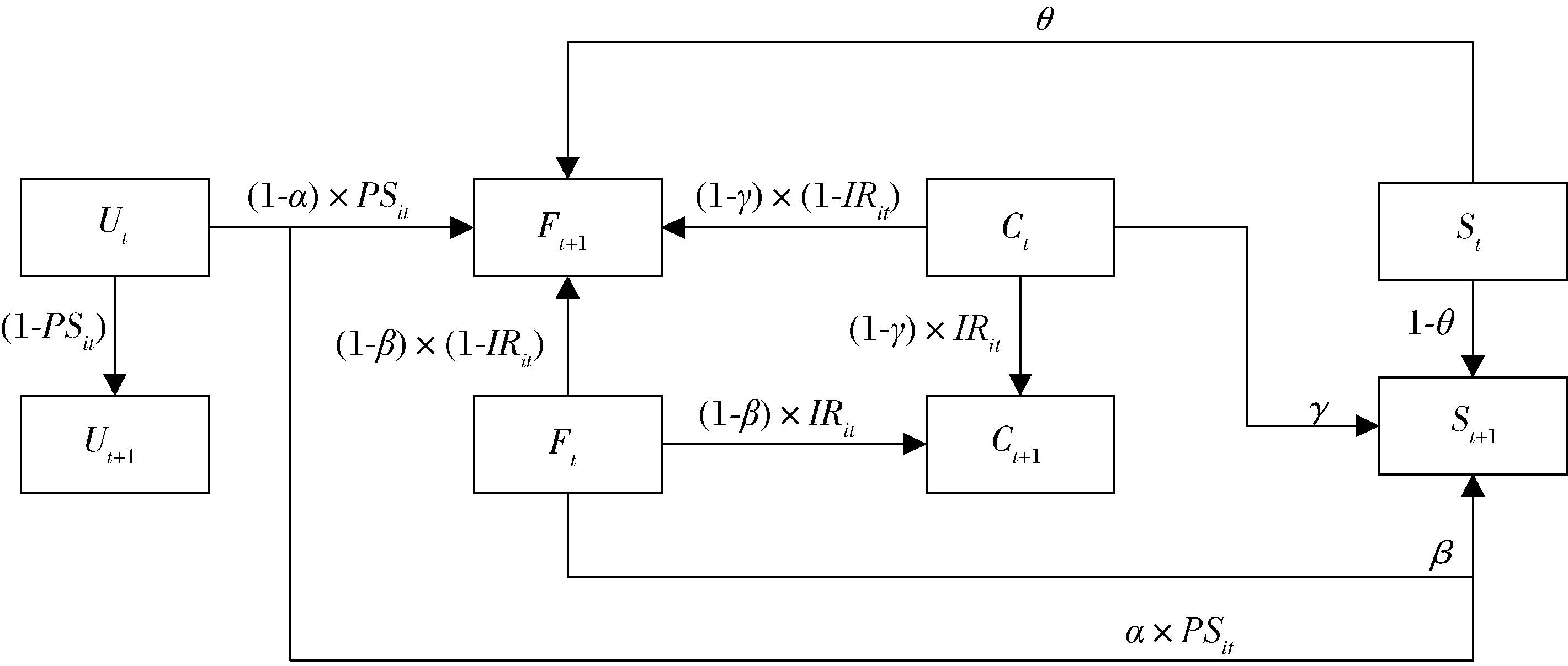
| 参数类型 | 参数符号 | 参数含义 |
|---|---|---|
| 基本参数 | n | 总用户数 |
| 基本参数 | UNt、FNt、CNt、SNt | 在t时刻未知者、关注者、传播者、沉默者的用户数量 |
| 基本参数 | Ut、Ft、Ct、St | 在t时刻未知者、关注者、传播者、沉默者的用户集合 |
| 基本参数 | e | 自然数e |
| 基本参数 | t | 当前时间步,表示政策发布后第t天 |
| 基本参数 | Forget | 遗忘率,表示用户遗忘各条已阅读微博评论的概率 |
| 基本参数 | PSt | t时刻未知者的网络关系中有传播者的比例 |
| 基本参数 | PSit | t时刻未知者i的网络关系中是否有传播者的状态值 |
| 舆情传播途径参数 | α | 未知者对于相关话题不感兴趣的概率 |
| 舆情传播途径参数 | β | 关注者对于相关话题不感兴趣的概率 |
| 舆情传播途径参数 | γ | 传播者对于相关话题不感兴趣的概率 |
| 舆情传播途径参数 | θ | 沉默者对于相关话题感兴趣的概率 |
| 舆情传播途径参数 | σ | 关注者和传播者受他人影响,参与传播的概率 |
| 舆情传播途径参数 | m | 各类人群每次浏览的微博评论数 |
| 即时满足心理参数 | IRt | t时刻关注者和传播者的平均即时满足心理强度 |
| 即时满足心理参数 | IRit | t时刻关注者或传播者i在知晓相关话题信息后,出于即时满足心理,参与话题传播的概率 |
| 即时满足心理参数 | IRi0 | 表示i用户的初始即时满足心理强度,服从正态分布 |
| 即时满足心理参数 | IR_ti | 表示i用户第一阶段即时满足心理持续时间,服从正态分布 |
| 即时满足心理参数 | p | 用户受即时满足心理影响,浏览微博评论内容的概率 |
| 即时满足心理参数 | D | 即时满足心理对时间的敏感度 |
| 自我调节参数 | ARi | 用户i的自我调节能力阈值集合,描述用户基于此能力对其他用户影响和自身心理的调节能力,服从正态分布 |
| 自我调节参数 | AR_ti | 用户i自我调节的最长时间范围,服从正态分布 |
| 自我调节参数 | B | 自我调节效率 |
| 自我调节参数 | E | 自我调节准备时间 |
| 自我调节参数 | LTi | 用户i不再进行自我调节的开始时间 |
| 自我调节参数 | T_infti | t时刻用户i受到的总影响量 |
| 自我调节参数 | infti | t时刻用户i受到相邻节点的影响量 |
"
"

"
"
"
| 模型 | 参数取值 |
|---|---|
| 复杂网络 | n=20000;m=8;Forget=0.663[ |
| IGSA-UFCS | α=0.2;β=0.5;γ=0.1;σ=0.1;θ=0.5;UN0 =19500;FN0 =0;CN0 =500;SN0 =0;B=0.01;C=1;D=0.2 |
| IGSA-UFCS | 用户初始即时满足心理强度的正态分布参数(u=0.5,σ=1) |
| IGSA-UFCS | 用户自我调节能力的正态分布参数(u=0.5,σ=1) |
| IGSA-UFCS | 用户最长自我调节天数的正态分布参数(u=70,σ=7) |
| IGSA-UFCS | 用户仅即时满足心理生效天数的正态分布参数(u=14,σ=7) |
| IGSA-UFCS | 用户粉丝数的幂律分布参数(λ=2.5) |
| 遗传算法 | 交叉概率=0.2;变异概率=0.2;迭代次数=50;种群数量=90 |
"
"
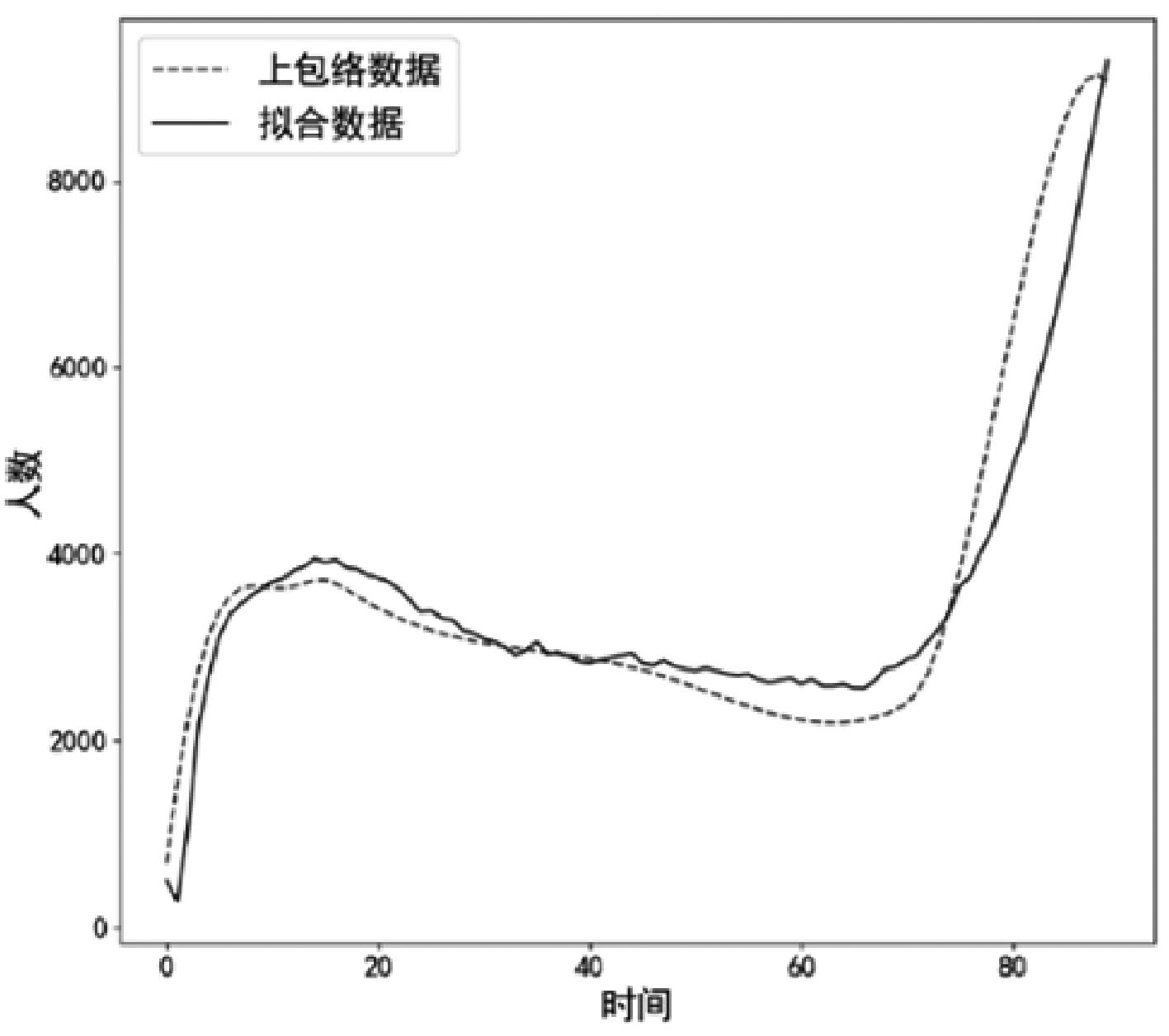
| 拟合目标 | 拟合参数取值(保留3位小数) | 拟合误差(保留2位小数) |
|---|---|---|
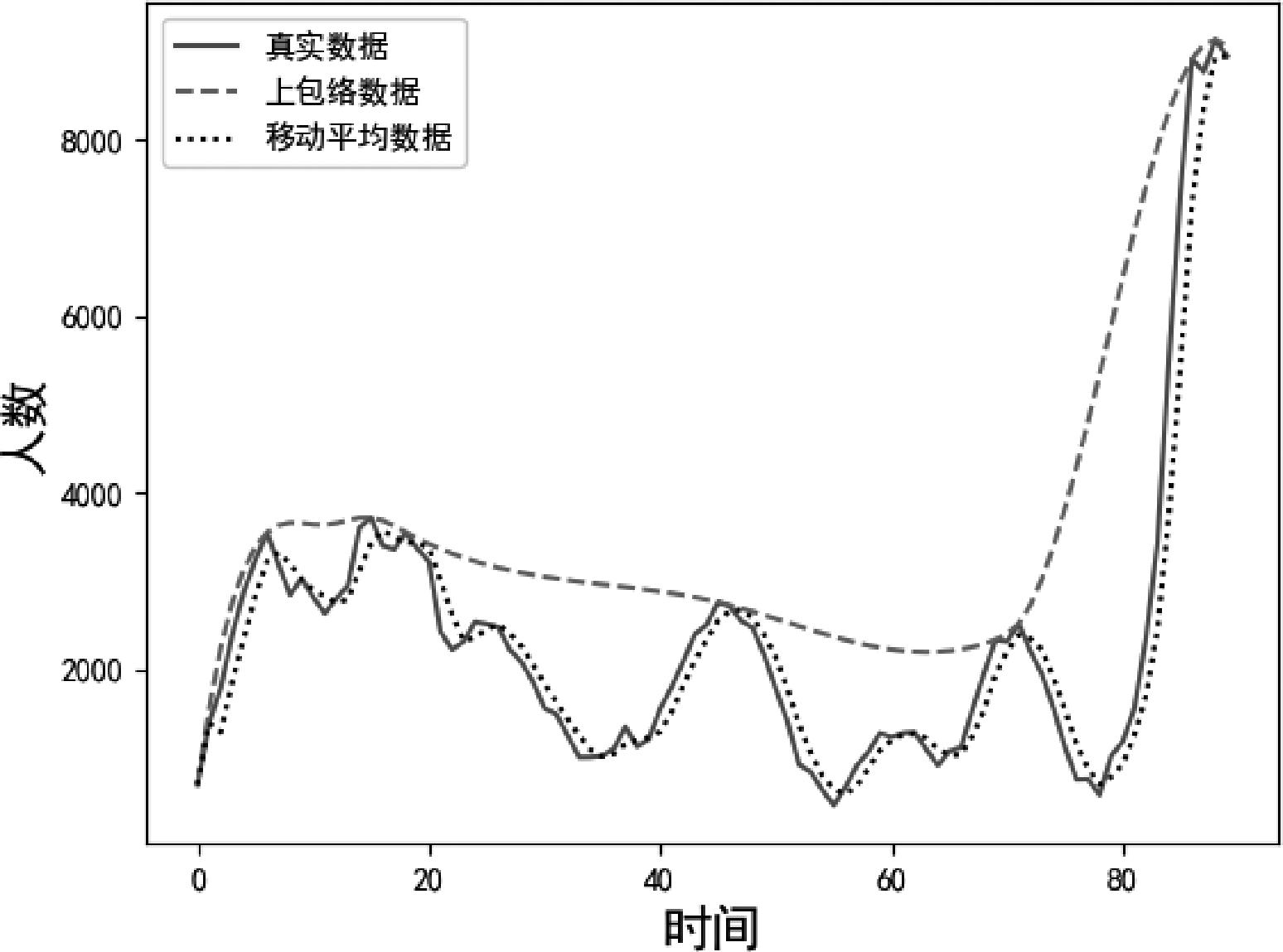
| 真实数据 | α=0.786;p=0.440;σ=0.093;γ=0.001;θ=0.835; β=0.767;B=0.032;C=1.000;D=0.833 | MSE=885651.94;RMSE=941.09; MAE=715.21;R2 =0.72;CV=27.27% |
| 上包络数据 | α=0473;p=0.981;σ=0.737;γ=0.000;θ=0.787; β=0.719;B=0.006;C=0.597;D=0.408 | MSE=336481.30;RMSE=891.066; MAE=380.14;R2 =0.90;CV=12.82% |
| 移动平均数据 | α=0.606;p=0.976;σ=1.000;γ=0.000;θ=0.792; β=0.770;B=0.029;C=1.000;D=0.402 | MSE=793998.02;RMSE=891.07; MAE=639.42;R2 =0.70;CV=25.85% |
"
"
"
"
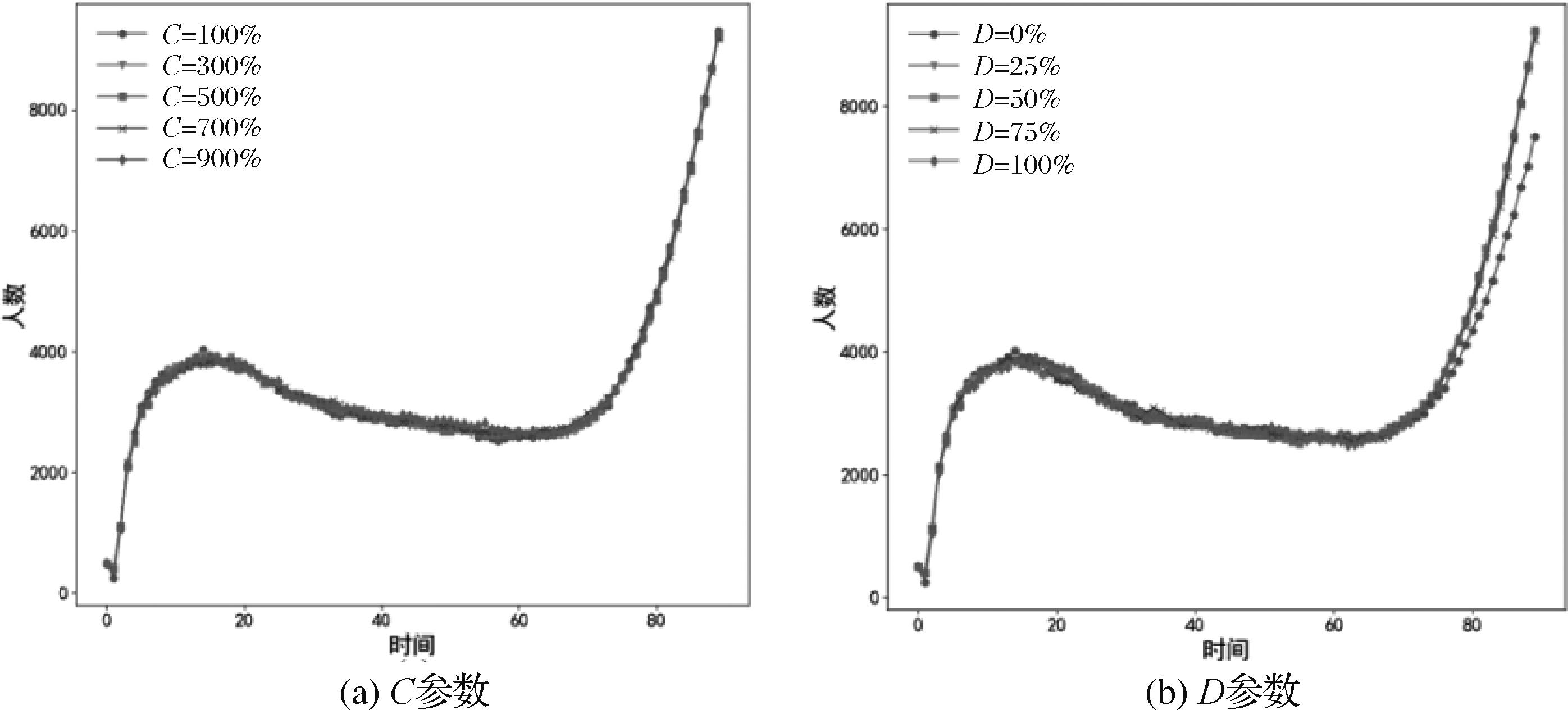
"
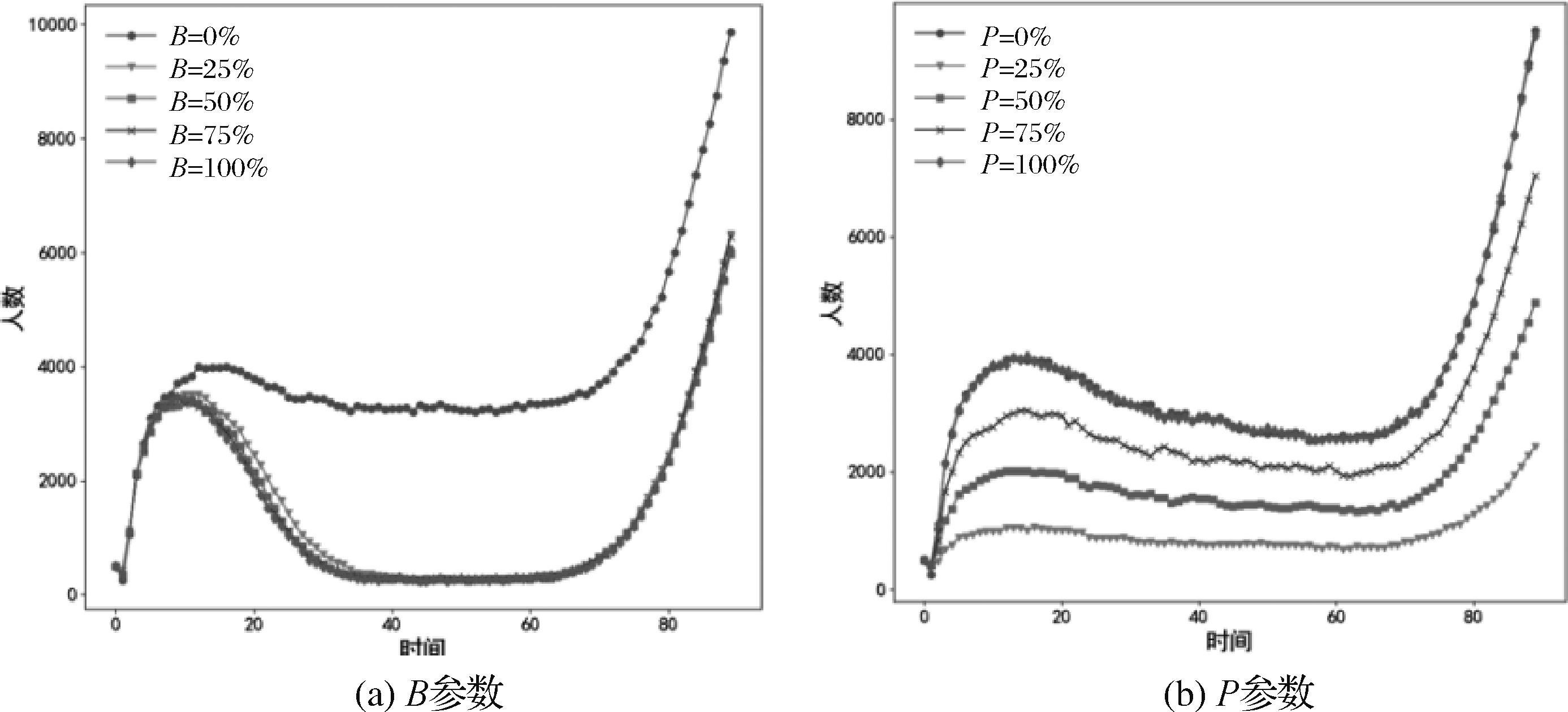
"
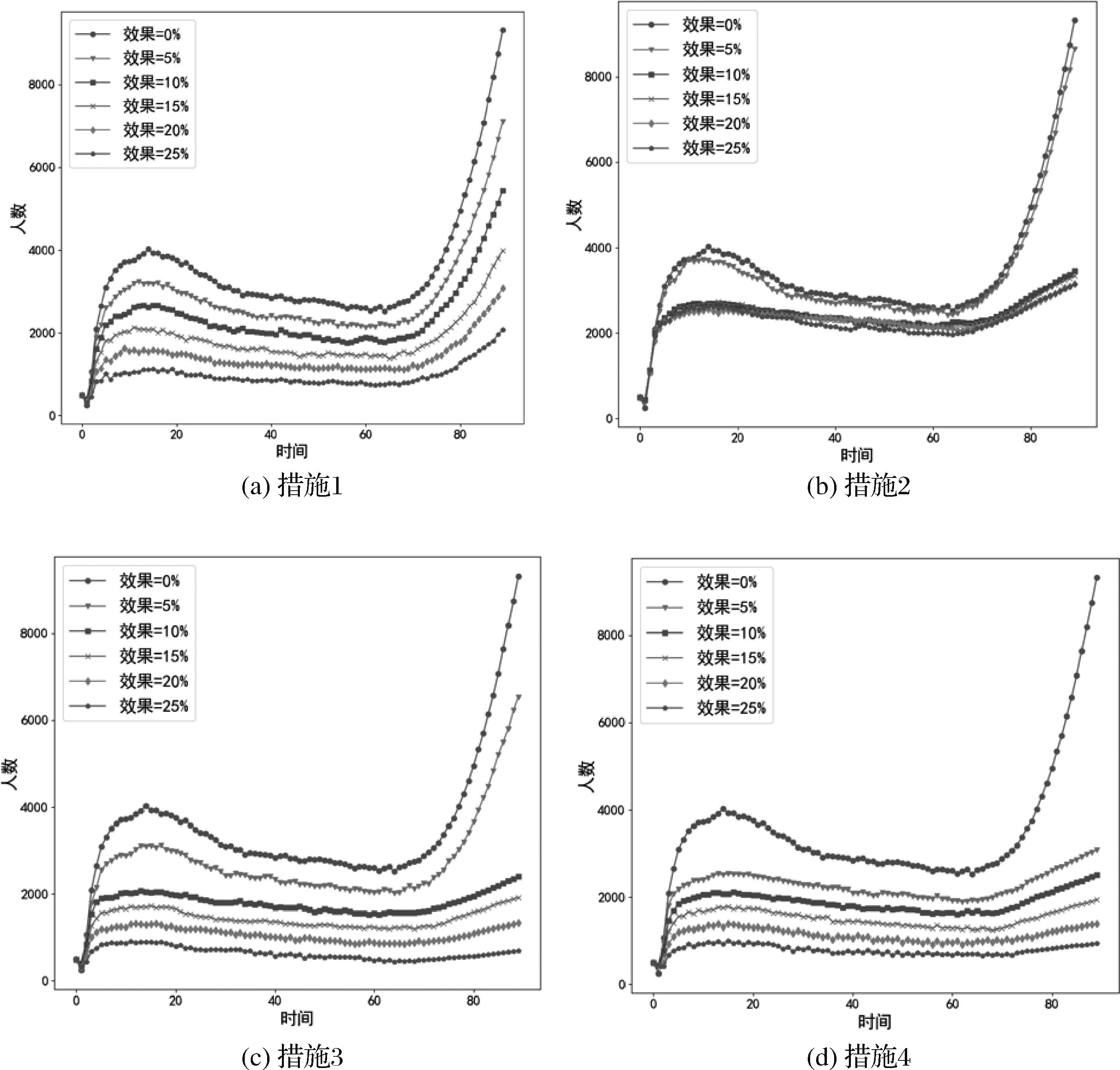
"
| 效果 | 措施1 | 措施2 | 措施3 | 措施4 |
|---|---|---|---|---|
| 5% | (2830,3241,242.05) | (3290,3709,299.7) | (2220,2533,52) | (2703,3119,217.9) |
| 10% | (2324,2669,176.3) | (2437,2697,59.25) | (1846,2115,43.1) | (1770,2073,40.85) |
| 15% | (1814,2136,124.75) | (2413,2737,54.65) | (1483,1789,33.65) | (1417,1729,33.9) |
| 20% | (1398,1633,97.25) | (2331,2562,50.45) | (1115,1387,18.15) | (1050,1333,20.95) |
| 25% | (967,1125,63.9) | (2272,2624,51.5) | (783,994,12.15) | (637,903,10.75) |
| [1] | 宋亮, 周洪林. 网民介入公共政策传播的路径及其风险规避[J]. 新闻世界, 2016(8): 34-39. |
| Song L, Zhou H L. The path of netizens' involvement in the dissemination of public policies and its risk avoidance[J]. News World, 2016(8): 34-39. | |
| [2] | Li S, Liu Z, Li Y. Temporal and spatial evolution of online public sentiment on emergencies[J]. Information Processing & Management, 2020, 57(2): 102177. |
| [3] | 王晰巍, 贾若男, 韦雅楠, 等. 多维度社交网络舆情用户群体聚类分析方法研究[J]. 数据分析与知识发现, 2021, 5(6): 25-35. |
| Wang X W, Jia R N, Wei Y N, et al. Clustering user groups of public opinion events from multi-dimensional social network[J]. Data Analysis and Knowledge Discovery, 2021, 5(6): 25-35. | |
| [4] | 郑石明, 兰雨潇, 黎枫. 网络公共舆论与政府回应的互动逻辑——基于新冠肺炎疫情期间“领导留言板”的数据分析[J]. 公共管理学报,2021, 18(3): 24-37+169. |
| Zheng S M, Lan Y X, Li F. The interactive logic of online public opinion and government response—Based on the data analysis of the “leadership message board” during the COVID-19 pandemic[J]. Journal of Public Management, 2021, 18(3): 24-37+169. | |
| [5] | 丁学君. 基于SCIR的微博舆情话题传播模型研究[J]. 计算机工程与应用, 2015, 51(8): 20-26+78. |
| Ding X J. Research on propagation model of public opinion topics based on SCIR in microblogging[J]. Computer Engineering and Applications, 2015, 51(8): 20-26+78. | |
| [6] | Suo S, Chen Y. The dynamics of public opinion in complex networks[J]. Journal of Artificial Societies and Social Simulation, 2008, 11(4): 2. |
| [7] | Hussain A, Tahir A, Hussain Z, et al. Artificial intelligence-enabled analysis of public attitudes on Facebook and Twitter toward COVID-19 vaccines in the United Kingdom and the United States: Observational study[J]. Journal of Medical Internet Research, 2021, 23(4): e26627. |
| [8] | Aral S, Walker D. Identifying influential and susceptible members of social networks[J]. Science, 2012, 337(6092): 337-341. |
| [9] | Gruhl D, Guha R, Liben-Nowell D, et al. Information diffusion through blogspace[C]//Proceedings of the 13th International Conference on World Wide Web, New York NY USA,ACM, 2004: 491-501. |
| [10] | 陈波, 于泠, 刘君亭, 等. 泛在媒体环境下的网络舆情传播控制模型[J]. 系统工程理论与实践, 2011, 31(11): 2140-2150. |
| Chen B, Yu L, Liu J T, et al. Dissemination and control model of Internet public opinion in the ubiquitous media environments[J]. Systems Engineering—Theory & Practice, 2011, 31(11): 2140-2150. | |
| [11] | 种大双, 孙绍荣. 基于传染病模型的重大突发事件舆情传播与控制[J]. 情报理论与实践, 2018, 41(5): 104-109. |
| Chong D S, Sun S R. Public opinion dissemination and control of serious emergencies: Based on epidemic model[J]. Information Studies (Theory & Application), 2018, 41(5): 104-109. | |
| [12] | Leskovec J, McGlohon M, Faloutsos C, et al. Patterns of cascading behavior in large blog graphs[C]//Proceedings of the 2007 SIAM International Conference on Data Mining,Society for Industrial and Applied Mathematics, Minneapolis, MN, USA,April 26-28,2007: 551-556. |
| [13] | 李青, 朱恒民. 基于BA网络的互联网舆情观点演化模型研究[J]. 情报杂志, 2012, 31(3): 6-9+35. |
| Li Q, Zhu H M. Study on the evolution model of the online public opinion viewpoint based on BA network[J]. Journal of Intelligence, 2012, 31(3): 6-9+35. | |
| [14] | 魏静, 黄阳江豪, 林萍, 等. 基于改进SIR模型的微博网络舆情传播研究[J].情报科学,2019, 37(6): 16-22. |
| Wei J, Huang Y J H, Lin P, et al. Public opinion transmission of micro-blog network based on improved SIR model[J]. Information Science, 2019, 37(6): 16-22. | |
| [15] | 魏静, 丁乐蓉, 朱恒民, 等. 基于情感和亲密度的社交网络舆情传播模型研究[J]. 情报科学, 2021, 39(4): 37-46. |
| Wei J, Ding L R, Zhu H M, et al. Research on public opinion transmission model of social network based on emotion and intimacy[J]. Information Science, 2021, 39(4): 37-46. | |
| [16] | 迟钰雪, 刘怡君. 逆反心理的网络舆情传播机制研究[J]. 系统工程学报, 2019, 34(5): 610-620. |
| Chi Y X, Liu Y J. Study on the transmission mechanism of online public opinion of reverse psychology[J]. Journal of Systems Engineering,2019,34(5): 610-620. | |
| [17] | 王明珠, 郭林江, 刘怡君. 考虑网民心理因素的网络舆情干预时机研究[J]. 中国管理科学, 2025, 33(6): 140-150. |
| Wang M Z, Guo L J, Liu Y J. Research on the timing of online public opinion intervention considering the psychological factors of netizens[J]. Chinese Journal of Management Science, 2025, 33(6): 140-150. | |
| [18] | 朱光, 颜燚, 杨沁蓉. 基于SEIR演化博弈模型的网络维权策略及衍生舆情传播研究[J]. 情报科学, 2023, 41(3): 89-99. |
| Zhu G, Yan Y, Yang Q R. Network rights-protection strategy and derivative public opinion dissemination based on SEIR evolutionary game model[J]. Information Science, 2023, 41(3): 89-99. | |
| [19] | Du J, Kerkhof P, van Koningsbruggen G M. Predictors of social media self-control failure: Immediate gratifications, habitual checking, ubiquity, and notifications[J]. Cyberpsychology, Behavior, and Social Networking, 2019, 22(7): 477-485. |
| [20] | Casey B J, Somerville L H, Gotlib I H, et al. Behavioral and neural correlates of delay of gratification 40 years later[J]. Proceedings of the National Academy of Sciences of the United States of America, 2011, 108(36): 14998-15003. |
| [21] | Muraven M, Tice D M, Baumeister R F. Self-control as a limited resource: Regulatory depletion patterns[J]. Journal of Personality and Social Psychology, 1998, 74(3): 774-789. |
| [22] | 王梓宁, 张国防. 考虑多交互关系与情感倾向的微博用户可信度评估算法[J]. 计算机应用研究, 2024, 41(10): 3000-3007. |
| Wang Z N, Zhang G F. Microblog users' credibility evaluation algorithm considering multi-interaction relationships and emotional tendencies[J]. Application Research of Computers, 2024, 41(10): 3000-3007. | |
| [23] | Ebbinghaus H. Memory: A contribution to experimental psychology[J]. Annals of Neurosciences, 2013, 20(4): 200408. |
| [24] | 中国政府网. 6月5日疫情防控最新消息![EB/OL]. (2022-06-06)[2025-03-03]. . |
| Chinese Government Website. Latest news on COVID-19 prevention and control as of June 5[EB/OL].(2022-06-06)[2025-03-03].. | |
| [25] | 中国政府网. 国务院联防联控机制:各地要严格落实疫情防控“九不准”要求[EB/OL]. (2022-06-25)[2025-03-03]. . |
| Chinese Government Website. Joint Prevention and Control Mechanism of the State Council: All localities must strictly implement the “Nine Prohibitions” requirements for epidemic prevention and control[EB/OL]. (2022-06-25)[2025-03-03].. | |
| [26] | 新华社. 严格执行第九版防控方案和“九不准”要求——国务院联防联控机制回答当前疫情防控有关问题[EB/OL].(2022-07-22)[2025-03-03].. |
| Xinhua News Agency. Strictly implement the ninth edition of the prevention and control plan and the “Nine Prohibitions” Requirements — Joint prevention and control mechanism of The State Council answers questions on current epidemic prevention and control[EB/OL]. (2022-07-22)[2025-03-03].. | |
| [27] | 卫生健康委网站. 国务院联防联控机制有关部门落实疫情防控“九不准”要求问题反映渠道[EB/OL]. (2022-07-10)[2025-03-03]. . |
| National Health Commission Website. Feedback channels for issues concerning the implementation of the “Nine Prohibitions” Requirements for epidemic prevention and control by relevant departments of the joint prevention and control mechanism of the State Council[EB/OL].(2022-07-10)[2025-03-03].. | |
| [28] | 央视网. 国家卫健委:对“九不准”现象开通公众留言板通报典型案例[EB/OL]. (2022-06-28)[2025-03-03]. . |
| CCTV Website. National Health Commission: A public message board has been opened to report typical cases of “Nine Prohibitions” violations[EB/OL].(2022-06-28)[2025-03-03].. | |
| [29] | 陈晨, 袁绍军, 尹兆磊, 等. 一种分布式发电功率时间序列波动性量化评估方法[J]. 电子与信息学报, 2022, 44(11): 3825-3832. |
| Chen C, Yuan S J, Yin Z L, et al. A fluctuation quantitative evaluation method for distributed energy power time series[J]. Journal of Electronics & Information Technology, 2022, 44(11): 3825-3832. | |
| [30] | 梁冉, 徐雅斌. 基于改进SEIR模型的网络舆情传播研究[J]. 计算机仿真, 2023, 40(5): 333-340. |
| Liang R, Xu Y B. Research on network public opinion communication based on improved SERI model[J]. Computer Simulation, 2023, 40(5): 333-340. |
| Viewed | ||||||
|
Full text |
|
|||||
|
Abstract |
|
|||||
|
||
