
主管:中国科学院
主办:中国优选法统筹法与经济数学研究会
中国科学院科技战略咨询研究院
主办:中国优选法统筹法与经济数学研究会
中国科学院科技战略咨询研究院

Chinese Journal of Management Science ›› 2026, Vol. 34 ›› Issue (11): 263-275.doi: 10.16381/j.cnki.issn1003-207x.2024.1216
Previous Articles Next Articles
Qingchun Meng1,2, Xin Cui1,2, Ziyi Zhu1,2, Yongbin Gao1,2, Xiaole Xue1,2( )
Received:2024-07-23
Revised:2025-03-04
Online:2026-11-25
Published:2026-11-10
Contact:
Xiaole Xue
E-mail:xlxue@sdu.edu.cn
CLC Number:
Qingchun Meng,Xin Cui,Ziyi Zhu, et al. Research on Government-Enterprise Collaborative Recovery Strategies for Supply Disruptions[J]. Chinese Journal of Management Science, 2026, 34(11): 263-275.

"
| 符号 | 说明 |
|---|---|
| 成本补贴策略下的补贴比例, | |
| 价格补贴策略下的补贴金额, | |
| 产品价格 | |
| 参考价格,初始参考价格 | |
| 消费者对参考价格和产品价格之差的敏感系数 | |
| 消费者对参考价格的记忆系数 | |
| 企业的恢复努力对参考价格的影响系数 | |
| 企业的恢复努力对社会效益的影响系数 | |
| 企业的边际利润系数 | |
| 企业的恢复努力水平对需求的影响系数 | |
| 企业的恢复努力成本系数 | |
| 恢复计划期长度 | |
| 政府的目标函数 | |
| 企业的目标函数 | |
"
"
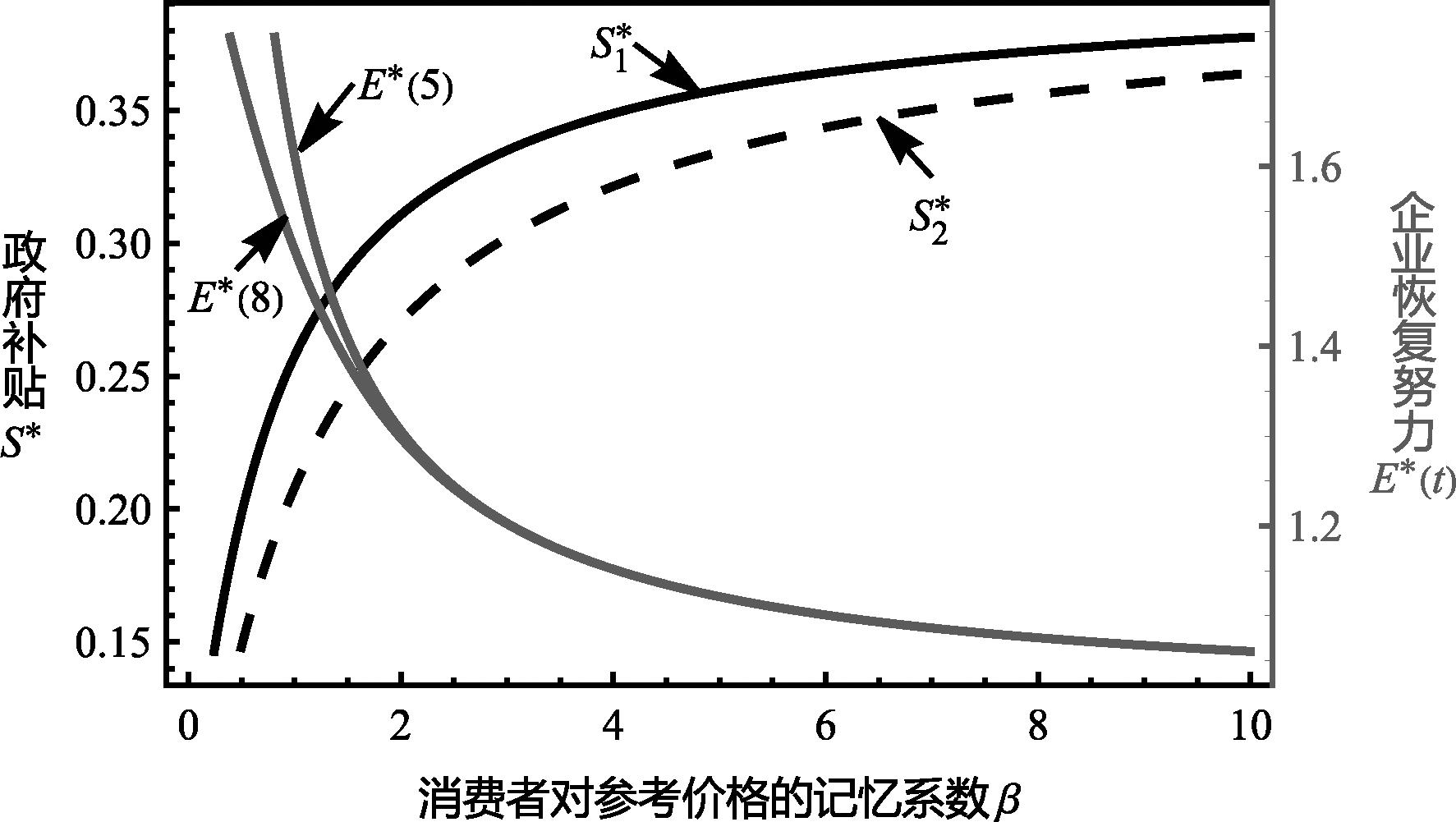
"
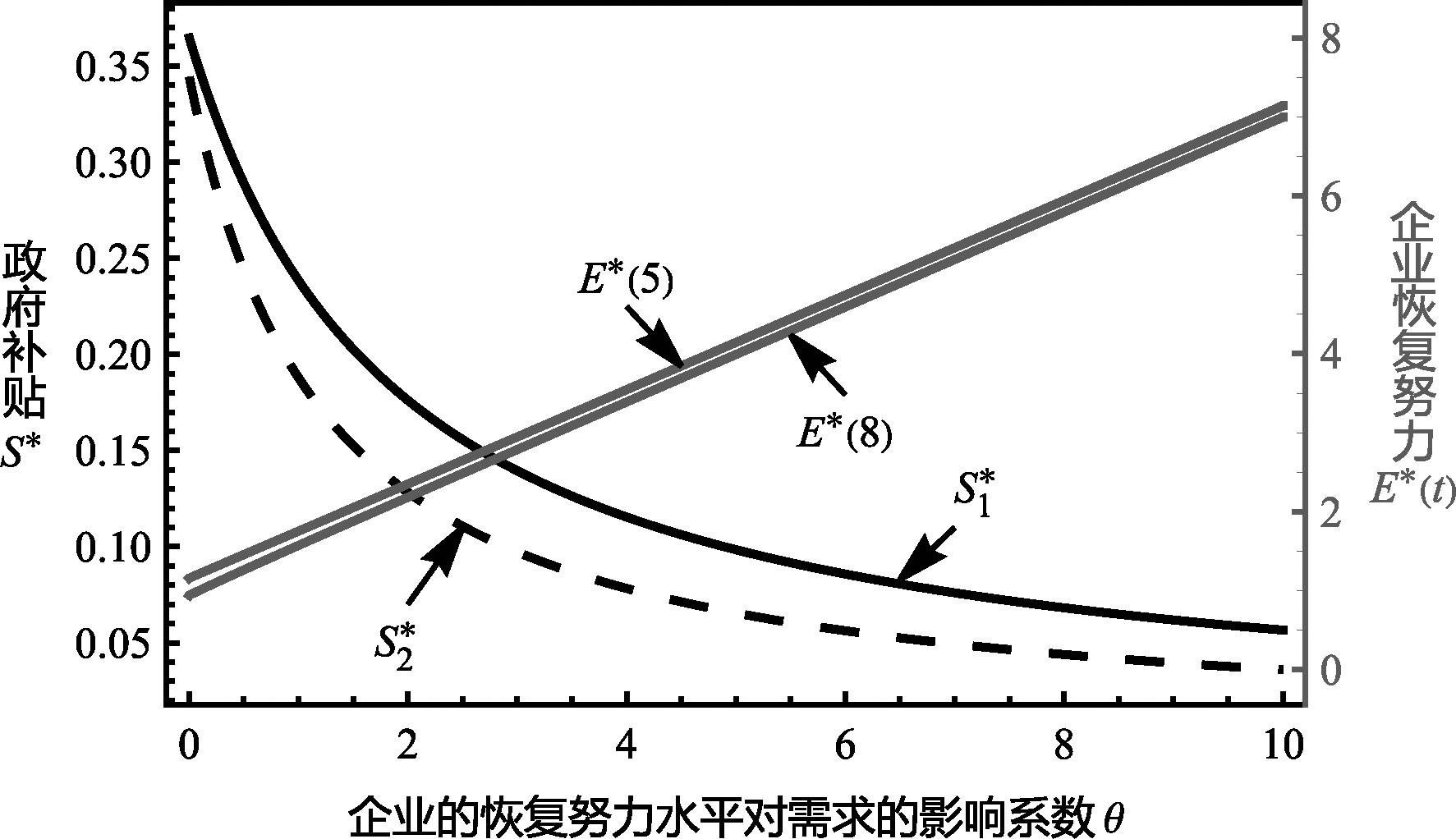
"
"
| 参数 | 取值 | 成本补贴策略 | 价格补贴策略 | ||||
|---|---|---|---|---|---|---|---|
| 0.8 | 312.302 | 309.263 | 621.565 | 312.302 | 417.773 | 730.075 | |
| 1.0 | 314.585 | 311.285 | 625.870 | 314.585 | 408.770 | 723.355 | |
| 1.2 | 317.051 | 313.491 | 630.542 | 317.051 | 402.116 | 719.167 | |
| 0.6 | 318.068 | 314.422 | 632.490 | 318.068 | 399.828 | 717.896 | |
| 0.8 | 314.585 | 311.285 | 625.870 | 314.585 | 408.770 | 723.355 | |
| 1.0 | 312.521 | 309.450 | 621.971 | 312.521 | 416.839 | 729.360 | |
| 2.5 | 336.415 | 331.159 | 667.574 | 336.415 | 388.397 | 724.812 | |
| 3.0 | 345.979 | 340.069 | 686.048 | 345.979 | 391.183 | 737.162 | |
| 3.5 | 356.686 | 350.122 | 706.808 | 356.686 | 396.673 | 753.359 | |
| 0.2 | 311.482 | 310.029 | 621.511 | 311.482 | 358.575 | 670.057 | |
| 0.4 | 314.585 | 311.285 | 625.870 | 314.585 | 408.770 | 723.355 | |
| 0.6 | 318.081 | 312.542 | 630.623 | 318.081 | 459.358 | 777.439 | |
| 0.4 | 208.203 | 205.741 | 413.944 | 208.203 | 302.387 | 510.590 | |
| 0.6 | 314.585 | 311.285 | 625.870 | 314.585 | 408.770 | 723.355 | |
| 0.8 | 422.750 | 418.613 | 841.363 | 422.750 | 516.935 | 939.685 | |
| 0.8 | 312.666 | 309.610 | 622.276 | 312.666 | 416.419 | 729.085 | |
| 1.0 | 314.585 | 311.285 | 625.870 | 314.585 | 408.770 | 723.355 | |
| 1.2 | 316.647 | 313.105 | 629.752 | 316.647 | 402.856 | 719.503 | |
| 0.8 | 318.044 | 313.919 | 631.963 | 318.044 | 412.228 | 730.272 | |
| 1.0 | 314.585 | 311.285 | 625.870 | 314.585 | 408.770 | 723.355 | |
| 1.2 | 312.279 | 309.529 | 621.808 | 312.279 | 406.464 | 718.743 | |
| 5.0 | 156.947 | 155.392 | 312.339 | 156.947 | 207.312 | 364.259 | |
| 10.0 | 314.585 | 311.285 | 625.870 | 314.585 | 408.770 | 723.355 | |
| 15.0 | 472.240 | 467.191 | 939.431 | 472.240 | 610.648 | 1082.888 | |
"
"
"
"
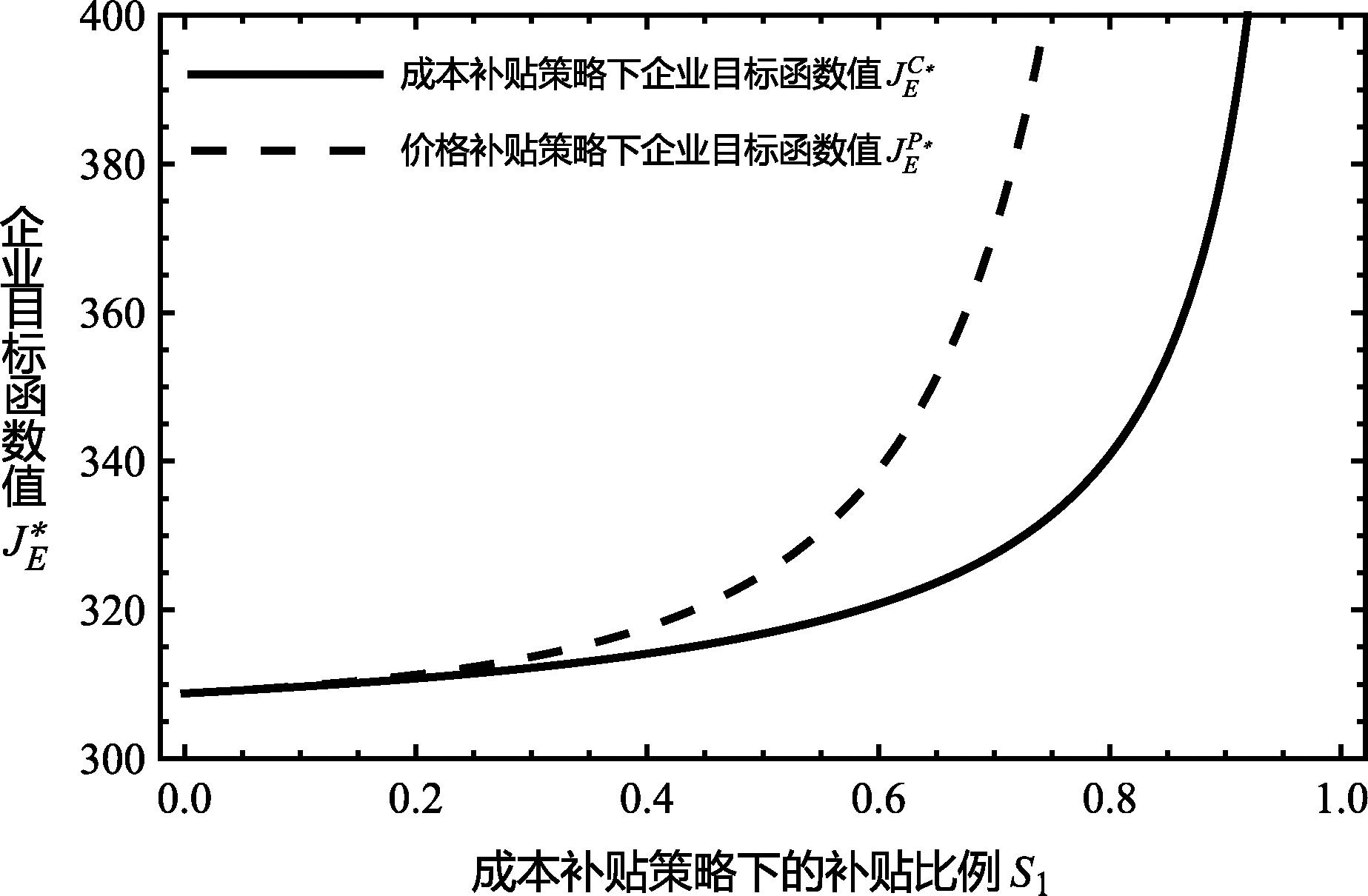
"
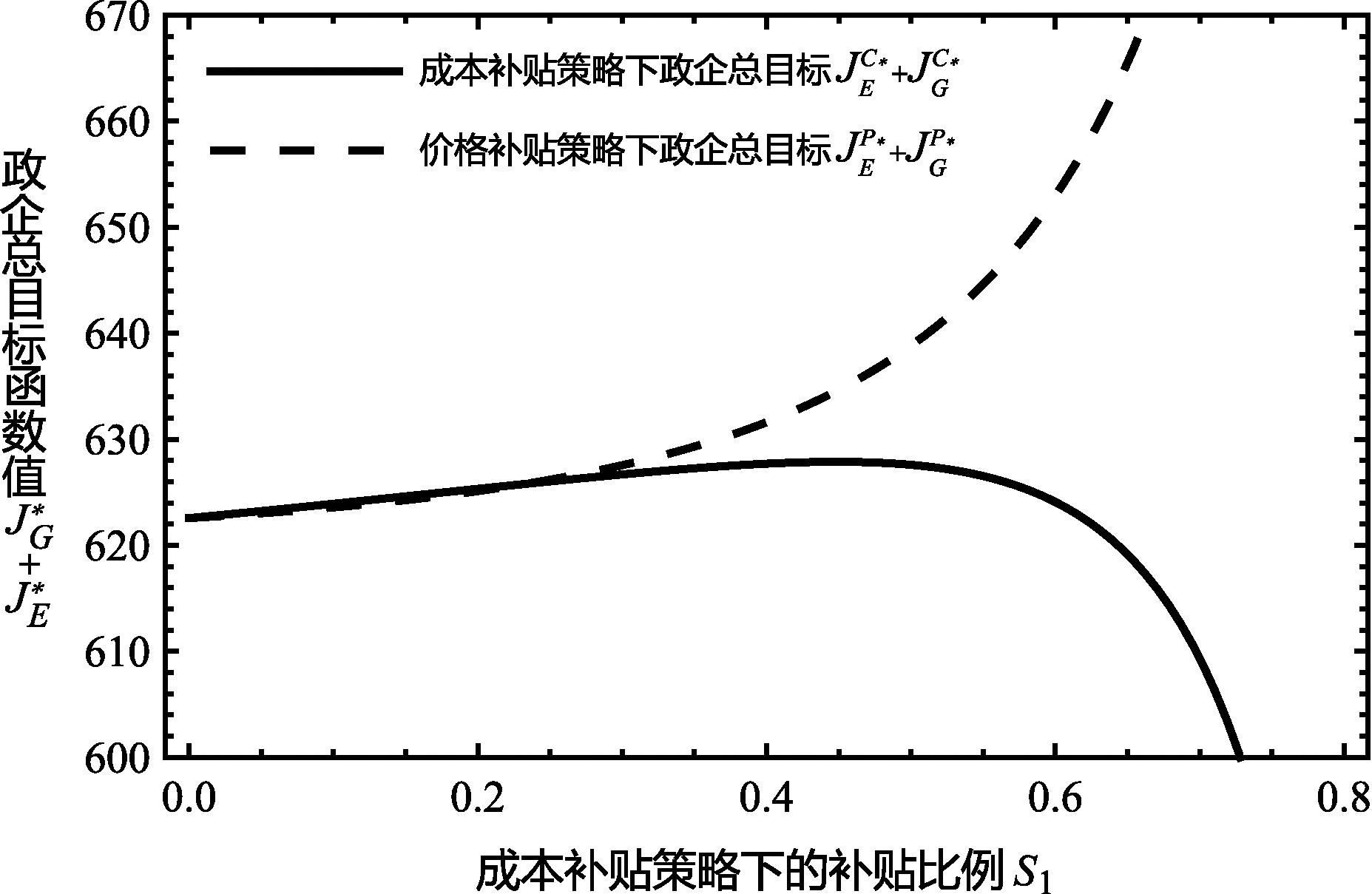
"
| [1] | Azad N, Hassini E. Recovery strategies from major supply disruptions in single and multiple sourcing networks[J]. European Journal of Operational Research, 2019, 275(2): 481-501. |
| [2] | Blackhurst J, Craighead C W, Elkins D, et al. An empirically derived agenda of critical research issues for managing supply-chain disruptions[J]. International Journal of Production Research, 2005, 43(19): 4067-4081. |
| [3] | 刘建新, 范秀成, 杨建华, 等. 大疫无常,有备无患?传染性疾病疫情反复对消费者恐慌性购买的影响研究[J]. 南开管理评论, 2025, 28(6): 112-123. |
| Liu J X, Fan X C, Yang J H, et al. Is preparedness all against the fickleness of the major epidemic? A study on the impact of the repeatability of the epidemic of infectious diseases on consumer’s panic buying[J]. Nankai Business Review, 2025, 28(6): 112-123. | |
| [4] | 郑元瑞, 沈琦. 严重疫情下恐慌性购买的社会心理学分析[J]. 心理月刊, 2020, 15(17): 66-67+70. |
| Zheng Y R, Shen Q. On the analysis of panic buying under severe pandemic conditions from the perspective of social psychology[J]. Psychologies Magazine, 2020, 15(17): 66-67+70. | |
| [5] | Kleindorfer P R, Saad G H. Managing disruption risks in supply chains[J]. Production and Operations Management, 2005, 14(1): 53-68. |
| [6] | 高佳, 荣鹰. 自然灾害对企业价值的实质影响——基于中国上市公司地震公告的事件研究[J]. 管理科学学报, 2022, 25(4): 67-87. |
| Gao J, Rong Y. The real impact of natural disaster on firm value: An event study of earthquake related announcements by Chinese listed firms[J]. Journal of Management Sciences in China, 2022, 25(4): 67-87. | |
| [7] | 彭正银, 楚伯微, 汪爽, 等. 使命驱动、网络联结与资源调配——重大突发事件应急志愿组织高效运作机制研究[J]. 管理科学学报, 2023, 26(11): 102-124. |
| Peng Z Y, Chu B W, Wang S, et al. Mission-drive, network connection and resource allocation: Efficient operation mechanism of emergency volunteer organizations in major emergencies[J]. Journal of Management Sciences in China, 2023, 26(11): 102-124. | |
| [8] | 程建新, 胡定晗, 刘派诚. 重大公共卫生突发事件中企业与政府合作何以可能?——非对称资源依赖条件下的组织间关系动力[J]. 中国行政管理, 2022, 38(3): 136-145. |
| Cheng J X, Hu D H, Liu P C. How is business-government cooperation possible during major public health emergencies? —The dynamics of inter-organizational relationships under the conditions of asymmetric resource dependence[J]. Chinese Public Administration, 2022, 38(3): 136-145. | |
| [9] | 薄洪光, 白思航, 韩鹏, 等. 考虑中断的制造型供应链协调调度模型[J]. 系统管理学报, 2021, 30(6): 1132-1141. |
| Bo H G, Bai S H, Han P, et al. Coordinated scheduling model of manufacturing supply chain considering disruption[J]. Journal of Systems & Management, 2021, 30(6): 1132-1141. | |
| [10] | Li S S, He Y, Minner S. Dynamic compensation and contingent sourcing strategies for supply disruption[J]. International Journal of Production Research, 2021, 59(5): 1511-1533. |
| [11] | 景熠, 刘威, 刘芹芹, 等. 突发事件冲击下应对供应中断的供应链响应计划研究[J]. 中国管理科学, 2025, 33(10): 57-66. |
| Jing Y, Liu W, Liu Q Q, et al. Research on the response planning of supply chain to cope with supply disruption under the impact of emergencies[J]. Chinese Journal of Management Science, 2025, 33(10): 57-66. | |
| [12] | Yoon J, Talluri S, Rosales C. Procurement decisions and information sharing under multi-tier disruption risk in a supply chain[J]. International Journal of Production Research, 2020, 58(5): 1362-1383. |
| [13] | 曹晓刚, 吴惠, 闻卉. 广告效应扰动下的闭环供应链应急与协调决策[J]. 管理科学学报, 2022, 25(3): 107-126. |
| Cao X G, Wu H, Wen H. Closed-loop supply chain emergency and coordination decisions under advertising effect disturbance[J]. Journal of Management Sciences in China, 2022, 25(3): 107-126. | |
| [14] | Qi X T, Bard J F, Yu G. Supply chain coordination with demand disruptions[J]. Omega, 2004, 32(4): 301-312. |
| [15] | Xia Y, Yang M H, Golany B, et al. Real-time disruption management in a two-stage production and inventory system[J]. IIE Transactions, 2004, 36(2): 111-125. |
| [16] | Paul S K, Sarker R, Essam D, et al. A mathematical modelling approach for managing sudden disturbances in a three-tier manufacturing supply chain[J]. Annals of Operations Research, 2019, 280(1-2): 299-335. |
| [17] | 赵琳, 牟宗玉. 需求扰动下生产规模不经济闭环供应链的应急渠道决策[J]. 中国管理科学, 2019, 27(7): 68-82. |
| Zhao L, Mu Z Y. Emergency channel decisions of closed-loop supply chain with production diseconomies under demand disruptions[J]. Chinese Journal of Management Science, 2019, 27(7): 68-82. | |
| [18] | 舒斯亮, 柳键. 需求扰动下物流服务商参与的不同权力结构产品供应链应急决策[J]. 系统工程, 2022, 40(3): 107-116. |
| Shu S L, Liu J. Emergency decision of product supply chain with different power structures involving logistics service provider under demand disruption[J]. Systems Engineering, 2022, 40(3): 107-116. | |
| [19] | 赵黎明, 李聪, 郭祥. 考虑参考价格效应的政企救灾动态协调策略[J]. 系统科学与数学, 2018, 38(1): 37-56. |
| Zhao L M, Li C, Guo X. Dynamic coordination relief strategy between government and enterprises with reference price effect[J]. Journal of Systems Science and Mathematical Sciences, 2018, 38(1): 37-56. | |
| [20] | 孟庆春, 朱子怡, 谢磊, 等. 考虑参考价格效应的中断供应链动态恢复策略[J]. 系统工程理论与实践, 2024, 44(4): 1268-1281. |
| Meng Q C, Zhu Z Y, Xie L, et al. Dynamic recovery strategy for disrupted supply chain under reference price effect[J]. Systems Engineering-Theory & Practice, 2024, 44(4): 1268-1281. | |
| [21] | 王永明, 郑姗姗. 地方政府应急管理效能提升的多重困境与优化路径——基于“河南郑州‘7·20’特大暴雨灾害”的案例分析[J].管理世界,2023,39(3): 83-96. |
| Wang Y M, Zheng S S. Multiple dilemmas and optimization path for improving the efficiency of local government emergency management: Case analysis based on Henan Zhengzhou torrential rain-caused disaster on July 20[J]. Journal of Management World, 2023, 39(3): 83-96. | |
| [22] | 杨曼, 刘德海. 政府主导下应急医疗物资多元化供给的随机微分博弈模型[J]. 系统工程理论与实践, 2023, 43(5): 1333-1349. |
| Yang M, Liu D H. Stochastic differential game model of diversified supply of emergency medical supplies led by government[J]. Systems Engineering-Theory & Practice, 2023, 43(5): 1333-1349. | |
| [23] | Kazaz B, Webster S, Yadav P. Interventions for an artemisinin-based malaria medicine supply chain[J]. Production and Operations Management, 2016, 25(9): 1576-1600. |
| [24] | Guo Y, Yu X, Zhou C, et al. Government subsidies for preventing supply disruption when the supplier has an outside option under competition[J]. Transportation Research Part E: Logistics and Transportation Review, 2021, 147: 102218. |
| [25] | 陶俐言, 孙洪达, 曹怡恒, 等. 供应链中断情境下考虑政府补贴的恢复策略[J]. 计算机集成制造系统, 2022, 28(1): 242-257. |
| Tao L Y, Sun H D, Cao Y H, et al. Recovery strategies considering government subsidies in the circumstances of supply chain interruption[J]. Computer Integrated Manufacturing Systems,2022,28(1): 242-257. | |
| [26] | 雷婷, 但斌, 刘墨林, 等. 考虑政府补贴的生鲜批发市场应急代储策略[J]. 系统工程理论与实践, 2023, 43(2): 455-468. |
| Lei T, Dan B, Liu M L, et al. Agent reserve strategy in a fresh produce wholesale market with the government subsidy under emergencies[J]. Systems Engineering —Theory & Practice, 2023, 43(2): 455-468. | |
| [27] | 扈衷权, 郭珂欣, 徐金鹏, 等. 协议企业储备模式下应急物资储备策略及供应链协调研究[J]. 系统工程理论与实践, 2024, 44(5): 1589-1602. |
| Hu Z Q, Guo K X, Xu J P, et al. Research on emergency material reserve strategy and supply chain coordination under agreement enterprise reserve model[J]. Systems Engineering —Theory & Practice, 2024, 44(5): 1589-1602. | |
| [28] | 樊彧, 邵建芳, 王熹徽. 基于匮乏成本的应急物资政企合作储备与运输策略研究[J]. 系统工程理论与实践, 2024, 44(5): 1603-1614. |
| Fan Y, Shao J F, Wang X H. A study of strategies on joint inventory and delivery of emergency supplies between the local authority and the suppliers based on deprivation cost[J]. Systems Engineering —Theory & Practice, 2024, 44(5): 1603-1614. | |
| [29] | 何洪阳, 张彬, 田苏俊. 平台经济政企协同治理的演化博弈分析——考虑随机扰动与连续策略的影响[J]. 中国管理科学, 2025, 33(5): 76-87. |
| He H Y, Zhang B, Tian S J. Evolutionary game analysis of government-enterprise collaborative governance in platform economy: Considering the effect of stochastic perturbations and continuous strategies[J]. Chinese Journal of Management Science, 2025, 33(5): 76-87. | |
| [30] | Zhang J, Lei L, Zhang S, et al. Dynamic vs. static pricing in a supply chain with advertising[J]. Computers & Industrial Engineering, 2017, 109: 266-279. |
| [31] | 朱桂菊, 游达明, 黄福华, 等. 参考价格效应下食品供应链溯源投入的微分博弈分析[J]. 系统工程, 2020, 38(1): 55-65. |
| Zhu G J, You D M, Huang F H, et al. Differential game analysis of traceability input in the food supply chain with reference price effect[J]. Systems Engineering, 2020, 38(1): 55-65. | |
| [32] | Zhang J, Gou Q L, Liang L, et al. Supply chain coordination through cooperative advertising with reference price effect[J]. Omega, 2013, 41(2): 345-353. |
| [33] | 赵黎明, 李聪, 郭祥. 基于微分博弈的政企救灾合作策略研究[J]. 系统工程理论与实践, 2018, 38(4): 885-898. |
| Zhao L M, Li C, Guo X. Research of cooperative relief strategy between government and enterprise based on differential game[J]. Systems Engineering —Theory & Practice, 2018, 38(4): 885-898. | |
| [34] | 杨曼, 刘德海. 物理-社会耦合系统下震后多方协同救援的微分博弈模型[J]. 中国管理科学, 2024, 32(1): 115-124. |
| Yang M, Liu D H. Differential game model of multi-party cooperative rescue after earthquake in physical-social coupling system[J]. Chinese Journal of Management Science, 2024, 32(1): 115-124. | |
| [35] | 宋晓彤, 张桂涛, 张晓彤. 考虑随机干扰的政企救灾协同策略研究[J]. 数学的实践与认识, 2020, 50(14): 135-146. |
| Song X T, Zhang G T, Zhang X T. A study on government-enterprise disaster relief coordination strategy considering random interference[J]. Mathematics in Practice and Theory, 2020, 50(14): 135-146. |
| [1] | Huali Sun, Chenxin Ma, Junge Zhang. Research on Response Strategy Considering Low-interest Loans and Business Interruption Insurance under the Supply Disruption Risk [J]. Chinese Journal of Management Science, 2026, 34(5): 342-350. |
| [2] | Haonan Xu, Jiaguo Liu. Research on OEM/ODM Supply Chain Decision Making Considering Supply Risk [J]. Chinese Journal of Management Science, 2026, 34(4): 276-286. |
| [3] | Yi Jing, Qinqin Liu, Lin Zhou. Research on the Manufacturer's Procurement Strategy Considering Supply Disruption Risk and Consumer Preference under the Impact of Sudden Events [J]. Chinese Journal of Management Science, 2026, 34(3): 93-103. |
| [4] | Ying Feng, Suyu Chen, Min Wei, Yanzhi Zhang. Optimal Gray Market Structure and Pricing Decisions Considering Reference Price effect [J]. Chinese Journal of Management Science, 2026, 34(2): 239-249. |
| [5] | Lei Zhu, Yaofeng Cui, Jiarui Wang, Jiahao Wu. Dynamic Optimization Model for Renewable Resource Development: An Example of Onshore Wind [J]. Chinese Journal of Management Science, 2025, 33(11): 336-344. |
| [6] | Jizi Li, Guopan Zhang, Chunling Liu, Biao Sun, Yong Wang. Optimal Control Analysis of New Energy Vehicle Firms Based on Low-Carbon & Intelligent Based Advertisement [J]. Chinese Journal of Management Science, 2025, 33(10): 159-165. |
| [7] | Yi Jing, Wei Liu, Qinqin Liu, Fengjiao Cheng, Huarong Zhang. Research on the Response Planning of Supply Chain to Cope with Supply Disruption under the Impact of Emergencies [J]. Chinese Journal of Management Science, 2025, 33(10): 57-66. |
| [8] | Yanfen Zhang,Qi Xu,Zhongmiao Sun. Dynamics of Contract Design for Platform Supply Chain with Competing Suppliers under Moral Hazard [J]. Chinese Journal of Management Science, 2024, 32(9): 160-170. |
| [9] | Lean Yu,Danping Wang,Nengmin Zeng. Supply-Chain Reconfiguration Strategy under the Risk of Emergencies [J]. Chinese Journal of Management Science, 2024, 32(9): 93-100. |
| [10] | Ying Feng,Min Wei,Wenhao He,Yanzhi Zhang. Price Decision-making in a Gray Market Supply Chain Considering Reference Price Effect under Quality Information Asymmetric [J]. Chinese Journal of Management Science, 2024, 32(6): 207-218. |
| [11] | Daoping Wang,Ke Zhang,Yu Zhou. Differential Game of Closed-Loop Supply Chain with Dynamic Stochastic Recovery Rate under Reward-penalty Mechanism of Government [J]. Chinese Journal of Management Science, 2024, 32(5): 158-170. |
| [12] | Zhongmiao Sun,Qi Xu,Yanfen Zhang. Dynamic Incentive Contract of On-Demand Service Platform with Different Types of Agents under Asymmetric Information [J]. Chinese Journal of Management Science, 2024, 32(5): 241-253. |
| [13] | CHENG Chang-gao, ZHOU Hai-wei, TANG Yan, MA Jun, SHI Yan-qiu. The Importance of Horizontal Ecological Compensation for River Basin Environmental Governance: A Study Based on the Perspective of Central Local Collaboration [J]. Chinese Journal of Management Science, 2023, 31(9): 278-286. |
| [14] | CHEN Xiao-hong, ZHOU Ming-hui, TANG Xiang-bo. Research on the Optimal Control Strategy for Pollution Reduction in Winter under the Constraints of Urban Air Quality Targets [J]. Chinese Journal of Management Science, 2023, 31(3): 1-9. |
| [15] | WANG Wei-hao, MA De-qing, HU Jin-song. Optimal Dynamic Advertising Strategies with Presence of Probable Product-Harm Crisis [J]. Chinese Journal of Management Science, 2022, 30(2): 204-216. |
| Viewed | ||||||
|
Full text |
|
|||||
|
Abstract |
|
|||||
|
||
