
主管:中国科学院
主办:中国优选法统筹法与经济数学研究会
中国科学院科技战略咨询研究院
主办:中国优选法统筹法与经济数学研究会
中国科学院科技战略咨询研究院

Chinese Journal of Management Science ›› 2026, Vol. 34 ›› Issue (11): 99-107.doi: 10.16381/j.cnki.issn1003-207x.2023.1332
Previous Articles Next Articles
Xi Xiong1, Guoliang Yang2,3, Dequn Zhou1, Zhongcheng Guan2,3( )
Received:2023-08-16
Revised:2024-04-04
Online:2026-11-25
Published:2026-11-10
Contact:
Zhongcheng Guan
E-mail:guan@casisd.cn
CLC Number:
Xi Xiong,Guoliang Yang,Dequn Zhou, et al. Research on Incentive Allocation of Inputs in Multi-centralized Organizations Considering the Degree of Decision-making Autonomy:Reallocation of Scientific and Technological Inputs in Higher Education Institutions[J]. Chinese Journal of Management Science, 2026, 34(11): 99-107.
"
"


"
中心化 系统 | 权力下放程度(K=2) | DMU聚类 | 效率得分 | 效率≥1 | |||
|---|---|---|---|---|---|---|---|
| 25%分位数 | 50%分位数 | 75%分位数 | 均值 | ||||
| 部属系统 | 集群a1 | MU1、MU2、MU3、MU8、MU9 | 0.6437 | 0.7935 | 1.0000 | 0.8058 | 2/5 |
| 集群a2 | MU4、MU5、MU6、MU7、MU10 | 0.6050 | 1.0000 | 1.0000 | 0.8048 | 3/5 | |
| 省属系统 | 集群b1 | PU9、PU10、PU12、PU14、PU16 | 0.2088 | 0.6920 | 0.7460 | 0.5687 | 1/5 |
| 集群b2 | PU1、PU2、PU3、PU4、PU5、PU6、PU7、PU8、PU11、PU13、PU15 | 0.5396 | 0.6338 | 0.9044 | 0.6846 | 2/11 | |
"
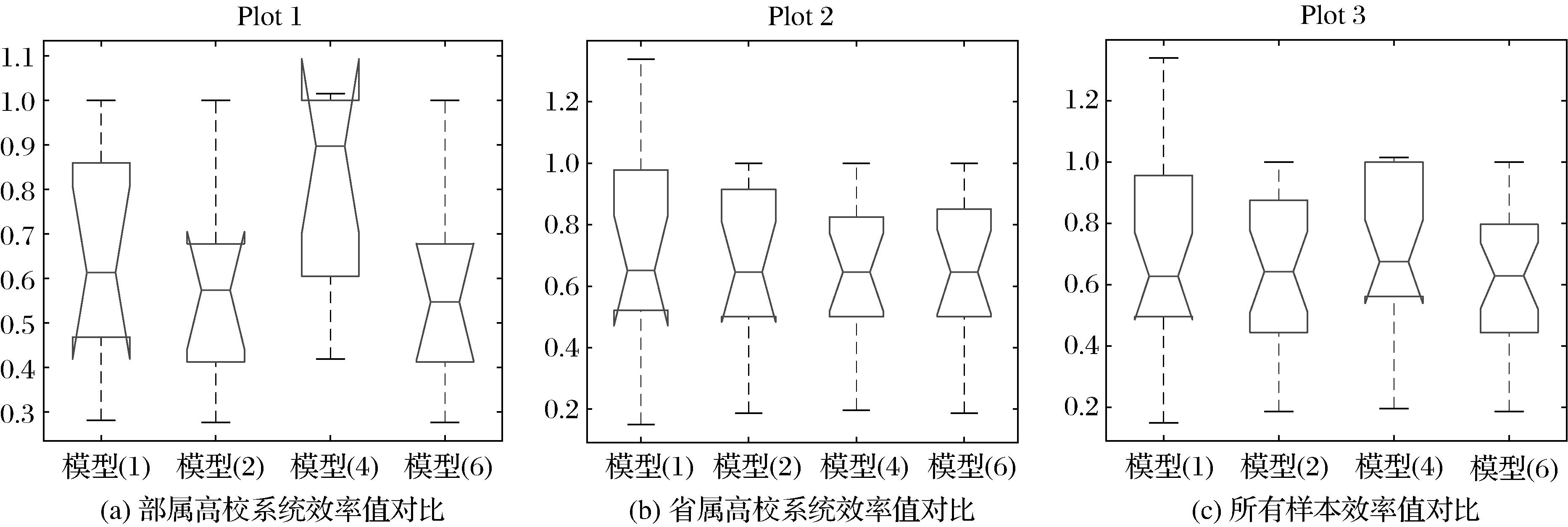
| DMU | 传统DEA-LP 模型(1) | 单一中心化系统 模型(2) | 多中心化系统 模型(4) | 多中心化系统 模型(6) |
|---|---|---|---|---|
| MU1 | 0.4680 | 0.3445 | 0.5767 | 0.3445 |
| MU2 | 0.5510 | 0.4377 | 0.6437 | 0.4220 |
| MU3 | 0.8595 | 0.6521 | 1.0149 | 0.5996 |
| MU4 | 0.6145 | 0.6761 | 1.0003 | 0.6761 |
| MU5 | 0.9663 | 0.8751 | 1.0000 | 0.8136 |
| MU6 | 1.0000 | 1.0000 | 1.0000 | 1.0000 |
| MU7 | 0.2808 | 0.2761 | 0.4185 | 0.2761 |
| MU8 | 0.6115 | 0.4939 | 0.7935 | 0.4939 |
| MU9 | 0.6444 | 0.6776 | 1.0000 | 0.6776 |
| MU10 | 0.3650 | 0.4121 | 0.6050 | 0.4121 |
| PU1 | 0.5462 | 0.4446 | 0.4446 | 0.4446 |
| PU2 | 1.0000 | 1.0000 | 1.0000 | 1.0000 |
| PU3 | 1.0479 | 1.0000 | 1.0000 | 1.0000 |
| PU4 | 0.6258 | 0.7229 | 0.7229 | 0.7229 |
| PU5 | 1.0893 | 0.9250 | 0.6039 | 0.7967 |
| PU6 | 0.9558 | 0.9044 | 0.9044 | 0.9044 |
| PU7 | 0.6299 | 0.6576 | 0.6576 | 0.6576 |
| PU8 | 0.6715 | 0.5396 | 0.5396 | 0.5396 |
| PU9 | 1.3389 | 1.0000 | 1.0000 | 1.0000 |
| PU10 | 0.5806 | 0.6048 | 0.7460 | 0.6048 |
| PU11 | 0.8746 | 0.7302 | 0.5618 | 0.7115 |
| PU12 | 0.2134 | 0.1881 | 0.2088 | 0.1881 |
| PU13 | 0.4142 | 0.4622 | 0.4622 | 0.4622 |
| PU14 | 0.1501 | 0.1868 | 0.1966 | 0.1868 |
| PU15 | 0.8034 | 0.6338 | 0.6338 | 0.6338 |
| PU16 | 0.4963 | 0.6250 | 0.6920 | 0.6250 |
| 均值 | 0.6846 | 0.6335 | 0.7087 | 0.6228 |
| 部属高校系统均值 | 0.6361 | 0.5845 | 0.8053 | 0.5716 |
| 省属高校系统均值 | 0.7149 | 0.6641 | 0.6484 | 0.6549 |

"
"
| DMU | 原始科技投入 | 分配后科技投入 | 调整方向 |
|---|---|---|---|
| MU1 | 92451.47 | 53315.72 | -39135.75 |
| MU2 | 44583.62 | 28697.87 | -15885.75 |
| MU3 | 18333.39 | 18606.59 | 273.20 |
| MU4 | 9657.79 | 9660.90 | 3.11 |
| MU5 | 30706.47 | 30706.47 | 0.00 |
| MU6 | 50467.01 | 50467.01 | 0.00 |
| MU7 | 80792.31 | 33813.68 | -46978.63 |
| MU8 | 50341.63 | 39947.55 | -10394.08 |
| MU9 | 20857.73 | 20857.73 | 0.00 |
| MU10 | 6463.67 | 3910.75 | -2552.93 |
| PU1 | 66858.19 | 29724.31 | -37133.88 |
| PU2 | 10224.70 | 10224.70 | 0.00 |
| PU3 | 10338.55 | 10338.55 | 0.00 |
| PU4 | 20183.02 | 14591.14 | -5591.88 |
| PU5 | 27808.00 | 16794.07 | -11013.93 |
| PU6 | 8752.96 | 7916.32 | -836.64 |
| PU7 | 24633.68 | 16198.87 | -8434.81 |
| PU8 | 27742.57 | 14970.70 | -12771.87 |
| PU9 | 13638.35 | 13638.35 | 0.00 |
| PU10 | 8744.65 | 6523.72 | -2220.93 |
| PU11 | 43630.04 | 24510.39 | -19119.65 |
| PU12 | 133428.44 | 27861.34 | -105567.10 |
| PU13 | 49449.60 | 22854.52 | -26595.08 |
| PU14 | 34293.18 | 6743.11 | -27550.07 |
| PU15 | 33204.17 | 21045.24 | -12158.93 |
| PU16 | 2425.00 | 1678.05 | -746.95 |
| 总计 | 920010.20 | 535597.67 | -384412.54 |
| 均值 | 35385.01 | 20599.91 | -14785.10 |
"
| 分配结果 | 整体系统 | 部属高校系统 | 省属高校系统 | |||
|---|---|---|---|---|---|---|
| 均值 | 25%分位数 | 50%分位数 | 75%分位数 | |||
| 成本补偿(Eff>1)/% | 0.17 | 0.00 | 0.00 | 0.02 | 0.21 | 0.00 |
| 成本节约(Eff<1) /% | -50.09 | -53.78 | -39.55 | -30.80 | -41.85 | -56.06 |
"
| 所属系统 | 变量 | 自主权下放程度 | |||
|---|---|---|---|---|---|
| 部属高校系统 | Eff>1 | 1(10.00%) | 5(50.00%) | 5(50.00%) | 5(50.00%) |
| 效率均值 | 0.6361 | 0.8053 | 0.8038 | 0.8036 | |
| 省属高校系统 | Eff>1 | 3(18.75%) | 3(18.75%) | —— | —— |
| 效率均值 | 0.6724 | 0.6484 | —— | —— | |
| [1] | 李艺萌. 目标困难度、灵活度和企业绩效的关系研究[D]. 西安: 西安科技大学, 2021. |
| Li Y M. Target difficulty, target flexibility, and firm performance [D]. Xi’an: Xi’an University of Science and Technology, 2021. | |
| [2] | Cook W D, Ramón N, Ruiz J L, et al. DEA-based benchmarking for performance evaluation in pay-for-performance incentive plans[J]. Omega, 2019, 84: 45-54. |
| [3] | Golany B. An interactive MOLP procedure for the extension of DEA to effectiveness analysis[J]. Journal of the Operational Research Society, 1988, 39(8): 725-734. |
| [4] | Lozano S, Villa G. Centralized resource allocation using data envelopment analysis[J]. Journal of Productivity Analysis, 2004, 22(1): 143-161. |
| [5] | Yadollahi A H, Ebrahimnejad A, Kazemi Matin R. Centralized resource reallocation in two-stage network structures with undesirable products[J]. Computational and Applied Mathematics, 2022, 41(6): 228. |
| [6] | Yang J, Li Y, Fang L. Financing capacity planning with environmental considerations: A non-parametric analysis[J]. Omega, 2023, 118: 102866. |
| [7] | 张倩伟,刘一博,王新宇.基于新型交叉效率的资源分配机制[J].系统工程理论与实践,2024,44 (5) : 1522-1533. |
| Zhang Q W, Liu Y B, Wang X Y. A resource allocation mechanism based on novel cross-efficiency[J]. Systems Engineering-Theory & Practice, 2024,44 (5) : 1522-1533 | |
| [8] | Lozano S, Contreras I. Centralised resource allocation using lexicographic goal programming. Application to the spanish public university system[J]. Socio-Economic Planning Sciences, 2022, 84: 101419. |
| [9] | Afsharian M, Ahn H, Thanassoulis E. A DEA-based incentives system for centrally managed multi-unit organisations[J]. European Journal of Operational Research, 2017, 259(2): 587-598. |
| [10] | Jahanshahloo G R, Memariani A, Lotfi F H, et al. A note on some of DEA models and finding efficiency and complete ranking using common set of weights[J]. Applied Mathematics and Computation, 2005, 166(2): 265-281. |
| [11] | Saati S, Hatami-Marbini A, Agrell P J, et al. A common set of weight approach using an ideal decision making unit in data envelopment analysis[J]. Journal of Industrial and Management Optimization, 2012, 8(3): 623-637. |
| [12] | 孙雪莲, 郭良栋. 改进的公共权重的区间DEA效率评价[J]. 数学的实践与认识, 2023, 53(10): 106-115. |
| Sun X L, Guo L D. Improved public weights for interval DEA efficiency evaluation[J]. Mathematics in Practice and Theory, 2023, 53(10): 106-115. | |
| [13] | Ji Z, Wu X, Guo J, et al. Goal-oriented common benchmarking based on global and stepwise reallocation: An application to 18 ports in Korea[J]. Expert Systems with Applications, 2024, 240: 122462. |
| [14] | Beasley J E. Allocating fixed costs and resources via data envelopment analysis[J]. European Journal of Operational Research, 2003, 147(1): 198-216. |
| [15] | Kao C, Hung H T. Data envelopment analysis with common weights: The compromise solution approach[J]. Journal of the Operational Research Society, 2005, 56(10): 1196-1203. |
| [16] | Bogetoft P. DEA-based yardstick competition: The optimality of best practice regulation[J]. Annals of Operations Research, 1997, 73: 277-298. |
| [17] | Varmaz A, Varwig A, Poddig T. Centralized resource planning and Yardstick competition[J]. Omega- The International Journal of Management Science, 2013, 41(1): 112-118. |
| [18] | Afsharian M, Ahn H, Thanassoulis E. A DEA-based incentives system for centrally managed multi-unit organisations[J]. European Journal of Operational Research, 2017, 259(2): 587-598. |
| [19] | Fang L. An incentive approach based on data envelopment analysis for intra-organization yardstick competition[J]. Journal of the Operational Research Society, 2020, 71(1): 153-160. |
| [20] | Chao S L, Yu M M. Applying data envelopment analysis to allocate incentive bonuses for container terminal operators[J]. Transport Policy, 2022, 125: 231-240. |
| [21] | Thanassoulis E. A data envelopment analysis approach to clustering operating units for resource allocation purposes[J]. Omega-The International Journal of Management Science, 1996, 24(4): 463-476. |
| [22] | Afsharian M, Ahn H, Thanassoulis E. A frontier-based system of incentives for units in organisations with varying degrees of decentralisation[J]. European Journal of Operational Research, 2019, 275(1): 224-237. |
| [23] | Dai Q Z, Li Y J, Lei X Y, et al. A DEA-based incentive approach for allocating common revenues or fixed costs[J]. European Journal of Operational Research, 2021, 292(2): 675-686. |
| [24] | O’Donnell C J, Prasada Rao D S, Battese G E. Metafrontier frameworks for the study of firm-level efficiencies and technology ratios[J]. Empirical Economics, 2008, 34(2): 231-255. |
| [25] | Zhang N, Kong F, Yu Y. Measuring ecological total-factor energy efficiency incorporating regional heterogeneities in China[J]. Ecological Indicators, 2015, 51: 165-172. |
| [26] | Wang X, Hu H. Sustainability in Chinese higher educational institutions’ social science research: A performance interface toward efficiency[J]. Sustainability, 2017, 9(11): 1952. |
| [27] | 苗玉宁, 杨冬英. 基于综合评价方法的中部地区科技资源配置效率分析[J]. 中国软科学, 2020(3): 134-149. |
| Miao Y N, Yang D Y. Analysis on the efficiency of allocation of scientific and technological resources in central China based on the comprehensive evaluation method[J]. China Soft Science, 2020(3): 134-149. | |
| [28] | 李康, 范跃进. “双一流”目标下一流大学科研效率评价[J]. 科研管理, 2022, 43(9): 41-47. |
| Li K, Fan Y J. An evaluation of the scientific research efficiency of first-class universities under the goal of construction of “double first-class university”[J]. Science Research Management, 2022, 43(9): 41-47. | |
| [29] | 杨敏, 费锡玥, 魏宇琪, 等. 基于资源共享与子系统交互的两阶段DEA评价方法——兼对我国“一流大学”科研绩效的评价[J]. 中国管理科学, 2022, 30(2): 256-263. |
| Yang M, Fei X Y, Wei Y Q, et al. Two-stage DEA evaluation method based on resource sharing and subsystem interaction—Evaluation of scientific research performance for “first-class” universities in China[J]. Chinese Journal of Management Science, 2022, 30(2): 256-263. | |
| [30] | 周文泳, 金为开, 柏方云. 研究型大学科研效率分类评价[J]. 科研管理, 2018, 39(S1): 44-51. |
| Zhou W Y, Jin W K, Bai F Y. A classified evaluation of scientific research efficiency of research oriented universities[J]. Science Research Management, 2018, 39(S1): 44-51. | |
| [31] | Xiong X, Yang G L, Guan Z C. Estimating the multi-period efficiency of high-tech research institutes of the Chinese academy of sciences: A dynamic slacks-based measure[J]. Socio-Economic Planning Sciences, 2020, 71: 100855. |
| Viewed | ||||||
|
Full text |
|
|||||
|
Abstract |
|
|||||
|
||
