
主管:中国科学院
主办:中国优选法统筹法与经济数学研究会
中国科学院科技战略咨询研究院
主办:中国优选法统筹法与经济数学研究会
中国科学院科技战略咨询研究院

中国管理科学 ›› 2026, Vol. 34 ›› Issue (8): 195-209.doi: 10.16381/j.cnki.issn1003-207x.2024.1677cstr: 32146.14.j.cnki.issn1003-207x.2024.1677
张名扬1,2, 邓岚3( ), 张菊亮4, 郭健涛5
收稿日期:2024-09-20
修回日期:2025-10-25
出版日期:2026-08-25
发布日期:2026-07-14
通讯作者:
邓岚
E-mail:landeng@bjtu.edu.cn
基金资助:
Mingyang Zhang1,2, Lan Deng3(), Juliang Zhang4, Jiantao Guo5
Received:2024-09-20
Revised:2025-10-25
Online:2026-08-25
Published:2026-07-14
Contact:
Lan Deng
E-mail:landeng@bjtu.edu.cn
摘要:
随着数字经济的蓬勃发展及消费者对个性化的不断追求,市场需求不确定性日益增加。为帮助零售商优化库存管理和定价策略,本文分析了应对这一挑战的三种模式:概率销售、快速响应及二者结合的联合模式。概率销售模式指零售商将正常销售的商品组合为概率产品,以较低价格为消费者提供其中一种商品。快速响应模式是在零售商观察到市场需求后,快速为缺货商品进行补货。本文构建了零售商在两阶段销售商品的模型,分别探讨了在传统市场和策略型消费者市场中,不同销售模式对零售商决策(如订货量和定价)及利润的影响。首先,对比了三种模式在不同市场环境下的表现。其次,分析了策略型消费者对零售商最优策略的影响。研究结果显示,在多数情况下,概率销售及联合模式为零售商带来的利润优于快速响应模式。当快速响应订货成本较低且正常订货成本较高时,联合模式的表现更优越;否则,概率销售模式更优。此外,在高快速响应订货成本下,随着市场需求的不确定性增强,概率销售模式的利润优势会扩大。
中图分类号:
张名扬,邓岚,张菊亮, 等. 需求不确定性下概率销售与快速响应模式对比[J]. 中国管理科学, 2026, 34(8): 195-209.
Mingyang Zhang,Lan Deng,Juliang Zhang, et al. Comparison of Probabilistic Sales and Quick Response under Demand Uncertainty[J]. Chinese Journal of Management Science, 2026, 34(8): 195-209.
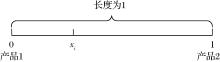
图1
消费者在Hotelling线上的位置"
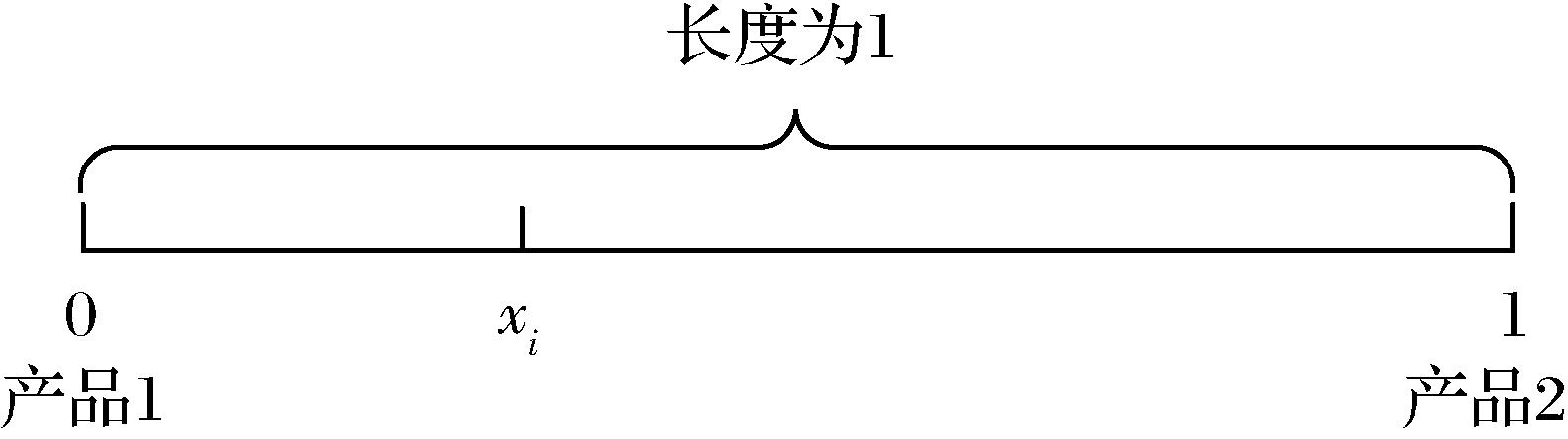

表1
符号和变量说明"
| 符号 | 变量说明 | |
|---|---|---|
| 产品j的正常订货单位成本, | ||
| 产品j的订货量, | ||
| 第一阶段的销售价格, | ||
| 消费者i在Hotelling线上的位置 | ||
| 消费者i对产品j的估值 | ||
| 产品j的需求 | ||
| 潜在消费者总人数 | ||
| 第二阶段概率产品的价格 | ||
| 零售商的最优定价 | ||
| 零售商的最优订货量 | ||
| 零售商的最优利润 | ||
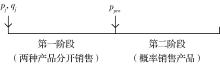
图2
零售商采用概率销售模式时的事件发生顺序"
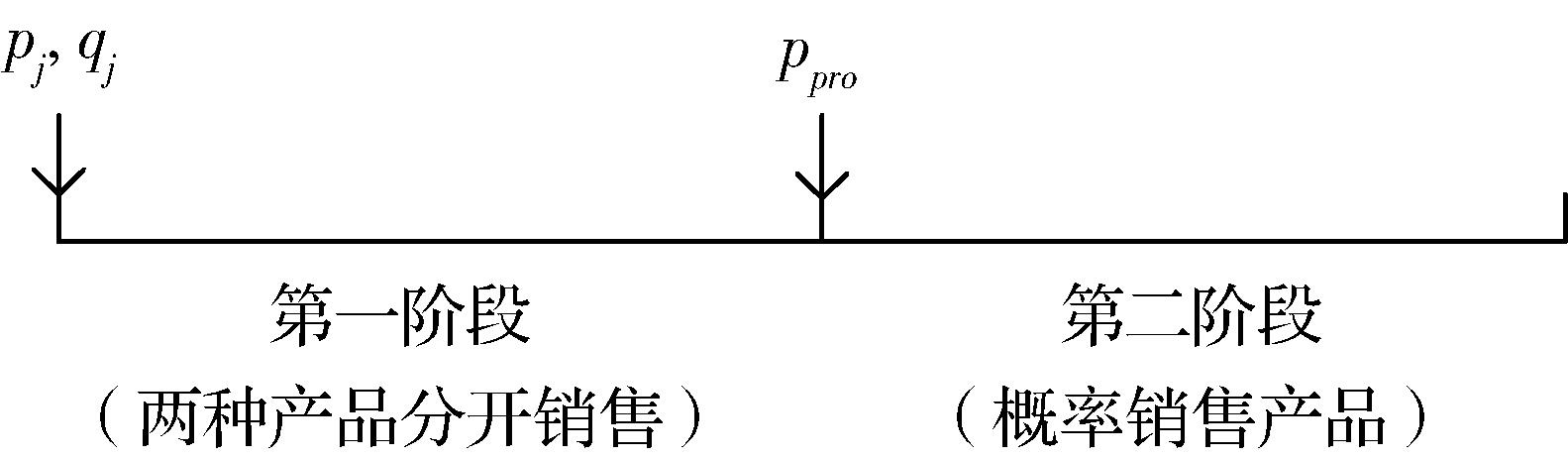
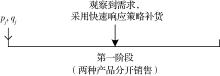
图3
零售商采用快速响应模式时的事件发生顺序"
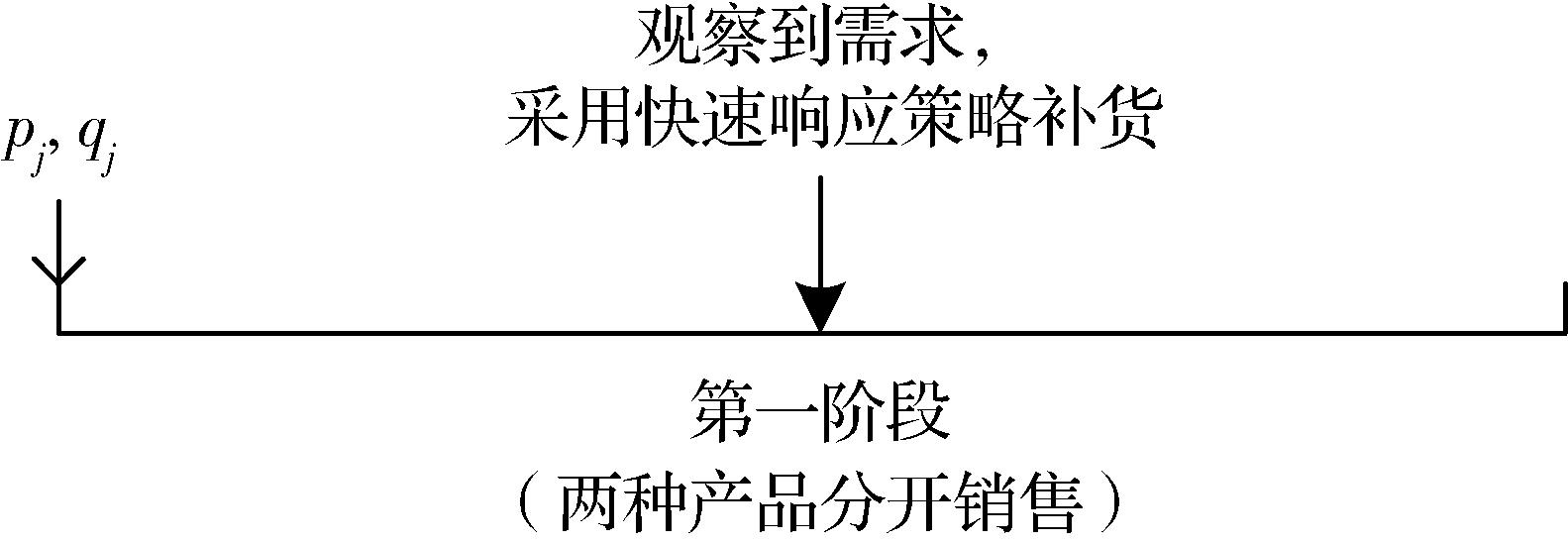
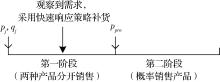
图4
零售商采用概率销售和快速响应联合策略时的事件发生顺序"
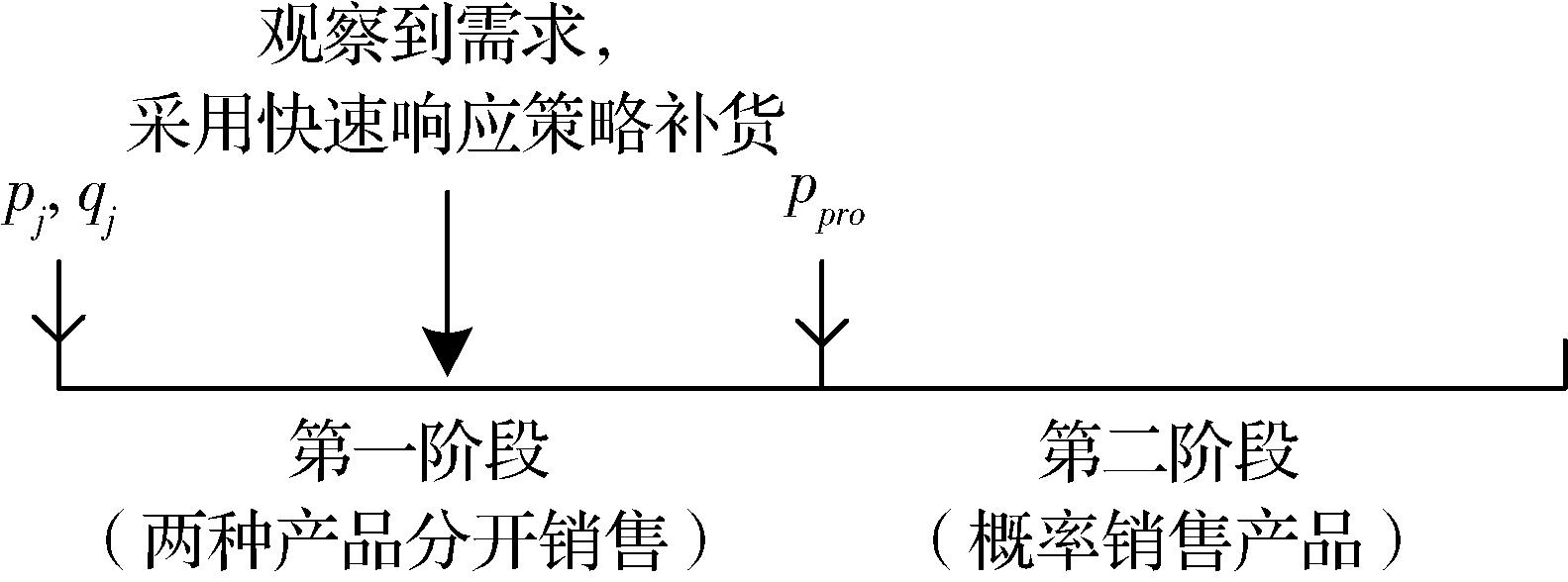
表2
本节新符号和参数定义"
| 符号 | 参数定义 |
|---|---|
| 考虑策略型消费者时,消费者对第二阶段获得产品的可能性的预期, | |
| 考虑策略型消费者时,策略型消费者心仪产品所占比例 | |
| 考虑策略型消费者时,零售商在两种模式下的最优订货量 | |
| 考虑策略型消费者时,零售商在两种模式下的最优定价 | |
| 考虑策略型消费者时,零售商在两种模式下的最优利润 |
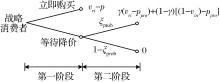
图5
策略型消费者的决策顺序"
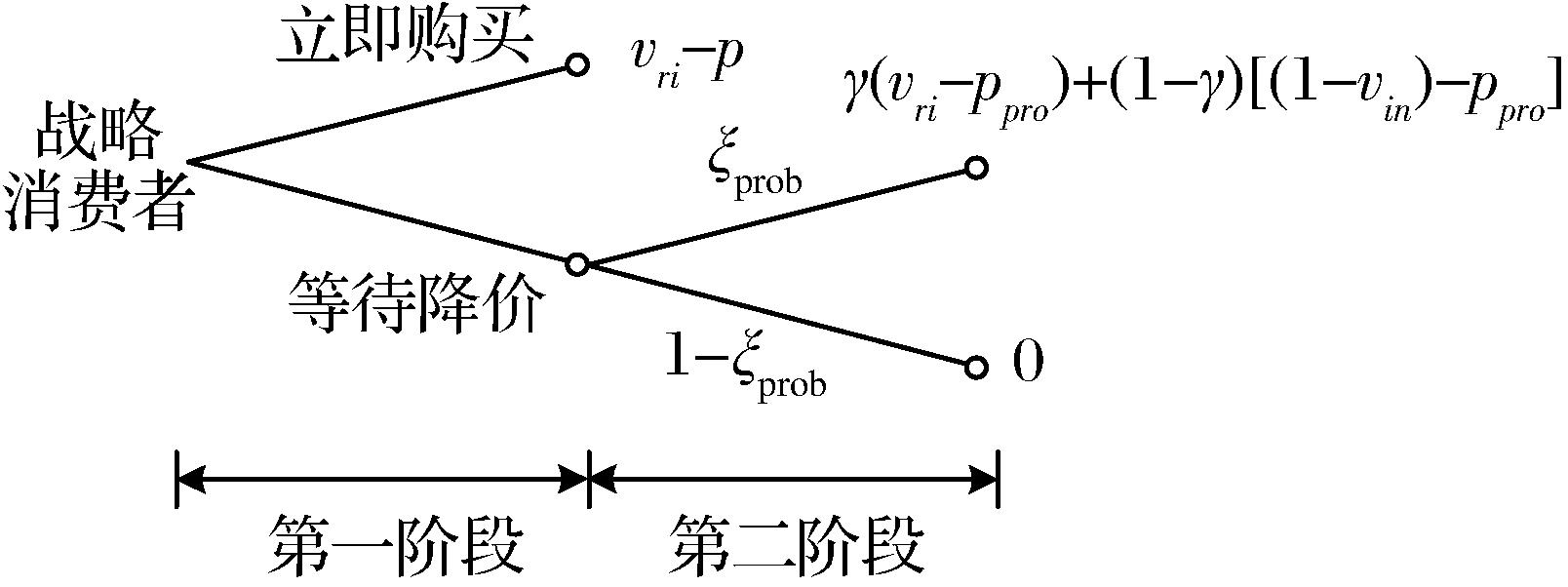
表3
无策略型消费者环境概率销售模式与快速响应模式对比"
| 0.05 | 12.272 | 12.226 | 12.426 | 13.279 | 4.2432 | 5.2839 | 6.5117 | 8.5512 | 0.2162 | 0.2121 | 0.2122 | 0.2227 |
| 0.1 | 11.772 | 11.642 | 11.703 | 12.278 | 6.9563 | 8.1265 | 9.3881 | 10.852 | 0.1855 | 0.1785 | 0.1754 | 0.1817 |
| 0.15 | 11.067 | 10.871 | 10.823 | 11.189 | 9.1747 | 10.198 | 11.29 | 12.491 | 0.1559 | 0.1467 | 0.1413 | 0.1446 |
| 0.2 | 10.189 | 9.967 | 9.8514 | 10.065 | 11.03 | 11.71 | 12.47 | 13.36 | 0.1271 | 0.116 | 0.1088 | 0.1102 |
| 0.25 | 9.1665 | 8.97 | 8.8373 | 8.9503 | 12.557 | 12.73 | 13.059 | 13.626 | 0.0989 | 0.0862 | 0.0781 | 0.0786 |
| 0.3 | 8.0253 | 7.9186 | 7.8205 | 7.8784 | 13.738 | 13.254 | 13.151 | 13.446 | 0.071 | 0.0573 | 0.0498 | 0.0504 |
| 0.35 | 6.7973 | 6.8546 | 6.8332 | 6.8701 | 14.485 | 13.248 | 12.83 | 12.929 | 0.0435 | 0.03 | 0.0245 | 0.0258 |
| 0.4 | 5.5295 | 5.8235 | 5.9012 | 5.9395 | 14.581 | 12.697 | 12.17 | 12.154 | 0.0163 | 0.0055 | 0.0028 | 0.0046 |
| 0.45 | 4.3063 | 4.8701 | 5.0445 | 5.0952 | 13.448 | 11.647 | 11.237 | 11.189 | -0.0098 | -0.0144 | -0.0152 | -0.0132 |
| 0.5 | 3.2867 | 4.0313 | 4.2765 | 4.3399 | 10.462 | 10.233 | 10.122 | 10.117 | -0.0275 | -0.0288 | -0.0296 | -0.0281 |
表4
无策略型消费者环境概率销售模式与快速响应模式对比(概率产品组合比例a1/2)"
| 0.05 | 6.3879 | 7.36 | 7.7513 | 7.9023 |
| 0.1 | 6.3245 | 7.1574 | 7.4252 | 7.8508 |
| 0.15 | 6.0446 | 6.7102 | 7.1421 | 7.5343 |
| 0.2 | 5.4752 | 6.0284 | 6.6264 | 6.8965 |
| 0.25 | 4.6157 | 5.3565 | 5.8106 | 6.0079 |
| 0.3 | 3.7867 | 4.4137 | 4.7657 | 5.1724 |
| 0.35 | 2.9788 | 3.4464 | 3.7766 | 4.0581 |
| 0.4 | 2.2325 | 2.5889 | 2.8398 | 2.9924 |
| 0.45 | 1.583 | 1.8051 | 1.9457 | 2.0656 |
| 0.5 | 1.0208 | 1.1706 | 1.3012 | 1.4229 |
表5
策略型消费者时“概率销售”模式与“概率销售+快速响应”联合模式对比(高快速响应成本)"
| 0.05 | 4E-06 | 0.0059 | 0.0954 | 0.399 | 3E-06 | 0.0074 | 0.1505 | 0.8362 | 4E-08 | 6E-05 | 0.0009 | 0.0039 | |
| 0.1 | 2E-06 | 0.0027 | 0.0421 | 0.1725 | 1E-06 | 0.0023 | 0.0461 | 0.2361 | 3E-08 | 5E-05 | 0.0008 | 0.0034 | |
| 0.15 | 5E-13 | 5E-07 | 0.0001 | 0.0024 | 7E-12 | 5E-07 | 5E-05 | 0.003 | 3E-08 | 5E-05 | 0.0008 | 0.0032 | |
| 0.2 | -2E-06 | -0.002 | -0.035 | -0.135 | -8E-07 | -0.002 | -0.043 | -0.223 | 3E-08 | 4E-05 | 0.0007 | 0.0025 | |
| 0.25 | -3E-06 | -0.004 | -0.045 | -0.171 | -3E-06 | -0.007 | -0.127 | -0.486 | -2E-09 | -2E-05 | -0.004 | -0.004 | |
| 0.3 | -3E-06 | 0.001 | 0.1077 | -0.012 | -3E-05 | -0.033 | -0.251 | -0.79 | -5E-07 | -0.004 | -0.007 | -0.005 | |
| 0.35 | 1E-05 | 0.2417 | 0.4004 | 0.2943 | -5E-04 | 0.0713 | -0.48 | -1.085 | -8E-06 | -0.009 | -0.005 | -0.004 | |
| 0.4 | 0.0396 | 0.6053 | 0.8016 | 0.7118 | 0.7098 | -0.092 | -0.605 | -1.221 | -0.025 | -0.005 | -0.002 | -6E-04 | |
| 0.45 | 0.5522 | 1.0739 | 1.2767 | 1.1888 | 0.8131 | -0.026 | -0.43 | -0.999 | -0.007 | -2E-04 | 0.0026 | 0.0045 | |
| 0.5 | 1.1264 | 1.6035 | 1.7518 | 1.6422 | 1.6273 | 0.7088 | 0.4238 | -0.101 | -6E-04 | 0.0061 | 0.0086 | 0.0106 | |
表6
策略型消费者时“概率销售”模式与“概率销售+快速响应”联合模式对比(低快速响应成本)"
| 0.05 | 2E-05 | 0.0297 | 0.4732 | 1.9297 | 2E-05 | 0.0368 | 0.7327 | 3.7338 | 3E-08 | 6E-05 | 0.0009 | 0.0039 |
| 0.1 | 2E-05 | 0.0242 | 1.6254 | 2.1094 | 9E-06 | 0.0207 | 17.017 | 24.66 | 9E-08 | 5E-05 | 0.0789 | 0.0812 |
| 0.15 | 1E-05 | 0.9574 | 0.1645 | 0.1706 | 7E-06 | 10.533 | 16.532 | 22.796 | 3E-08 | 0.0708 | 0.0675 | 0.0668 |
| 0.2 | 1E-05 | 0.0018 | -1.065 | -1.399 | 6E-06 | 9.7336 | 14.932 | 20.338 | 1E-07 | 0.0599 | 0.0518 | 0.0464 |
| 0.25 | 8E-06 | 0.0122 | -2.061 | -2.553 | 9E-06 | 0.0218 | 13.241 | 18.174 | 1E-07 | 0.0003 | 0.0262 | 0.019 |
| 0.3 | 5E-06 | -1.585 | -2.674 | -3.266 | 5E-05 | 7.2329 | 11.906 | 16.214 | 9E-07 | 0.0247 | 0.0056 | 0.002 |
| 0.35 | -1E-05 | -1.947 | -3.006 | -3.658 | 0.0005 | 6.5573 | 10.507 | 14.268 | 8E-06 | 0.0003 | -0.007 | -0.011 |
| 0.4 | -0.038 | -2.094 | -3.132 | -3.788 | 0.728 | 5.6325 | 9.1364 | 12.364 | -0.025 | -0.009 | -0.017 | -0.022 |
| 0.45 | -1.041 | -2.11 | -3.089 | -3.69 | 2.0753 | 4.7864 | 7.8619 | 10.524 | -0.006 | -0.016 | -0.026 | -0.03 |
| 0.5 | -1.048 | -2.052 | -2.901 | -3.399 | 1.8557 | 4.269 | 6.7588 | 8.76 | -0.012 | -0.024 | -0.034 | -0.037 |
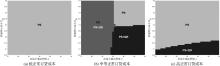
图6
最优模式选择"
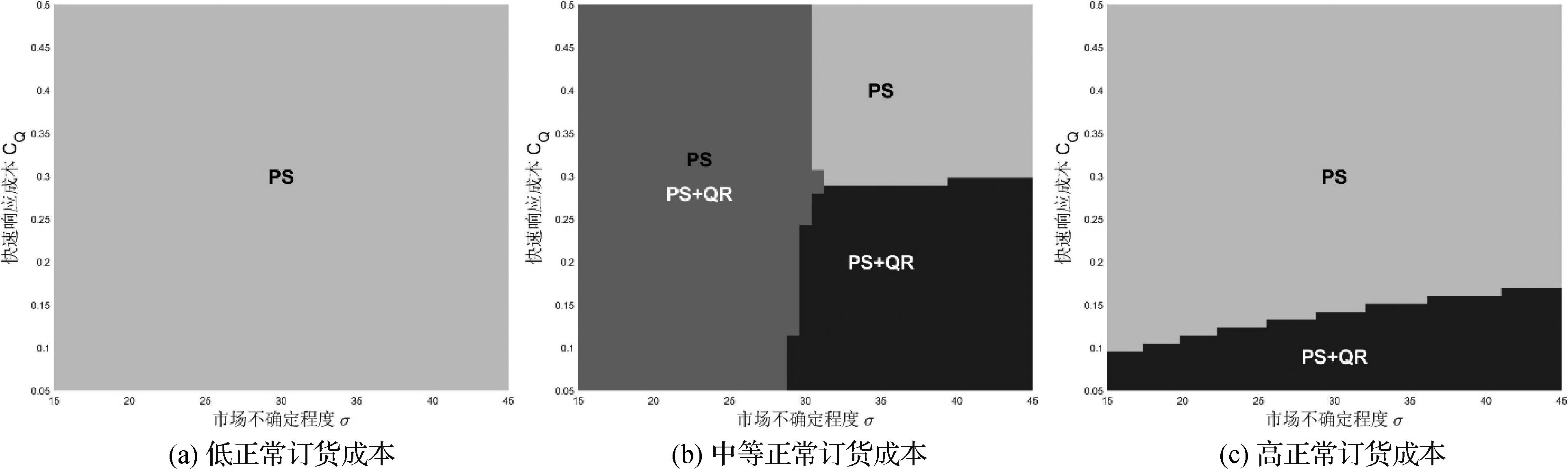
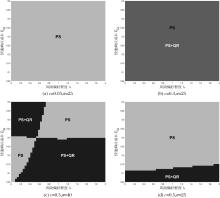
图7
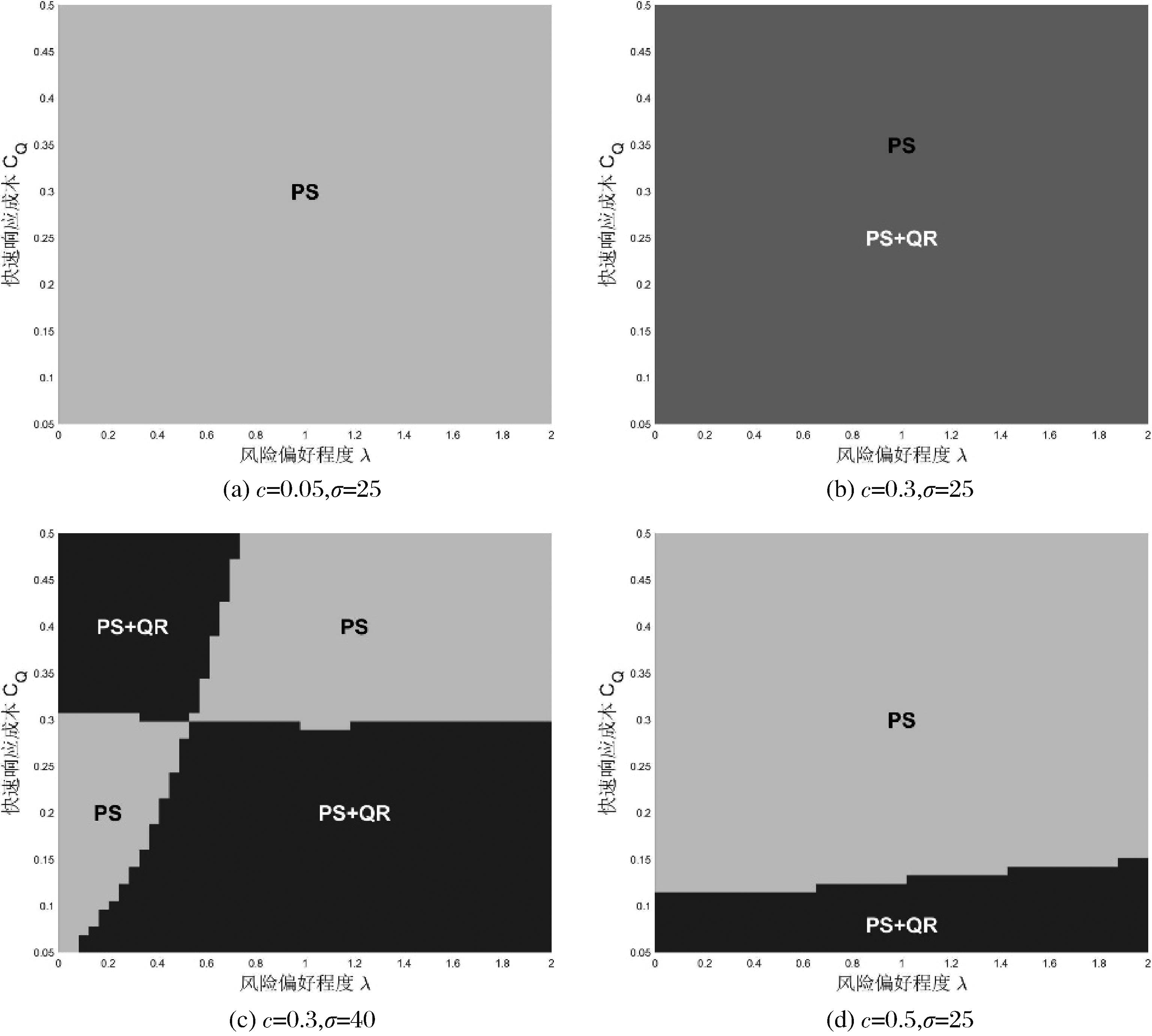
考虑风险偏好的策略型消费者最优模式选择"
| [1] | Fay S, Xie J. Probabilistic goods: A creative way of selling products and services[J]. Marketing Science, 2008, 27(4): 674-690. |
| [2] | Zhang Y, Zhang J. Strategic customer behavior with disappointment aversion customers and two alleviation policies[J]. International Journal of Production Economics, 2017, 191: 170-177. |
| [3] | Li Q, Ma J. Research on price Stackelberg game model with probabilistic selling based on complex system theory[J]. Communications in Nonlinear Science and Numerical Simulation, 2016, 30(1-3): 387-400. |
| [4] | 毛可, 傅科, 徐佳焱. 无理由退货政策下的概率销售策略[J]. 系统工程理论与实践, 2020, 40(4): 964-977. |
| Mao K, Fu K, Xu J Y. Probabilistic selling with money back guarantees[J]. Systems Engineering —Theory Practice, 2020, 40(4): 964-977. | |
| [5] | 杨光, 刘新旺, 秦晋栋. 基于消费者损失效用的概率销售策略研究[J].中国管理科学,2020,28(7): 146-155. |
| Yang G, Liu X W, Qin J D. Probabilistic selling policy based on consumers’ loss utility[J]. Chinese Journal of Management Science, 2020, 28(7): 146-155. | |
| [6] | 舒斯亮, 柳键. 不同权力结构下供应链概率销售策略比较研究[J]. 中国管理科学, 2022, 30(9): 152-161. |
| Shu S L, Liu J. A comparative study on probabilistic selling strategy of supply chain under different power structures[J]. Chinese Journal of Management Science, 2022, 30(9): 152-161. | |
| [7] | Fay S, Gheibi S. The effect of probabilistic selling on channel dynamics in supply chains[J]. Manufacturing Service Operations Management,2023,26(2): 632-645. |
| [8] | 戴睿, 吴明霞. 考虑消费者信息更新的概率销售策略[J]. 运筹与管理, 2024, 33(3): 133-139. |
| Dai R, Wu M X. Probabilistic selling strategy considering Consumers’Information update[J]. Operations Research and Management Science, 2024, 33(3): 133-139. | |
| [9] | Yin Z, Huang T. Probabilistic selling with customization? A theoretical analysis[J]. Production and Operations Management, 2025, 34(9): 2891-2909. |
| [10] | 沈瑞蓉, 徐燕翼. 考虑消费者公平偏好行为的概率销售定价策略研究[J]. 工业工程与管理, 2022, 27(2): 118-127. |
| Shen R R, Xu Y Y. Research on pricing strategy of probabilistic selling based on Consumers’Fair preference[J]. Industrial Engineering and Management, 2022, 27(2): 118-127. | |
| [11] | Huang T, Yu Y. Sell probabilistic goods? A behavioral explanation for opaque selling[J]. Marketing Science, 2014, 33(5): 743-759. |
| [12] | Huang Y S, Wu T Y, Fang C C, et al. Decisions on probabilistic selling for consumers with different risk attitudes[J]. Decision Analysis, 2021, 18(2): 121-138. |
| [13] | 付红, 高江明, 李凯, 等. 考虑消费者重复购买行为的盲盒设计与库存联合决策[J]. 系统管理学报, 2025, 34(6): 1497-1508. |
| Fu H, Gao J M, Li K, et al. Joint decision-making on blind box design and inventory considering consumer’s repurchase behavior[J]. Journal of Systems Management, 2025, 34(6): 1497-1508. | |
| [14] | Fay S, Xie J. Timing of product allocation: Using probabilistic selling to enhance inventory management[J]. Management Science, 2015, 61(2): 474-484. |
| [15] | Zheng Q, Pan X A, Carrillo J E. Probabilistic selling for vertically differentiated products with salient thinkers[J]. Marketing Science, 2019, 38(3): 442-460. |
| [16] | Cachon G P, Swinney R. Purchasing, pricing, and quick response in the presence of strategic consumers[J]. Management Science, 2009, 55(3): 497-511. |
| [17] | Cachon G P, Swinney R. The value of fast fashion: Quick response, enhanced design, and strategic consumer behavior[J]. Management Science, 2011, 57(4): 778-795. |
| [18] | Fisher M, Raman A. Reducing the cost of demand uncertainty through accurate response to early sales[J]. Operations Research, 1996, 44(1): 87-99. |
| [19] | Eppen G D, Iyer A V. Improved fashion buying with Bayesian updates[J]. Operations Research, 1997, 45(6): 805-819. |
| [20] | Petruzzi N C, Dada M. Information and inventory recourse for a two-market, price-setting retailer[J]. Manufacturing Service Operations Management, 2001, 3(3): 242-263. |
| [21] | Lin Y T, Parlaktürk A. Quick response under competition[J]. Production and Operations Management, 2012, 21(3): 518-533. |
| [22] | Choi T M. Inventory service target in quick response fashion retail supply chains[J]. Service Science, 2016, 8(4): 406-419. |
| [23] | Deshpande V, Pendem P K. Logistics performance, ratings, and its impact on customer purchasing behavior and sales in E-commerce platforms[J]. Manufacturing Service Operations Management, 2023, 25(3): 827-845. |
| [24] | Xu J, Duan Y. Pricing, ordering, and quick response for online sellers in the presence of consumer disappointment aversion[J]. Transportation Research Part E: Logistics and Transportation Review, 2020, 137: 101925. |
| [25] | Long X, Nasiry J. Sustainability in the fast fashion industry[J]. Manufacturing Service Operations Management, 2022, 24(3): 1276-1293. |
| [26] | 王辉, 易思源, 杨海丽. 供应链中的快速反应和行为学研究: 综述与展望[J]. 管理评论, 2023, 35(4): 303-310. |
| Wang H, Yi S Y, Yang H L. Quick response and behavioral research in supply chains: Review and outlook[J]. Management Review, 2023, 35(4): 303-310. | |
| [27] | Qiu R, Sun Y, Zhou H, et al. Dynamic pricing and quick response of a retailer in the presence of strategic consumers: A distributionally robust optimization approach[J]. European Journal of Operational Research, 2023, 307(3): 1270-1298. |
| [28] | Wang H, Bai C, Lev B, et al. Quick response under strategic consumers with high-price and stockout regrets[J]. Computers Operations Research, 2024, 166: 106590. |
| [29] | Fay S, Xie J. The economics of buyer uncertainty: Advance selling vs. probabilistic selling[J]. Marketing Science, 2010, 29(6): 1040-1057. |
| [30] | Jerath K, Netessine S, Veeraraghavan S K. Revenue management with strategic customers: Last-minute selling and opaque selling[J]. Management Science, 2010, 56(3): 430-448. |
| [31] | Rice D H, Fay S A, Xie J. Probabilistic selling vs. markdown selling: Price discrimination and management of demand uncertainty in retailing[J]. International Journal of Research in Marketing, 2014, 31(2): 147-155. |
| [32] | Zhang Y, Hua G, Wang S, et al. Managing demand uncertainty: Probabilistic selling versus inventory substitution[J]. International Journal of Production Economics, 2018, 196: 56-67. |
| [33] | Zhang J, Deng L, Liu H, et al. Which strategy is better for managing multi-product demand uncertainty: Inventory substitution or probabilistic selling?[J]. European Journal of Operational Research, 2022, 302(1): 79-95. |
| [34] | Liu Q, Van Ryzin G J. Strategic capacity rationing to induce early purchases[J]. Management Science, 2008, 54(6): 1115-1131. |
| [35] | Huang T, Van Mieghem J A. The promise of strategic customer behavior: On the value of click tracking[J]. Production and Operations Management, 2013, 22(3): 489-502. |
| [36] | Chun S Y, Ovchinnikov A. Strategic consumers, revenue management, and the design of loyalty programs[J]. Management Science, 2019, 65(9): 3969-3987. |
| [37] | Araman V F, Fayad B. Intertemporal price discrimination with time-varying valuations[J]. Operations Research, 2021, 69(1): 245-265. |
| [38] | Du J, Zhang J, Hua G. Pricing and inventory management in the presence of strategic customers with risk preference and decreasing value[J]. International Journal of Production Economics, 2015, 164: 160-166. |
| [39] | Su X, Zhang F. On the value of commitment and availability guarantees when selling to strategic consumers[J]. Management Science, 2009, 55(5): 713-726. |
| [40] | 李贺, 张玉林, 仲伟俊. 考虑战略消费者行为风险的动态定价策略[J]. 管理科学学报, 2012, 15(10): 11-25. |
| Li H, Zhang Y L, Zhong W J. Dynamic pricing strategies in the presence of strategic consumer behavior risks[J]. Journal of Management Sciences in China, 2012, 15(10): 11-25. | |
| [41] | Chen Y, Shi C. Joint pricing and inventory management with strategic customers[J]. Operations Research, 2019, 67(6): 1610-1627. |
| [42] | Lin Y T, Parlaktürk A K, Swaminathan J M. Are strategic customers bad for a supply chain?[J]. Manufacturing Service Operations Management, 2018, 20(3): 481-497. |
| [43] | Wang J, Levin Y, Nediak M. Selling passes to strategic customers[J]. Operations Research, 2020, 68(4): 1095-1115. |
| [44] | Chen Y, Trichakis N. Technical note—On revenue management with strategic customers choosing when and what to buy[J]. Operations Research, 2021, 69(1): 175-187. |
| [45] | Singh N, Ramachandran K, Subramanian R. Intertemporal product management with strategic consumers: The value of defective product returns[J]. Manufacturing Service Operations Management, 2022, 24(2): 1146-1164. |
| [46] | Chen H, Hu M, Wu J. Intertemporal price discrimination via randomized promotions[J]. Manufacturing Service Operations Management, 2023, 25(3): 1176-1194. |
| [47] | 蔺康康, 刘新民, 王垒. 考虑异质性策略消费者等待时间的产品定价换代策略研究[J]. 中国管理科学, 2024, 32(8): 204-213. |
| Lin K K, Liu X M, Wang L. Product pricing and rollover strategy based on the waiting time for heterogeneous strategic consumers[J]. Chinese Journal of Management Science, 2024, 32(8): 204-213. | |
| [48] | 夏良杰, 黄迎, 冯锦茹, 等. 面向策略型消费者的过度自信零售商产品定价与订货决策研究[J]. 中国管理科学, 2026, 34(3): 297-308. |
| Xia L J, Huang Y, Feng J R, et al. Pricing and ordering policies of overconfident retailers considering strategic consumers[J]. Chinese Journal of Management Science, 2026, 34(3): 297-308. | |
| [49] | 李犇, 高倩, 郭晓龙, 等. 考虑策略消费者线上凑单购买行为的免邮策略研究[J]. 中国管理科学, 2026, 34(5): 1-10. |
| Li B, Gao Q, Guo X L, et al. Contingent Free-Shipping Decisions when Considering the Merging Behavior of Strategic Consumers[J]. Chinese Journal of Management Science, 2026, 34(5): 1-10. | |
| [50] | Gneezy U, List J A, Wu G. The uncertainty effect: When a risky prospect is valued less than its worst possible outcome[J]. The Quarterly Journal of Economics, 2006, 121(4): 1283-1309. |
| [1] | 张鹏, 王慧娟, 马俊, 朱小武. 具有非对称零售服务质量的网络零售商退货运费险竞争策略研究[J]. 中国管理科学, 2026, 34(8): 257-268. |
| [2] | 尚文芳, 谷鑫涛, 李涛. 需求不确定下碳期权采购对供应链决策及协调机制的影响研究[J]. 中国管理科学, 2026, 34(8): 329-344. |
| [3] | 邓旭东, 黎婷, 马云峰, 杨习杰. 基于不确定需求的货位分配策略[J]. 中国管理科学, 2026, 34(5): 166-174. |
| [4] | 夏良杰, 黄迎, 冯锦茹, 王君, 李友东. 面向策略型消费者的过度自信零售商产品定价与订货决策研究[J]. 中国管理科学, 2026, 34(3): 297-308. |
| [5] | 袁红平, 张莉, 曹兵兵. 区块链技术赋能的馈赠型产品供应链隐私保护与信誉维护决策研究[J]. 中国管理科学, 2026, 34(2): 336-347. |
| [6] | 袁明利, 邱若臻, 孙月. 考虑需求和提前期不确定性的生产-库存计划仿射可调节鲁棒优化模型[J]. 中国管理科学, 2025, 33(9): 97-108. |
| [7] | 刘旭旺, 王骏嘉, 齐微, 雒兴刚. 考虑参照点效应和价格承诺的平台电商企业竞争定价策略研究[J]. 中国管理科学, 2025, 33(8): 278-288. |
| [8] | 杨洁, 张欣, 李登峰. 考虑层级联盟的需求不确定联合采购成本分摊策略研究[J]. 中国管理科学, 2025, 33(2): 195-206. |
| [9] | 项寅. 需求不确定下的突发疫情应急医疗设施动态布局[J]. 中国管理科学, 2024, 32(6): 129-139. |
| [10] | 胡强,谢家平,张广思. 电商平台与竞争性商家数据赋能策略研究[J]. 中国管理科学, 2024, 32(6): 46-56. |
| [11] | 唐飞,代颖,马祖军. 考虑顾客忠诚度的竞争性企业以旧换新策略[J]. 中国管理科学, 2024, 32(5): 13-23. |
| [12] | 万光羽,蒲霏嫣,李紫纯,曹裕. 企业营销能力与生产运营能力交互作用及其对绩效影响研究[J]. 中国管理科学, 2024, 32(5): 275-285. |
| [13] | 占济舟,晋雅琪. 考虑退货运费险的竞争型电商平台定价策略研究[J]. 中国管理科学, 2024, 32(5): 325-334. |
| [14] | 王君, 马闻康, 鲁馨蔓. 考虑成本信息透明和学习效应的跨期定价策略[J]. 中国管理科学, 2024, 32(2): 11-22. |
| [15] | 郭丽彬, 郭响甜, 李健. 考虑风险规避和质量不信任的共享平台区块链技术引入时机[J]. 中国管理科学, 2024, 32(12): 215-224. |
| 阅读次数 | ||||||
|
全文 |
|
|||||
|
摘要 |
|
|||||
|
||
