
主管:中国科学院
主办:中国优选法统筹法与经济数学研究会
中国科学院科技战略咨询研究院
主办:中国优选法统筹法与经济数学研究会
中国科学院科技战略咨询研究院

中国管理科学 ›› 2026, Vol. 34 ›› Issue (4): 63-76.doi: 10.16381/j.cnki.issn1003-207x.2025.0278cstr: 32146.14.j.cnki.issn1003-207x.2025.0278
任广乾1, 景曼1, 焦豪2( ), 薛坤坤1
收稿日期:2025-02-20
修回日期:2025-06-03
出版日期:2026-04-25
发布日期:2026-03-27
通讯作者:
焦豪
E-mail:haojiao@bnu.edu.cn
基金资助:
Guangqian Ren1, Man Jing1, Hao Jiao2(), Kunkun Xue1
Received:2025-02-20
Revised:2025-06-03
Online:2026-04-25
Published:2026-03-27
Contact:
Hao Jiao
E-mail:haojiao@bnu.edu.cn
摘要:
“链主”企业是产业链强链、补链、延链的关键力量,国有企业具有成为“链主”企业的核心优势,充分发挥“链主”国有企业的辐射带动作用、引领链上民营企业协同发展是增强产业链韧性的重要途径。本文基于2009—2023年沪深A股上市民营企业及其前五大供应商和客户的数据,从产业链企业关联的视角考察“链主”国有企业对链上民营企业创新能力的影响及作用机制。研究发现,“链主”国有企业能够发挥“头雁效应”,引领链上民营企业创新能力提升。机制检验发现,“链主”国有企业通过技术创新溢出、缓解融资约束和优化资源配置三条路径提升链上民营企业创新能力。异质性研究发现,“链主”国有企业对链上民营企业的创新引领效应存在异质性,非西部地区、高市场竞争程度以及与“链主”国有企业地理距离较近的链上民营企业受益更显著。此外,当“链主”国有企业属于高科技行业以及数字化转型程度较高时,其对链上民营企业的创新引领效应更显著。经济后果检验发现,“链主”国有企业通过提高链上民营企业创新能力进一步提升了企业价值。研究结论深化了对“链主”国有企业纵向产业引领作用的认识,为进一步释放“链主”国有企业效能、促进国有企业民营企业协同提升产业链韧性提供经验依据。
中图分类号:
任广乾,景曼,焦豪, 等. “链主”国有企业能引领链上民营企业创新能力提升吗?——基于产业链溢出效应的视角[J]. 中国管理科学, 2026, 34(4): 63-76.
Guangqian Ren,Man Jing,Hao Jiao, et al. Can State-owned Enterprises as “Chain Leader” Lead the Improvement of Innovation Capabilities of Private Enterprises on the Chain? From the Perspective of Spillover Effects in the Industrial Chain[J]. Chinese Journal of Management Science, 2026, 34(4): 63-76.
图1
“链主”国有企业引领链上民营企业创新能力提升的作用路径图"
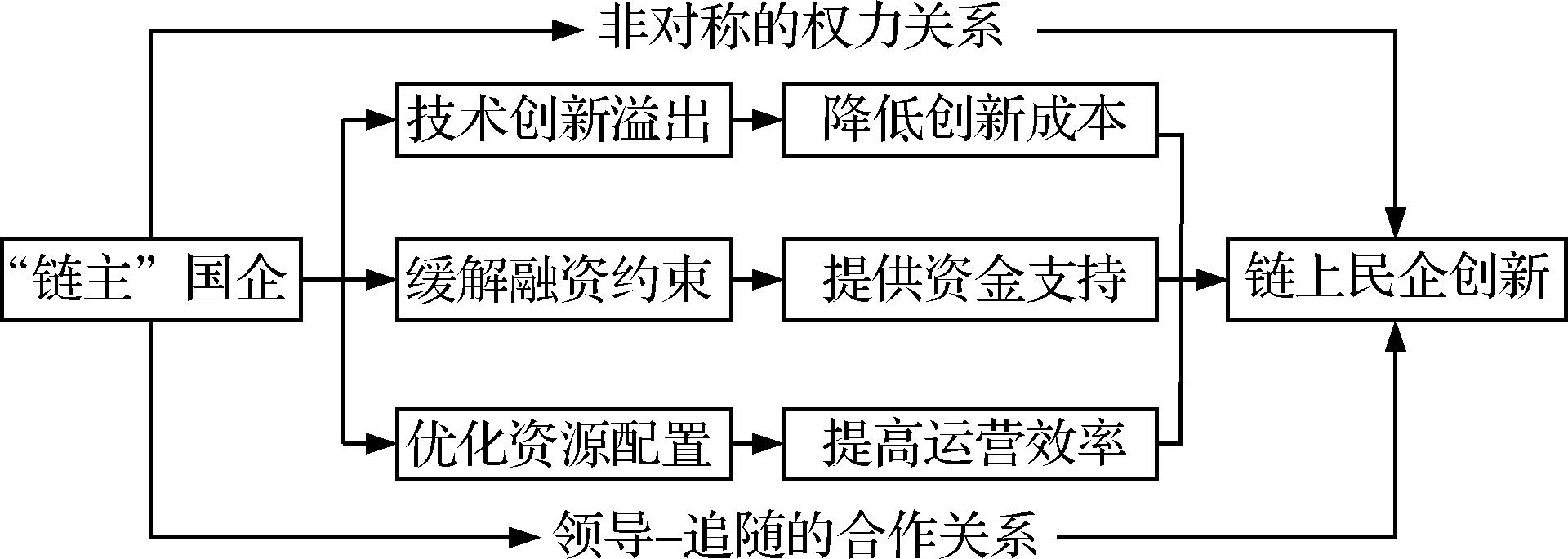

表1
变量定义及界定"
| 变量类型 | 变量名 | 变量符号 | 变量计算 |
|---|---|---|---|
| 被解释变量 | 链上民营企业创新能力 | Innov | 企业发明专利申请数加1取自然对数 |
| 解释变量 | “链主”国有企业 | LZSOE | 国有企业若同时满足上述三个条件取值为1,反之为0 |
| 控制变量 | 企业规模 | Size | 总资产的自然对数 |
| 企业年龄 | Age | 公司上市年数加1取自然对数 | |
| 资产负债率 | Lev | 资产负债/总资产 | |
| 资产收益率 | Roa | 净利润/总资产 | |
| 营业收入增长率 | Growth | 营业收入增长额/上年营业收入总额 | |
| 现金流比率 | Cashflow | 经营活动产生的现金流量/总资产 | |
| 第一大股东持股比例 | Top1 | 第一大股东持股数量/总股数 | |
| 董事会规模 | Board | 董事会人数的自然对数 | |
| 独立董事比例 | Indep | 独立董事/董事会人数 | |
| 两职合一 | Dual | 董事长与总经理是同一个人取值为1,反之为0 | |
| 年份/行业 | Year/Ind | 年份/行业虚拟变量 |
表2
描述性统计结果"
| 变量 | (1) | (2) | (3) | (4) | (5) | (6) |
|---|---|---|---|---|---|---|
| 观测值 | 均值 | 标准差 | 最小值 | 中位数 | 最大值 | |
| Innov | 622 | 2.802 | 1.897 | 0.000 | 2.792 | 8.586 |
| LZSOE | 622 | 0.064 | 0.245 | 0.000 | 0.000 | 1.000 |
| Size | 622 | 23.314 | 1.711 | 20.401 | 23.195 | 30.600 |
| Age | 622 | 2.122 | 0.925 | 0.000 | 2.398 | 3.367 |
| Lev | 622 | 0.510 | 0.177 | 0.093 | 0.520 | 0.919 |
| Roa | 622 | 0.053 | 0.055 | -0.147 | 0.047 | 0.233 |
| Growth | 622 | 0.178 | 0.332 | -0.372 | 0.110 | 2.370 |
| Cashflow | 622 | 0.059 | 0.071 | -0.133 | 0.055 | 0.277 |
| Top1 | 622 | 0.285 | 0.172 | 0.001 | 0.298 | 0.716 |
| Indep | 622 | 0.373 | 0.052 | 0.333 | 0.357 | 0.571 |
| Board | 622 | 2.148 | 0.215 | 1.609 | 2.197 | 2.708 |
| Dual | 622 | 0.315 | 0.465 | 0.000 | 0.000 | 1.000 |
表3
基准回归结果"
| 变量 | (1) | (2) | (3) | (4) |
|---|---|---|---|---|
| Innov | Innov | Innov | Innov | |
| LZSOE | 0.864*** | 0.502*** | 0.519*** | 0.512*** |
| (2.756) | (2.704) | (2.756) | (2.743) | |
| Size | 0.868*** | 0.847*** | 0.799*** | |
| (10.124) | (9.475) | (9.467) | ||
| Age | -0.058 | -0.066 | -0.041 | |
| (-0.670) | (-0.783) | (-0.469) | ||
| Lev | 0.490 | 0.573 | ||
| (0.834) | (0.981) | |||
| Roa | 0.628 | 0.648 | ||
| (0.413) | (0.403) | |||
| Growth | -0.286* | -0.313* | ||
| (-1.765) | (-1.895) | |||
| Cashflow | -0.656 | -0.947 | ||
| (-0.605) | (-0.856) | |||
| Top1 | -0.413 | |||
| (-0.826) | ||||
| Indep | 3.841** | |||
| (2.500) | ||||
| Board | 1.263** | |||
| (2.292) | ||||
| Dual | 0.100 | |||
| (0.660) | ||||
| Constant | 1.637* | -17.362*** | -17.090*** | -20.307*** |
| (1.713) | (-8.522) | (-8.421) | (-8.148) | |
| Year | Yes | Yes | Yes | Yes |
| Ind | Yes | Yes | Yes | Yes |
| N | 622 | 622 | 622 | 622 |
| R² | 0.386 | 0.652 | 0.654 | 0.667 |
表4
稳健性检验结果"
| 变量 | (1) | (2) | (3) | (4) | (5) |
|---|---|---|---|---|---|
| Innov | Innov | Innov2 | Innov3 | Innov | |
| LZSOE | 0.536*** | 0.762* | 0.451** | 0.010** | |
| (3.012) | (1.830) | (2.257) | (2.345) | ||
| LZSOE2 | 0.790*** | ||||
| (2.604) | |||||
| Controls | Yes | Yes | Yes | Yes | Yes |
| Constant | -22.216*** | -20.579*** | -19.091*** | -0.062 | -20.392*** |
| (-9.250) | (-8.249) | (-6.251) | (-0.894) | (-8.208) | |
| Year | Yes | Yes | Yes | Yes | Yes |
| Ind | Yes | Yes | Yes | Yes | Yes |
| Province | Yes | No | No | No | No |
| N | 622 | 382 | 622 | 622 | 622 |
| R² | 0.731 | 0.675 | 0.598 | 0.543 | 0.667 |
表5
内生性检验结果"
| 变量 | (1) | (2) | (3) | (4) |
|---|---|---|---|---|
| Innov | LZSOE | Innov | Innov | |
| LZSOE | 12.779* | 0.496** | 0.519*** | |
| (1.871) | (2.495) | (2.761) | ||
| IV | 0.021* | |||
| (1.832) | ||||
| IMR | -0.087 | |||
| (-0.619) | ||||
| Controls | Yes | Yes | Yes | Yes |
| Constant | -0.365 | -16.586*** | -17.201*** | -20.590*** |
| (-1.283) | (-4.168) | (-5.176) | (-7.761) | |
| Year | Yes | Yes | Yes | Yes |
| Ind | Yes | Yes | Yes | Yes |
| N | 622 | 622 | 330 | 594 |
| R² | 0.161 | 0.672 | 0.662 |
表6
机制检验结果"
| 变量 | (1) | (2) | (3) | (4) | (5) | (6) | (7) |
|---|---|---|---|---|---|---|---|
| Innov | JSYC | Innov | WW | Innov | ZYYH | Innov | |
| LZSOE | 0.512*** | 0.178** | 0.479** | -0.028* | 0.497*** | -0.008** | 0.492*** |
| (2.743) | (2.423) | (2.512) | (-1.915) | (2.625) | (-2.088) | (2.659) | |
| JSYC/WW/ZYYH | 0.187* | -0.554* | -2.580* | ||||
| (1.683) | (-1.821) | (-1.828) | |||||
| Controls | Yes | Yes | Yes | Yes | Yes | Yes | Yes |
| Constant | -20.307*** | -0.020 | -20.303*** | 0.034 | -20.288*** | 0.051 | -20.177*** |
| (-8.148) | (-0.033) | (-8.184) | (0.196) | (-8.054) | (1.303) | (-8.220) | |
| Year | Yes | Yes | Yes | Yes | Yes | Yes | Yes |
| Ind | Yes | Yes | Yes | Yes | Yes | Yes | Yes |
| N | 622 | 622 | 622 | 622 | 622 | 622 | 622 |
| R² | 0.667 | 0.319 | 0.669 | 0.433 | 0.669 | 0.246 | 0.669 |
表7
链上民营企业特征的异质性检验结果"
| 变量 | (1) | (2) | (3) | (4) | (5) | (6) |
|---|---|---|---|---|---|---|
| 非西部地区企业 | 西部地区企业 | 市场竞争程度较高 | 市场竞争程度较低 | 与“链主”国有企业距离较近 | 与“链主”国有企业距离较远 | |
| Innov | Innov | Innov | Innov | Innov | Innov | |
| LZSOE | 0.498** | 0.499 | 0.556** | 0.075 | 0.695** | 0.424 |
| (2.568) | (1.128) | (2.335) | (0.294) | (2.558) | (1.580) | |
| Controls | Yes | Yes | Yes | Yes | Yes | Yes |
| Constant | -21.894*** | -11.220 | -18.876*** | -19.916*** | -22.257*** | -18.572*** |
| (-8.797) | (-1.212) | (-6.632) | (-6.887) | (-6.290) | (-7.902) | |
| Year | Yes | Yes | Yes | Yes | Yes | Yes |
| Ind | Yes | Yes | Yes | Yes | Yes | Yes |
| N | 556 | 66 | 404 | 218 | 316 | 306 |
| R² | 0.690 | 0.925 | 0.673 | 0.758 | 0.711 | 0.731 |
| P-value | 0.002 | 0.064 | 0.002 | |||
表8
“链主”国有企业特征的异质性检验结果"
| 变量 | (1) | (2) | (3) | (4) |
|---|---|---|---|---|
| 高科技行业 | 非高科技 行业 | 数字化转型程度较高 | 数字化转型程度较低 | |
| Innov | Innov | Innov | Innov | |
| LZSOE | 0.649*** | 0.028 | 0.346* | 1.078 |
| (2.770) | (0.103) | (1.727) | (1.329) | |
| Controls | Yes | Yes | Yes | Yes |
| Constant | -21.329*** | -19.038*** | -22.068*** | -18.883*** |
| (-7.833) | (-5.639) | (-6.478) | (-6.803) | |
| Year | Yes | Yes | Yes | Yes |
| Ind | Yes | Yes | Yes | Yes |
| N | 394 | 228 | 328 | 294 |
| R² | 0.720 | 0.745 | 0.744 | 0.571 |
| P-value | 0.000 | 0.075 | ||
表9
经济后果检验结果"
| 变量 | (1) | (2) |
|---|---|---|
| TobinQ | TobinQ | |
| LZSOE | 0.035 | 0.019 |
| (0.751) | (0.436) | |
| LZSOE×Innov | 0.040* | 0.036* |
| (1.793) | (1.768) | |
| Innov | 0.035*** | 0.051*** |
| (3.748) | (5.788) | |
| Controls | Yes | Yes |
| Constant | 2.955*** | 3.425*** |
| (8.445) | (10.723) | |
| Year/Ind | No | Yes |
| N | 585 | 585 |
| R² | 0.319 | 0.555 |
| [1] | 赵晓阳, 衣长军, 廖佳. 供应链网络位置能否提升企业创新多样性水平?[J]. 中国管理科学, 2023, 31(12): 340-349. |
| Zhao X Y, Yi C J, Liao J. Can the supply chain network location improve the level of innovation diversity of enterprises?[J]. Chinese Journal of Management Science, 2023, 31(12): 340-349. | |
| [2] | 邵云飞, 陈燕萍, 吴晓波, 等. 从 “研发” 到 “市场”: 链主企业如何实现关键核心技术的商业化?[J]. 管理世界, 2024, 40(12): 19-43. |
| Shao Y F, Chen Y P, Wu X B, et al. From “R & D” to “market”: How can leading-chain enterprises commercialize key core technology?[J]. Journal of Management World, 2024, 40(12): 19-43. | |
| [3] | 马忠, 芦雅琳. “链主” 企业如何带动链上企业全要素生产率提升[J]. 广东财经大学学报, 2024, 39(3): 52-65. |
| Ma Z, Lu Y L. How can “chain master” improve the total factor productivity of upstream and downstream enterprises[J]. Journal of Guangdong University of Finance & Economics, 2024, 39(3): 52-65. | |
| [4] | 赖烽辉, 李善民. 共同股东网络与国有企业创新知识溢出——基于国有企业考核制度变迁的实证研究[J]. 经济研究, 2023, 58(6): 119-136. |
| Lai F H, Li S M. Common ownership networks and innovation spillovers of state-owned enterprises:An empirical study based on performance evaluation method change[J]. Economic Research Journal, 2023, 58(6): 119-136. | |
| [5] | 张蕊. 促进国有企业民营企业高质量协同发展[N]. 光明日报, 2024-11-05 (11). |
| Zhang R. Promoting high-quality collaborative development between state-owned enterprises and private enterprises[N]. Guangming Daily, 2024-11-05 (11). | |
| [6] | 王欣, 肖红军. 推动国有企业与民营企业协同发展: 进展、问题与对策[J]. 经济体制改革, 2022(5): 5-13. |
| Wang X, Xiao H J. The coordinated development of state-owned enterprises and private enterprises: Progress, problems and solutions[J]. Reform of Economic System, 2022(5): 5-13. | |
| [7] | 中国社会科学院工业经济研究所课题组,曲永义. 产业链链长的理论内涵及其功能实现[J]. 中国工业经济, 2022(7): 5-24. |
| Research Group of the Institute of Industrial Economics of CASS, Qu Y Y.The theoretical connotation of the central enterprise as the chain leader of industry chain and the function realization[J]. China Industrial Economics, 2022(7): 5-24. | |
| [8] | 戴明禹, 滕曼茹. 国有资本参股对民营企业供应链上下游企业融资的影响[J]. 经济理论与经济管理, 2024, 44(12): 73-92. |
| Dai M Y, Teng M R. The impact of state-owned capital participation on financing of upstream and downstream enterprises in the supply chain of private enterprises[J]. Economic Theory and Business Management, 2024, 44(12): 73-92. | |
| [9] | 赵晶, 刘玉洁, 付珂语, 等. 大型国有企业发挥产业链链长职能的路径与机制——基于特高压输电工程的案例研究[J]. 管理世界, 2022, 38(5): 221-240. |
| Zhao J, Liu Y J, Fu K Y, et al. The path and mechanism for large state-owned enterprises to play the function of industry chain leader: A case study based on UHV transmission project[J]. Journal of Management World, 2022, 38(5): 221-240. | |
| [10] | 潘红波, 杨朝雅, 李丹玉. 如何激发民营企业创新——来自实际控制人财富集中度的视角[J]. 金融研究, 2022(4): 114-132. |
| Pan H B, Yang C Y, Li D Y. How to stimulate private enterprises’ innovation: Evidence from ultimate controllers’wealth concentration[J]. Journal of Financial Research, 2022(4): 114-132. | |
| [11] | Li K, Xiang Y, Zhou C, et al. Promote or inhibit: State-owned equity participation and family firms’ innovation investment[J]. Journal of Innovation & Knowledge, 2023, 8(2): 100354. |
| [12] | 谷方杰, 汪梦玉, 张文锋. 混合所有制改革对企业创新投入影响的实证研究[J]. 中国软科学, 2024(4): 214-224. |
| Gu F J, Wang M Y, Zhang W F. Empirical study on the impact of mixed-ownership reform on enterprise innovation input[J]. China Soft Science, 2024(4): 214-224. | |
| [13] | 王健, 李明操, 蒋忠中, 等. 企业绿色技术创新的供应链溢出效应研究[J]. 管理科学学报, 2025, 28(1): 77-99. |
| Wang J, Li M C, Jiang Z Z, et al. Supply chain spillover effects of green technology innovations[J]. Journal of Management Sciences in China, 2025, 28(1): 77-99. | |
| [14] | 杨金玉, 彭秋萍, 葛震霆. 数字化转型的客户传染效应——供应商创新视角[J]. 中国工业经济, 2022(8): 156-174. |
| Yang J Y, Peng Q P, Ge Z T. Spillover effect of digital transformation along the supply chain: The perspective of supplier innovation[J]. China Industrial Economics, 2022(8): 156-174. | |
| [15] | 严兵, 程敏, 王乃合. ESG绿色溢出、供应链传导与企业绿色创新[J]. 经济研究, 2024, 59(7): 72-91. |
| Yan B, Cheng M, Wang N H. ESG green spillover, supply chain transmission and corporate green innovation[J]. Economic Research Journal, 2024, 59(7): 72-91. | |
| [16] | 刘晨, 王俊秋, 花贵如. 供应链溢出效应下企业数字化转型的动因研究[J]. 管理学报, 2024, 21(6): 938-947. |
| Liu C, Wang J Q, Hua G R. Research on the motivation of enterprise digital transformation under supply chain spillover effects[J]. Chinese Journal of Management, 2024, 21(6): 938-947. | |
| [17] | 于苏, 于小悦, 王竹泉. “链主”企业的供应链治理与链上企业全要素生产率[J]. 经济管理, 2023, 45(4): 22-40. |
| Yu S, Yu X Y, Wang Z Q. Supply chain governance of the “chain master” and enterprises' TFP in chain[J]. Business and Management Journal, 2023, 45(4): 22-40. | |
| [18] | 熊永莲, 张誉夫. 产业链“链主”培育对本地企业韧性的影响研究[J]. 财经论丛, 2025(2): 18-28. |
| Xiong Y L, Zhang Y F. Research on the impact of the cultivation of “industry chain leaders” on the resilience of local enterprises[J]. Collected Essays on Finance and Economics, 2025(2): 18-28. | |
| [19] | 齐平, 宋威辉. 链主企业对中国制造业产业链高质量发展的影响[J]. 南方经济, 2023(5): 84-106. |
| Qi P, Song W H. The influence of leading-chain-enterprises on the high-quality development of China’s manufacturing industry chain[J]. South China Journal of Economics, 2023(5): 84-106. | |
| [20] | 王进富, 李婷婷, 张颖颖. 链主企业生态主导力提升产业链韧性路径研究——以比亚迪和中国新能源汽车产业链为例[J]. 科技进步与对策, 2024, 41(21): 151-160. |
| Wang J F, Li T T, Zhang Y Y. The pathways of ecological dominance of leading firms in industrial chain to enhance the resilience of industrial chains: A case study of BYD and China’s new energy vehicle industry chain[J]. Science & Technology Progress and Policy, 2024, 41(21): 151-160. | |
| [21] | Fu Y, Liu R, Yang J, et al. “Lean in”: The moderating effect of female ownership on the relationship between human capital and organizational innovation[J]. Journal of Intellectual Capital, 2021, 22(4): 792-814. |
| [22] | Guo S, Zan B, Sun Y, et al. Effects of top managers’ military experience on technological innovation in the transition economies of China[J]. Technological Forecasting and Social Change, 2020, 153: 119909. |
| [23] | 江旭, 靳瑞杰, 沈明眉. 政企关系与民营企业创新决策研究[J]. 科研管理, 2022, 43(8): 63-72. |
| Jiang X, Jin R J, Shen M M. Research on government-business relations and innovation decision-making of private enterprises[J]. Science Research Management, 2022, 43(8): 63-72. | |
| [24] | 万源星, 许永斌, 许文瀚. 加计扣除政策、研发操纵与民营企业自主创新[J].科研管理, 2020, 41(2): 83-93. |
| Wan Y X, Xu Y B, Xu W H. Additional deduction policy, R & D manipulation and independent innovation of private firms[J]. Science Research Management, 2020, 41(2): 83-93. | |
| [25] | 魏娟, 史亚雅, 叶文平, 等. 供应链优势企业数字化转型的双边溢出效应研究[J]. 财经研究, 2025, 51(1): 78-93. |
| Wei J, Shi Y Y, Ye W P, et al. A research on the bilateral spillover effect of the digital transformation of dominant enterprises in the supply chain[J]. Journal of Finance and Economics, 2025, 51(1): 78-93. | |
| [26] | 霍春辉, 何地, 庞铭. “链主”企业提升产业链现代化水平的功能作用与实现路径[J]. 科学管理研究, 2024, 42(2): 103-109. |
| Huo C H, He D, Pang M. The functional and realization path of chain owner enterprises promoting the modernization of industrial chain[J]. Scientific Management Research, 2024, 42(2): 103-109. | |
| [27] | 王旭, 褚旭. 基于企业规模门槛效应的外部融资对绿色创新影响研究[J]. 系统工程理论与实践, 2019, 39(8): 2027-2037. |
| Wang X, Chu X. External financing and enterprises’ green technology innovation: A study based on the threshold model of firm size[J]. Systems Engineering-Theory & Practice, 2019, 39(8): 2027-2037. | |
| [28] | Xu S, Chen S, Jiao W, et al. State-owned enterprises shareholders and innovation of private enterprises: Evidence from China[J]. Technovation, 2025, 140: 103144. |
| [29] | 任广乾, 景曼, 王玲杰. 国有企业推动新质生产力发展的逻辑机理与实现路径[J]. 经济社会体制比较, 2024(6): 51-58. |
| Ren G Q, Jing M, Wang L J. The logical mechanism and implementation path of state-owned enterprises promoting the development of new quality productive forces[J]. Comparative Economic and Social Systems, 2024(6): 51-58. | |
| [30] | 肖斌, 陈其源. 中国式现代化下国有企业产业控制的功能定位、作用机制与提升路径[J]. 经济学家, 2024(8): 67-76. |
| Xiao B, Chen Q Y. The functional orientation, mechanism and promotion of industrial control in state-owned enterprises under Chinese-style modernization[J]. Economist, 2024(8): 67-76. | |
| [31] | 田祥宇, 杜洋洋, 朱丽萍. 国有资本参股能提高民营企业股价信息含量吗[J]. 会计研究, 2023(3): 83-97. |
| Tian X Y, Du Y Y, Zhu L P. Can state-owned capital participation increase the information content of private enterprises’Share price?[J]. Accounting Research, 2023(3): 83-97. | |
| [32] | 吴世农, 杨玲玲, 汤旭东. 企业混合所有制改革与中国式扶贫脱贫之道——基于国有资本参股民营企业的视角[J]. 财经研究, 2023, 49(8): 34-48. |
| Wu S N, Yang L L, Tang X D. Mixed ownership reform and the way of poverty alleviation in China: Evidence from state-owned capital shareholders in private firms[J]. Journal of Finance and Economics, 2023, 49(8): 34-48. | |
| [33] | 潘爱玲, 凌润泽, 李彬. 供应链金融如何服务实体经济——基于资本结构调整的微观证据[J]. 经济管理, 2021, 43(8): 41-55. |
| Pan A L, Ling R Z, Li B. How does supply chain finance serve the real economy? Evidence from adjustment of capital structure[J]. Economic Management Journal, 2021, 43(8): 41-55. | |
| [34] | 刘亚伟, 吴德满, 翟华云. 链主企业助推链上企业创新——基于制造业上市公司的实证[J]. 统计与决策, 2025, 41(7): 184-188. |
| Liu Y W, Wu D M, Zhai H Y. Chain-owner enterprises boost enterprise innovation in chain: Based on the empirical analysis of manufacturing listed companies[J]. Statistics & Decision, 2025, 41(7): 184-188. | |
| [35] | 胡登峰, 黄紫微, 李博, 等. 关键核心技术突破助推链长职能的培育机制研究——以中国建材补链强链为例[J]. 管理世界, 2024, 40(6): 169-194. |
| Hu D F, Huang Z W, Li B, et al. Research on the cultivation mechanism of key core technology breakthroughs to promote chain leader’s functions in the industrial chain: A case study of CNBM’s complementing the chain with technology and integrating to strengthen the chain[J]. Journal of Management World, 2024, 40(6): 169-194. | |
| [36] | Chen S, Ma H. Peer effects in decision-making: Evidence from corporate investment[J]. China Journal of Accounting Research, 2017, 10(2): 167-188. |
| [37] | 叶振宇, 庄宗武. 产业链龙头企业与本地制造业企业成长: 动力还是阻力[J]. 中国工业经济, 2022(7): 141-158. |
| Ye Z Y, Zhuang Z W. Industrial chain leading firms and local manufacturing firms’growth: Driving force or resistance[J]. China Industrial Economics, 2022(7): 141-158. | |
| [38] | 刘贯春, 段玉柱, 刘媛媛. 经济政策不确定性、资产可逆性与固定资产投资[J]. 经济研究, 2019, 54(8): 53-70. |
| Liu G C, Duan Y Z, Liu Y Y. Economic policy uncertainty, asset reversibility, and real investment: Evidence from China[J]. Economic Research Journal, 2019, 54(8): 53-70. | |
| [39] | 任广乾, 景曼, 薛坤坤. 国资监管体制改革能否提升国有企业新质生产力?——基于以“管资本”为主改革的准自然实验[J]. 厦门大学学报(哲学社会科学版), 2025, 75(2): 40-55. |
| Ren G Q, Jing M, Xue K K. Can the reform of the state-owned assets supervision system enhance the new quality productive forces of state-owned enterprises? Based on quasi-natural experiment verification of “capital management reform”[J]. Journal of Xiamen University (Arts & Social Sciences), 2025, 75(2): 40-55. | |
| [40] | 董旭, 王笑笑. 数字化转型对企业绿色创新的影响——微观传导机制与政府财税干预[J]. 创新科技, 2024, 24(7): 75-91. |
| Dong X, Wang X X. The impact of digital transformation on enterprises' green innovation: Micro transmission mechanisms and government fiscal interventions[J]. Innovation Science and Technology, 2024, 24(7): 75-91. | |
| [41] | 任广乾, 景曼, 薛坤坤, 等. 数字化转型能否提升国有企业绩效?——基于 “三重赋能” 视角的研究[J]. 工程管理科技前沿, 2025, 44(3): 76-82. |
| Ren G Q, Jing M, Xue K K, et al. Can digital transformation improve the performance of state-owned enterprises?—research based on the perspective of “triple empowerment”[J]. Frontiers of Science & Technology of Engineering Management, 2025, 44(3): 76-82. | |
| [42] | 苏利平, 于慧杰. “双碳” 目标下绿色技术创新如何影响企业价值——基于门槛效应的研究[J]. 创新科技, 2025, 25(4): 45-61. |
| Su L P, Yu H J. How green technology innovation affects enterprise value un-der the “dual carbon” goals[J]. Innovation Science and Technology, 2025, 25(4): 45-61. |
| [1] | 李春雨,张翠华,李艳婷. 差异化创新能力下考虑跟随产品入侵的制造商创新研发策略研究[J]. 中国管理科学, 2023, 31(11): 67-79. |
| [2] | 苏媛, 李广培. 绿色技术创新能力、产品差异化与企业竞争力——基于节能环保产业上市公司的分析[J]. 中国管理科学, 2021, 29(4): 46-56. |
| [3] | 陈其安, 张慧. 系统风险冲击、企业创新能力与股票价格波动性:理论与实证[J]. 中国管理科学, 2021, 29(3): 1-13. |
| [4] | 李美娟, 袁宁, 徐林明. 基于正交投影法的动态评价方法[J]. 中国管理科学, 2020, 28(12): 208-219. |
| [5] | 张军, 陈晓萍, 姜中霜. 用户-企业共享价值诉求与企业创新能力关系研究——以顾客授权为中介[J]. 中国管理科学, 2018, 26(12): 177-185. |
| [6] | 杜娟, 霍佳震. 基于数据包络分析的中国城市创新能力评价[J]. 中国管理科学, 2014, 22(6): 85-93. |
| [7] | 张军, 许庆瑞, 张素平. 知识积累、知识激活与创新能力关系研究[J]. 中国管理科学, 2014, 22(10): 142-148. |
| [8] | 李美娟, 陈国宏, 肖细凤. 基于一致性组合评价的区域技术创新能力评价与比较分析[J]. 中国管理科学, 2009, 17(2): 131-139. |
| [9] | 吴建祖, 宣慧玉. 创新能力不对称企业研发投资策略时机研究[J]. 中国管理科学, 2006, (6): 135-139. |
| [10] | 向刚,汪应洛. 企业持续创新能力:要素构成与评价模型[J]. 中国管理科学, 2004, (6): 137-142. |
| [11] | 官建成, 马宁. DEA控制投影模型及其应用[J]. 中国管理科学, 2003, (1): 66-70. |
| 阅读次数 | ||||||
|
全文 |
|
|||||
|
摘要 |
|
|||||
|
||
