
主管:中国科学院
主办:中国优选法统筹法与经济数学研究会
中国科学院科技战略咨询研究院
主办:中国优选法统筹法与经济数学研究会
中国科学院科技战略咨询研究院

中国管理科学 ›› 2026, Vol. 34 ›› Issue (1): 1-27.doi: 10.16381/j.cnki.issn1003-207x.2025.2189cstr: 32146.14.j.cnki.issn1003-207x.2025.2189
• • 下一篇
杨善林1( ), 付超1, 任明仑1, 刘心报1, 刘业政1, 江兵1, 李建平2, 梁昌勇1, 梁哲3, 梁樑1, 蒋翠清1, 焦建玲1, 裴军1, 魏少波1
收稿日期:2025-05-31
修回日期:2025-12-26
出版日期:2026-01-25
发布日期:2026-01-29
通讯作者:
杨善林
E-mail:yangsl@hfut.edu.cn
Shanlin Yang1(), Chao Fu1, Minglun Ren1, Xinbao Liu1, Yezheng Liu1, Bing Jiang1, Jianping Li2, Changyong Liang1, Zhe Liang3, Liang Liang1, Cuiqing Jiang1, Jianling Jiao1, Jun Pei1, Shaobo Wei1
Received:2025-05-31
Revised:2025-12-26
Online:2026-01-25
Published:2026-01-29
Contact:
Shanlin Yang
E-mail:yangsl@hfut.edu.cn
摘要:
我国管理科学与工程学科历经初创期(1949-1977年)、恢复重建期(1978-20世纪90年代中后期)与繁荣创新期(20世纪90年代中后期至今)三个阶段,逐步构建起包含一般管理、系统管理、行为管理、运筹优化、智能管理等20个分支领域的较为成熟的学科知识体系,为全球管理科学理论发展和实践应用做出了重要贡献,并成为整个科学体系不可或缺的重要组成部分。本文从学科体系的形成与发展、学科的主要研究领域与研究方法、学科发展的主要特征、学科对经济社会发展的贡献等方面系统阐述中国管理科学与工程学科的形成与发展,从中可以发现,中国管理科学与工程学科有其自身的发展脉络、学科内涵、学科体系和独立的学术贡献。学科发展呈现四大核心特征:紧密结合中国管理实践,从“两弹一星”、港珠澳大桥等重大工程中提炼本土理论;坚持理论方法创新,形成综合集成研讨厅、灰色系统理论等原创性理论成果;融入文化传承与创新,汲取传统管理智慧并实现现代转化;从中国管理实践出发全方位深化国际合作,促进学科发展。学科为科技创新管理、重大工程管理、产业升级与社会治理提供了系统性理论支撑与技术赋能。未来,学科将聚焦AI与管理深度融合、全球供应链风险管控等方向,持续推进理论创新与实践应用,为高质量发展提供支撑。
中图分类号:
杨善林,付超,任明仑, 等. 中国管理科学与工程学科的形成与发展[J]. 中国管理科学, 2026, 34(1): 1-27.
Shanlin Yang,Chao Fu,Minglun Ren, et al. The Formation and Development of China’s Management Science and Engineering Discipline[J]. Chinese Journal of Management Science, 2026, 34(1): 1-27.
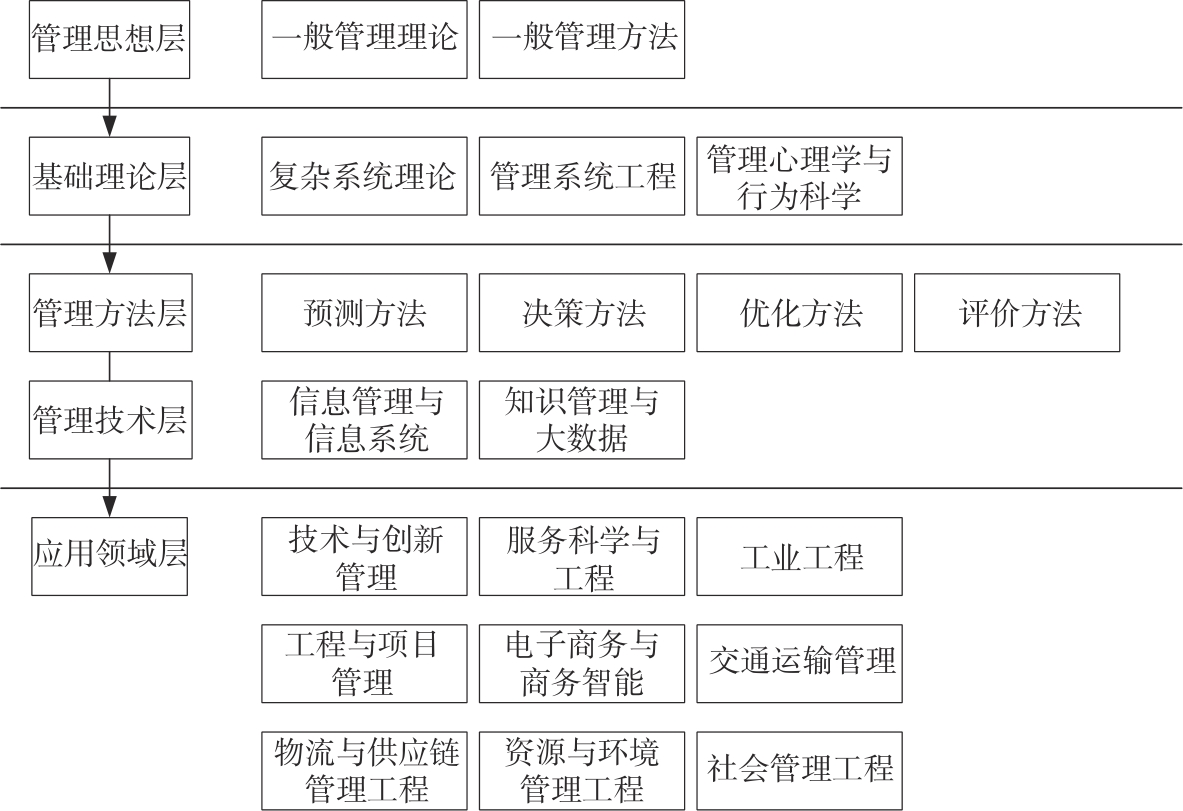
图1
管理科学与工程学科体系与研究领域"
| [1] | 杨善林, 胡祥培, 傅为忠. 企业管理学: 第四版[M]. 北京: 高等教育出版社, 2021. |
| Yang S L, Hu X P, Fu W Z. Enterprise management: 4th ed[M]. Beijing: Higher Education Press, 2021. | |
| [2] | 中国大百科全书(第三版)总编委会. 中国大百科全书: 管理科学与工程[M]. 北京: 中国大百科全书出版社, 2024. |
| Encyclopedia of China Editorial Board (3rd ed). Encyclopedia of China: management science and engineering[M]. Beijing: Encyclopedia of China Publishing House, 2024. | |
| [3] | 佘丛国, 席酉民. 国内外管理科学与工程研究热点的比较分析[J]. 科学学研究, 2002, 20(4): 406-410. |
| She C G, Xi Y M. Comparison and analysis of focal points of management science and engineering study between at home and abroad[J]. Studies in Science of Science, 2002, 20(4): 406-410. | |
| [4] | 徐伟宣, 李建平. 我国管理科学与工程学科的新进展[J]. 中国科学院院刊, 2008, 23(2): 162-167. |
| Xu W X, Li J P. New advances in management science and engineering in China[J]. Bulletin of Chinese Academy of Sciences, 2008, 23(2): 162-167. | |
| [5] | 余玉刚, 霍红, 李建平, 等. 管理科学与工程学科“十四五”发展战略与重点前沿领域研究报告[R].研究报告,科学出版社, 2023. |
| Yu Y G, Huo H, Li J P, et al. Research report on the “14th Five-Year” development strategy and key frontier areas of the discipline of management science and engineering[R]. Discussion Paper,Science Press, 2023. | |
| [6] | 汪应洛. 当代中国管理科学与工程的学科发展与创新[J]. 管理学报, 2005, 2(1): 1-3. |
| Wang Y L. Development and innovation of contemporary management science and engineering in China[J]. Chinese Journal of Management, 2005, 2(1): 1-3. | |
| [7] | 盛昭瀚, 霍红, 陈晓田, 等. 笃步前行 创新不止——我国管理科学与工程学科70年回顾、反思与展望[J]. 管理世界, 2021, 37(2): 185-202+213+13. |
| Sheng Z H, Huo H, Chen X T, et al. Moving forward with the everlasting progress of innovation: The review, reflection and prospect on seven decades of management science and engineering discipline in China[J]. Journal of Management World, 2021, 37(2): 185-202+213+13. | |
| [8] | 马庆国. “管理科学与工程”的学科定位与人才培养[J]. 高等教育研究, 2005, 26(12): 69-78. |
| Ma Q G. Disciplinary location of Managerial science and engineering and its education[J]. Journal of Higher Education, 2005, 26(12): 69-78. | |
| [9] | 张朋, 谢云东, 吴强, 等. 我国管理科学与工程学科研究热点及演化趋势[J]. 管理科学学报, 2022, 25(5): 1-12. |
| Zhang P, Xie Y D, Wu Q, et al. Hot topics and thematic evolutionary trends of researches on Management Science and Engineering in China[J]. Journal of Management Sciences in China, 2022, 25(5): 1-12. | |
| [10] | 李怀祖, 田鹤亭. “管理科学与管理工程”学科的中外比较分析[J]. 学位与研究生教育, 1994(4): 8-13. |
| Li H Z, Tian H T. A comparative analysis of “management science and management engineering” between China and foreign countries[J]. Academic Degrees & Graduate Education, 1994(4): 8-13. | |
| [11] | 张玲玲, 刘作仪, 李若筠, 等. 我国管理科学与工程学科的发展现状与趋势——基于专家调查问卷的分析[J]. 公共管理学报, 2006, 3(1): 99-106. |
| Zhang L L, Liu Z Y, Li R J /Y), et al. The state-of-arts and trend of the development of China’s management science and engineering—an analysis based on expert questionnaire[J]. Journal of Public Management, 2006, 3(1): 99-106. | |
| [12] | 霍红, 余玉刚, 郑圣明, 等. 国家自然科学基金管理科学与工程学科的申请代码与学科布局: 面向基础理论与时代变革[J]. 管理世界, 2021, 37(12): 208-217. |
| Huo H, Yu Y G, Zheng S M, et al. Application codes and discipline layout of NSFC’s management science and engineering: Towards fundamental theory and times transformation[J]. Journal of Management World, 2021, 37(12): 208-217. | |
| [13] | 成思危. 中国管理科学的学科结构与发展重点选择[J]. 管理科学学报, 2000, 3(1): 1-6. |
| Cheng S W. Structure and focal points of management sciences in China[J]. Journal of Manegement Sciences in China, 2000, 3(1): 1-6. | |
| [14] | 钱学森, 王寿云. 组织管理的技术——系统工程[N]. 文汇报, 1978-09-27(4). |
| Qian X S, Wang S Y. The technique of organizational management—systems engineering[N]. Wenhui Daily, 1978-09-27(4). | |
| [15] | 陈德泉, 计雷, 李之杰. 华罗庚教授在应用数学方面的贡献[J]. 数学进展, 1986, 15(3): 236-239. |
| Chen D Q, Ji L, Li Z J. Professor Hua Luogeng’s contribution to applied mathematics[J]. Advances in Mathematics, 1986, 15(3): 236-239. | |
| [16] | 钱学森, 于景元, 戴汝为. 一个科学新领域——开放的复杂巨系统及其方法论[J]. 自然杂志, 1990, 12(1): 3-10+64. |
| Qian X S, Yu J Y, Dai R W. A new field of science—Open complex giant system and its methodology[J]. Chinese Journal of Nature, 1990, 12(1): 3-10+64. | |
| [17] | Gu J F. The Wuli Shili Renli Approach (WSR): An oriental systems methodology[C]//Proceedings of Systems Methodology I: Possibilities for Cross Cultural Learning and Integration, Hull, UK, July, University of Hull Press, 1995: 29-38. |
| [18] | Deng J L. Control problems of grey systems[J]. Systems & Control Letters, 1982, 1(5): 288-294. |
| [19] | 席酉民, 熊畅, 刘鹏. 和谐管理理论及其应用述评[J]. 管理世界, 2020, 36(2): 195-209+212. |
| Xi Y M, Xiong C, Liu P. Review and discussion on the application of He Xie management theory[J]. Journal of Management World, 2020, 36(2): 195-209+212. | |
| [20] | 吴照云, 姜浩天. 中国管理学派:源起、发展与建设[J]. 中国文化与管理, 2022, (1): 2-16+224-225. |
| Wu Z Y, Jiang H T. Chinese management school: Origin, development and construction[J]. Chinese Culture and Management, 2022, (1): 2-16+224-225. | |
| [21] | 郭宇宽, 张宏云, 冯耕中. 自在、自证到自为的中国本土管理学——自主知识体系历史建构过程研究[J]. 中国管理科学, 2025, 33(1): 52-61. |
| Guo Y K, Zhang H Y, Feng G Z. From self-being, self-proving to self-conscious: The historical construction process of independent knowledge system in Chinese management science[J]. Chinese Journal of Management Science, 2025, 33(1): 52-61. | |
| [22] | 刘源张. 关于管理科学的几点思考[J]. 决策借鉴, 1995(5): 2-5. |
| Liu Y Z. Some reflections on management science[J]. Policy-making Reference, 1995(5): 2-5. | |
| [23] | Jia L, You S, Du Y. Chinese context and theoretical contributions to management and organization research: A three-decade review[J]. Management and Organization Review, 2012, 8(1): 173-209. |
| [24] | 郭重庆. 中国管理学界的社会责任与历史使命[J]. 中国科学院院刊, 2007, 22(2): 132-136. |
| Guo C Q. The social responsibility and historical mission of China management science academe[J]. Bulletin of Chinese Academy of Sciences, 2007, 22(2): 132-136. | |
| [25] | 苏东水, 赵晓康. 论东方管理文化复兴的现代意义[J]. 复旦学报(社会科学版), 2001, 43(6): 109-113+118. |
| Su D S, Zhao X K. Contemporary value of the revival of oriental management and culture[J]. Fudan Journal (Social Sciences Edition), 2001, 43(6): 109-113+118. | |
| [26] | 胡祖光, 朱明伟. 东方管理学13篇[M]. 北京: 中国经济出版社, 2002. |
| Hu Z G, Zhu M W. Thirteen essays on eastern management[M]. Beijing: China Economic Publishing House, 2002. | |
| [27] | 齐善鸿, 曹振杰. 道本管理论: 中西方管理哲学融和的视角[J]. 管理学报, 2009, 6(10): 1279-1284+1290. |
| Qi S H, Cao Z J. On the Tao-oriented management: A view of harmonization of management philosophy of China and the west[J]. Chinese Journal of Management, 2009, 6(10): 1279-1284+1290. | |
| [28] | 黄如金. 论和合公共管理——创新和合公共管理的基本分析[J]. 中国工业经济, 2006(10): 82-90. |
| Huang R J. Research on He-he public management[J]. China Industrial Economy, 2006(10): 82-90. | |
| [29] | 贾良定, 尤树洋, 刘德鹏, 等. 构建中国管理学理论自信之路——从个体、团队到学术社区的跨层次对话过程理论[J]. 管理世界, 2015, 31(1): 99-117. |
| Jia L D, You S Y, Liu D P, et al. Constructing the road of self-confidence in China’s management theory—The theory of cross-level dialogue process from individual, team to academic community[J]. Journal of Management World, 2015, 31(1): 99-117. | |
| [30] | 钱学森, 乌家培. 组织管理社会主义建设的技术——社会工程[J]. 经济管理, 1979, 1(1): 5-9. |
| Qian X S, Wu J P. Social engineering-the technology of organizing and managing socialist construction[J]. Economic Management, 1979, 1(1): 5-9. | |
| [31] | Tu X Y, Li X S, Sun K Y, et al. Intelligent management system (IMS)[J]. IFAC Proceedings Volumes, 1992, 25(16): 145-151. |
| [32] | Long D, Yang W, Scanlon B R, et al. South-to-North Water Diversion stabilizing Beijing’s groundwater levels[J]. Nature Communications, 2020, 11: 3665. |
| [33] | 盛昭瀚, 张维. 管理科学研究中的计算实验方法[J]. 管理科学学报, 2011, 14(5): 1-10. |
| Sheng Z H, Zhang W. Computational experiments in management science and research[J]. Journal of Management Sciences in China, 2011, 14(5): 1-10. | |
| [34] | 杨宏, 张昊, 周昊澄. 中国空间站工程技术与管理创新[J]. 工程管理科技前沿, 2022, 41(3): 1-6. |
| Yang H, Zhang H, Zhou H C. Engineering technology and management innovation of China space station[J]. Frontiers of Science & Technology of Engineering Management, 2022, 41(3): 1-6. | |
| [35] | 林鸣. 基于建设世界一流工程的工程伦理思考[J]. 工程管理科技前沿, 2022, 41(2): 1-7. |
| Lin M. Engineering ethics reflection on world-class project construction[J]. Frontiers of Science & Technology of Engineering Management, 2022, 41(2): 1-7. | |
| [36] | 凌文辁. 行为科学在中国[J]. 战略决策研究, 2010, 1(3): 39-44. |
| Ling W Q. Behavioral science in China[J]. Journal of Strategy and Decision-Making, 2010, 1(3): 39-44. | |
| [37] | 俞文钊. 中国的激励理论及其模式[M]. 上海: 华东师范大学出版社, 1993. |
| Yu W Z. China’s incentive theory and its model[M]. Shanghai: East China Normal University Press, 1993. | |
| [38] | 林姿葶, 郑伯埙, 周丽芳. 家长式领导之回顾与前瞻: 再一次思考[J]. 管理学季刊, 2017(4): 1-32. |
| Lin Z T, Zheng B X, Zhou L F. Paternalistic leadership theory: A critical review[J]. Quarterly Journal of Management, 2017(4): 1-32. | |
| [39] | 陈国权. 领导和管理的时空理论[J]. 中国管理科学, 2017, 25(1): 181-196. |
| Chen G Q. Time-space theory of leadership and management[J]. Chinese Journal of Management Science, 2017, 25(1): 181-196. | |
| [40] | 王重鸣, 阳浙江. 创业型领导理论研究及发展趋势[J]. 心理科学, 2006, 29(4): 774-777. |
| Wang Z M, Yang Z J. Researches on entrepreneurial leadership theories and their trends[J]. Psychological Science, 2006, 29(4): 774-777. | |
| [41] | 中国科学院数学研究所线性规划组. 物資調运工作中的先进方法——圖上作業法[J]. 数学通报, 1958(11): 2-6. |
| Linear Programming Group, Institute of Mathematics, Chinese Academy of Sciences. An advanced method in material dispatching—Drawing operation method[J]. Mathematical Bulletin, 1958(11): 2-6. | |
| [42] | 刘源张. 运筹学在纺织工业中的应用[M]. 北京: 科学技术出版社, 1960. |
| Liu Y Z. Application of operational research in textile industry[M]. Beijing: Science Press, 1960. | |
| [43] | 越民义. 排队论中之一问题——M/W/n[J]. 数学学报, 1959, 2(4): 494-502. |
| Yue M Y. On the problem M/W/n in the theory of queues[J]. Acta Mathematica Sinica, 1959, 2(4): 494-502. | |
| [44] | Kwan M K. Graphic programming using odd or even points[J]. Chinese Mathematics, 1962(1): 263-266. |
| [45] | 郑维敏. 关于知识库[J]. 系统工程理论与实践, 1984, 4(2): 8–14. |
| Zheng W M. About knowledge base[J]. Systems Engineering-theory & Practice, 1984, 4(2): 8-14. | |
| [46] | 陈锡康. 全国粮食产量预测研究[J]. 中国科学院院刊, 1992, 7(4): 330-333. |
| Chen X K. Study on national grain output forecast[J]. Bulletin of Chinese Academy of Sciences, 1992, 7(4): 330-333. | |
| [47] | Yu J, Li S, Wang Y, et al. Optimal decay rate of vibrating beam equations controlled by combined boundary feedback forces[J]. Science in China Series E: Technological Sciences, 1999, 42(4): 354-364. |
| [48] | 汪应洛. 支持快速产品创新的先进制造模式及其管理研究[J]. 中国机械工程, 2000, 11(S1): 86-88. |
| Wang Y L. Research on advanced manufacturing mode supporting rapid product innovation[J]. China Mechanical Engineering, 2000, 11(S1): 86-88. | |
| [49] | Yang S L, Hu X, Fang F. Representation and decomposition of complex decision-making tasks in AOBDIDSS[J]. Tsinghua Science and Technology, 2005, 10(S1): 811–816. |
| [50] | Ding L Y, Zhou C, Deng Q X, et al. Real-time safety early warning system for cross passage construction in Yangtze Riverbed Metro Tunnel based on the internet of things[J]. Automation in Construction, 2013, 36: 25-37. |
| [51] | Tang L X, Li F, Chen Z L. Integrated scheduling of production and two-stage delivery of make-to-order products: Offline and online algorithms[J]. INFORMS Journal on Computing, 2019, 31(3): 493-514. |
| [52] | Wang S Y, Zhang X, Zhao L. Why the effects of oil price shocks on China’s economy are changing[J]. The Energy Journal, 2020, 41(6): 107-132. |
| [53] | Wei Y M, Liu L C, Kang J N, et al. Navigating energy transition solutions for climate targets with minerals constraint[J]. Nature Climate Change, 2025, 15(8): 833-841. |
| [54] | Liang L, Wu J, Cook W D, et al. The DEA game cross-efficiency model and its Nash equilibrium[J]. Operations Research, 2008, 56(5): 1278-1288. |
| [55] | Liang Z, Xiao F, Qian X, et al. A column generation-based heuristic for aircraft recovery problem with airport capacity constraints and maintenance flexibility[J]. Transportation Research Part B: Methodological, 2018, 113: 70-90. |
| [56] | Hao J, Yuan J, Li J. HCEG: A heterogeneous clustering ensemble learning approach with gravity-based strategy for data assets intelligent pricing[J]. Information Sciences, 2024, 678: 121082. |
| [57] | Wang Y, Zhang Q, Yang X. Evolution of the Chinese guarantee network under financial crisis and stimulus program[J]. Nature Communications, 2020, 11: 2693. |
| [58] | Li Q, Zeng D D, Xu D J, et al. Understanding and predicting users’ rating behavior: A cognitive perspective[J]. INFORMS Journal on Computing, 2020, 32(4): 996-1011. |
| [59] | Zeng G, Gao J, Shekhtman L, et al. Multiple metastable network states in urban traffic[J]. PNAS, 2020, 117(30): 17528-17534. |
| [60] | Zhang L M, Zeng G W, Li D Q, et al. Scale-free resilience of real traffic Jams[J]. Proceedings of the National Academy of Sciences of the United States of America, 2019, 116(18): 8673-8678. |
| [61] | Hua Z, Chen W, Zhang Z G. Competition and coordination in two-tier public service systems under government fiscal policy[J]. Production and Operations Management, 2016, 25(8): 1430-1448. |
| [62] | 黄梯云, 马天超, 潘启树. 微型计算机与数学方法在生产计划优化决策系统中应用研究[J]. 哈尔滨工业大学学报, 1983, 15(3): 92-102. |
| Huang T Y, Ma T C, Pan Q S. Study on application of microcomputer and mathematical method in decision making information processing system for optimization of production[J]. Journal of Harbin Institute of Technology, 1983, 15(3): 92-102. | |
| [63] | 马费成, 杨列勋. 信息资源——它的定义、内容、划分、特征及开发利用[J]. 情报理论与实践, 1993, 16(2): 1-3+32. |
| Ma F C, Yang L X. Information resources-its definition, content, division, characteristics and development and utilization[J]. Information Studies (Theory & Application), 1993, 16(2): 1-3+32. | |
| [64] | Chau P Y K, Tam K Y. Factors affecting the adoption of open systems: An exploratory study[J]. MIS Quarterly, 1997, 21(1): 1-24. |
| [65] | 吴晓波. 二次创新的周期与企业组织学习模式[J]. 管理世界, 1995, 11(3): 168-172. |
| Wu X B. The cycle of secondary innovation and the organizational learning model of enterprises[J]. Journal of Management World, 1995, 11(3): 168-172. | |
| [66] | 陈禹. 信息化进程中经济运行机制和产业结构的变化[J]. 电子展望与决策, 1996(3): 23-24. |
| Chen Y. Changes of economic operation mechanism and industrial structure in the process of informatization[J]. Computer Security,1996(3): 23-24. | |
| [67] | 王众托. 知识管理系统初探[C]//中国系统工程学会第十届年会论文集. 大连, 中国, October 15-17, 1998. |
| Wang Z T. A preliminary exploration of knowledge management systems[C]//Proceedings of the 10th Annual Conference of Chinese Society for Systems Engineering. Dalian, China, October 15-17, 1998. | |
| [68] | 张巨俭, 甘仞初. 管理信息系统的发展方向及实现技术[J]. 计算机应用研究, 2003, 20(1): 8-10. |
| Zhang J J, Gan R C. The trend of the management information system development and realization technology[J]. Application Research of Computers, 2003, 20(1): 8-10. | |
| [69] | 赖茂生, 杨秀丹, 胡晓峰, 等. 信息资源开发利用基本理论研究[J]. 情报理论与实践, 2004, 27(3): 229-235. |
| Lai M S, Yang X D, Hu X F, et al. Research on the basic theory of information resources development and utilization[J]. Information Studies: Theory & Application, 2004, 27(3): 229-235. | |
| [70] | 陈晓红, 高原康彦. 一种新的决策支持系统开发方法——层次模型法[J]. 系统工程, 2000, 18(4): 58-63+72. |
| Chen X H, Gao Y K Y. A new decision support system development method-layer model method[J]. Systems Engineering, 2000, 18(4): 58-63+72. | |
| [71] | 李常洪, 李敏强, 寇纪淞. 多Agent合作结构研究[J]. 管理科学学报, 2003, 6(5): 6-11. |
| Li C H, Li M Q, Kou J S. On cooperation structure of multi-agent[J]. Journal of Management Sciences in China, 2003, 6(5): 6-11. | |
| [72] | 黎志成, 聂晖, 谢颂华. 基于过程知识库的管理人员群体行为定性模拟研究[J]. 科技进步与对策, 2005, 22(7): 5-7. |
| Li Z C, Nie H, Xie S H. Qualitative simulation of managers’ group behavior based on process knowledge database[J]. Science & Technology Progress and Policy, 2005, 22(7): 5-7. | |
| [73] | 乌家培. 经济学与管理学的关系[J]. 管理科学学报, 2000, 3(2): 82-83. |
| Wu J P. The relationship between economics and management[J]. Journal of Manegement Sciences in China, 2000, 3(2): 82-83. | |
| [74] | 马庆国, 王小毅. 从神经经济学和神经营销学到神经管理学[J]. 管理工程学报, 2006, 20(3): 129-132. |
| Ma Q G, Wang X Y. From neuroeconomics and neuromarketing to neuromanagement[J]. Journal of Industrial Engineering and Engineering Management, 2006, 20(3): 129-132. | |
| [75] | 杨善林, 周开乐. 大数据中的管理问题: 基于大数据的资源观[J]. 管理科学学报, 2015, 18(5): 1-8. |
| Yang S L, Zhou K L. Management issues in big data: The resource-based view of big data[J]. Journal of Management Sciences in China, 2015, 18(5): 1-8. | |
| [76] | 陈国青, 吴刚, 顾远东, 等. 管理决策情境下大数据驱动的研究和应用挑战——范式转变与研究方向[J]. 管理科学学报, 2018, 21(7): 1-10. |
| Chen G Q, Wu G, Gu Y D, et al. The challenges for big data driven research and applications in the context of managerial decision-making: Paradigm shift and research directions[J]. Journal of Management Sciences in China, 2018, 21(7): 1-10. | |
| [77] | Grover V, Chiang R H L, Liang T P, et al. Creating strategic business value from big data analytics: A research framework[J]. Journal of Management Information Systems, 2018, 35(2): 388-423. |
| [78] | Li L, Su F, Zhang W, et al. Digital transformation by SME entrepreneurs: A capability perspective[J]. Information Systems Journal, 2018, 28(6): 1129-1157. |
| [79] | 周钟, 陈智高. 产业集群网络中知识转移行为仿真分析——企业知识刚性视角[J]. 管理科学学报, 2015, 18(1): 41-49. |
| Zhou Z, Chen Z G. Simulation of knowledge transfers in industrial cluster networks: A firm’s knowledge rigidity perspective[J]. Journal of Management Sciences in China, 2015, 18(1): 41-49. | |
| [80] | 马庆国, 付辉建, 卞军. 神经工业工程: 工业工程发展的新阶段[J]. 管理世界, 2012, 28(6): 163-168+179. |
| Ma Q G, Fu H J, Bian J. Neuroindustrial engineering: A new stage of industrial engineering development[J]. Journal of Management World, 2012, 28(6): 163-168+179. | |
| [81] | 曾大军, 李一军, 唐立新, 等. 决策智能理论与方法研究[J]. 管理科学学报, 2021, 24(8): 18-25. |
| Zeng D J, Li Y J, Tang L X, et al. Decision intelligence research: Theory and methods[J]. Journal of Management Sciences in China, 2021, 24(8): 18-25. | |
| [82] | Han E, Yin D, Zhang H. Bots with feelings: Should AI agents express positive emotion in customer service?[J]. Information Systems Research, 2023, 34(3): 1296-1311. |
| [83] | Chen G, Huang L, Xiao S, et al. Attending to customer attention: A novel deep learning method for leveraging multimodal online reviews to enhance sales prediction[J]. Information Systems Research, 2024, 35(2): 829-849. |
| [84] | 曾仕强. 中国式管理[J]. 企业文化, 2005(8): 74-77. |
| Zeng S Q. Chinese style management[J]. Culture Corporate, 2005(8): 74-77. | |
| [85] | 成中英. C理论——中国管理哲学[M]. 修订版. 北京: 东方出版社, 2011. |
| Cheng Z Y. C theory-China’s management philosophy[M]. Revised ed. Beijing: Oriental Press, 2011. | |
| [86] | 徐淑英, 吕力. 中国本土管理研究的理论与实践问题: 对徐淑英的访谈[J]. 管理学报, 2015, 12(3): 313-321. |
| Xu S Y, Lü L. The theoretical and practical issues in Chinese indigenous management research[J]. Chinese Journal of Management, 2015, 12(3): 313-321. | |
| [87] | 汪寿阳, 余乐安, 黎建强. TEI@I方法论及其在外汇汇率预测中的应用[J]. 管理学报, 2007, 4(1): 21-27. |
| Wang S Y, Yu L A, Li J Q. TEI@I methodology and its application to exchange rates prediction[J]. Chinese Journal of Management, 2007, 4(1): 21-27. | |
| [88] | 盛昭瀚. 扎根中国实践是我国管理学研究的优良品格[J]. 管理工程学报, 2024, 38(2): 1-7. |
| Sheng Z H. Taking root in Chinese practice is the excellent character of China’s management research[J]. Journal of Industrial Engineering and Engineering Management, 2024, 38(2): 1-7. | |
| [89] | 汪应洛. 系统工程理论、方法与应用[M]. 2版. 北京: 高等教育出版社, 1998. |
| Wang Y L. Theory, method and application of systems engineering[M]. 2nd ed. Beijing: Higher Education Press, 1998. | |
| [90] | Wang F Y. Parallel control and management for intelligent transportation systems: Concepts, architectures, and applications[J]. IEEE Transactions on Intelligent Transportation Systems, 2010, 11(3): 630-638. |
| [91] | 王红卫, 李珏, 刘建国, 等. 人机融合复杂社会系统研究[J]. 中国管理科学, 2023, 31(7): 1-21. |
| Wang H W, Li J, Liu J G, et al. Research on human-machine integration complex social system[J]. Chinese Journal of Management Science, 2023, 31(7): 1-21. | |
| [92] | Wei Y M, Han R, Liang Q M, et al. An integrated assessment of INDCs under shared socioeconomic pathways: An implementation of C3IAM[J]. Natural Hazards, 2018, 92(2): 585-618. |
| [93] | Jia J S, Lu X, Yuan Y, et al. Population flow drives spatio-temporal distribution of COVID-19 in China[J]. Nature, 2020, 582(7812): 389-394. |
| [94] | Tang Z Y, Tian L J, Liu P, et al. Parking reservation scheme in a commuting system with shared autonomous vehicles and parking space constraint[J]. Transportation Research Part B: Methodological, 2025, 192: 103116. |
| [95] | Wang L, Yan L, Zhou T, et al. Understanding physicians’ online-offline behavior dynamics: An empirical study[J]. Information Systems Research, 2020, 31(2): 537-555. |
| [96] | Jia N, Luo X, Fang Z, et al. When and how artificial intelligence augments employee creativity[J]. Academy of Management Journal, 2024, 67(1): 5-32. |
| [97] | Lin Z, Goh K Y, Heng C S. The demand effects of product recommendation networks: An empirical analysis of network diversity and stability[J]. MIS Quarterly, 2017, 41(2): 397-426. |
| [98] | Song P, Xue L, Rai A, et al. The ecosystem of software platform: A study of asymmetric cross-side network effects and platform governance[J]. MIS Quarterly,2018, 42(1): 121-142. |
| [99] | He G, Pan Y, Park A, et al. Reducing single-use cutlery with green nudges: Evidence from China’s food-delivery industry[J]. Science, 2023, 381(6662): eadd9884. |
| [100] | Li Y, Li N, Guo J, et al. A network view of advice-giving and individual creativity in teams: A brokerage-driven, socially perpetuated phenomenon[J]. Academy of Management Journal, 2018, 61(6): 2210-2229. |
| [101] | Bloom N, Han R, Liang J. Hybrid working from home improves retention without damaging performance[J]. Nature, 2024, 630(8018): 920-925. |
| [102] | 凌文辁, 陈龙, 王登. CPM领导行为评价量表的建构[J]. 心理学报, 1987, 19(2): 199-207. |
| Ling W Q, Chen L, Wang D. Construction of cpm scale for leadership behavior assessment[J]. Acta Psychologica Sinica, 1987, 19(2): 199-207. | |
| [103] | 郑伯埙, 周丽芳, 黄敏萍, 等. 家长式领导的三元模式: 中国大陆企业组织的证据[J]. 本土心理学研究, 2003(20): 209-252. |
| Cheng B S, Zhou L F, Huang M P, et al. The triarchic model of paternalistic leadership: Evidence from Chinese enterprises in China’s mainland[J]. Indigenous Psychological Research, 2003(20): 209-252. | |
| [104] | Cheng Z, Rai A, Tian F, et al. Social learning in information technology investment: The role of board interlocks[J]. Management Science, 2021, 67(1): 547-576. |
| [105] | Zhou K Z, Gao G Y, Zhao H. State ownership and firm innovation in China: An integrated view of institutional and efficiency logics[J]. Administrative Science Quarterly, 2017, 62(2): 375-404. |
| [106] | Fisman R, Huang W, Ning B, et al. Superstition and risk taking: Evidence from “zodiac year” beliefs in China[J]. Management Science, 2023, 69(9): 5174-5188. |
| [107] | Li Z F, Wang S Y, Deng X T. A linear programming algorithm for optimal portfolio selection with transaction costs[J]. International Journal of Systems Science, 2000, 31(1): 107-117. |
| [108] | He S, Li Z, Zhang S. Approximation algorithms for homogeneous polynomial optimization with quadratic constraints[J]. Mathematical Programming, 2010, 125(2): 353-383. |
| [109] | 孙会君, 高自友. 一类有竞争的物流配送中心选址模型[J]. 交通运输工程学报, 2002, 2(4): 54-57. |
| Sun H J, Gao Z Y. Competitive location model of logistics distribution center[J]. Journal of Traffic and Transportation Engineering, 2002, 2(4): 54-57. | |
| [110] | Li C, Wang M, Huang H J. The corridor problem: More comprehensive results on the no-toll equilibrium[J]. Transportation Research Part B: Methodological, 2025, 194: 103187. |
| [111] | 罗治洪, 唐立新, 张悟移. 钢铁原料物流计划问题的建模与求解[J]. 系统工程理论与实践, 2008, 28(5): 77-84+104. |
| Luo Z H, Tang L X, Zhang W Y. Modeling and solving to raw materials logistics planning problem in iron and steel industry[J]. Systems Engineering-Theory & Practice, 2008, 28(5): 77-84+104. | |
| [112] | 唐坚强, 祁超, 王红卫. 带时间窗的多仓库订单拆分与异构车辆路径联合优化方法[J]. 系统工程理论与实践, 2023, 43(5): 1446-1464. |
| Tang J Q, Qi C, Wang H W. Integrated optimization approach to multi-depot order splitting and heterogeneous vehicle routing with time windows[J]. Systems Engineering-Theory & Practice, 2023, 43(5): 1446-1464. | |
| [113] | Li Y, Cai X, Xu L, et al. Heuristic approach on dynamic lot-sizing model for durable products with end-of-use constraints[J]. Annals of Operations Research, 2016, 242(2): 265-283. |
| [114] | Wang D, Fu M. A hierarchical dynamic programming approach for sequencing hydro power projects[J]. IFAC Proceedings Volumes, 1985, 18(9): 339-344. |
| [115] | 王沛, 谭跃进. 多星联合对地观测调度问题的列生成算法[J]. 系统工程理论与实践, 2011, 31(10): 1932-1939. |
| Wang P, Tan Y J. Column generation for the earth observation satellites scheduling problem[J]. Systems Engineering —Theory & Practice, 2011, 31(10): 1932-1939. | |
| [116] | Zhou S, Ding Y, Huh W T, et al. Constant job-allowance policies for appointment scheduling: Performance bounds and numerical analysis[J]. Production and Operations Management, 2021, 30(7): 2211-2231. |
| [117] | Zhang Q, Li H. MOEA/D: A multiobjective evolutionary algorithm based on decomposition[J]. IEEE Transactions on Evolutionary Computation, 2007, 11(6): 712-731. |
| [118] | Yu Y, Tang J, Gong J, et al. Mathematical analysis and solutions for multi-objective line-cell conversion problem[J]. European Journal of Operational Research, 2014, 236(2): 774-786. |
| [119] | Wang F, Lai X, Shi N. A multi-objective optimization for green supply chain network design[J]. Decision Support Systems, 2011, 51(2): 262-269. |
| [120] | Chen J, Liang Y, Shen H, et al. Offline-channel planning in smart omnichannel retailing[J]. Manufacturing & Service Operations Management, 2022, 24(5): 2444-2462. |
| [121] | Liang Z, Feng Y, Zhang X, et al. Robust weekly aircraft maintenance routing problem and the extension to the tail assignment problem[J]. Transportation Research Part B: Methodological, 2015, 78: 238-259. |
| [122] | Shu J, Song M. Dynamic container deployment: Two-stage robust model, complexity, and computational results[J]. INFORMS Journal on Computing, 2014, 26(1): 135-149. |
| [123] | 徐光煇. 随机服务系统GI/M/n的k阶忙期[J]. 中国科学, 1977, 7(1): 60-68. |
| Xu G H. K-order busy period of GI/M/n in random service system[J]. Scientia Sinica (Mathematica), 1977, 7(1): 60-68. | |
| [124] | Xu Z. Uncertain Multi-attribute decision making: methods and applications[M]. Berlin, Heidelberg: Springer, 2015. |
| [125] | Jiang Y, Shang J, Kemerer C F, et al. Optimizing E-tailer profits and customer savings: Pricing multistage customized online bundles[J]. Marketing Science, 2011, 30(4): 737-752. |
| [126] | Yang M, Wang Z, Liang L. A novel centralized cross-efficiency evaluation via explainable artificial intelligence in the context of big data[J]. European Journal of Operational Research, 2025, 327(1): 247-262. |
| [127] | 胡祥培, 李永刚, 孙丽君, 等. 基于物联网的在线智能调度决策方法[J]. 管理世界, 2020, 36(8): 178-189. |
| Hu X P, Li Y G, Sun L J, et al. Online intelligent scheduling decision approaches based on Internet of Things[J]. Journal of Management World, 2020, 36(8): 178-189. | |
| [128] | Huang C, Tang Z, Hu S, et al. ORLM: A customizable framework in training large models for automated optimization modeling[J]. Operations Research, 2025, 73(6): 2986-3009. |
| [129] | 黄梯云, 梁昌勇, 杨善林. 集成定性推理的IDSS结构模型研究[J]. 管理科学学报, 2000, 3(4): 84-89. |
| Huang T Y, Liang C Y, Yang S L. Research on the structure model of IDSS integrating qualitative reasoning[J]. Journal of Management Sciences in China, 2000, 3(4): 84-89. | |
| [130] | 谢康, 肖静华, 周先波, 等. 中国工业化与信息化融合质量: 理论与实证[J]. 经济研究, 2012, 47(1): 4-16+30. |
| Xie K, Xiao J H, Zhou X B, et al. Quality of convergence between industrialization and informatization in China[J]. Economic Research Journal, 2012, 47(1): 4-16+30. | |
| [131] | 张维, 曾大军, 李一军, 等. 混合智能管理系统理论与方法研究[J]. 管理科学学报, 2021,24(8): 10-17. |
| Zhang W, Zeng D J, Li Y J, et al. Hybrid intelligence management system research: Theory and methods[J]. Journal of Management Sciences in China, 2021,24(8): 10-17. | |
| [132] | 谭跃进, 吕欣, 葛冰峰, 等. 基于模型的高端装备创新研制任务集成管理[J]. 管理世界, 2023, 39(1): 204-215. |
| Tan Y J, Lu X, Ge B F, et al. Model-based task integration management on the innovative development of high-end equipment manufacturing[J]. Journal of Management World, 2023, 39(1): 204-215. | |
| [133] | Kwok R C W, Ma J, Vogel D R. Effects of group support systems and content facilitation on knowledge acquisition[J]. Journal of Management Information Systems, 2002, 19(3): 185–229. |
| [134] | 荣莉莉, 王众托. 基于知识和模糊神经网络的学习型评价系统[J]. 管理科学学报, 2003, 6(3): 1-7. |
| Rong L L, Wang Z T. Learning evaluation system based on knowledge and fuzzy neural networks[J]. Journal of Management Sciences in China, 2003, 6(3): 1-7. | |
| [135] | 徐宗本, 冯芷艳, 郭迅华, 等. 大数据驱动的管理与决策前沿课题[J]. 管理世界, 2014, 30(11): 158-163. |
| Xu Z B, Feng Z Y, Guo X H, et al. Frontier topics of management and decision-making driven by big data[J]. Journal of Management World, 2014, 30(11): 158-163. | |
| [136] | 巴志超, 李纲, 安璐, 等. 国家安全大数据综合信息集成: 应用架构与实现路径[J]. 中国软科学, 2018(7): 9-20. |
| Ba Z C, Li G, An L, et al. Information integration of big data for national security: Application architecture and realization methods[J]. China Soft Science, 2018(7): 9-20. | |
| [137] | Baesens B, Bapna R, Marsden J R, et al. Transformational issues of big data and analytics in networked business[J]. MIS Quarterly, 2016, 40(4): 807-818. |
| [138] | 陈剑, 刘运辉. 数智化使能运营管理变革: 从供应链到供应链生态系统[J]. 管理世界, 2021, 37(11): 227-240+14. |
| Chen J, Liu Y H. Operations management innovation enabled by digitalization and intellectualization: From supply chain to supply chain ecosystem[J]. Journal of Management World, 2021, 37(11): 227-240+14. | |
| [139] | 盛昭瀚, 薛小龙, 安实. 构建中国特色重大工程管理理论体系与话语体系[J]. 管理世界, 2019, 35(4): 2-16+51+195. |
| Sheng Z H, Xue X L, An S. Constructing theoretical system and discourse system of mega infrastructure construction management with Chinese characteristics[J]. Journal of Management World, 2019, 35(4): 2-16+51+195. | |
| [140] | 杨善林, 王建民, 侍乐媛, 等. 新一代信息技术环境下高端装备智能制造工程管理理论与方法[J]. 管理世界, 2023, 39(1): 177-190. |
| Yang S L, Wang J M, Shi L Y, et al. Engineering management theory and methodology for high-end equipment intelligent manufacturing in the era of new-generation information technology[J]. Journal of Management World, 2023, 39(1): 177-190. | |
| [141] | 王红卫, 钟波涛, 李永奎, 等. 大型复杂工程智能建造与运维的管理理论和方法[J]. 管理科学, 2022, 35(1): 55-59. |
| Wang H W, Zhong B T, Li Y K, et al. Management theory and method of intelligent construction, operation and maintenance for large-scale complex projects[J]. Journal of Management Science, 2022, 35(1): 55-59. | |
| [142] | 杨善林, 华中生. 关于服务科学及其研究的思考[J]. 信息与管理研究, 2018, 3(Z1): 1-14. |
| Yang S L, Hua Z S. Reflect on service science and researches related with it[J]. Journal of Information and Management, 2018, 3(Z1): 1-14. | |
| [143] | 吴晓波, 林福鑫, 邵贻玥, 等. 关键用户驱动的复杂产品系统创新: 以中国盾构机的超越追赶为例[J]. 科研管理, 2025, 46(5): 44-54. |
| Wu X B, Lin F X, Shao Y Y, et al. Key user-driven innovation of complex product systems: A case study of the beyond catch-up of China’s shield machine[J]. Science Research Management, 2025, 46(5): 44-54. | |
| [144] | 杨善林, 李霄剑, 莫杭杰, 等. 科技战略供应链的基本特征与关键科学问题[J]. 中国管理科学, 2025, 33(1): 1-13. |
| Yang S L, Li X J, Mo H J, et al. The basic characteristics and key scientific problems of technology strategic supply chain[J]. Chinese Journal of Management Science, 2025, 33(1): 1-13. | |
| [145] | 席酉民, 汪应洛, 陶谦坎. 大型水利工程建设决策研究[J]. 系统工程理论与实践, 1986, 6(1): 12-18. |
| Xi Y M, Wang Y L, Tao Q K. Study on decision-making of large-scale water conservancy project construction[J]. Systems Engineering-theory & Practice, 1986, 6(1): 12-18. | |
| [146] | 汪恭书, 殷振豪, 蔡超勋, 等. 川藏铁路建设预制化生产物流运作管理模式研究[J]. 工程管理学报, 2020, 34(5): 58-63. |
| Wang G S, Yin Z H, Cai C X, et al. Research on the operation management mode of prefabricated production and logistics in Sichuan-Tibet railway project[J]. Journal of Engineering Management, 2020, 34(5): 58-63. | |
| [147] | 蔡文. 可拓集合和不相容问题[J]. 科学探索, 1983, 3(1): 83–97. |
| Cai W. Extension set and incompatible problems[J]. Exploration of Science, 1983, 3(1): 83–97. | |
| [148] | 栾恩杰. 系统工程思想的演化: 古代先贤的系统工程观到当代复杂系统工程方法[J]. 工程管理科技前沿, 2022, 41(5): 1-8. |
| Luan E J. The evolution of system engineering thought: From the system engineering view of ancient Chinese scholars to the contemporary complex system engineering method[J]. Frontiers of Science and Technology of Engineering Management, 2022, 41(5): 1-8. | |
| [149] | 高鑫, 宋瑞震, 曾赛星, 等. 基于随机演化博弈的重大调水工程生态补偿: 以南水北调工程为例[J]. 工程管理科技前沿, 2022, 41(1): 26-34. |
| Gao X, Song R Z, Zeng S X, et al. Ecological compensation of major water transfer project based on stochastic evolutionary game: A case study of south-to-north water transfer project[J]. Frontiers of Science and Technology of Engineering Management, 2022, 41(1): 26-34. | |
| [150] | 赵克勤. 集对与集对分析——一个新的概念和一种新的系统分析方法[C]//全国系统理论与区域规划研讨会论, 包头, 中国, 8月10-13日, 1989. |
| Zhao K Q. Set pair and set pair analysis—a new concept and a new system analysis method[C]//Proceedings of the National Symposium on Systems Theory and Regional Planning, Baotou, China, August 10-13, 1989. | |
| [151] | 熊乐宁. 数字时代,华为如何重塑供应链?[J]. 华为技术, 2022, (3): 66-71. |
| Xiong L N. How Huawei reshapes its supply chain in the digital era?[J]. Huawei Technologies, 2022, (3): 66-71. | |
| [152] | 史培军, 张欢. 中国应对巨灾的机制——汶川地震的经验[J]. 清华大学学报(哲学社会科学版), 2013, 28(3): 96-113+160. |
| Shi P J, Zhang H. China’s response to the catastrophe: The experience of Wenchuan earthquake[J]. Journal of Tsinghua University (Philosophy and Social Sciences), 2013, 28(3): 96-113+160. |
| [1] | 郭宇宽, 张宏云, 冯耕中. 自在、自证到自为的中国本土管理学[J]. 中国管理科学, 2025, 33(1): 52-61. |
| [2] | 陈国权, 吴凡, 王婧懿, 林燕玲, 付悦, 罗庆烨. 时空理论的研究进展和未来展望[J]. 中国管理科学, 2025, 33(1): 195-208. |
| [3] | 霍红. 国家自然科学基金资助体系中管理科学与工程学科的资助特点与发展路径[J]. 中国管理科学, 2023, 31(1): 1-8. |
| [4] | 舒嘉, 丁溢, 倪文君. 管理科学与工程理论与方法突破若干重点前沿领域[J]. 中国管理科学, 2022, 30(5): 27-30. |
| 阅读次数 | ||||||
|
全文 |
|
|||||
|
摘要 |
|
|||||
|
||
