
主管:中国科学院
主办:中国优选法统筹法与经济数学研究会
中国科学院科技战略咨询研究院
主办:中国优选法统筹法与经济数学研究会
中国科学院科技战略咨询研究院

中国管理科学 ›› 2026, Vol. 34 ›› Issue (4): 34-46.doi: 10.16381/j.cnki.issn1003-207x.2024.0854cstr: 32146.14.j.cnki.issn1003-207x.2024.0854
丁松1,2,3( ), 神兴傲4, 党耀国5, 郭旭鹏5
收稿日期:2024-05-30
修回日期:2024-10-17
出版日期:2026-04-25
发布日期:2026-03-27
通讯作者:
丁松
E-mail:dingsong1129@163.com
基金资助:
Song Ding1,2,3(), Xingao Shen4, Yaoguo Dang5, Xupeng Guo5
Received:2024-05-30
Revised:2024-10-17
Online:2026-04-25
Published:2026-03-27
Contact:
Song Ding
E-mail:dingsong1129@163.com
摘要:
现实经济系统中,主系统发展趋势易受到邻近区域溢出效应的影响,而当前灰色多变量模型仅考虑关联变量的时间效用,忽视了相邻区域的动态空间邻近效应。因此,本文基于地理距离和经济距离构建出新型综合空间邻近项以衡量空间邻近效应,并据此建立三类考虑空间邻近效应的新型灰色多变量模型。同时,创造性地设计出模型智能算法筛选程序,使用三项算法匹配判断准则,为三类灰色多变量模型选择最佳智能寻优算法,提高模型超参数求解的可靠性、稳定性和可解释性。最后,将三类新型灰色多变量模型应用于上海市经济总量的预测研究,综合利用误差指标、统计检验、蒙特卡洛模拟等方法,验证了所提模型的有效性和稳健性。
中图分类号:
丁松,神兴傲,党耀国, 等. 考虑空间邻近效应的经济时间序列预测建模与应用研究[J]. 中国管理科学, 2026, 34(4): 34-46.
Song Ding,Xingao Shen,Yaoguo Dang, et al. Modelling and Application of Economic Time Series Forecasting Considering Spatial Proximity Effect[J]. Chinese Journal of Management Science, 2026, 34(4): 34-46.
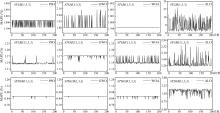
图1
备选算法与三类时空灰色多变量模型的蒙特卡洛仿真折线图"
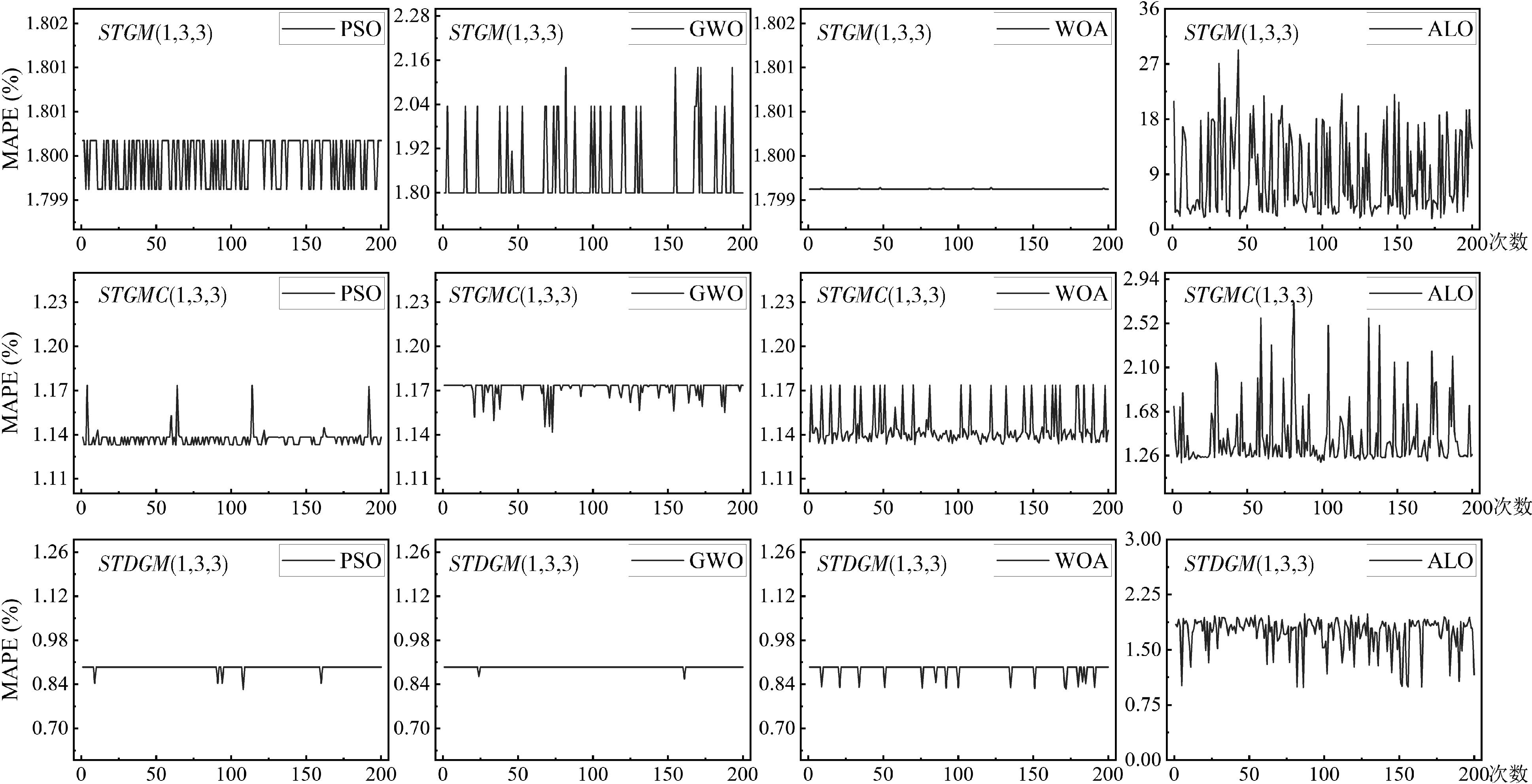

表1
候选算法与基准算法的DM检验和Wilcoxon检验结果"
| 模型 | 基准 算法 | 候选 算法 | DM检验 | Wilcoxon检验 | |
|---|---|---|---|---|---|
| DM值 | P值 | P值 | |||
STGMC (1, 3, 3) | PSO | GWO | -55.9186 | 0.0000 | 0.0000 |
| WOA | -10.6447 | 0.0000 | 0.0000 | ||
| ALO | -16.1185 | 0.0000 | 0.0000 | ||
STDGM (1, 3, 3) | WOA | PSO | -3.1964 | 0.0014 | 0.0090 |
| GWO | -4.8209 | 0.0000 | 0.0000 | ||
| ALO | -42.5222 | 0.0000 | 0.0000 | ||
STGM (1, 3, 3) | WOA | PSO | -8.0086 | 0.0000 | 0.0000 |
| GWO | -6.1543 | 0.0000 | 0.0000 | ||
| ALO | -16.9115 | 0.0000 | 0.0000 | ||
表2
4种粒子群算法的参数设置"
| 组别 | 惯性系数w | 加速度因子c1 | 加速度因子c2 |
|---|---|---|---|
| 组1 | 0.40000 | 2.00000 | 2.00000 |
| 组2 | 0.72900 | 1.49445 | 1.49445 |
| 组3 | 0.60000 | 1.70000 | 1.70000 |
| 组4 | 0.50000 | 1.00000 | 1.00000 |
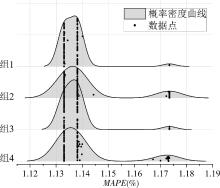
图2
四组参数下STGMC(1,3,3)模型蒙特卡洛模拟的概率密度曲线图"
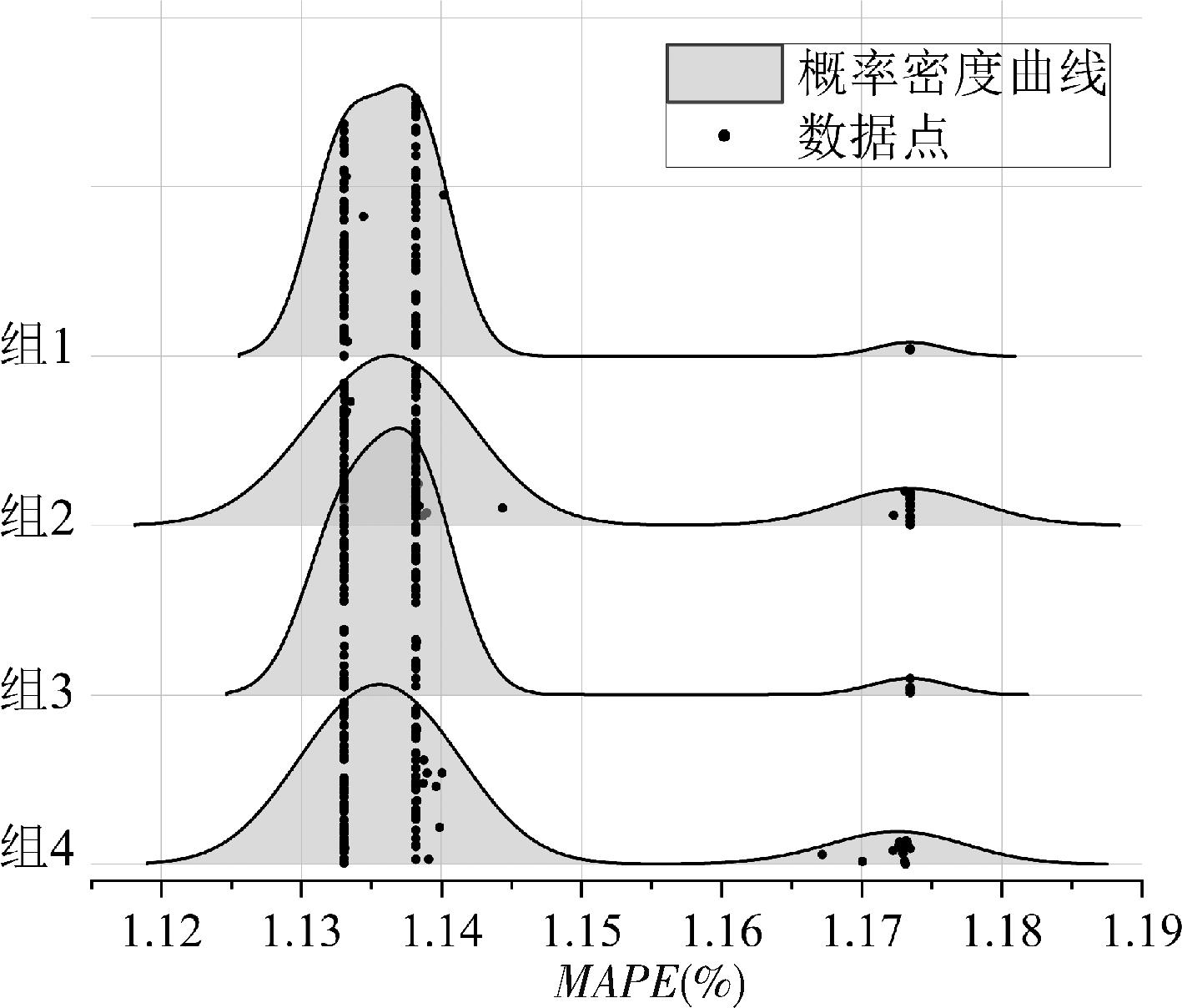
表3
经济距离系数"
| 2001 | 2002 | 2003 | 2004 | 2005 | 2006 | 2007 | 2008 | 2009 | 2010 | 2011 | |
|---|---|---|---|---|---|---|---|---|---|---|---|
| 江苏 | 0.0018 | 0.0009 | 0.0005 | 0.0007 | 0.0006 | 0.0005 | 0.0002 | 0.0008 | 0.0047 | 0.0051 | 0.0023 |
| 浙江 | 0.0008 | 0.0012 | 0.0014 | 0.0018 | 0.0014 | 0.0022 | 0.0012 | 0.0025 | 0.0088 | 0.0137 | 0.0063 |
| 安徽 | 0.0001 | 0.0001 | 0.0000 | 0.0000 | 0.0000 | 0.0000 | 0.0000 | 0.0041 | 0.0173 | 0.0142 | 0.0054 |
| 2012 | 2013 | 2014 | 2015 | 2016 | 2017 | 2018 | 2019 | 2020 | 2021 | ||
| 江苏 | 0.0054 | 0.0583 | 0.0542 | 0.0031 | 0.0076 | 0.0020 | 0.0005 | 0.0009 | 0.0004 | 0.0005 | |
| 浙江 | 0.0093 | 0.0238 | 0.0244 | 0.0208 | 0.0213 | 0.0027 | 0.0021 | 0.0022 | 0.0007 | 0.0007 | |
| 安徽 | 0.0143 | 0.1326 | 0.1584 | 0.0282 | 0.0389 | 0.0065 | 0.0025 | 0.0004 | 0.0001 | 0.0002 |

图3
3类新型时空灰色多变量模型识别出的空间邻近效应"
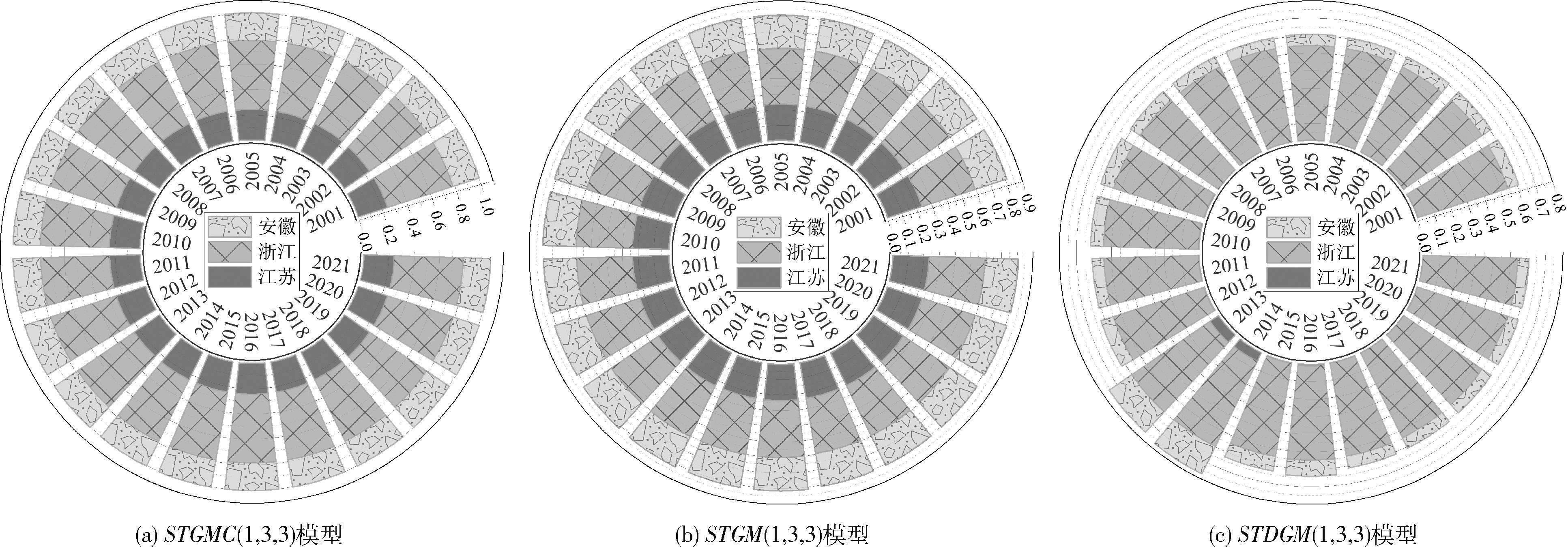
表4
三类新型时空灰色多变量模型的空间权重系数与结构参数"
| 模型 | ||||||||||
|---|---|---|---|---|---|---|---|---|---|---|
| STGM(1,3,3) | 1.000 | 1.000 | 0.999 | 2.447 | 0.372 | -0.025 | 0.732 | 0.570 | 5.557 | — |
| STGMC(1,3,3) | 0.968 | 0.659 | 0.987 | -0.007 | 0.014 | 0.015 | 0.509 | -0.538 | -1.146 | 417.166 |
| STDGM(1,3,3) | 0.000 | 1.000 | 0.295 | -0.117 | 0.057 | 0.002 | 0.060 | 0.844 | -0.139 | 74.215 |
表5
时空灰色多变量模型与传统灰色多变量模型对上海市经济总量的预测结果"
| 年份 | 观测值 | SPDGM(1,3,3) | STGM(1,3,3) | GM(1,3) | STGMC(1,3,3) | GMC(1,3) | STDGM(1,3,3) | DGM(1,3) |
|---|---|---|---|---|---|---|---|---|
| 2001 | 525.77 | 525.77 | 525.77 | 525.77 | 525.77 | 525.77 | 525.77 | 525.77 |
| 2002 | 579.50 | 525.64 | 491.84 | 482.25 | 579.50 | 608.63 | 580.13 | 589.71 |
| 2003 | 680.40 | 642.23 | 684.11 | 895.56 | 685.10 | 698.19 | 680.13 | 678.39 |
| 2004 | 810.16 | 761.22 | 811.12 | 1114.13 | 798.32 | 804.06 | 810.16 | 798.90 |
| 2005 | 919.71 | 898.24 | 924.53 | 1251.39 | 932.80 | 929.42 | 925.60 | 940.98 |
| 2006 | 1059.89 | 1014.53 | 1052.95 | 1358.70 | 1087.08 | 1069.06 | 1067.55 | 1062.70 |
| 2007 | 1287.87 | 1165.98 | 1251.29 | 1512.78 | 1250.12 | 1224.84 | 1271.47 | 1221.67 |
| 2008 | 1453.69 | 1387.34 | 1423.54 | 1672.26 | 1426.22 | 1397.01 | 1443.66 | 1455.92 |
| 2009 | 1574.24 | 1555.68 | 1580.66 | 1787.91 | 1612.91 | 1582.27 | 1560.35 | 1631.37 |
| 2010 | 1791.54 | 1669.17 | 1781.86 | 1946.27 | 1791.54 | 1773.99 | 1794.45 | 1757.65 |
| 2011 | 2000.97 | 1857.45 | 1958.72 | 2180.93 | 1972.07 | 1961.72 | 2015.62 | 1969.86 |
| 2012 | 2130.56 | 2056.68 | 2115.85 | 2403.49 | 2158.53 | 2149.35 | 2167.03 | 2186.21 |
| 2013 | 2320.41 | 2194.38 | 2331.51 | 2615.79 | 2320.97 | 2347.84 | 2323.29 | 2334.86 |
| 2014 | 2526.98 | 2384.06 | 2514.60 | 2840.03 | 2498.68 | 2559.91 | 2465.67 | 2538.52 |
| 2015 | 2688.70 | 2583.36 | 2690.77 | 2967.98 | 2728.03 | 2782.17 | 2772.39 | 2747.65 |
| 2016 | 2988.70 | 2751.18 | 2927.12 | 3227.31 | 2973.56 | 3015.45 | 2935.72 | 2929.77 |
| 2017 | 3292.50 | 3044.00 | 3243.89 | 3502.83 | 3292.50 | 3264.99 | 3293.08 | 3241.51 |
| 2018 | 3601.18 | 3336.34 | 3587.62 | 3805.20 | 3598.91 | 3530.41 | 3572.48 | 3555.80 |
| 拟合期MAPE(%) | 5.45 | 1.80 | 16.60 | 1.14 | 1.95 | 0.89 | 1.71 | |
| 拟合期RMSE | 134.08 | 33.23 | 245.95 | 22.29 | 40.50 | 31.26 | 38.74 | |
| 2019 | 3798.76 | 3633.59 | 3828.71 | 4111.62 | 3810.79 | 3809.81 | 3848.18 | 3875.22 |
| 2020 | 3896.33 | 3847.29 | 4043.91 | 4287.46 | 4039.72 | 4108.00 | 4015.64 | 4094.51 |
| 2021 | 4321.49 | 3975.32 | 4539.83 | 4631.47 | 4268.77 | 4430.73 | 4480.92 | 4234.94 |
| 预测期MAPE(%) | 4.54 | 3.21 | 8.48 | 1.74 | 2.75 | 2.68 | 3.03 | |
| 预测期RMSE | 223.24 | 153.14 | 340.08 | 88.48 | 137.67 | 118.46 | 132.43 | |
表6
考虑邻近地区经济总量的传统灰色多变量模型对上海市经济总量的预测结果"
| 模型 | STGM (1,3,3) | GM (1,6) | STGMC (1,3,3) | GMC(1,6) | STDGM (1,3,3) | DGM(1,6) | |
|---|---|---|---|---|---|---|---|
| 预测指标 | |||||||
| 样本内 | MAPE(%) | 1.80 | 1.80 | 1.14 | 3.28 | 0.89 | 1.16 |
| RMSE | 33.23 | 33.19 | 22.94 | 48.08 | 31.26 | 18.50 | |
| 样本外 | MAPE(%) | 3.21 | 3.32 | 1.74 | 5.32 | 2.68 | 4.10 |
| RMSE | 153.14 | 157.08 | 88.48 | 224.12 | 118.46 | 230.78 | |
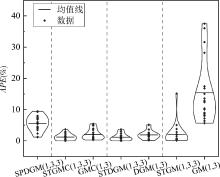
图4
对比模型APE分布"
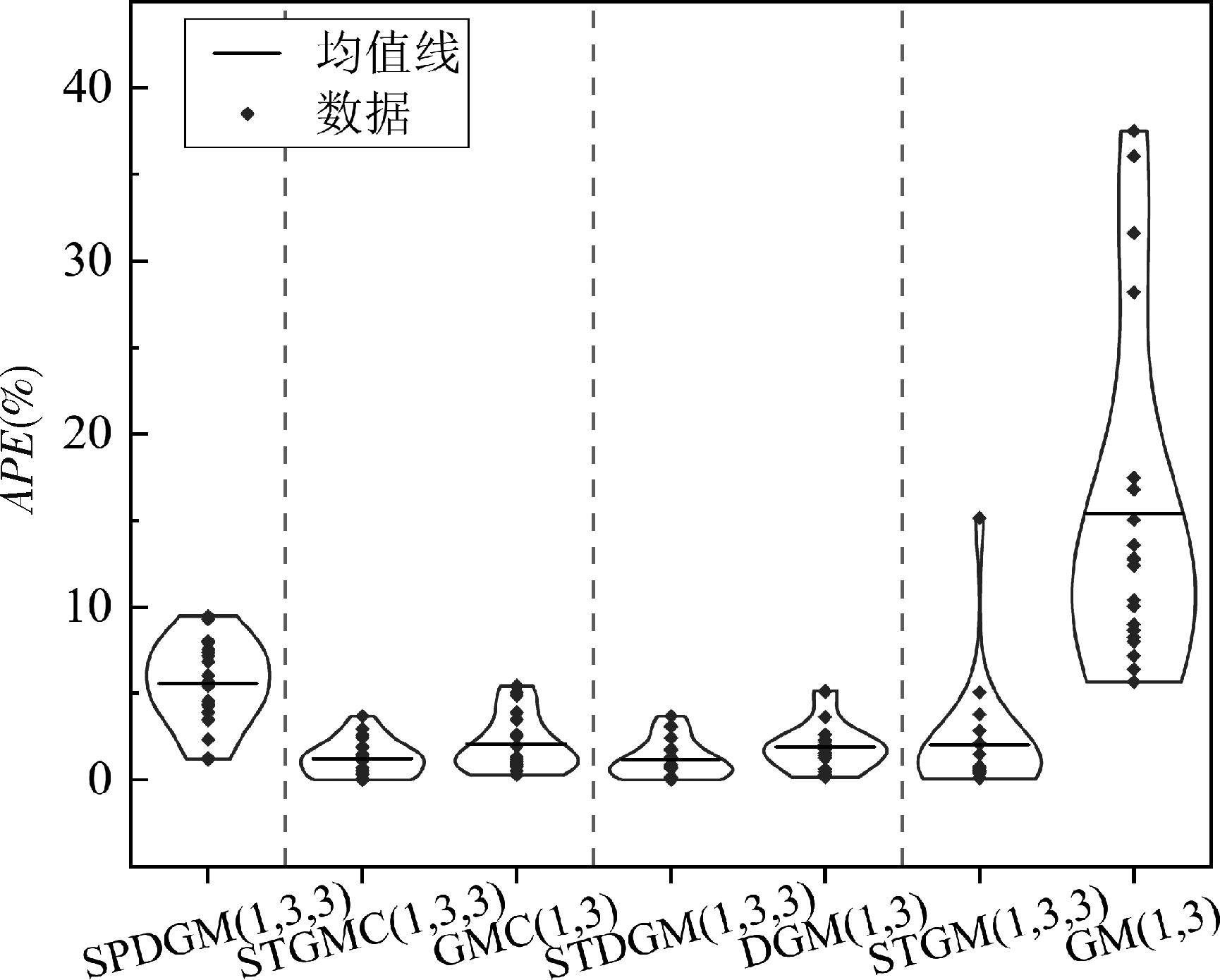
表7
时空灰色多变量模型与对比模型的HLN检验结果"
| 改进模型 | 传统模型 | HLN检验 | P值 |
|---|---|---|---|
| STGM(1,3,3) | GM(1,3) | -12.6166*** | 0.0000 |
| STGMC(1,3,3) | GMC(1,3) | -2.3161** | 0.0313 |
| STDGM(1,3,3) | DGM(1,3) | -2.1456** | 0.0444 |
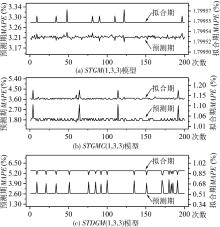
图5
新型时空灰色多变量模型的蒙特卡洛模拟折线图"
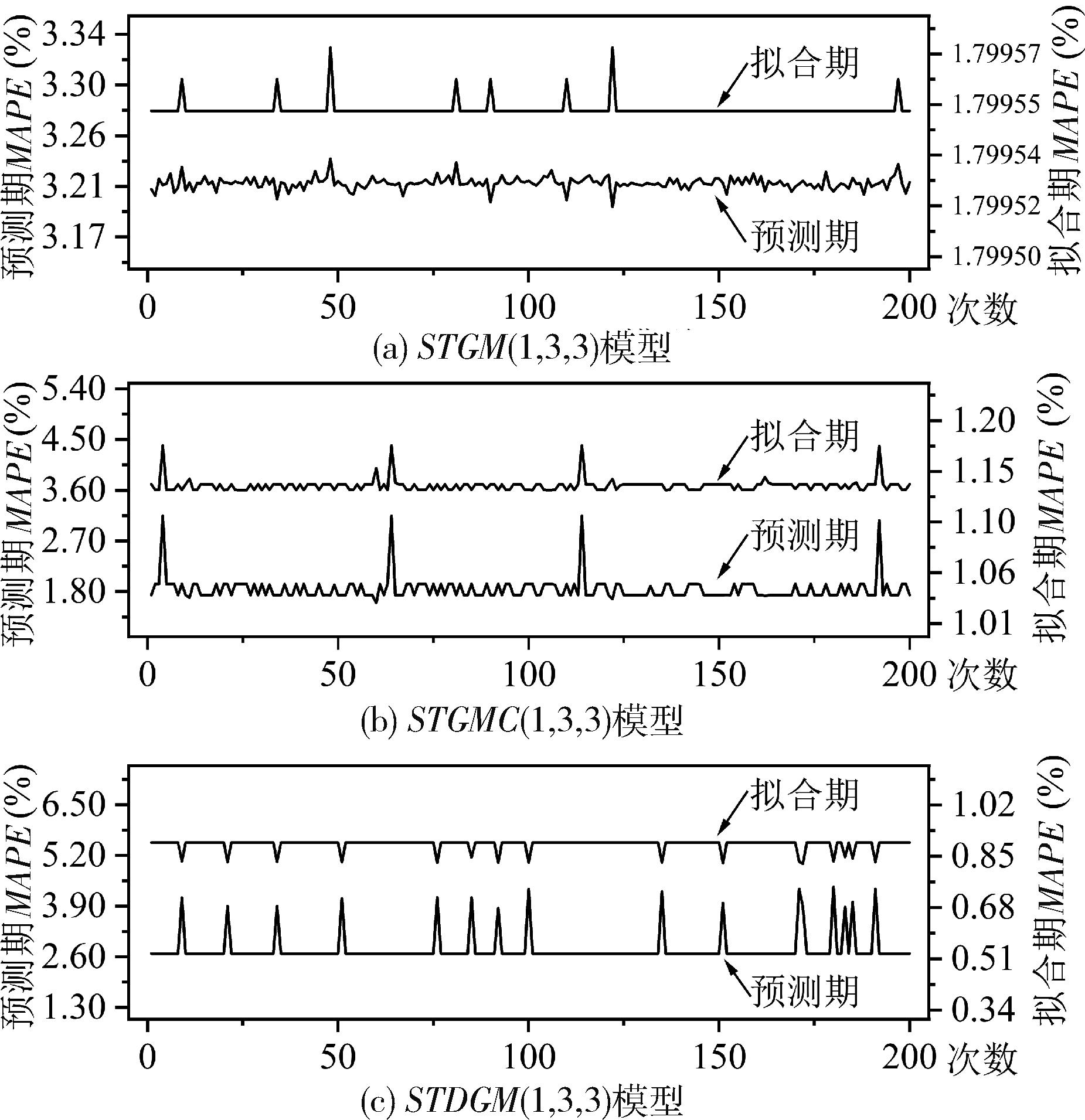
图6
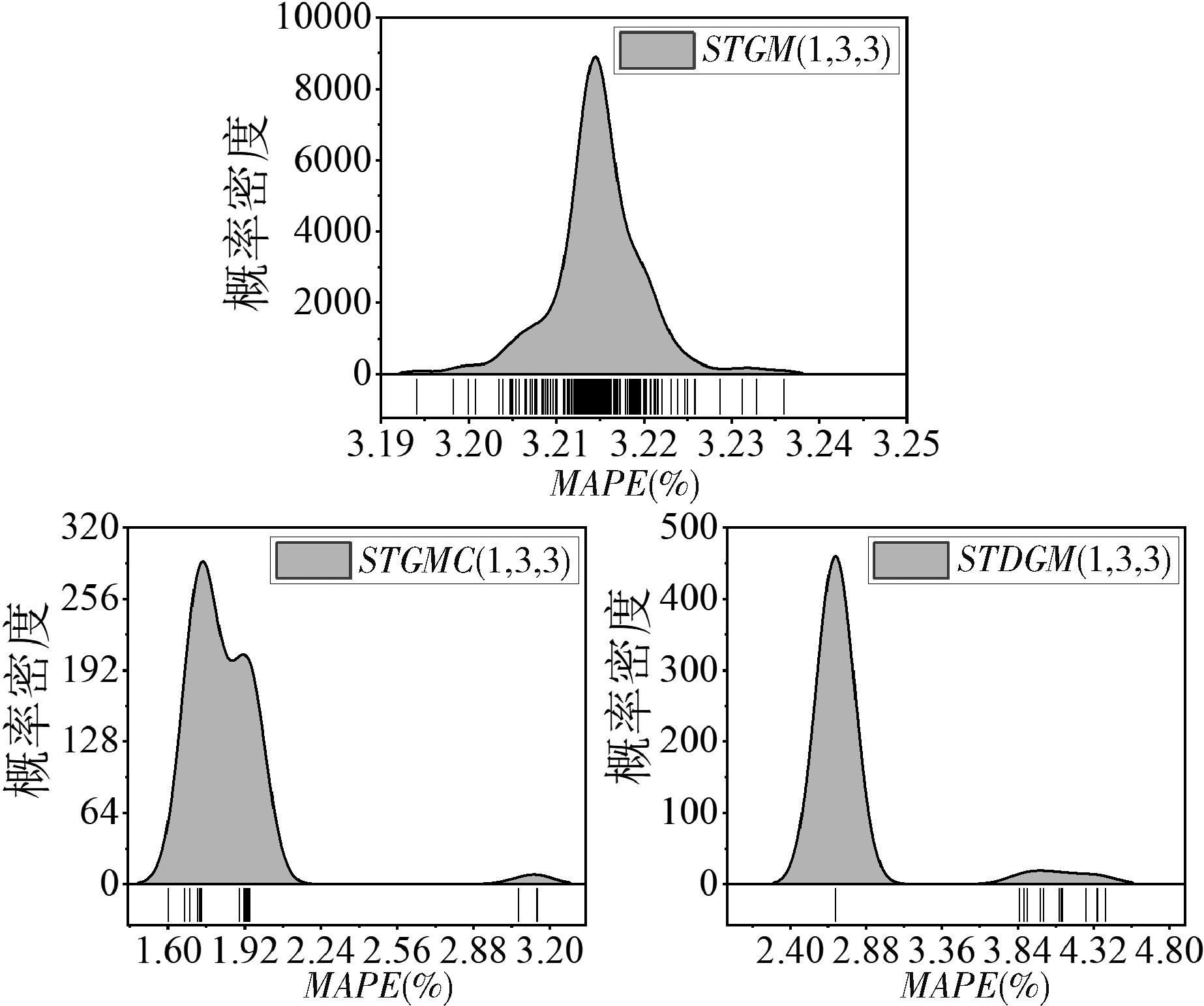
时空灰色多变量模型预测期MAPE概率密度曲线图"
| [1] | 邓聚龙. 灰色系统(社会·经济)[M]. 北京: 国防工业出版社, 1985. |
| Deng J L. Gery system (social and economic)[M]. Beijing: National Defense Industry Press, 1985. | |
| [2] | 梅韵杰, 曾祥艳, 闫书丽. 三参数区间灰数序列的矩阵型自回归时滞灰色多变量模型[J]. 中国管理科学, 2024, 32(9): 48-58. |
| Mei Y J, Zeng X Y, Yan S L. A matrix autoregressive time-delay grey multivariable model for three-parameter interval grey number sequences[J]. Chinese Journal of Management Science, 2024, 32(9): 48-58. | |
| [3] | 曾波, 李惠, 余乐安, 等. 季节波动数据特征提取与分数阶灰色预测建模[J]. 系统工程理论与实践, 2022, 42(2): 471-486. |
| Zeng B, Li H, Yu L A, et al. Feature extraction and fractional grey prediction modeling of seasonal fluctuation data[J]. Systems Engineering-Theory & Practice, 2022, 42(2): 471-486. | |
| [4] | 党耀国, 魏龙, 丁松. 基于驱动信息控制项的灰色多变量离散时滞模型及其应用[J]. 控制与决策, 2017, 32(9): 1672-1680. |
| Dang Y G, Wei L, Ding S. Delay multi-variables discrete grey model based on the driving-information control and its application[J]. Control and Decision, 2017, 32(9): 1672-1680. | |
| [5] | 曾波, 刘思峰, 曲学鑫. 一种强兼容性的灰色通用预测模型及其性质研究[J]. 中国管理科学, 2017, 25(5): 150-156. |
| Zeng B, Liu S F, Qu X X. Researching on a grey common prediction modeling with strong compatibility and its properties[J]. Chinese Journal of Management Science, 2017, 25(5): 150-156. | |
| [6] | 熊萍萍, 陈诗婷, 周依凡, 等. 基于新型核与灰度序列的MGM(1, m, N)模型及其应用[J]. 中国管理科学, 2022, 30(7): 130-139. |
| Xiong P P, Chen S T, Zhou Y F, et al. MGM (1, m, N) model based on the new kernel and degree of greyness sequences and its application[J]. Chinese Journal of Management Science, 2022, 30(7): 130-139. | |
| [7] | Ding S, Zhang H. Forecasting Chinese provincial CO2 emissions: A universal and robust new-information-based grey model[J]. Energy Economics, 2023, 121: 106685. |
| [8] | 李晔, 丁圆苹. 基于驱动因素控制的线性时变参数DLDGM(1, N)模型[J]. 中国管理科学, 2022, 30(3): 221-229. |
| Li Y, Ding Y P. Construction of linear time-varying parameters DLDGM(1, N) model based on driving factors control[J]. Chinese Journal of Management Science, 2022, 30(3): 221-229. | |
| [9] | 叶莉莉, 谢乃明, 罗党. 累积时滞非线性ATNDGM(1, N)模型构建及应用[J]. 系统工程理论与实践, 2021, 41(9): 2414-2427. |
| Ye L L, Xie N M, Luo D. Construction of accumulative time-delay nonlinear ATNDGM(1, N) model and its application[J]. Systems Engineering-Theory & Practice, 2021, 41(9): 2414-2427. | |
| [10] | 丁松, 党耀国, 徐宁. 基于虚拟变量控制的GM(1, N)模型构建及其应用[J]. 控制与决策, 2018, 33(2): 309-315. |
| Ding S, Dang Y G, Xu N. Construction and application of GM(1, N) based on control of dummy variables[J]. Control and Decision, 2018, 33(2): 309-315. | |
| [11] | 谢乃明, 刘思峰. 多变量离散灰色模型及其性质[J]. 系统工程理论与实践, 2008, 28(6): 143-150+165. |
| Xie N M, Liu S F. Research on the discrete grey model of multi-variables and its properties[J]. Systems Engineering-Theory & Practice, 2008, 28(6): 143-150+165. | |
| [12] | Tien T L. The indirect measurement of tensile strength of material by the grey prediction model GMC(1, n)[J]. Measurement Science and Technology, 2005, 16(6): 1322. |
| [13] | 肖新平, 宋中民, 李峰. 灰技术基础及其应用[M]. 北京: 科学出版社, 2005. |
| Xiao X P, Song Z M, Li F. Grey technology foundation and its application[M]. Beijing: Science Press, 2005. | |
| [14] | Tien T L. A research on the grey prediction model GM(1, n)[J]. Applied Mathematics and Computation, 2012, 218(9): 4903-4916. |
| [15] | 吴利丰, 于亮, 文朝霞. 预测复杂装备研制费用的GM(0,N)模型[J].中国管理科学,2019,27(7): 203-207. |
| Wu L F, Yu L, Wen Z X. GM(0, N)model for its application on forecasting the development cost of complicated equipment[J]. Chinese Journal of Management Science, 2019, 27(7): 203-207. | |
| [16] | Ding S, Tao Z, Hu J. Forecasting the economic indices of the high-tech industries in China using the grey multivariable convolution model[J]. Applied Soft Computing, 2022, 126: 109301. |
| [17] | 罗党, 李良帅. 多变量时滞阻尼累加灰色模型及其应用[J]. 控制与决策, 2024, 39(8): 2703-2710. |
| Luo D, Li L S. Multivariable time-lag damping accumulated grey model and its application[J]. Control and Decision, 2024, 39(8): 2703-2710. | |
| [18] | 段辉明, 何成琳, 王思琦, 等. 灰色微分动态多变量预测模型及其应用[J]. 系统工程理论与实践, 2022, 42(5): 1402-1412. |
| Duan H M, He C L, Wang S Q, et al. Grey differential dynamic multivariate forecasting model and its application[J]. Systems Engineering-Theory & Practice, 2022, 42(5): 1402-1412. | |
| [19] | 叶莉, 党耀国, 王俊杰. 基于冲击效应的灰色多变量时滞预测模型及其应用[J]. 系统工程理论与实践, 2023, 43(5): 1515-1533. |
| Ye L, Dang Y G, Wang J J. Impact effect-based grey multivariable time delay model and its application[J]. Systems Engineering-Theory & Practice, 2023, 43(5): 1515-1533. | |
| [20] | Ding S, Hu J, Lin Q. Accurate forecasts and comparative analysis of Chinese CO2 emissions using a superior time-delay grey model[J]. Energy Economics, 2023, 126: 107013. |
| [21] | Harris R, Moffat J, Evenhuis E, et al. Does spatial proximity raise firm productivity? Evidence from British manufacturing[J]. Cambridge Journal of Regions, Economy and Society, 2019, 12(3): 467-487. |
| [22] | Chica-Olmo J, Sari-Hassoun S, Moya-Fernández P. Spatial relationship between economic growth and renewable energy consumption in 26 European countries[J]. Energy Economics, 2020, 92: 104962. |
| [23] | Mariotti S, Mutinelli M, Nicolini M, et al. Productivity spillovers from foreign multinational enterprises to domestic manufacturing firms: To what extent does spatial proximity matter?[J]. Regional Studies, 2015, 49(10): 1639-1653. |
| [24] | Cao X, Liu C, Wu M, et al. Heterogeneity and connection in the spatial-temporal evolution trend of China’s energy consumption at provincial level[J]. Applied Energy, 2023, 336: 120842. |
| [25] | Zhang X, Dang Y, Ding S, et al. A novel discrete multivariable grey model with spatial proximity effects for economic output forecast[J]. Applied Mathematical Modelling, 2023, 115: 431-452. |
| [26] | Zhou B, Dong Y, Yang G, et al. A graph-attention based spatial-temporal learning framework for tourism demand forecasting[J]. Knowledge-Based Systems, 2023, 263: 110275. |
| [27] | Ruan Z, Sun W, Yuan Y, et al. Accurately forecasting solar radiation distribution at both spatial and temporal dimensions simultaneously with fully-convolutional deep neural network model[J]. Renewable and Sustainable Energy Reviews, 2023, 184: 113528. |
| [28] | Liu M, Liu G, Sun L. Spatial–temporal dependence and similarity aware traffic flow forecasting[J]. Information Sciences, 2023, 625: 81-96. |
| [29] | Asadi R, Regan A C. A spatio-temporal decomposition based deep neural network for time series forecasting[J]. Applied Soft Computing, 2020, 87: 105963. |
| [30] | Lv Z, Wang X, Cheng Z, et al. ST-TDCN: A two-channel tree-structure spatial–temporal convolutional network model for traffic velocity prediction[J]. Expert Systems with Applications, 2024, 257: 125053. |
| [31] | Zhang J, Wang X, Yang M, et al. A novel synchronous spatio-temporal relationship network for geographical-related time-spatial series forecasting[J]. Information Sciences, 2025, 689: 121484. |
| [32] | Artell J, Ahtiainen H, Pouta E. Distance decay and regional statistics in international benefit transfer[J]. Ecological Economics, 2019, 164: 106383. |
| [33] | 刘京星, 黄健柏, 刘天琦. 中国与“一带一路” 国家钢铁产能合作影响因素研究——基于多维动态距离的新视角[J]. 经济地理, 2018, 38(10): 99-110. |
| Liu J X, Huang J B, Liu T Q. Research on affecting factors in iron and steel capacity cooperation between China and the countries along “B & R” from a new perspective of multidimensional dynamic distance[J]. Economic Geography, 2018, 38(10): 99-110. | |
| [34] | 潘文卿, 娄莹, 李宏彬. 价值链贸易与经济周期的联动: 国际规律及中国经验[J]. 经济研究, 2015, 50(11): 20-33. |
| Pan W Q, Lou Y, Li H B. On-chain trade and business cycle co-movement: World regularity and Chinese experience[J]. Economic Research Journal, 2015, 50(11): 20-33. | |
| [35] | 周伟杰, 姜慧敏, 党耀国. 基于动态局部累加生成的灰色预测建模及应用[J]. 系统工程理论与实践, 2023, 43(11): 3353-3367. |
| Zhou W J, Jiang H M, Dang Y G. Construction and application of grey prediction model based on dynamic partial accumulation generation[J]. Systems Engineering-Theory & Practice, 2023, 43(11): 3353-3367. | |
| [36] | Harvey D, Leybourne S, Newbold P. Testing the equality of prediction mean squared errors[J]. International Journal of Forecasting, 1997, 13(2): 281-291. |
| [37] | Ding S, Shen X, Zhang H, et al. An innovative data-feature-driven approach for CO2 emission predictive analytics: A perspective from seasonality and nonlinearity characteristics[J]. Computers & Industrial Engineering, 2024, 192: 110195. |
| [38] | 丁松, 李若瑾, 党耀国. 基于初始条件优化的GM(1, 1)幂模型及其应用[J]. 中国管理科学, 2020, 28(1): 153-161. |
| Ding S, Li R J, Dang Y G. Construction and application of GM(1, 1)power model based on the optimized initial condition[J]. Chinese Journal of Management Science, 2020, 28(1): 153-161. | |
| [39] | 叶璟, 李艳. 双向灰色A-S型综合关联模型及应用[J].系统工程理论与实践,2023, 43(11): 3336-3352. |
| Ye J, Li Y. Bidirectional grey A-S comprehensive relational model and its applications[J]. Systems Engineering-Theory & Practice, 2023, 43(11): 3336-3352. |
| [1] | 苟小义, 米传民, 曾波, 李明珠, 徐盈婷. 纵横维度视角下的新型季节离散灰色预测模型及其应用[J]. 中国管理科学, 2025, 33(7): 178-186. |
| [2] | 丁圆苹, 党耀国, 王俊杰. 欧勒多项式驱动的自适应多变量灰色预测模型及应用[J]. 中国管理科学, 2025, 33(12): 185-199. |
| [3] | 梅韵杰,曾祥艳,闫书丽. 三参数区间灰数序列的矩阵型自回归时滞灰色多变量模型[J]. 中国管理科学, 2024, 32(9): 48-58. |
| [4] | 李树良,杨爽艺,曾波,孟伟,白云. 离散型灰色预测模型的无偏性与自适应性及其应用[J]. 中国管理科学, 2024, 32(8): 149-158. |
| [5] | 熊萍萍, 陈诗婷, 周依凡, 刘煜淳, 丁松. 基于新型核与灰度序列的MGM(1,m,N)模型及其应用[J]. 中国管理科学, 2022, 30(7): 130-139. |
| [6] | 李惠,曾波,周文浩. 基于灰色参数组合优化新模型的生活垃圾清运量预测研究[J]. 中国管理科学, 2022, 30(4): 96-107. |
| [7] | 李晔, 丁圆苹. 基于驱动因素控制的线性时变参数DLDGM(1,N)模型[J]. 中国管理科学, 2022, 30(3): 221-229. |
| [8] | 丁松, 李若瑾, 党耀国. 基于初始条件优化的GM(1,1)幂模型及其应用[J]. 中国管理科学, 2020, 28(1): 153-161. |
| [9] | 曾波, 刘思峰, 白云, 周猛. 基于灰色系统建模技术的人体疾病早期预测预警研究[J]. 中国管理科学, 2020, 28(1): 144-152. |
| [10] | 张文杰, 袁红平. 基于多目标加权灰靶决策模型的节能服务公司选择研究[J]. 中国管理科学, 2019, 27(2): 179-186. |
| [11] | 杨保华, 赵金帅. 优化离散灰色幂模型及其应用[J]. 中国管理科学, 2016, 24(2): 162-168. |
| [12] | 王晓佳, 杨善林. 基于组合插值的GM(1,1)模型预测方法的改进与应用 [J]. 中国管理科学, 2012, (2): 129-134. |
| [13] | 王正新, 党耀国, 练郑伟. 无偏GM(1,1)幂模型其及应用[J]. 中国管理科学, 2011, 19(4): 144-151. |
| [14] | 关叶青, 刘思峰. 关于弱化缓冲算子序列的研究[J]. 中国管理科学, 2007, 15(4): 89-92. |
| [15] | 唐万梅, 向长合. 基于二次插值的GM(1,1)模型预测方法的改进[J]. 中国管理科学, 2006, (6): 109-112. |
| 阅读次数 | ||||||
|
全文 |
|
|||||
|
摘要 |
|
|||||
|
||
