
主管:中国科学院
主办:中国优选法统筹法与经济数学研究会
中国科学院科技战略咨询研究院
主办:中国优选法统筹法与经济数学研究会
中国科学院科技战略咨询研究院

中国管理科学 ›› 2026, Vol. 34 ›› Issue (11): 361-369.doi: 10.16381/j.cnki.issn1003-207x.2023.2035
• • 上一篇
王方1,3, 赵桉坤1, 余乐安2( )
收稿日期:2023-12-04
修回日期:2024-06-11
出版日期:2026-11-25
发布日期:2026-11-10
通讯作者:
余乐安
E-mail:yulean@amss.ac.cn
基金资助:
Fang Wang1,3, Ankun Zhao1, Lean Yu2()
Received:2023-12-04
Revised:2024-06-11
Online:2026-11-25
Published:2026-11-10
Contact:
Lean Yu
E-mail:yulean@amss.ac.cn
摘要:
针对新能源汽车月度销量时序数据具有的趋势性、季节性、复杂性等数据特征混叠的问题,基于“分解-集成”的建模思想,构建了新能源汽车月度销量预测的二次分解集成框架。首先,通过集合经验模态分解算法将原始序列分解,提取出趋势性数据特征。然后,采用STL(seasonal and trend decomposition using loess)算法从去趋势项序列中提取季节项及残差项。在此基础上,分别使用Logistic回归、差分自回归移动平均模型和深度极限学习机模型对趋势项、季节项以及残差项进行预测。最后,将各分项的预测值,通过线性加权集成的方法得到最终的预测结果。基于我国新能源汽车销量数据的实证分析结果表明,提出的二次分解集成模型在3步、6步和12步的预测中的平均绝对百分比误差分别为5.80%、6.10%和7.34%,较基准模型均下降了15%以上,预测建模效果提升显著。
中图分类号:
王方,赵桉坤,余乐安. 数据特征驱动的新能源汽车月度销量二次分解集成预测[J]. 中国管理科学, 2026, 34(11): 361-369.
Fang Wang,Ankun Zhao,Lean Yu. Quadratic Decomposition-ensemble Method for Multi-step Forecast of Monthly Sales Volume of New energy Vehicles[J]. Chinese Journal of Management Science, 2026, 34(11): 361-369.
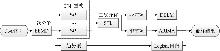
图1
EEMD-STL-Logistic/ARIMA/DELM预测流程"
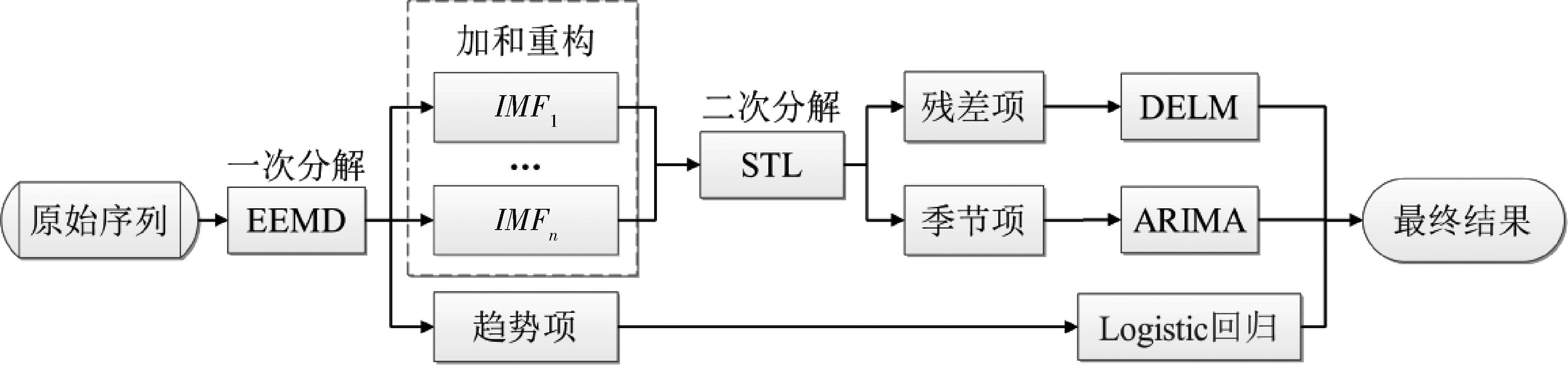

图2
2014年1月-2022年12月份我国新能源汽车月度销量变化趋势"
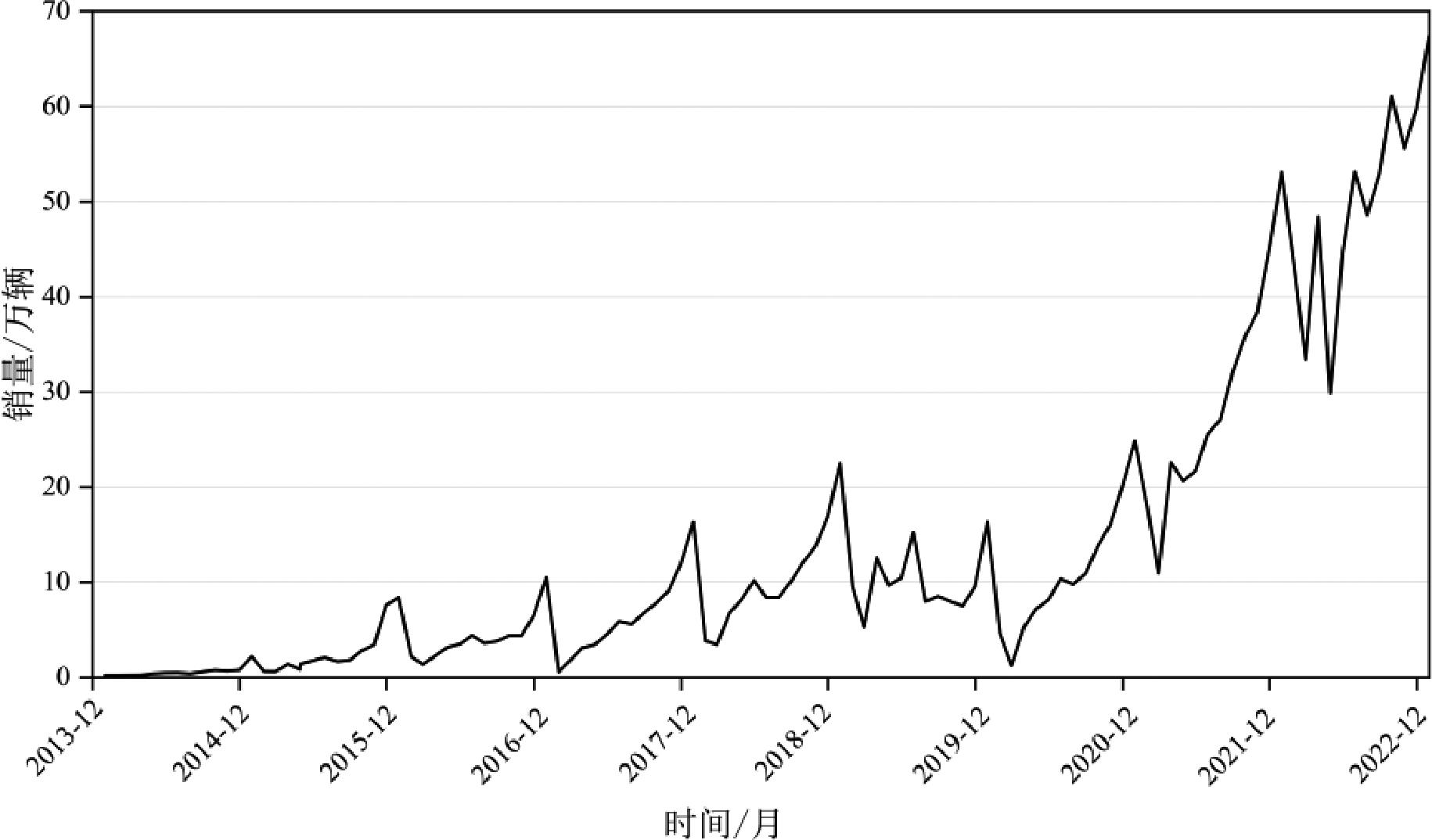

表1
向前3步预测各模型的MAPE和RMSE值"
| 模型类型 | 模型 | MAPE(%) | RMSE |
|---|---|---|---|
| 单模型 | ARIMA | 30.35 | 119405.16 |
| DELM | 25.89 | 115382.89 | |
| 混合模型 | STL-DELM | 22.82 | 88672.87 |
| STL-Logistic-DELM | 19.84 | 74644.39 | |
| EEMD-DELM | 19.76 | 73773.00 | |
| Logistic-DELM | 19.42 | 84145.79 | |
| EEMD-STL二次分解模型 | EEMD-STL-Logistic/ARIMA/DELM | 5.80 | 30674.27 |
图3
3步、6步、12步预测结果绝对误差箱型图"
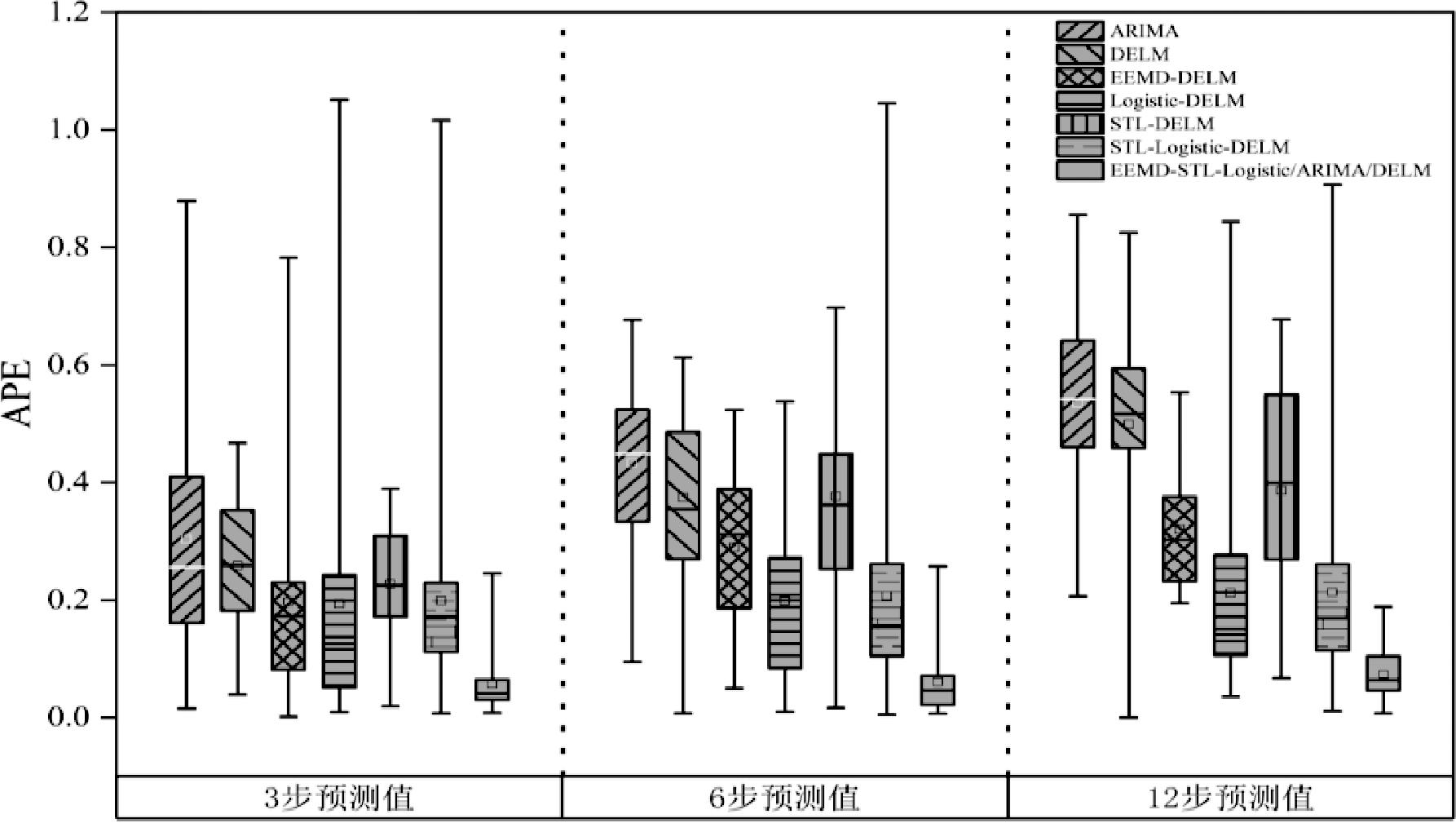
表2
向前6步预测各模型的MAPE和RMSE值"
| 模型类型 | 模型 | MAPE(%) | RMSE |
|---|---|---|---|
| 单模型 | ARIMA | 43.35 | 185337.14 |
| DELM | 37.47 | 163836.84 | |
| 混合模型 | STL-DELM | 29.16 | 130331.64 |
| EEMD-DELM | 28.93 | 128935.81 | |
| STL-Logistic-DELM | 20.72 | 89934.26 | |
| Logistic-DELM | 19.86 | 74209.33 | |
| EEMD-STL二次分解模型 | EEMD-STL-Logistic/ARIMA/DELM | 6.10 | 34528.85 |
表3
向前12步预测各模型的MAPE和RMSE值"
| 模型类型 | 模型 | MAPE(%) | RMSE |
|---|---|---|---|
| 单模型 | ARIMA | 53.53 | 203995.03 |
| DELM | 49.87 | 218202.42 | |
| 混合模型 | STL-DELM | 38.66 | 154678.18 |
| EEMD-DELM | 31.97 | 183536.88 | |
| STL-Logistic-DELM | 21.34 | 72712.26 | |
| Logistic-DELM | 21.26 | 80366.28 | |
| EEMD-STL二次分解模型 | EEMD-STL-Logistic/ARIMA/DELM | 7.34 | 41435.26 |
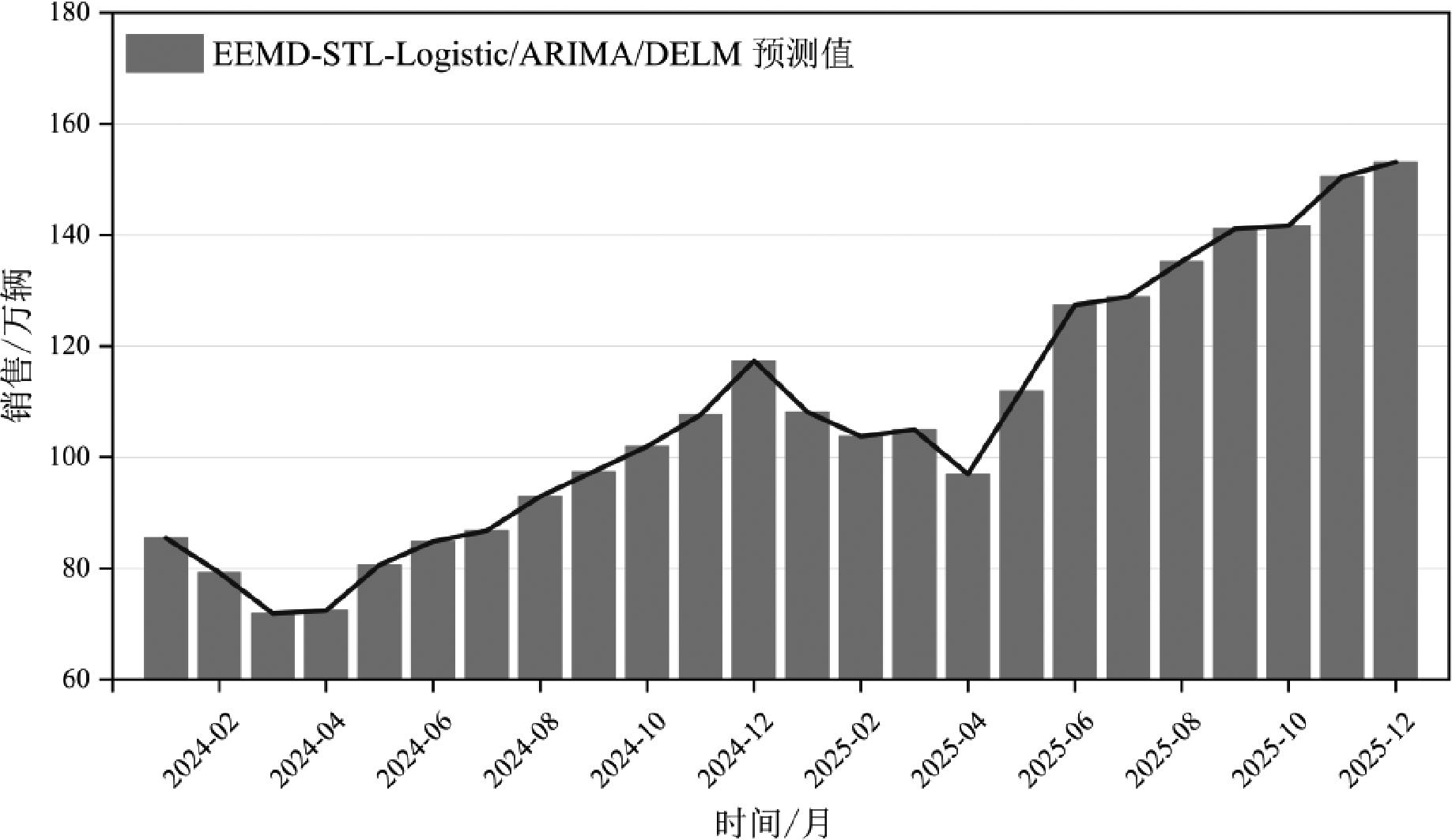
图4
2024年1月-2025年12月的新能源汽车月度销量预测结果"
| [1] | Gao J, Ma S, Zou H, et al. How does population agglomeration influence the adoption of new energy vehicles? Evidence from 290 cities in China[J]. Technological Forecasting and Social Change, 2023, 196: 122857. |
| [2] | 陈俊廷, 邢剑炜, 肖俊极. 新能源汽车市场的本地偏好与地方保护[J]. 数量经济技术经济研究, 2023, 40(11): 117-136. |
| Chen J T, Xing J W, Xiao J J. Home bias and local protectionism in the Chinese electric vehicle market[J]. Journal of Quantitative & Technological Economics, 2023, 40(11): 117-136. | |
| [3] | 吴琪, 李政, 王楠, 等. 中国镍矿供需形势及对策建议[J]. 科技导报, 2024, 42(5): 53-60. |
| Wu Q, Li Z, Wang N, et al. Dometic supply-demand situation of nickel and suggested countermeasures in China[J]. Science & Technology Review, 2024, 42(5): 53-60. | |
| [4] | He L Y, Pei L L, Yang Y H. An optimised grey buffer operator for forecasting the production and sales of new energy vehicles in China[J]. Science of the Total Environment, 2020, 704: 135321. |
| [5] | Liu L, Liu S, Wu L, et al. Forecasting the development trend of new energy vehicles in China by an optimized fractional discrete grey power model[J]. Journal of Cleaner Production, 2022, 372: 133708. |
| [6] | 刘连义, 刘思峰, 吴利丰. 基于离散时间灰色幂模型的新能源汽车销售量预测[J]. 中国管理科学, 2024, 32(1): 106-114. |
| Liu L Y, Liu S F, Wu L F. New energy vehicle sales forecast based on siscrete time grey power model[J]. Chinese Journal of Management Science, 2024, 32(1): 106-114. | |
| [7] | 李树良, 杨爽艺, 曾波, 等. 离散型灰色预测模型的无偏性与自适应性及其应用[J]. 中国管理科学, 2024, 32(8): 149-158. |
| Li S L, Yang S Y, Zeng B, et al. Unbiased and adaptive of discrete grey prediction model and its application[J]. Chinese Journal of Management Science, 2024, 32(8): 149-158. | |
| [8] | 龙子泉, 常静敏, 陈植元. 激励政策对新能源汽车推广的影响研究——基于修正Bass模型的实证分析[J]. 科技管理研究, 2016, 36(4): 138-144. |
| Long Z Q, Chang J M, Chen Z Y. Effects of incentives to the promotion of new energy vehicles: Based on the empirical analysis of modified bass model[J]. Science and Technology Management Research, 2016, 36(4): 138-144. | |
| [9] | 刘颖琦, 王萌, 王静宇. 中国新能源汽车市场预测研究[J]. 经济与管理研究, 2016, 37(4): 86-91. |
| Liu Y Q, Wang M, Wang J Y. The predictive research on China’s new energy vehicles market[J]. Research on Economics and Management, 2016, 37(4): 86-91. | |
| [10] | 谭涛, 黄泽涛, 林雁玲, 等. 大数据驱动的我国新能源汽车需求分析[J].可再生能源,2020, 38(7): 967-971. |
| Tan T, Huang Z T, Lin Y L, et al. Big data driven demand analysis of new energy vehicles[J]. Renewable Energy Resources, 2020, 38(7): 967-971. | |
| [11] | 童芳, 兰凤崇, 陈吉清. 新能源汽车发展影响因素分析及保有量预测[J]. 科技管理研究, 2016, 36(17): 112-116. |
| Tong F, Lan F C, Chen J Q. Analysis of factors affecting the new energy vehicle development and ownership forecast[J]. Science and Technology Management Research, 2016, 36(17): 112-116. | |
| [12] | Gao J, Xie Y, Cui X, et al. Chinese automobile sales forecasting using economic indicators and typical domestic brand automobile sales data: A method based on econometric model[J]. Advances in Mechanical Engineering, 2018, 10(2): 1687814017749325. |
| [13] | Kaya A, Kaya G, Wang J. Forecasting automobile sales in turkey with artificial neural networks[J]. International Journal of Business Analytics, 2019, 6(3): 50-60. |
| [14] | Wang W. Application of the optimal linear combination forecast model in tourism demand forecasting: A case of forecasting of visitors from China's mainland to Macao[J]. Mathematics practice and knowledge, 2018, 48(12): 49-58. |
| [15] | Fan D, Sun H, Yao J, et al. Well production forecasting based on ARIMA-LSTM model considering manual operations[J]. Energy, 2021, 220: 119708. |
| [16] | Wang H, Li M, Jiao Y, et al. New energy vehicle sales forecasting method based on combination model[J]. Softw Guide 2023, 22(2), 133–141. |
| [17] | Yan R, Liao J, Yang J, et al. Multi-hour and multi-site air quality index forecasting in Beijing using CNN, LSTM, CNN-LSTM, and spatiotemporal clustering[J]. Expert Systems with Applications, 2021, 169: 114513. |
| [18] | Ma X, Li M, Tong J, et al. Deep learning combinatorial models for intelligent supply chain demand forecasting[J]. Biomimetics, 2023, 8(3): 312. |
| [19] | Gao J, Xie Y, Gu F, et al. A hybrid optimization approach to forecast automobile sales of China[J]. Advances in Mechanical Engineering, 2017, 9(8): 168781401771922. |
| [20] | 蒋翠清, 王香香, 王钊. 基于消费者关注度的汽车销量预测方法研究[J]. 数据分析与知识发现, 2021, 5(1): 128-139. |
| Jiang C Q, Wang X X, Wang Z. Forecasting car sales based on consumer attention[J]. Data Analysis and Knowledge Discovery, 2021, 5(1): 128-139. | |
| [21] | 施文, 赵雪. 在线消费者投诉对产品销量的影响机制:召回的中介作用[J]. 南开管理评论, 2025,28 (5) : 138-148+160. |
| Shi W, Zhao X. The impact of online consumer complaints on product sales: Recalls as mediation[J]. Nankai Business Review, 2025,28 (5) : 138-148+160. | |
| [22] | 张丰婷, 杨菊花, 任金荟, 等. 基于优化变分模态分解和核极限学习机的集装箱吞吐量预测[J]. 计算机应用, 2022, 42(8): 2333-2342. |
| Zhang F T, Yang J H, Ren J H, et al. Container throughput prediction based on optimal variational mode decomposition and kernel extreme learning machine[J]. Journal of Computer Applications, 2022, 42(8): 2333-2342. | |
| [23] | 柴建, 寇红红. 基于TEI@I方法论的系统管理预测技术研究综述及展望[J]. 管理评论, 2020, 32(7): 280-292. |
| Chai J, Kou H H. Review and prospect of system management prediction technology based on TEI@I methodology[J].Management Review,2020,32(7):280-292. | |
| [24] | 张大斌, 张博婷, 凌立文, 等. 基于二次分解聚合策略的我国碳交易价格预测[J]. 系统科学与数学, 2022, 42(11): 3094-3106. |
| Zhang D B, Zhang B T, Ling L W, et al. Carbon price forecasting based on secondary decomposition and aggregation strategy[J]. Journal of Systems Science and Mathematical Sciences, 2022, 42(11): 3094-3106. | |
| [25] | 梁小珍, 邬志坤, 杨明歌, 等. 基于二次分解策略和模糊时间序列模型的航空客运需求预测研究[J]. 中国管理科学, 2021, 28(12): 108-117. |
| Liang X Z, Wu Z K, Yang M G, et al. Air passenger demand forecasting based on a dual decomposition strategy and fuzzy time series model[J]. Chinese Journal of Management Science, 2021, 28(12): 108-117. | |
| [26] | 刘金培, 罗瑞, 陈华友, 等. 非结构化数据驱动的混合二次分解汇率区间多尺度组合预测[J]. 中国管理科学, 2023, 31(6): 60-70. |
| Liu J P, Luo R, Chen H Y, et al. Multi-scale combination forecasting of interval exchange rate with hybrid secondary decomposition driven by unstructured data[J]. Chinese Journal of Management Science, 2023, 31(6): 60-70. | |
| [27] | 宋江涛, 崔双喜, 刘洪广. 基于二次分解NGO-VMD残差项与长短时记忆神经网络的超短期风功率预测[J]. 科学技术与工程, 2023, 23(6): 2428-2437. |
| Song J T, Cui S X, Liu H G. Ultra-short-term wind power prediction based on the quadratic decomposition NGO-VMD residual term and long short-term memory(LSTM)[J]. Science Technology and Engineering, 2023, 23(6): 2428-2437. | |
| [28] | 程文辉, 车文刚. 基于二次分解与LSTM的金融时间序列预测算法研究[J]. 重庆邮电大学学报(自然科学版), 2022, 34(4): 638-645. |
| Cheng W H, Che W G. Research on financial time series forecasting algorithm based on secondary decomposition and LSTM[J]. Journal of Chongqing University of Posts and Telecommunications (Natural Science Edition), 2022, 34(4): 638-645. | |
| [29] | 陈凯杰, 唐振鹏, 吴俊传, 等. 贵金属期货价格预测方法及实证研究[J].中国管理科学,2022,30(12): 245-253. |
| Chen K J, Tang Z P, Wu J C, et al. Prediction method and empirical study of precious metal futures price[J]. Chinese Journal of Management Science, 2022, 30(12): 245-253. | |
| [30] | 徐小峰, 余乐安, 林姿汝, 等. 基于特征融合的生鲜商品短期销量组合预测[J]. 管理科学学报, 2022, 25(12): 102-123. |
| Xu X F, Yu L A, Lin Z R, et al. Combination forecasting of short-term sales for fresh products based on feature fusion[J]. Journal of Management Sciences in China, 2022, 25(12): 102-123. | |
| [31] | 徐建闽, 臧鹏, 首艳芳. 基于ARIMA模型和K-means聚类分析的动态规划算法[J]. 重庆交通大学学报(自然科学版), 2022, 41(7): 9-13. |
| Xu J M, Zang P, Shou Y F. Dynamic programming algorithm based on ARIMA model and K-means clustering analysis[J]. Journal of Chongqing Jiaotong University (Natural Sciences), 2022, 41(7): 9-13. | |
| [32] | 胡玉乾, 胡磊, 孙鹏, 等. 基于非平稳的淮河流域干旱时空演变特征研究[J]. 北京师范大学学报(自然科学版), 2022, 58(1): 116-124. |
| Hu Y Q, Hu L, Sun P, et al. Spatio-temporal evolution of drought events in Huaihe River Basin: A non-stationary standardized precipitation evapotranspiration index study[J]. Journal of Beijing Normal University (Natural Science), 2022, 58(1): 116-124. | |
| [33] | 冉茂亮, 陈彦如, 杨新彪. 基于EEMD-LMD-LSTM-LEC深度学习模型的短时物流需求预测[J]. 控制与决策, 2022, 37(10): 2513-2523. |
| Ran M L, Chen Y R, Yang X B. Short-term logistics demand forecasting based on EEMD-LMD-LSTMLEC deep learning model[J]. Control and Decision, 2022, 37(10): 2513-2523. | |
| [34] | 赵健, 樊彦国, 张音. 基于EEMD-BP组合模型的区域海平面变化多尺度预测[J]. 系统工程理论与实践, 2019, 39(10): 2713-2722. |
| Zhao J, Fan Y G, Zhang Y. Multi-scale prediction of regional sea level variations based on EEMD-BP combined model[J]. Systems Engineering —Theory & Practice, 2019, 39(10): 2713-2722. | |
| [35] | 曾能民, 张明, 余乐安. 基于 “拆分-填充-分解-集成” 的我国线上零售额预测研究[J]. 中国管理科学, 2022, 30(12): 63-76. |
| Zeng N M, Zhang M, Yu L A. Forecasting online retail sales of China based on splitting—filling—decomposition—ensemble model[J]. Chinese Journal of Management Science, 2022, 30(12): 63-76. | |
| [36] | 王兴芬, 张彦博. 不同时间窗下铁矿石期货价格预测精度研究——基于CNN-LSTM注意力模型的分析[J]. 价格理论与实践, 2022(11): 142-145. |
| Wang X F, Zhang Y B. Research on the accuracy of iron ore futures price forecasting under different time horizon: Analysis based on CNN-LSTM-Attention model[J]. Price (Theory & Practice), 2022(11): 142-145. | |
| [37] | 陈晓东. 中国金属期货市场高频波动率预测模型比较研究[J]. 管理工程学报, 2016, 30(3): 114-120. |
| Chen X D. Comparative study on prediction model of high-frequency fluctuation of China’s futures market[J]. Journal of Industrial Engineering and Engineering Management, 2016, 30(3): 114-120. | |
| [38] | 中华人民共和国财政部. 关于免征新能源汽车车辆购置税的公告[EB/OL].(2014-08-01)[2024-06-05]. . |
| Ministry of Finance of the People's Republic of China. Announcement on the Exemption of Vehicle Purchase Tax for New Energy Vehicles[EB/OL].(2014-08-01)[2024-06-05]. . | |
| [39] | 伍业锋, 张雅茜. 基于EEMD模型的固定资产投资周期识别与预测[J]. 调研世界, 2021(1): 4-13. |
| Wu Y F, Zhang Y X. Identification and prediction of fixed assets investment cycle based on EEMD model[J]. The World of Survey and Research, 2021(1): 4-13. | |
| [40] | 刘雪, 刘锦涛, 李佳利, 等. 基于季节分解和长短期记忆的北京市鸡蛋价格预测[J]. 农业工程学报, 2020, 36(9): 331-340. |
| Liu X, Liu J T, Li J L, et al. Egg price forecasting in Beijing market using seasonal-trend decomposition procedures based on seasonal decomposition and long-short term memory[J]. Transactions of the Chinese Society of Agricultural Engineering, 2020, 36(9): 331-340. | |
| [41] | 李灯熬, 白晓东, 夏鸿伟, 等. 基于STL-Former的中短期光伏功率预测[J]. 热能动力工程, 2024, 39(4): 140-146+153. |
| Li D A, Bai X D, Xia H W, et al. Short-and medium-term photovoltaic power prediction based on STL-former[J]. Journal of Engineering for Thermal Energy and Power, 2024, 39(4): 140-146+153. | |
| [42] | 中华人民共和国国务院办公厅. 《新能源汽车产业发展规划(2021—2035年)》[EB/OL].(2020-11-02)[2024-06-05]. . |
| General Office of the State Council of the People's Republic of China. “Development Plan for the New Energy Vehicle Industry (2021-2035)”[EB/OL].(2020-11-02)[2024-06-05]. . |
| [1] | 赵萌, 王海龙, 邬文帅, 王翰林, 王亚君. 一种新的拓展三维机会挖掘算法:基于新能源汽车市场的机会挖掘[J]. 中国管理科学, 2026, 34(8): 356-368. |
| [2] | 林帅成, 张桂涛. “双积分”政策下考虑新能源汽车续航和广告宣传的微分策略研究[J]. 中国管理科学, 2026, 34(4): 319-329. |
| [3] | 邹宗保, 陈力豪, 梁强, 周少锐. 集中还是分离:车电运营策略对竞争对手电池供应商选择的影响研究[J]. 中国管理科学, 2026, 34(3): 309-319. |
| [4] | 朱庆缘, 刘畅, 潘应浩, 吴杰, 周德群. “双积分”政策下考虑碳减排研发的汽车市场主体均衡分析[J]. 中国管理科学, 2026, 34(2): 357-368. |
| [5] | 文姝, 李春发, 吴光强, 张俊, 李瑞迁. 消费者后悔预期影响、燃油汽车现售竞争与新能源汽车预售策略选择[J]. 中国管理科学, 2026, 34(11): 326-335. |
| [6] | 李冬冬, 林雯窈, 高伟伟, 商辰宣. 政企合作视角下新能源汽车充电基础设施最优投资模式研究[J]. 中国管理科学, 2026, 34(1): 342-352. |
| [7] | 饶卫振, 常悦, 刘鹏. 新能源汽车动力电池协作回收模式及运营方法研究[J]. 中国管理科学, 2025, 33(9): 325-338. |
| [8] | 冯章伟, 杜碧升, 于志勇, 牟善栋. 区块链驱动的新能源汽车动力电池回收与溯源技术投入策略研究[J]. 中国管理科学, 2025, 33(4): 313-324. |
| [9] | 熊勇清, 舒楠茜. 新能源汽车负面口碑、干预措施与消费者购买意愿[J]. 中国管理科学, 2025, 33(4): 335-344. |
| [10] | 黎继子, 张国盼, 刘春玲, 孙彪, 王勇. 基于低碳和智能广告定位的新能源汽车企业最优控制决策分析[J]. 中国管理科学, 2025, 33(10): 159-165. |
| [11] | 李树良,杨爽艺,曾波,孟伟,白云. 离散型灰色预测模型的无偏性与自适应性及其应用[J]. 中国管理科学, 2024, 32(8): 149-158. |
| [12] | 李冬冬,商辰宣,吕宏军,杨晶玉,张岭. “后补贴”时代考虑消费者需求异质性的新能源汽车推广政策研究[J]. 中国管理科学, 2024, 32(4): 141-152. |
| [13] | 丁军飞, 浦徐进, 曹雨馨, 李静. EPR制度下新能源汽车闭环供应链的回收成本分担机制研究[J]. 中国管理科学, 2024, 32(12): 257-268. |
| [14] | 王丹丹, 乐为, 杨雅雯, 郭本海. 嵌入性风险视角下我国新能源汽车产业技术创新网络演化研究[J]. 中国管理科学, 2024, 32(11): 312-324. |
| [15] | 刘连义,刘思峰,吴利丰. 基于离散时间灰色幂模型的新能源汽车销售量预测[J]. 中国管理科学, 2024, 32(1): 106-114. |
| 阅读次数 | ||||||
|
全文 |
|
|||||
|
摘要 |
|
|||||
|
||
