
主管:中国科学院
主办:中国优选法统筹法与经济数学研究会
中国科学院科技战略咨询研究院
主办:中国优选法统筹法与经济数学研究会
中国科学院科技战略咨询研究院

Chinese Journal of Management Science ›› 2026, Vol. 34 ›› Issue (2): 348-356.doi: 10.16381/j.cnki.issn1003-207x.2023.1570
Previous Articles Next Articles
Dazhi Linghu1,2,3, Yuanyuan Peng1,3, Xinli Wu2,3, Bangzhu Zhu1,3( )
)
Received:2023-09-21
Revised:2024-05-27
Online:2026-02-25
Published:2026-02-04
Contact:
Bangzhu Zhu
E-mail:wpzbz@126.com
CLC Number:
Dazhi Linghu,Yuanyuan Peng,Xinli Wu, et al. Initial Carbon Quota Allocation at Provincial Level in China from the New Development Concept[J]. Chinese Journal of Management Science, 2026, 34(2): 348-356.
"

"
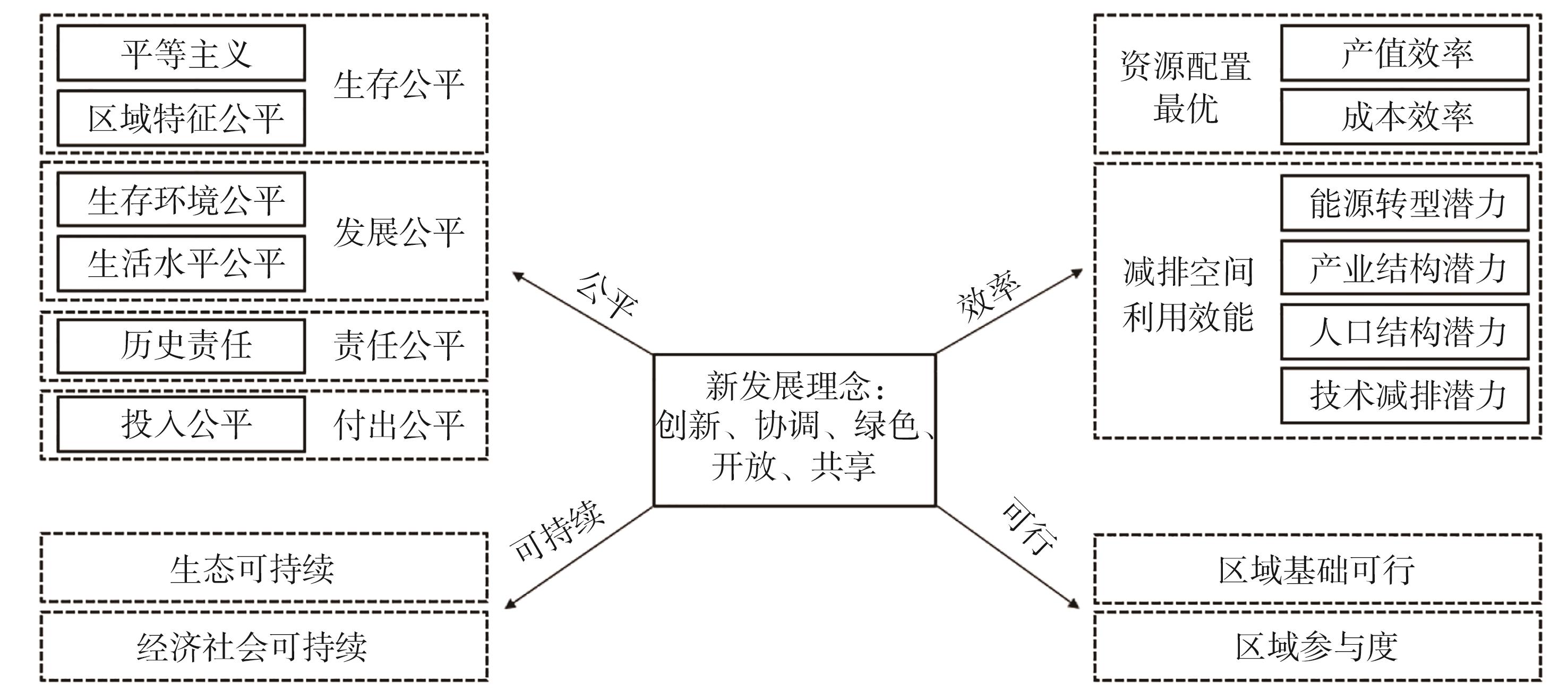
| 一级原则 | 二级原则 | 三级原则 | 指标 | 性质 |
|---|---|---|---|---|
| 公平 | 生存公平 | 平等主义 | 人口 | + |
| 区域特征公平 | 面积 | + | ||
| 禀赋 | + | |||
| 发展公平 | 生存环境公平 | 人均GDP | - | |
| 外贸开放度 | - | |||
| 生活水平公平 | 人均能源消费量 | - | ||
| 责任公平 | 历史责任 | 人均累积碳排放 | - | |
| 付出公平 | 投入公平 | 工业污染治理投资完成额占比 | + | |
| 效率 | 资源配置效率 | 产值效率 | 碳生产力 | + |
| 工业碳生产力 | + | |||
| 成本效率 | 碳排放强度 | - | ||
| 能源强度 | - | |||
| 减排空间利用效率 | 能源转型潜力 | 能源结构 | - | |
| 能源弹性 | - | |||
| 单位能耗碳排放 | - | |||
| 产业转型潜力 | 第二产业GDP占比 | - | ||
| 人口结构潜力 | 劳动人口数占比 | - | ||
| 技术减排潜力 | 研发支出占比 | + | ||
| 绿色专利数 | + | |||
| 可持续 | 生态可持续 | 森林覆盖率 | + | |
| 耕地覆盖率 | + | |||
| 城市绿化率 | + | |||
| 湿地覆盖率 | + | |||
| 经济社会可持续 | 城镇化率 | - | ||
| 可行 | 区域基础可行 | 一般公共预算收入 | + | |
| 政府节能环保投入 | + | |||
| 金融存款余额 | + | |||
| 区域参与度 | 受教育程度 | - | ||
| 居民人均消费支出 | - | |||
| 企业参与度 | - |
"
| 分配比例 | 初始配额量(万吨) | 排放空间(万吨) | |
|---|---|---|---|
| 北京 | 0.0306 | 220447.10 | 202482.40 |
| 天津 | 0.0254 | 182779.53 | 127498.20 |
| 河北 | 0.0347 | 249721.51 | -191433.62 |
| 山西 | 0.0302 | 217508.00 | -481120.28 |
| 内蒙古 | 0.0235 | 169216.64 | -493493.68 |
| 辽宁 | 0.0278 | 200313.82 | -74666.54 |
| 吉林 | 0.0318 | 229339.21 | 132555.20 |
| 黑龙江 | 0.0311 | 224137.87 | 62107.42 |
| 上海 | 0.0219 | 157763.99 | 73529.10 |
| 江苏 | 0.0314 | 226474.38 | -119127.78 |
| 浙江 | 0.0321 | 231209.17 | 68866.37 |
| 安徽 | 0.0384 | 276393.29 | 65490.31 |
| 福建 | 0.0346 | 249546.57 | 117150.94 |
| 江西 | 0.0379 | 272940.58 | 161129.59 |
| 山东 | 0.0352 | 253399.93 | -282747.44 |
| 河南 | 0.0401 | 288804.45 | 80996.97 |
| 湖北 | 0.0361 | 260037.36 | 93052.77 |
| 湖南 | 0.0387 | 278849.40 | 139168.80 |
| 广东 | 0.0347 | 250284.69 | 2231.67 |
| 广西 | 0.0402 | 289538.77 | 167018.42 |
| 海南 | 0.0367 | 264374.82 | 248044.76 |
| 重庆 | 0.0344 | 248095.07 | 186373.37 |
| 四川 | 0.0404 | 291115.58 | 182397.07 |
| 贵州 | 0.0408 | 293803.77 | 157826.25 |
| 云南 | 0.0404 | 290977.01 | 178057.55 |
| 陕西 | 0.0330 | 237954.23 | -17669.74 |
| 甘肃 | 0.0351 | 253176.33 | 171349.36 |
| 青海 | 0.0295 | 212821.72 | 189853.98 |
| 宁夏 | 0.0243 | 175261.87 | -29671.53 |
| 新疆 | 0.0287 | 206681.60 | -120823.65 |
"
| 本方案 | 参照1 | 参照2 | 参照3 | |||||
|---|---|---|---|---|---|---|---|---|
| MAC(元) | 总成本(亿元) | MAC(元) | 总成本(亿元) | MAC(元) | 总成本(亿元) | MAC(元) | 总成本(亿元) | |
| 北京 | 2222.48 | 45001.39 | 9128.68 | 258742.10 | 1422.85 | 18816.00 | 1664.63 | 25285.34 |
| 天津 | 1790.72 | 22831.37 | 2492.18 | 49618.34 | 1833.59 | 24180.21 | 1823.66 | 23864.50 |
| 河北 | 1120.87 | -21457.32 | 723.93 | -20260.62 | 1199.22 | -20863.91 | 967.30 | -21827.02 |
| 山西 | 1945.93 | -93622.45 | 1317.49 | -72641.62 | 2086.35 | -97103.73 | 1794.28 | -89367.72 |
| 内蒙古 | 1561.11 | -77039.80 | 1277.30 | -66963.23 | 1575.49 | -77503.90 | 2022.18 | -89686.92 |
| 辽宁 | 1267.69 | -9465.38 | 1308.60 | -8924.94 | 1479.16 | -6101.65 | 1498.86 | -5716.34 |
| 吉林 | 2222.48 | 29460.18 | 3199.84 | 53023.84 | 3375.26 | 60788.09 | 3207.30 | 53344.00 |
| 黑龙江 | 2586.22 | 16062.37 | 2856.42 | 24429.30 | 3297.48 | 40805.91 | 2948.47 | 27568.71 |
| 上海 | 3511.10 | 25816.83 | 5499.04 | 41968.25 | 2205.46 | 7894.47 | 2607.63 | 18606.14 |
| 江苏 | 330.60 | -3938.40 | 290.91 | -4666.96 | 273.88 | -4326.90 | 280.18 | -4305.51 |
| 浙江 | 570.58 | 3929.35 | 683.61 | 7838.98 | 472.75 | 1381.66 | 609.35 | 5153.78 |
| 安徽 | 1111.45 | 7278.90 | 1012.22 | 4131.37 | 1115.98 | 7434.34 | 1032.13 | 4723.64 |
| 福建 | 884.10 | 10357.35 | 1042.15 | 16858.01 | 698.38 | 4520.42 | 1010.49 | 15442.64 |
| 江西 | 1652.47 | 26626.16 | 1849.83 | 35836.31 | 1657.41 | 26841.27 | 1767.55 | 31840.22 |
| 山东 | 522.00 | -14759.48 | 254.08 | -10488.66 | 526.03 | -14770.51 | 415.11 | -13891.09 |
| 河南 | 828.81 | 6713.09 | 668.13 | 1670.91 | 845.71 | 7348.04 | 706.45 | 2709.99 |
| 湖北 | 855.68 | 7962.34 | 880.15 | 8844.64 | 818.32 | 6685.49 | 851.35 | 7809.95 |
| 湖南 | 967.68 | 13467.10 | 987.93 | 14325.24 | 991.75 | 14489.93 | 984.15 | 14163.18 |
| 广东 | 2222.48 | 495.98 | 3380.56 | 16779.03 | 1422.85 | -382.68 | 1664.63 | -2724.64 |
| 广西 | 2092.85 | 34954.39 | 2130.69 | 36702.21 | 2125.82 | 36474.73 | 2221.50 | 41057.36 |
| 海南 | 7766.03 | 192632.29 | 8505.85 | 232405.67 | 8281.44 | 219947.31 | 8576.77 | 236413.85 |
| 重庆 | 1327.00 | 24731.78 | 1639.88 | 40155.75 | 1353.58 | 25899.89 | 1413.46 | 28627.98 |
| 四川 | 973.49 | 17756.23 | 1020.06 | 20025.87 | 973.54 | 17758.56 | 918.18 | 15228.63 |
| 贵州 | 2454.16 | 38733.13 | 2162.80 | 26590.47 | 2338.46 | 33667.84 | 2442.88 | 38224.87 |
| 云南 | 1693.86 | 30160.50 | 1591.98 | 25560.21 | 1684.98 | 29745.44 | 1713.64 | 31094.68 |
| 陕西 | 1297.38 | -2292.43 | 867.83 | -8370.51 | 1317.36 | -1844.87 | 1320.17 | -1780.67 |
| 甘肃 | 4496.88 | 77053.73 | 4531.76 | 78541.55 | 4970.62 | 98428.70 | 3967.31 | 56151.19 |
| 青海 | 10174.09 | 193159.06 | 13625.34 | 357048.50 | 10412.09 | 202861.59 | 9735.94 | 175917.90 |
| 宁夏 | 7159.39 | -21243.01 | 8567.52 | 4111.89 | 7022.85 | -23185.37 | 8485.68 | 2372.66 |
| 新疆 | 2434.39 | -29413.23 | 1952.59 | -31579.06 | 2588.43 | -27889.30 | 2407.68 | -29636.54 |
| 平均值 | 2280.02 | 2368.63 | 2345.57 | 2368.63 | ||||
"

"
| [1] | 王文举, 孔晓旭. 基于2030年碳达峰目标的中国省域碳配额分配研究[J]. 数量经济技术经济研究, 2022, 39(7): 113-132. |
| Wang W J, Kong X X. Analysis on China’s provincial carbon quota allocation based on the 2030 carbon peak goal[J]. The Journal of Quantitative & Technical Economics, 2022, 39(7): 113-132. | |
| [2] | 田云, 陈池波. 基于碳排放权分配的中国省域碳减排奖惩方案[J]. 中国人口·资源与环境, 2020, 30(11): 54-62. |
| Tian Y, Chen C B. Reward and punishment scheme of China’s provincial carbon emission reduction based on the allocation of carbon emission rights[J]. China Population, Resources and Environment, 2020, 30(11): 54-62. | |
| [3] | 令狐大智, 武新丽, 叶飞. 考虑双重异质性的碳配额分配及交易机制研究[J]. 中国管理科学, 2021, 29(3): 176-187. |
| Linghu D Z, Wu X L, Ye F. Carbon quota allowance & trading mechanism considering double heterogeneity[J]. Chinese Journal of Management Science, 2021, 29(3): 176-187. | |
| [4] | 方恺, 张琦峰, 叶瑞克, 等. 巴黎协定生效下的中国省际碳排放权分配研究[J]. 环境科学学报, 2018, 38(3): 1224-1234. |
| Fang K, Zhang Q F, Ye R K, et al. Allocating China’s carbon emission allowance to the provincial quotas in the context of the Paris Agreement[J]. Acta Scientiae Circumstantiae, 2018, 38(3): 1224-1234. | |
| [5] | 冯青, 吴志彬, 徐玖平. 基于投入产出规模的省际碳排放配额分配研究[J]. 中国管理科学, 2023, 31(3): 268-276. |
| Feng Q, Wu Z B, Xu J P. Research on inter-provincial carbon emission allowance allocation based on input-output scale[J]. Chinese Journal of Management Science, 2023, 31(3): 268-276. | |
| [6] | 朱帮助, 黄丽清, 江民星, 等. 配额分配对跨期碳市场有效性的影响研究[J]. 管理科学学报, 2022, 25(9): 52-65. |
| Zhu B Z, Huang L Q, Jiang M X, et al. The impact of permit allocation on intertemporal carbon market efficiency[J]. Journal of Management Sciences in China, 2022, 25(9): 52-65. | |
| [7] | 杨超, 吴立军, 李江风, 等. 公平视角下中国地区碳排放权分配研究[J]. 资源科学, 2019, 41(10): 1801-1813. |
| Yang C, Wu L J, Li J F, et al. Distribution of carbon emission rights in China based on equity perspective[J]. Resources Science, 2019, 41(10): 1801-1813. | |
| [8] | 王文举, 陈真玲. 中国省级区域初始碳配额分配方案研究——基于责任与目标、公平与效率的视角[J]. 管理世界, 2019, 35(3): 81-98. |
| Wang W J, Chen Z L. Study on the initial carbon quota allocation scheme of provincial regions in China—Based on the perspective of responsibility and goal, fairness and efficiency[J]. Journal of Management World, 2019, 35(3): 81-98. | |
| [9] | 程纪华. 中国省域碳排放总量控制目标分解研究[J]. 中国人口·资源与环境, 2016, 26(1): 23-30. |
| Cheng J H. Decomposition of carbon cap targets at provincial level in China: A case study of Zhejiang[J]. China Population, Resources and Environment, 2016, 26(1): 23-30. | |
| [10] | Li L, Li Y, Ye F, et al. Carbon dioxide emissions quotas allocation in the Pearl River Delta region: Evidence from the maximum deviation method[J]. Journal of Cleaner Production, 2018, 177: 207-217. |
| [11] | Kverndokk S. Tradeable CO2Emission permits: Initial distribution as a justice problem[J]. Environmental Values, 1995, 4(2): 129-148. |
| [12] | 祁悦, 谢高地. 碳排放空间分配及其对中国区域功能的影响[J]. 资源科学, 2009, 31(4): 590-597. |
| Qi Y, Xie G D. The carbon emission permits allocation and its impact on regional functions in China[J]. Resources Science, 2009, 31(4): 590-597. | |
| [13] | Cantore N. Distributional aspects of emissions in climate change integrated assessment models[J]. Energy Policy, 2011, 39(5): 2919-2924. |
| [14] | Han R, Tang B J, Fan J L, et al. Integrated weighting approach to carbon emission quotas: An application case of Beijing-Tianjin-Hebei region[J]. Journal of Cleaner Production, 2016, 131: 448-459. |
| [15] | Yang Y, Cai W J, Wang C, et al. Regional allocation of CO2 intensity reduction targets based on cluster analysis[J]. Advances in Climate Change Research, 2012, 3(4): 220-228. |
| [16] | Qin Q, Liu Y, Li X, et al. A multi-criteria decision analysis model for carbon emission quota allocation in China’s east coastal areas: Efficiency and equity[J]. Journal of Cleaner Production, 2017, 168: 410-419. |
| [17] | 冯阳, 路正南. 差别责任视角下碳排放权区域分配方法研究[J]. 软科学, 2016, 30(11): 122-126. |
| Feng Y, Lu Z N. Regional allocation of carbon emission rights in perspective of variant responsibility[J]. Soft Science, 2016, 30(11): 122-126. | |
| [18] | 张博, 何明洋. 基于全国统一碳市场下的中国各省市初始碳排放权分配方案研究[J]. 云南财经大学学报, 2015, 31(6): 102-113. |
| Zhang B, He M Y. Study on the plan of allocating the initial carbon emission rights across provinces in China based on the unified national carbon market[J]. Journal of Yunnan University of Finance and Economics, 2015, 31(6): 102-113. | |
| [19] | 刘书林. 论新发展理念的理论视野与现实需要[J]. 政治学研究, 2022(2): 138-149+172. |
| Liu S L. A study on theoretical vision and practical needs of implementing the new development philosophy[J]. CASS Journal of Political Science, 2022(2): 138-149+172. | |
| [20] | 常庆欣, 邬欣欣. 新发展理念对抢抓碳达峰窗口期的引领效应研究[J]. 理论学刊, 2021(6): 79-87. |
| Chang Q X, Wu X X. The research on leading effects of the new development philosophy on seizing the window period of emission peak[J]. Theory Journal, 2021(6): 79-87. | |
| [21] | 周谷平, 倪好, 董雪兵. “绿水青山就是金山银山”理念促进区域协调发展的三重路径与要素支撑[J]. 浙江大学学报(人文社会科学版), 2021, 51(6): 149-156. |
| Zhou G P, Ni H, Dong X B. The concept that lucid waters and lush mountains are invaluable assets promoting regional coordinated development: Three paths and supporting elements[J]. Journal of Zhejiang University (Humanities and Social Sciences), 2021, 51(6): 149-156. | |
| [22] | 张乾元, 谢文娟. 五大发展理念的内在关系及其历史地位[J]. 理论月刊, 2017(3): 12-17. |
| Zhang Q Y, Xie W J. The internal relationship and historical position of the five development concepts[J]. Theory Monthly, 2017(3): 12-17. | |
| [23] | 王丹, 郝雨浓. 绿色发展理念的内涵与价值探究[J]. 人民论坛·学术前沿, 2021(23): 129-131. |
| Wang D, Hao Y N. On the connotation and value of the concept of green development[J]. Frontiers, 2021(23): 129-131. | |
| [24] | 邵帅, 徐俐俐, 杨莉莉. 千里“碳缘”一线牵: 中国区域碳排放空间关联网络的结构特征与形成机制[J]. 系统工程理论与实践, 2023, 43(4): 958-983. |
| Shao S, Xu L L, Yang L L. Structural characteristics and formation mechanism of carbon emission spatial association networks within China[J]. Systems Engineering-Theory & Practice, 2023, 43(4): 958-983. | |
| [25] | 马平平, 张明, 宋妍. 公众新媒体监督如何促进企业绿色转型基于发展与减排协同视角[J]. 中国管理科学, 2024, 32(12): 71-87. |
| Ma P P, Zhang M, Song Y. How public monitoring based on the new media platform can promote green transformation of enterprises: Based on the synergistic perspective of development and emission reduction[J]. Chinese Journal of Management Science, 2024, 32(12): 71-87. | |
| [26] | 王倩, 高翠云. 公平和效率维度下中国省际碳权分配原则分析[J]. 中国人口·资源与环境, 2016, 26(7): 53-61. |
| Wang Q, Gao C Y. Analysis of allocation principles for China’s provincial carbon emission allowance under the equity and efficiency dimension[J]. China Population, Resources and Environment, 2016, 26(7): 53-61. | |
| [27] | 王群伟, 周波, 张成. “减规模”还是“增绿色”? 异质性环保政策工具下的企业环保行为响应[J]. 中国管理科学, 2023, 31(1): 256-266. |
| Wang Q W, Zhou B, Zhang C. “Production cut” or “green development?” the corporate environmental protection behavior responsiveness induced by heterogeneous environmental policy instruments[J]. Chinese Journal of Management Science, 2023, 31(1): 256-266. | |
| [28] | 吴鹏, 王琦, 霍红, 等. 韧性城市运营管理: 新兴研究热点及其进展[J]. 中国管理科学, 2025, 33(1): 34-51. |
| Wu P, Wang Q, Huo H, et al. Progress and prospects in an emerging hot topic: Resilient city operations management[J]. Chinese Journal of Management Science, 2025, 33(1): 34-51. | |
| [29] | 王应明. 运用离差最大化方法进行多指标决策与排序[J]. 中国软科学, 1998(3): 36-38. |
| Wang Y M. Multi-index decision-making and ranking by maximizing deviation method[J]. China Soft Science, 1998(3): 36-38. | |
| [30] | 单豪杰. 中国资本存量K的再估算: 1952—2006年[J]. 数量经济技术经济研究, 2008, 25(10): 17-31. |
| Shan H J. Reestimating the capital stock of China: 1952-2006[J]. The Journal of Quantitative & Technical Economics, 2008, 25(10): 17-31. |
| [1] | XUE Xiao-long, NIU Xiang-fei. Research on the Health Evaluation of The Megaproject Team's Immune System Based on The Coordinated Development Degree [J]. Chinese Journal of Management Science, 2018, 26(8): 186-196. |
| [2] | DAI Jun-liang, LIU Cheng-shui. Study on Customer Tagmeme Evaluating Based on Customer Value [J]. Chinese Journal of Management Science, 2007, 15(3): 123-129. |
| [3] | YANG Yi, WU Chang, QI Sheng-li. Study of Effectiveness Evaluation of Maintenance Support System Based on Set Pair Analysis [J]. Chinese Journal of Management Science, 2006, (6): 131-134. |
| [4] | WANG Xue-rong. The Practical Method of Dynamically Evaluating the Comprehensive Performance Based on Evidential Reasoning [J]. Chinese Journal of Management Science, 2006, (4): 121-127. |
| [5] | Zhang Ling-ling, TONG Ren-cheng. Study on Comprehensive evahuation Index System for Information System of Enterprise [J]. Chinese Journal of Management Science, 2004, (1): 95-100. |
| [6] | XU Xian-ping . The risk evaluation and control of risk investment [J]. Chinese Journal of Management Science, 2001, (4): 75-80. |
| [7] | ZHANG Qing. The Research on Evaluation Performance of an Enterprise Based on Orientation of Development [J]. Chinese Journal of Management Science, 2001, (2): 58-64. |
| [8] | CHEN Jian-ming, ZHANG Zhong-yi. The Application of Fuzzy Method to Evaluation of Information Systems [J]. Chinese Journal of Management Science, 2000, (1): 75-80. |
| [9] | Wang Pan, Qu Bin. Fuzzy Comprehensive Evaluation of Wuhan’s Medical S&T Development during the 7th and sib "Five-Year-Plan" [J]. Chinese Journal of Management Science, 1999, (1): 55-59. |
| [10] | Chai Xioqing. A Method of Acquiring Hierarchical Structure of Index System Based on Interpretative Structural Modeling [J]. Chinese Journal of Management Science, 1997, (4): 60-64. |
| [11] | Hong Chi, Tong Fengqin, Lei Ji. A Study of An Index System and An Optimal Model ofSustainable Deuvelopment [J]. Chinese Journal of Management Science, 1996, (1): 8-12. |
| Viewed | ||||||
|
Full text |
|
|||||
|
Abstract |
|
|||||
|
||
