
主管:中国科学院
主办:中国优选法统筹法与经济数学研究会
中国科学院科技战略咨询研究院
主办:中国优选法统筹法与经济数学研究会
中国科学院科技战略咨询研究院

Chinese Journal of Management Science ›› 2026, Vol. 34 ›› Issue (7): 206-217.doi: 10.16381/j.cnki.issn1003-207x.2024.0911
Zongyu Yao, Lihui Zhang( ), Yifei Li, Yafan Fu
Received:2024-06-04
Revised:2025-05-20
Online:2026-07-25
Published:2026-06-18
Contact:
Lihui Zhang
E-mail:zlh6699@126.com
CLC Number:
Zongyu Yao,Lihui Zhang,Yifei Li, et al. Robust Optimization Approach for Repetitive Project Scheduling[J]. Chinese Journal of Management Science, 2026, 34(7): 206-217.

"
调度 策略 | 初始计划的项目绩效 | 最坏情况下施工的项目绩效 | ||
|---|---|---|---|---|
| 计划工期/天 | 计划成本/美元 | 实际工期/天 | 实际成本/美元 | |
| DP | 116.54 | 965423 | 131.02 | 1050322 |
| RP | 113.57 | 979680 | 123.57 | 1013730 |
| FDRP | 112.57 | 978432 | 121.07 | 1015145 |
"
| 保守性水平 | 完工工期/天 | 工期偏差率(%) | 完工率(%) | |||||||
|---|---|---|---|---|---|---|---|---|---|---|
| RP | FDRP | DP | UP | RP/UP | FDRP/UP | DP/UP | RP | FDRP | DP | |
| 117.14 | 116.36 | 119.88 | 114.75 | 2.89 | 1.41 | 5.72 | 86.2 | 97.73 | 0.42 | |
| 116.14 | 114.86 | 114.21 | 2.00 | 0.57 | 5.87 | 98.73 | 99.99 | |||
| 115.14 | 114.14 | 114.12 | 1.06 | 0.02 | 5.97 | 99.97 | 100.00 | |||
| 保守性水平 | 成本/美元 | 延误子工序比例(%) | ||||||||
| RP | FDRP | DP | RP | FDRP | DP | |||||
| 982987 | 981425 | 985915 | 9.85 | 6.18 | 22.56 | |||||
| 985063 | 983063 | 11.08 | 8.88 | |||||||
| 986571 | 984832 | 11.94 | 10.67 | |||||||
"
| 风险水平 | 完工工期/天 | 工期偏差率(%) | 完工率(%) | |||||||
|---|---|---|---|---|---|---|---|---|---|---|
| RP | FDRP | DP | UP | RP/UP | FDRP/UP | DP/UP | RP | FDRP | DP | |
| 低 | 115.81 | 114.58 | 119.50 | 113.33 | 2.60 | 1.11 | 6.44 | 99.24 | 100.00 | 5.26 |
| 中 | 116.14 | 114.86 | 119.88 | 114.21 | 2.00 | 0.57 | 5.87 | 98.73 | 99.99 | 0.42 |
| 高 | 116.26 | 114.98 | 120.32 | 114.81 | 1.49 | 0.14 | 5.35 | 98.22 | 99.95 | 0.00 |
| 风险水平 | 成本/美元 | 延误子工序比例(%) | ||||||||
| RP | FDRP | DP | RP | FDRP | DP | |||||
| 低 | 984009 | 980432 | 983774 | 10.66 | 7.75 | 21.8 | ||||
| 中 | 985063 | 983063 | 985915 | 11.08 | 8.88 | 22.56 | ||||
| 高 | 985482 | 984125 | 986725 | 11.23 | 9.45 | 22.98 | ||||
"
| 分布类型 | 完工工期/天 | 工期偏差率(%) | 完工率(%) | |||||||
|---|---|---|---|---|---|---|---|---|---|---|
| RP | FDRP | DP | UP | RP/UP | FDRP/UP | DP/UP | RP | FDRP | DP | |
| 右偏 | 116.14 | 114.86 | 119.88 | 114.21 | 2.00 | 0.57 | 5.87 | 98.73 | 99.99 | 0.42 |
| 对称 | 118.07 | 117.10 | 123.11 | 116.88 | 1.21 | 0.19 | 6.32 | 47.32 | 89.25 | 0 |
| 左偏 | 120.00 | 118.92 | 126.44 | 118.83 | 1.17 | 0.08 | 7.61 | 0.79 | 23.58 | 0 |
| 分布类型 | 成本/美元 | 延误子工序比例(%) | ||||||||
| RP | FDRP | DP | RP | FDRP | DP | |||||
| 右偏 | 985063 | 983063 | 985915 | 11.08 | 8.88 | 22.56 | ||||
| 对称 | 992323 | 990418 | 1004709 | 14.41 | 15.34 | 25.05 | ||||
| 左偏 | 999475 | 1000020 | 1023936 | 17.09 | 19.44 | 27.48 | ||||
"
保守性 水平 | 低风险水平 | 中风险水平 | 高风险水平 | ||||||
|---|---|---|---|---|---|---|---|---|---|
| 完工工期/天 | 工期偏差率(%) | 延误子工序 比例(%) | 完工工期/天 | 工期偏差率(%) | 延误子工序 比例(%) | 完工工期/天 | 工期偏差率(%) | 延误子工序 比例(%) | |
| 116.18 | 1.24 | 5.77 | 116.36 | 1.41 | 6.18 | 116.64 | 1.17 | 7.80 | |
| 114.58 | 1.11 | 7.75 | 114.86 | 0.57 | 8.88 | 114.98 | 0.14 | 9.45 | |
| 113.86 | 0 | 8.21 | 114.14 | 0.02% | 10.67 | 114.53 | 0.08 | 12.90 | |
"
"
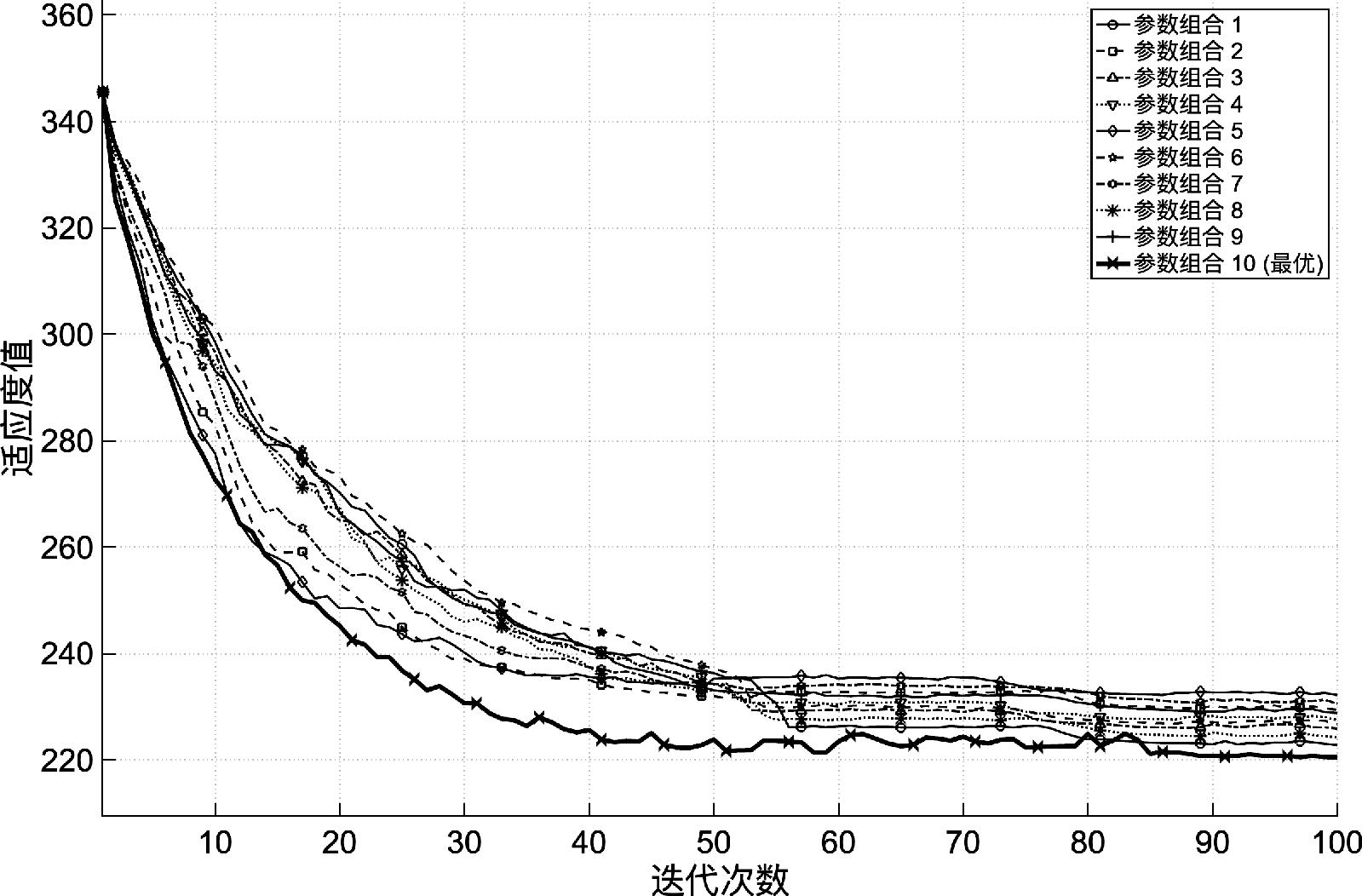
| 实验编号 | 参数组合 | 实验编号 | 参数组合 |
|---|---|---|---|
| 1 | (50,0.7,0.05,100,2.0,2.0) | 6 | (50,0.8,0.2,100,2.0,2.0) |
| 2 | (50,0.8,0.05,100,2.0,2.0) | 7 | (50,0.8,0.1,100,1.5,2.5) |
| 3 | (50,0.7,0.1,100,2.0,2.0) | 8 | (50,0.8,0.1,10,01.5,1.5) |
| 4 | (100,0.8,0.1,100,2.0,2.0) | 9 | (100,0.8,0.1,200,2.0,2.0) |
| 5 | (50,0.9,0.1,100,2.0,2.0) | 10 | (50,0.8,0.1,100,2.0,2.0) |
"
| 调度方案 | 风险水平 | ||||||||
|---|---|---|---|---|---|---|---|---|---|
| 低 | 中 | 高 | |||||||
| 延误成本/元 | 工期/天 | 完工率(%) | 延误成本/元 | 工期/天 | 完工率(%) | 延误成本/元 | 工期/天 | 完工率(%) | |
| RS[ | 450292 | 234.90 | 99.83 | 1173532 | 236.11 | 93.44 | 2460675 | 238.21 | 62.74 |
| RP | 258448 | 234.11 | 100 | 980936 | 234.35 | 99.82 | 2444753 | 235.52 | 94.9 |
| FDRP | 260812 | 227.16 | 100 | 1055612 | 231.54 | 99.93 | 2688726 | 233.20 | 97.45 |
| [1] | Van de Vonder S, Demeulemeester E, Herroelen W. Proactive heuristic procedures for robust project scheduling: An experimental analysis[J]. European Journal of Operational Research, 2008, 189(3): 723-733. |
| [2] | 郭武山. 南水北调中线水源工程投资计划与管理[J]. 人民长江, 2015, 46(6): 28-30. |
| Guo W S. Investment plan and management of water sources project for Middle Route Project of South to North Water Diversion[J]. Yangtze River, 2015, 46(6): 28-30. | |
| [3] | Yang I T, Chang C Y. Stochastic resource-constrained scheduling for repetitive construction projects with uncertain supply of resources and funding[J]. International Journal of Project Management,2005, 23(7): 546-553. |
| [4] | Cao Q, Zou X, Zhang L. Multiobjective robust optimization model for generating stable and makespan-protective repetitive schedules[J]. Journal of Construction Engineering and Management,2022,148(9): 04022099. |
| [5] | Tokdemir O B, Erol H, Dikmen I. Delay risk assessment of repetitive construction projects using line-of-balance scheduling and Monte Carlo simulation[J]. Journal of Construction Engineering and Management, 2019, 145(2): 04018132. |
| [6] | Katsuragawa C M, Lucko G, Isaac S, et al. Fuzzy linear and repetitive scheduling for construction projects[J]. Journal of Construction Engineering and Management, 2021, 147(3): 04021002. |
| [7] | Arabpour Roghabadi M, Moselhi O. Optimized crew selection for scheduling of repetitive projects[J]. Engineering, Construction and Architectural Management, 2021, 28(6): 1517-1540. |
| [8] | 张玲, 王晶, 黄钧. 不确定需求下应急资源配置的鲁棒优化方法[J]. 系统科学与数学, 2010, 30(10): 1283-1292. |
| Zhang L, Wang J, Huang J. Robust optimal resource allocation model for uncertain demands[J]. Journal of Systems Science and Mathematical Sciences, 2010, 30(10): 1283-1292. | |
| [9] | 胡雪君, 赵雁, 单汩源, 等. 基于自适应大邻域搜索的鲁棒多项目调度方法[J]. 中国管理科学, 2022, 30(9): 217-231. |
| Hu X J, Zhao Y, Shan G Y, et al. An adaptive large neighborhood search metaheuristic for robust multi-project scheduling[J]. Chinese Journal of Management Science, 2022, 30(9): 217-231. | |
| [10] | Van de Vonder S, Demeulemeester E, Herroelen W, et al. The use of buffers in project management: The trade-off between stability and makespan[J]. International Journal of Production Economics, 2005, 97(2): 227-240. |
| [11] | Salama T, Salah A, Moselhi O. Integration of linear scheduling method and the critical chain project management[J]. Canadian Journal of Civil Engineering, 2018, 45(1): 30-40. |
| [12] | Salama T, Moselhi O. Multi-objective optimization for repetitive scheduling under uncertainty[J]. Engineering, Construction and Architectural Management, 2019, 26(7): 1294-1320. |
| [13] | Zhang L, Dai G, Zou X, et al. Robustness-based multi-objective optimization for repetitive projects under work continuity uncertainty[J]. Engineering, Construction and Architectural Management, 2020, 27(10): 3095-3113. |
| [14] | Bertsimas D, Sim M. The price of robustness[J]. Operations Research, 2004, 52(1): 35-53. |
| [15] | Yamashita D S, Armentano V A, Laguna M. Robust optimization models for project scheduling with resource availability cost[J]. Journal of Scheduling, 2007, 10(1): 67-76. |
| [16] | Cohen I, Golany B, Shtub A. The stochastic time–cost tradeoff problem: A robust optimization approach[J]. Networks, 2007, 49(2): 175-188. |
| [17] | Hazır Ö, Erel E, Günalay Y. Robust optimization models for the discrete time/cost trade-off problem[J]. International Journal of Production Economics, 2011, 130(1): 87-95. |
| [18] | Artigues C, Leus R, Talla Nobibon F. Robust optimization for resource-constrained project scheduling with uncertain activity durations[J]. Flexible Services and Manufacturing Journal, 2013, 25(1-2): 175-205. |
| [19] | Bruni M E, Di Puglia Pugliese L, Beraldi P, et al. An adjustable robust optimization model for the resource-constrained project scheduling problem with uncertain activity durations[J]. Omega, 2017, 71: 66-84. |
| [20] | Balouka N, Cohen I. A robust optimization approach for the multi-mode resource-constrained project scheduling problem[J]. European Journal of Operational Research, 2021, 291(2): 457-470. |
| [21] | Zhang Y, Cui N, Hu X, et al. Robust project scheduling integrated with materials ordering under activity duration uncertainty[J]. Journal of the Operational Research Society, 2020, 71(10): 1581-1592. |
| [22] | Fu F, Liu Q, Yu G. Robustifying the resource-constrained project scheduling against uncertain durations[J]. Expert Systems with Applications, 2024, 238: 122002. |
| [23] | Bruni M E, Hazır Ö. A risk-averse distributionally robust project scheduling model to address payment delays[J]. European Journal of Operational Research, 2024, 318(2): 398-407. |
| [24] | Bendotti P, Brunod Indrigo L, Chrétienne P, et al. Anchor-robust project scheduling with non-availability periods[J]. Discrete Optimization, 2024, 54: 100864. |
| [25] | Koster A M C A, Segschneider J, Ventsch N. Γ-robust optimization of project scheduling problems[J]. Computers & Operations Research, 2024, 161: 106453. |
| [26] | Zolfaghar Dolabi H R, Afshar A, Abbasnia R. CPM/LOB scheduling method for project deadline constraint satisfaction[J]. Automation in Construction, 2014, 48: 107-118. |
| [27] | 刘一欣, 郭力, 王成山. 微电网两阶段鲁棒优化经济调度方法[J]. 中国电机工程学报, 2018, 38(14): 4013-4022+4307. |
| Liu Y X, Guo L, Wang C S. Economic dispatch of microgrid based on two stage robust optimization[J]. Proceedings of the CSEE, 2018, 38(14): 4013-4022+4307. | |
| [28] | Bertsimas D, Sim M. Robust discrete optimization and network flows[J]. Mathematical Programming, 2003, 98(1-3): 49-71. |
| [29] | Wei C, Li Y, Cai X. Robust optimal policies of production and inventory with uncertain returns and demand[J]. International Journal of Production Economics, 2011, 134(2): 357-367. |
| [30] | Damci A, Arditi D, Polat G. Resource leveling in line-of-balance scheduling[J]. Computer-Aided Civil and Infrastructure Engineering, 2013, 28(9): 679-692. |
| [31] | 崔晓, 何正文, 王能民. 考虑信息处理投入的随机资源需求反应性项目调度优化[J]. 中国管理科学, 2025, 33(8): 218-229. |
| Cui X, He Z W, Wang N M. Optimization of reactive project scheduling with stochastic resource requirements considering information handling input[J]. Chinese Journal of Management Science,2025,33(8): 218-229. | |
| [32] | Ben-Tal A, El Ghaoui L, Nemirovski A. Robust Optimization[M]. Princeton: Princeton University Press, 2009. |
| [33] | Hyari K H, El-Rayes K, El-Mashaleh M. Automated trade-off between time and cost in planning repetitive construction projects[J]. Construction Management and Economics, 2009, 27(8): 749-761. |
| Viewed | ||||||
|
Full text |
|
|||||
|
Abstract |
|
|||||
|
||
