
主管:中国科学院
主办:中国优选法统筹法与经济数学研究会
中国科学院科技战略咨询研究院
主办:中国优选法统筹法与经济数学研究会
中国科学院科技战略咨询研究院

Chinese Journal of Management Science ›› 2026, Vol. 34 ›› Issue (4): 156-167.doi: 10.16381/j.cnki.issn1003-207x.2024.0283
Previous Articles Next Articles
Shaolong Hu1,2, Xudong Wang3, Chuanfeng Han4, Lingpeng Meng3( )
)
Received:2024-02-28
Revised:2024-08-04
Online:2026-04-25
Published:2026-03-27
Contact:
Lingpeng Meng
E-mail:lpmeng@shmtu.edu.cn
CLC Number:
Shaolong Hu,Xudong Wang,Chuanfeng Han, et al. Optimization Model and Strategies for Route and Fleet Allocation Considering Port Congestion and Carbon Emission Reduction[J]. Chinese Journal of Management Science, 2026, 34(4): 156-167.

"
| 符号 | 说明 |
|---|---|
| 集合 | |
| 顶点(港口)集, | |
| 弧边(航段)集, | |
| 船舶种类集, | |
| O/D(起点/终点)对集, | |
| 航线集, | |
| O/D对 | |
| 参数/变量 | |
| 航线索引, | |
| 航段索引, | |
| O/D对 | |
| 航段 | |
| 目的港口为港口 | |
| 港口 | |
| 航段 | |
| 设计航速 | |
| 航线 | |
| 航段 | |
| 航段 | |
| 航段 | |
| 在航段上 | |
| 航段 | |
| 目的港口为 | |
| 每天锚地使用费用 | |
| 航段 | |
| 航线 | |
| 航段 | |
| 航段 | |
| 模拟船舶在港口等待时间影响参数 | |
| 航段 | |
"
| 数据集 | 港口数/航线数/航段数 | 投影算法(秒) | 标准对角化算法(秒) | 改进对角化算法(秒) |
|---|---|---|---|---|
| S1 | 4/2/2 | 16 | 15 | 14 |
| S2 | 8/8/12 | 239 | 223 | 197 |
| S3 | 37/65/75 | 1,417 | 1,030 | 864 |
| S4 | 30/50/109 | 3,102 | 2,419 | 1,920 |
| S5 | 47/79/56 | 3,652 | 3,299 | 2,541 |
| S6 | 37/65/163 | - | 3,510 | 2,892 |
| S7 | 30/50/129 | - | 5,193 | 4,252 |
| S8 | 37/65/327 | - | 5,459 | 4,287 |
| S9 | 47/79/100 | - | - | 9,737 |
| S10 | 47/79/141 | - | - | 10,084 |
"
"
| 船舶容量/标准集装箱 | 船舶吨位/吨 | 设计船速/节 | 最小船速/节 | 碳税税率/(美元/吨) |
|---|---|---|---|---|
| 2900 | 36000 | 25 | 12 | 20 |
| MFO价格/LNG价格/(美元/吨) | MFO碳排放系数/ LNG碳排放系数(千克-CO2/千克) | 主机燃料消耗率/ 辅机燃料消耗率(克/千瓦时) | 船舶停泊费费率/ (美元/净吨/天) | 航次固定费用/美元 |
338 896 | 3.1705 2.1622 | 206 221 | 0.08 | 50000 |
"
| 航段 | 航段因终点港口拥堵停留天数/天 |
|---|---|
| 1 | |
| 3 | |
| 1 | |
| 1 |
"
| 航段 | 拥堵停留天数/天 | 航段 | 拥堵停留天数/天 |
|---|---|---|---|
| 2 | 1 | ||
| 5 | 3 | ||
| 2 | 1 | ||
| 4 | 3 | ||
| 2 | 2 | ||
| 4 | 2 |
"
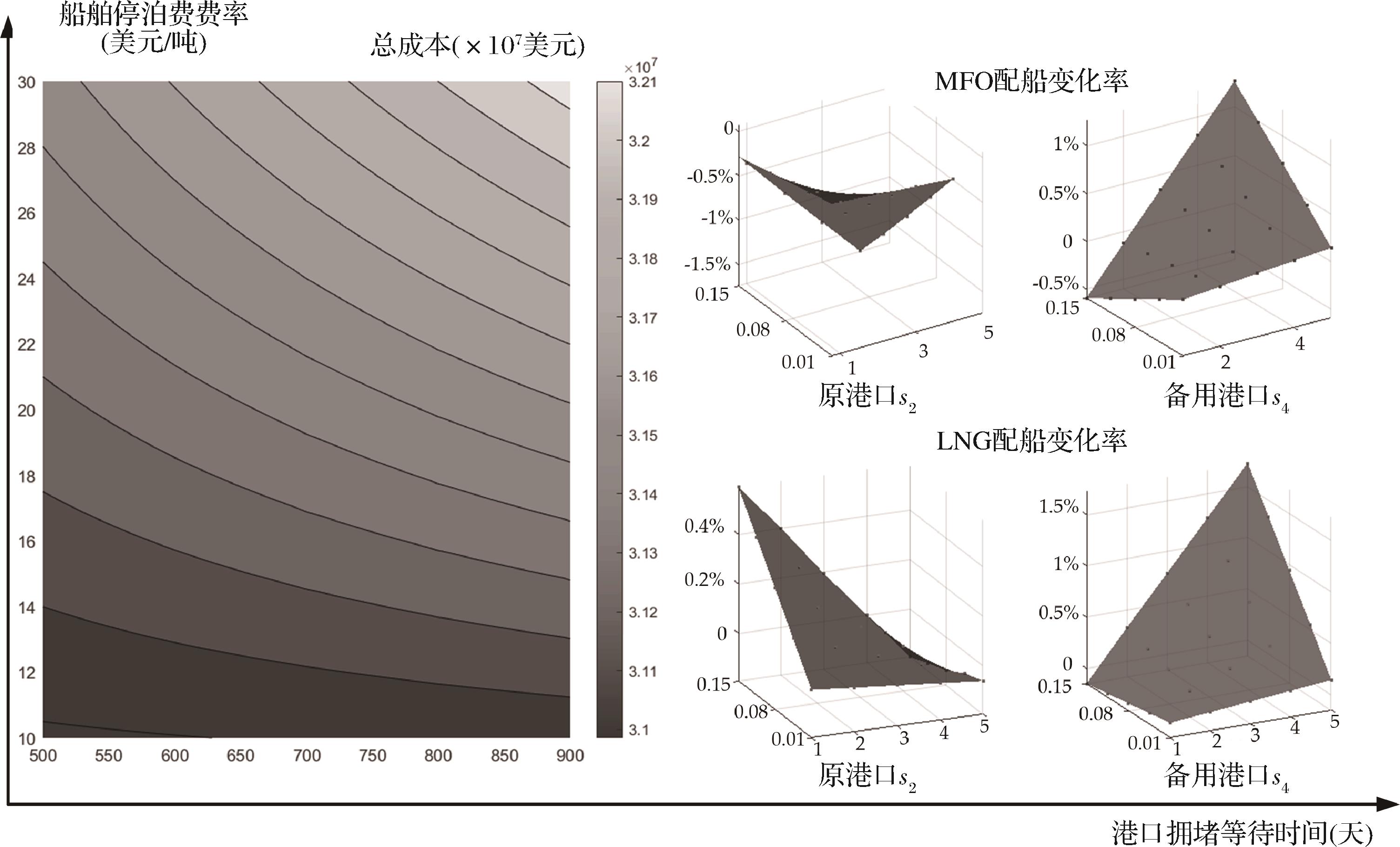
"
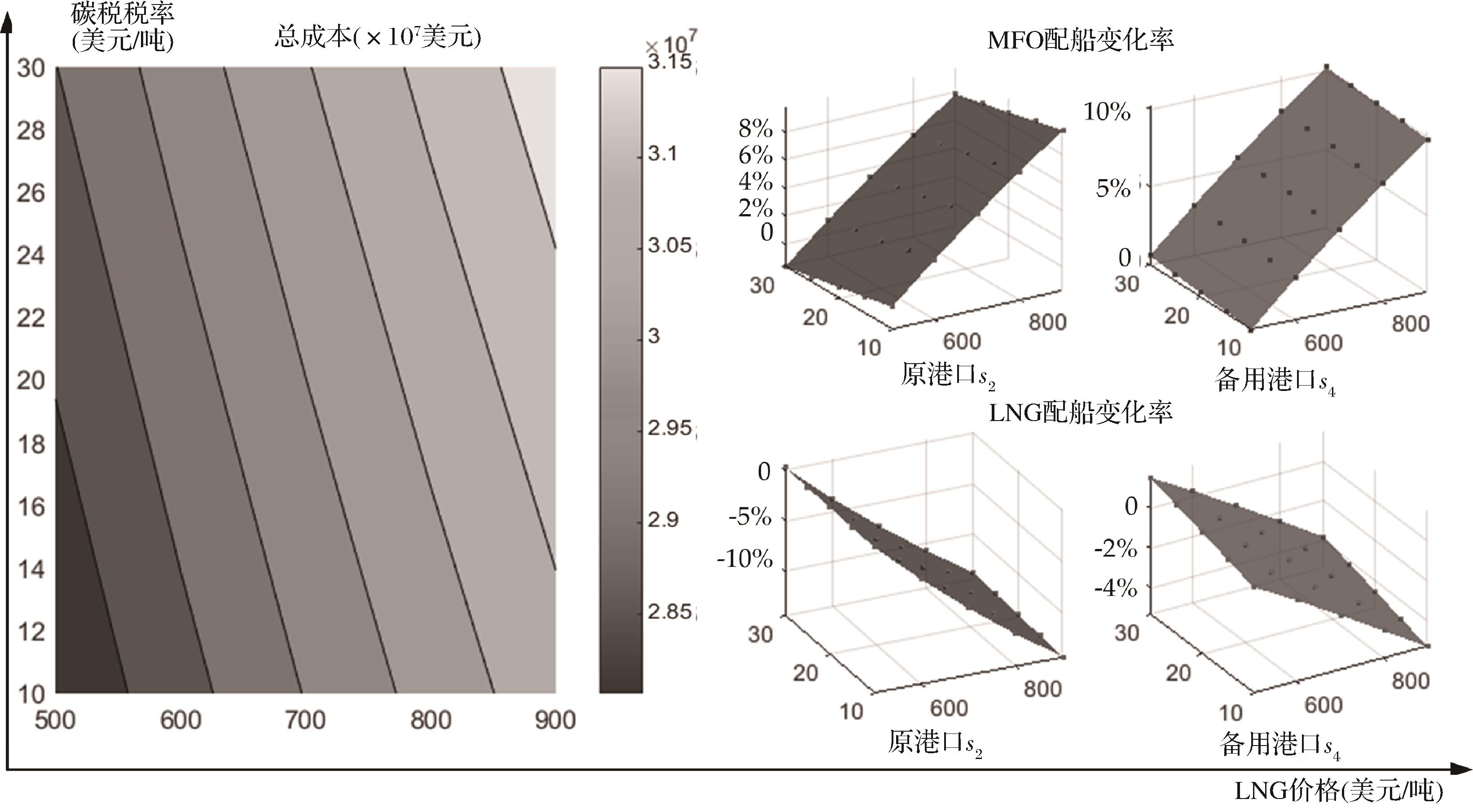
"
| [1] | Gui D, Wang H, Yu M, et al. Risk assessment of port congestion risk during the COVID-19 pandemic[J]. Journal of Marine Science and Engineering, 2022, 10(2): 150. |
| [2] | Xiao G, Wang T, Chen X, et al. Evaluation of ship pollutant emissions in the ports of los angeles and long beach[J]. Journal of Marine Science and Engineering, 2022, 10(9): 1206. |
| [3] | Gidado U M. Consequences of port congestion on logistics and supply chain in African ports[J]. Developing Country Studies, 2015, 5: 160-167. |
| [4] | Steinbach S. Port congestion, container shortages, and U.S. foreign trade[J]. Economics Letters, 2022, 213: 110392. |
| [5] | Peng W, Bai X, Yang D, et al. A deep learning approach for port congestion estimation and prediction[J]. Maritime Policy & Management, 2023, 50(7): 835-860. |
| [6] | Tai H H, Chang C C. Cost advantages of far east/Europe trunk route deployment with port selection in east Asia[J]. Journal of Marine Science and Technology, 2023, 31(1): 6. |
| [7] | Chen J, Ye J, Zhuang C, et al. Liner shipping alliance management: Overview and future research directions[J] Ocean & Coastal Management, 2022, 219: 106039. |
| [8] | Koza D F, Desaulniers G, Ropke S. Integrated liner shipping network design and scheduling[J]. Transportation Science, 2020, 54(2): 512-533. |
| [9] | Huang L, Tan Y, Guan X. Hub-and-spoke network design for container shipping considering disruption and congestion in the post COVID-19 era[J]. Ocean & Coastal Management, 2022, 225: 106230. |
| [10] | Wang S, Meng Q. Robust schedule design for liner shipping services[J]. Transportation Research Part E: Logistics and Transportation Review, 2012, 48(6): 1093-1106. |
| [11] | Meng L, Wang X, Jin J, et al. Optimization model for container liner ship scheduling considering disruption risks and carbon emission reduction[J]. Journal of Marine Science and Engineering, 2023, 11(7): 1449. |
| [12] | 黄肖玲, 代霞梅, 纪国良, 等. 基于“前港后厂”模式的进口铁矿石采购物流成本优化[J]. 中国管理科学, 2021, 29(8): 218-228. |
| Huang X L, Dai X M, Ji G L, et al. Optimization on the procurement logistics system of importing iron ore based on the “port before factory” mode[J]. Chinese Journal of Management Science, 2021, 29(8): 218-228. | |
| [13] | Jin J G, Meng Q, Wang H. Feeder vessel routing and transshipment coordination at a congested hub port[J]. Transportation Research Part B: Methodological, 2021, 151: 1-21. |
| [14] | Abioye O F, Dulebenets M A, Kavoosi M, et al. Vessel schedule recovery in liner shipping: Modeling alternative recovery options[J]. IEEE Transactions on Intelligent Transportation Systems, 2021, 22(10): 6420-6434. |
| [15] | Bütün C, Petrovic S, Muyldermans L. The capacitated directed cycle hub location and routing problem under congestion[J]. European Journal of Operational Research, 2021, 292(2): 714-734. |
| [16] | Mohammadi M, Tavakkoli-Moghaddam R, Siadat A, et al. Design of a reliable logistics network with hub disruption under uncertainty[J]. Applied Mathematical Modelling, 2016, 40(9-10): 5621-5642. |
| [17] | Tsao Y C, Linh V T. Seaport- dry port network design considering multimodal transport and carbon emissions[J]. Journal of Cleaner Production, 2018, 199: 481-492. |
| [18] | Snyder L V, Daskin M S. Reliability models for facility location: The expected failure cost case[J]. Transportation Science, 2005, 39(3): 400-416. |
| [19] | Cui T, Ouyang Y, Shen Z M. Reliable facility location design under the risk of disruptions[J]. Operations Research, 2010, 58(4-Part-1): 998-1011. |
| [20] | Rahimi Y, Ali Torabi S, Tavakkoli-Moghaddam R. A new robust-possibilistic reliable hub protection model with elastic demands and backup hubs under risk[J]. Engineering Applications of Artificial Intelligence, 2019, 86: 68-82. |
| [21] | An Y, Zhang Y, Zeng B. The reliable hub-and-spoke design problem: Models and algorithms[J]. Transportation Research Part B: Methodological, 2015, 77: 103-122. |
| [22] | 周海英, 李伯棠. 碳税与客户低碳偏好下港航企业减排决策分析[J]. 中国航海, 2022, 45(3): 72-79. |
| Zhou H Y, Li B T. The ways for port and shipping enterprises to make decision on emission-reduction in the context of carbon tax and client’s low carbon preference[J]. Navigation of China, 2022, 45(3): 72-79. | |
| [23] | 夏凡, 王欢, 王之扬. “双碳”背景下我国碳排放权交易体系与碳税协调发展机制研究[J]. 西南金融, 2023(1): 3-15. |
| Xia F, Wang H, Wang Z Y. Research on the coordinated development mechanism of China’s carbon emission trading system and carbon tax in the background of “carbon peaking and carbon neutrality”[J]. Southwest Finance, 2023(1): 3-15. | |
| [24] | Wang S, Zhen L, Psaraftis H N, et al. Implications of the EU’s inclusion of maritime transport in the emissions trading system for shipping companies[J]. Engineering, 2021, 7(5): 554-557. |
| [25] | 镇璐, 诸葛丹, 汪小帆. 绿色港口与航运管理研究综述[J].系统工程理论与实践,2020,40(8):2037-2050. |
| Zhen L, Zhuge D, Wang X F. Researches on green ports and shipping management: An overview[J]. Systems Engineering-Theory & Practice, 2020, 40(8): 2037-2050. | |
| [26] | Mallouppas G, Yfantis E A, Mallouppas G, et al. Decarbonization in shipping industry: A review of research, technology development, and innovation proposals[J]. Journal of Marine Science and Engineering, 2021, 9(4): 415. |
| [27] | Reinhardt L B, Pisinger D, Sigurd M M, et al. Speed optimizations for liner networks with business constraints[J]. European Journal of Operational Research, 2020, 285(3): 1127-1140. |
| [28] | Zhen L, Wu Y, Wang S, et al. Green technology adoption for fleet deployment in a shipping network[J]. Transportation Research Part B: Methodological, 2020, 139: 388-410. |
| [29] | Leurent F. Cost versus time equilibrium over a network[J]. European Journal of Operational Research, 1993, 71(2): 205-221. |
| [30] | Abrahamsson T, Lundqvist L. Formulation and estimation of combined network equilibrium models with applications to Stockholm[J]. Transportation Science, 1999, 33(1): 80-100. |
| [31] | Lions J L, Stampacchia G. Variational inequalities[J]. Communications on Pure and Applied Mathematics, 1967, 20(3): 493-519. |
| [32] | Nagurney A, Dong J, Zhang D. A supply chain network equilibrium model[J]. Transportation Research Part E: Logistics and Transportation Review, 2002, 38(5): 281-303. |
| [33] | Nagurney A, Besik D, Dong J. Tariffs and quotas in world trade: A unified variational inequality framework[J]. European Journal of Operational Research, 2019, 275(1): 347-360. |
| [34] | Dafermos S, Nagurney A. A network formulation of market equilibrium problems and variational inequalities[J].Operations Research Letters,1984,3(5): 247-250. |
| [35] | Matsypura D, Nagurney A, Liu Z. Modeling of electric power supply chain networks with fuel suppliers via variational inequalities[J]. International Journal of Emerging Electric Power Systems, 2007, 8(1): 5. |
| [36] | Wu Y, Wang S, Zhen L, et al. How to operate ship fleets under uncertainty[J]. Production and Operations Management, 2023, 32(10): 3043-3061. |
| [37] | Corbett J J, Wang H, Winebrake J J. The effectiveness and costs of speed reductions on emissions from international shipping[J]. Transportation Research Part D: Transport and Environment, 2009, 14(8): 593-598. |
| [38] | Sheffi Y. Urban Transportation Networks[M]. New Jersey, USA: Prentice Hall, 1985. |
| [39] | Mahmassani H S, Mouskos K C. Some numerical results on the diagonalization algorithm for network assignment with asymmetric interactions between cars and trucks[J]. Transportation Research Part B: Methodological, 1988, 22(4): 275-290. |
| [40] | Meng L, Wang X, He J, et al. Ship allocation considering energy type and transportation preference: A variational inequality approach[J]. Advanced Engineering Informatics, 2024, 59: 102291. |
| [1] | Yeming Dai, Shuang Yu. Remanufacturing Closed-loop Supply Chain Decision Considering Retailer’s Dual Behavior Preference under Carbon Tax Regulation [J]. Chinese Journal of Management Science, 2025, 33(8): 308-320. |
| [2] | Lin Pan,Xiajing Xu,Rongting Zhou. Research on Dual Channel Dynamic Pricing of Community Fresh Food Supply Chain from the Perspective of Competition [J]. Chinese Journal of Management Science, 2024, 32(7): 300-310. |
| [3] | Haixiang Wu,Bing Xu. Multi-period International Supply Chain Network Equilibrium under Technology Diffusion and Trade Protectionism [J]. Chinese Journal of Management Science, 2024, 32(2): 324-334. |
| [4] | Xiu-li MENG,Yi-fan WU,Bo LIU. Multi-Period Crowdsourcing Logistics Service Quality Optimization Considering Delay Insurance [J]. Chinese Journal of Management Science, 2023, 31(12): 87-95. |
| [5] | XIA Xi-qiang, LI Biao. A Study on the Impact of Government Carbon Tax and Subsidy Policies on Outsourced Remanufacturing [J]. Chinese Journal of Management Science, 2022, 30(9): 105-115. |
| [6] | CAO Yu, YI Chao-qun, WAN Guang-yu. Inventory Decisions and Coordination Mechanism for Dual-Channel Supply Chain under Carbon Tax Policy [J]. Chinese Journal of Management Science, 2022, 30(1): 111-123. |
| [7] | WANG Jun, CHENG Xian-xue, JIANG Yu-shan, DONG Zhen-min. Behavior Selection of Supply Chain Members Considering Reference Carbon Emission under Carbon Tax Policy [J]. Chinese Journal of Management Science, 2021, 29(7): 128-138. |
| [8] | YANG Jian-hua, HAN Meng-ying. The Influence Research on the Joint Ordering Policy for Spare Parts Considering Carbon Tax [J]. Chinese Journal of Management Science, 2021, 29(7): 23-32. |
| [9] | DIAO Xin-wei, ZENG Zhen-xiang, SUN Cheng. Research on Coordination of Supply Chain with Two Products Based on Mix Carbon Policy [J]. Chinese Journal of Management Science, 2021, 29(2): 149-159. |
| [10] | GUO Jie. Online Tourism Supply Chain Network Equilibrium Model with the Transaction Risk Investment [J]. Chinese Journal of Management Science, 2020, 28(6): 137-145. |
| [11] | WANG Shan-shan, ZHANG Li-hao, FAN Ti-jun. Equilibrium Strategies of Carbon Reduction Technology Adoption in Competitive Supply Chains [J]. Chinese Journal of Management Science, 2020, 28(6): 73-82. |
| [12] | ZHOU Yan-ju, HU Feng-ying, ZHOU Zheng-long. Pricing Strategy and Social Welfare in Supply Chain with Competing Manufacturers Based on Carbon Tax Policy [J]. Chinese Journal of Management Science, 2019, 27(7): 94-105. |
| [13] | ZHOU Zhang-jin, FU Xiao-ling, LI Min. Research on Stations Distribution of Waste Collection Based on Carbon Emission [J]. Chinese Journal of Management Science, 2018, 26(4): 41-48. |
| [14] | CAO Bin-bin, XIAO Zhong-dong, ZHU Chun-yang. Research on Decision-making of Supply Chain with Dual Sale Mode Considering Government's Low-carbon Policies [J]. Chinese Journal of Management Science, 2018, 26(4): 30-40. |
| [15] | MI Chuan-min, LI Dan-dan, ZHANG Ting, QIAN Yuan-yuan, ZHOU Zhi-peng. Study on Financial Market Supernetwork Equilibrium Considering Social Network and Internet Finance [J]. Chinese Journal of Management Science, 2018, 26(12): 56-65. |
| Viewed | ||||||
|
Full text |
|
|||||
|
Abstract |
|
|||||
|
||
