
主管:中国科学院
主办:中国优选法统筹法与经济数学研究会
中国科学院科技战略咨询研究院
主办:中国优选法统筹法与经济数学研究会
中国科学院科技战略咨询研究院

Chinese Journal of Management Science ›› 2026, Vol. 34 ›› Issue (1): 234-243.doi: 10.16381/j.cnki.issn1003-207x.2023.0577
Previous Articles Next Articles
Lifang Peng, Nannan Zhao( )
)
Received:2023-04-07
Revised:2023-09-07
Online:2026-01-25
Published:2026-01-29
Contact:
Nannan Zhao
E-mail:zhaonannan@stu.xmu.edu.cn
CLC Number:
Lifang Peng,Nannan Zhao. Location-routing Problem Considering Psychological Cost in Emergency Logistics[J]. Chinese Journal of Management Science, 2026, 34(1): 234-243.
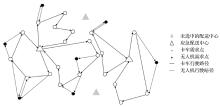
"


"
| 符号 | 说明 | 符号 | 说明 |
|---|---|---|---|
| π | 卡车可以到达的节点( | 卡车最大载重量 | |
| K | 每个卡车及其对应的无人机的集合,k ∈ K | 无人机最大载重量 | |
| 需求点i的需求量 | 无人机最大飞行时间 | ||
| 需求点i的受灾人数 | 一辆卡车(含无人机)的固定成本 | ||
| 卡车k在弧(i, j)行驶距离 | 卡车行驶单位距离的成本 | ||
| 无人机k在弧(i, j)行驶距离 | 无人机行驶单位距离的成本 | ||
| 卡车平均行驶速度 | 应急设施点的固定建设费用 | ||
| 无人机平均行驶速度 | 需求点i的等待时间 | ||
| 仓库n的容量 | P(t) | 单位心理成本 | |
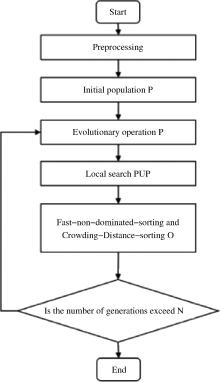
"

"
| 类型 | 算例 | 需求点数量 | 候选仓库 | 节点数量 | 区域 |
|---|---|---|---|---|---|
| S | S1-S5 | 10 | 2 | 12 | 10×10 |
| M | M1-M5 | 50 | 6 | 56 | 50×50 |
| L | L1-L5 | 120 | 12 | 132 | 100×100 |
"
| 算例 | ENSGA-II | NSGA-II | ||||||||||
|---|---|---|---|---|---|---|---|---|---|---|---|---|
| 目标1 | 目标2 | 目标3 | IGD | HV | RT | 目标1 | 目标2 | 目标3 | IGD | HV | RT | |
| S1 | 0.49 | 28310.99 | 2335.06 | 0.39 | 0.93 | 76.22 | 0.49 | 28314.00 | 2517.57 | 0.44 | 0.93 | 72.65 |
| S2 | 0.77 | 24014.76 | 3760.73 | 0.53 | 0.44 | 66.25 | 0.78 | 24014.93 | 3760.73 | 0.59 | 0.35 | 65.5 |
| S3 | 0.30 | 25130.99 | 2512.90 | 0.35 | 0.75 | 89.08 | 0.34 | 25134.47 | 2514.83 | 0.32 | 0.65 | 89.08 |
| S4 | 0.53 | 23937.13 | 2681.90 | 0.40 | 0.86 | 74.01 | 0.53 | 23938.24 | 2681.74 | 0.34 | 0.82 | 66.78 |
| S5 | 0.83 | 21344.17 | 3567.91 | 0.48 | 0.40 | 73.89 | 0.84 | 21344.17 | 3637.51 | 0.56 | 0.38 | 71.57 |
| M1 | 2.41 | 25485.30 | 62386.73 | 0.28 | 0.78 | 101.69 | 2.66 | 26769.96 | 72685.87 | 0.30 | 0.63 | 90.41 |
| M2 | 2.69 | 49974.95 | 67315.76 | 0.34 | 0.77 | 114.65 | 2.73 | 49920.89 | 70633.06 | 0.37 | 0.63 | 105.18 |
| M3 | 2.34 | 27241.96 | 65420.06 | 0.27 | 0.83 | 98.65 | 2.58 | 28112.59 | 74683.02 | 0.33 | 0.84 | 91.66 |
| M4 | 2.50 | 26607.13 | 60975.33 | 0.27 | 0.85 | 101.57 | 2.49 | 26664.67 | 66951.70 | 0.26 | 0.77 | 93.39 |
| M5 | 2.36 | 28829.30 | 67952.22 | 0.31 | 0.83 | 98.94 | 2.84 | 29258.68 | 72437.38 | 0.25 | 0.78 | 88.49 |
| L1 | 8.66 | 83985.67 | 438618.54 | 0.37 | 0.83 | 177.08 | 9.04 | 84281.34 | 513641.03 | 0.27 | 0.76 | 162.55 |
| L2 | 7.28 | 71900.16 | 412912.97 | 0.36 | 0.71 | 173.6 | 7.67 | 80357.30 | 455425.31 | 0.38 | 0.71 | 160.64 |
| L3 | 7.57 | 81969.99 | 401440.47 | 0.29 | 0.74 | 177.29 | 8.22 | 89749.63 | 472506.05 | 0.36 | 0.84 | 162.97 |
| L4 | 8.01 | 87282.02 | 404709.85 | 0.30 | 0.69 | 194.64 | 8.30 | 89607.98 | 445726.60 | 0.28 | 0.68 | 181.78 |
| L5 | 8.06 | 97707.57 | 420210.44 | 0.34 | 0.91 | 196.42 | 9.42 | 97371.74 | 498813.67 | 0.28 | 0.86 | 188.31 |
"
| 应急设施 | 费用(千元) | 容量(件) |
|---|---|---|
| 1 | 21 | 5600 |
| 2 | 24 | 5800 |
| 3 | 23 | 4200 |
| 5 | 24 | 5800 |
| 5 | 22 | 5200 |
| 6 | 29 | 4100 |
"
| 需求点 | 需求量 | 服务类型 |
|---|---|---|
| 1 | 275 | 卡车 |
| 2 | 133 | 卡车 |
| 3 | 227 | 卡车 |
| 4 | 407 | 卡车 |
| 5 | 36 | 卡车 |
| 6 | 49 | 卡车 |
| 7 | 266 | 卡车 |
| … | … | … |
| 81 | 108 | 无人机 |
| 82 | 129 | 无人机 |
| 83 | 78 | 无人机 |
| 84 | 45 | 无人机 |
| 85 | 26 | 无人机 |
| 86 | 132 | 无人机 |
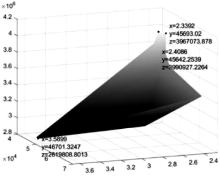
"
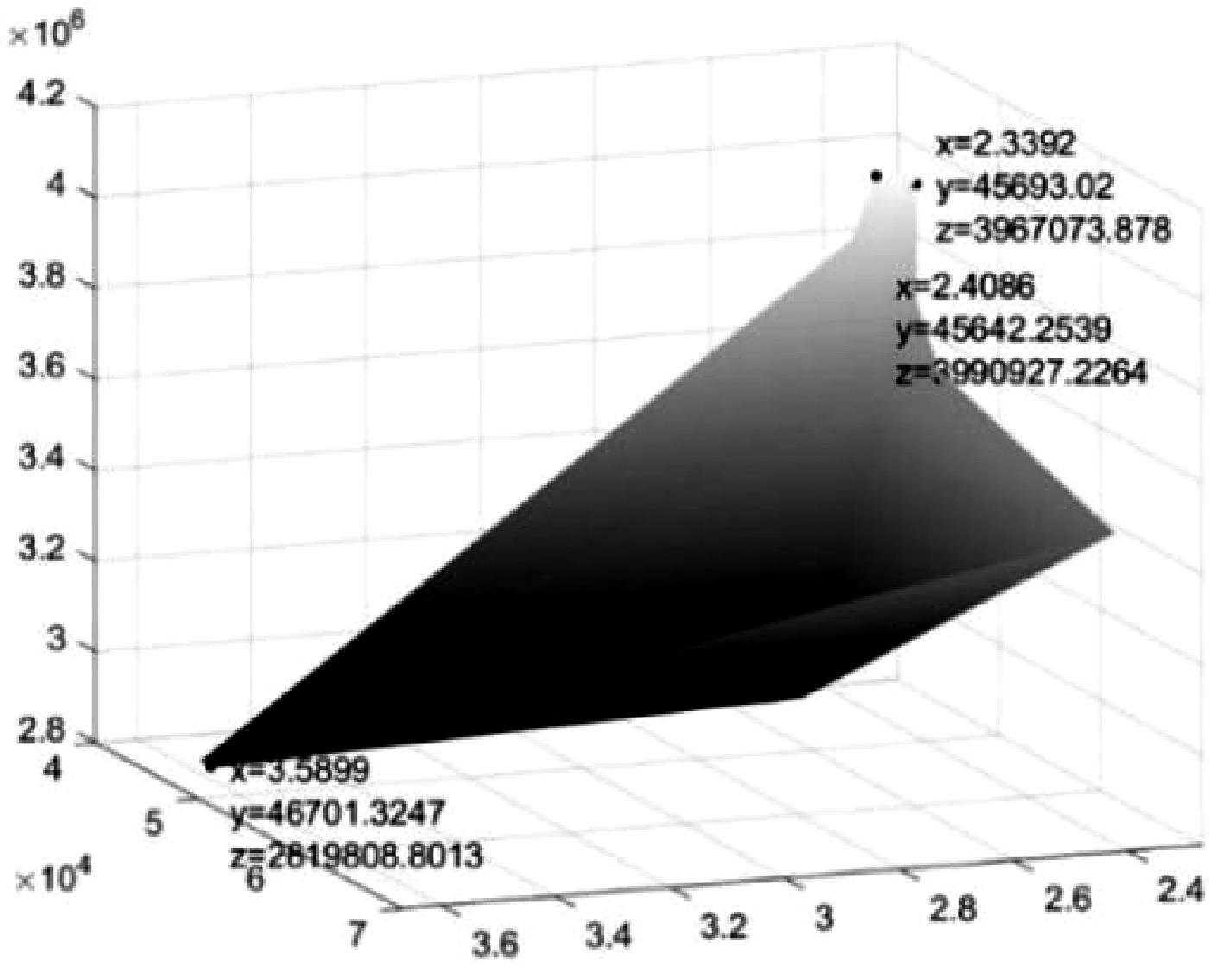

"
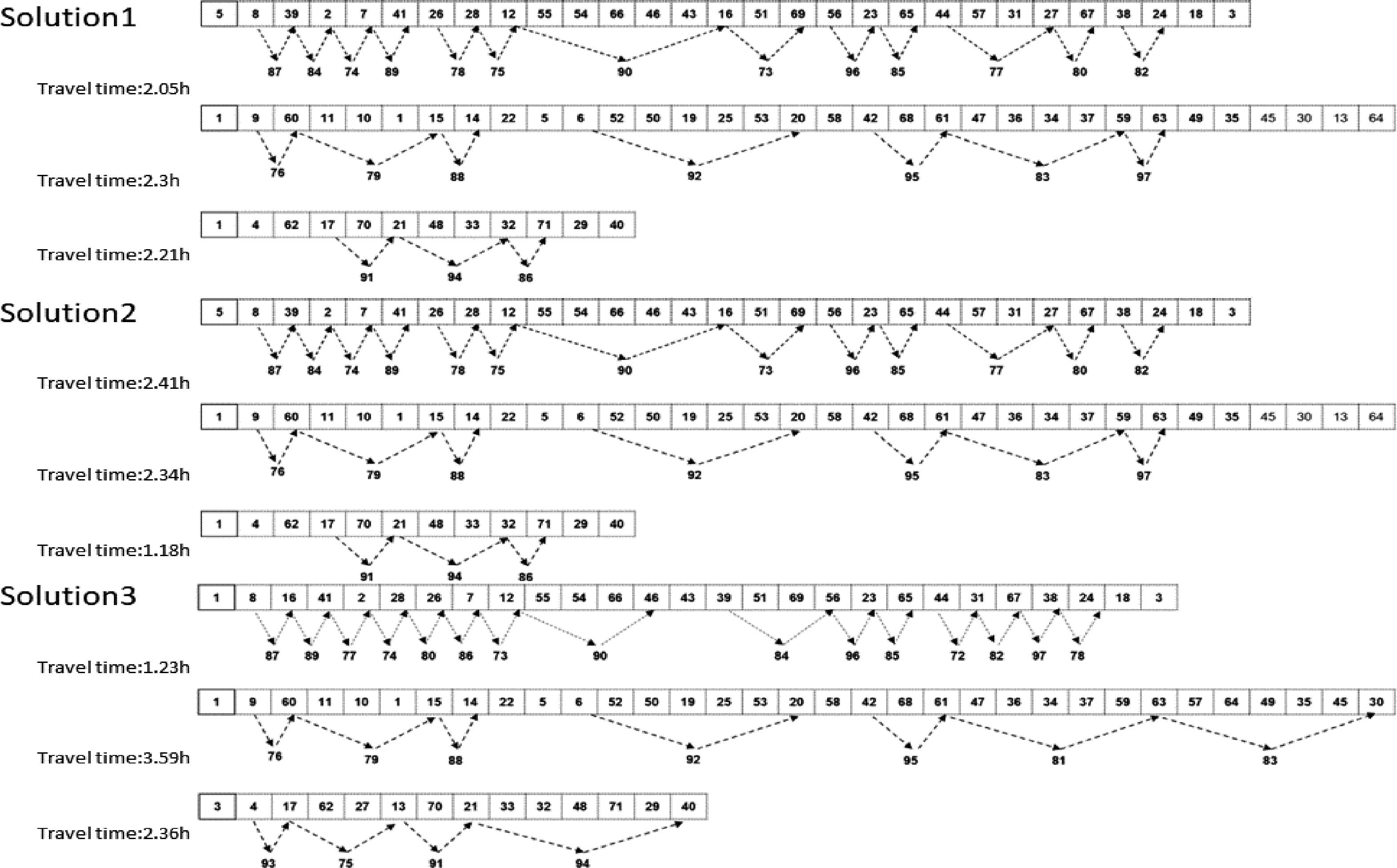

"

"
| 配送模型 | 目标一 | 目标二 | 目标三 | IGD | HV | |||
|---|---|---|---|---|---|---|---|---|
| min | mean | min | mean | min | mean | |||
| truck_drone | 2.34 | 2.55 | 45642.25 | 46687.36 | 2819808.80 | 3393923.88 | 0.32 | 0.92 |
| only_truck | 9.00 | 9.50 | 47005.38 | 50264.83 | 14332289.58 | 17143453.94 | 0.33 | 0.72 |
| Gap | 6.66 | 6.94 | 1363.12 | 3577.46 | 11512480.78 | 13749530.06 | 0.01 | -0.19 |

"

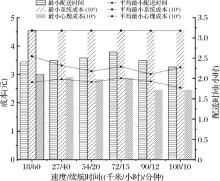
"

| [1] | Kundu T, Sheu J B, Kuo H T. Emergency logistics management—Review and propositions for future research[J]. Transportation Research Part E: Logistics and Transportation Review, 2022, 164: 102789. |
| [2] | Statista. Number of natural disasters worldwide 2021[EB/OL]. (2022-2-2) [2022-8-5]. . |
| [3] | Wang H, Du L, Ma S. Multi-objective open location-routing model with split delivery for optimized relief distribution in post-earthquake[J]. Transportation Research Part E: Logistics and Transportation Review, 2014, 69: 160-179. |
| [4] | Salhi S, Rand G K. The effect of ignoring routes when locating depots[J]. European Journal of Operational Research, 1989, 39(2): 150-156. |
| [5] | Wang S, Tao F, Shi Y. Optimization of location–routing problem for cold chain logistics considering carbon footprint[J]. International Journal of Environmental Research and Public Health, 2018, 15(1): 86-103. |
| [6] | 王海军, 杜丽敬, 马士华. 震后应急物流系统中双目标开放式选址: 路径问题模型与算法研究[J]. 管理工程学报, 2016, 30(2): 108-115. |
| Wang H J, Du L J, Ma S H. Model and algorithms for integrated open location and routing problem in emergency logistics under earthquake[J]. Journal of Industrial Engineering and Engineering Management, 2016, 30(2): 108-115. | |
| [7] | Peng Z, Wang C, Xu W, et al. Research on location-routing problem of maritime emergency materials distribution based on bi-level programming[J]. Mathematics, 2022, 10(8): 1-23. |
| [8] | Kinston W, Rosser R. Disaster: Effects on mental and physical state[J]. Journal of Psychosomatic Research, 1974, 18(6): 437-456. |
| [9] | Sheu J B, Pan C. A method for designing centralized emergency supply network to respond to large-scale natural disasters[J]. Transportation Research Part B: Methodological, 2014, 67: 284-305. |
| [10] | Hu Z H, Sheu J B, Yin Y Q, et al. Post-disaster relief operations considering psychological costs of waiting for evacuation and relief resources[J]. Transportmetrica A: Transport Science, 2017, 13(2): 108-138. |
| [11] | 顺丰科技.顺丰无人机助力抗疫第一线,累计运送物资超 11吨[EB/OL].(2020-3-6)[2022-8-5]. . |
| SF Technology. SF drone helps the first line of anti-epidemic, the cumulative delivery of materials exceeds 11 tons.[EB/OL].(2020-3-6)[2022-8-5].. | |
| [12] | 中国网.无人机为重庆山火救援出力 空中科技已成应急救援重要帮手[EB/OL]. (2022-9-1) [2022-9-15]. . |
| Net China. Aerial technology has become an important aid for emergency rescue in Chongqing[EB/OL]. (2022-9-1) [2022-9-15]. . | |
| [13] | Murray C C, Chu A G. The flying sidekick traveling salesman problem: Optimization of drone-assisted parcel delivery[J]. Transportation Research Part C: Emerging Technologies, 2015, 54: 86-109. |
| [14] | Agatz N, Bouman P, Schmidt M. Optimization approaches for the traveling salesman problem with drone[J].Transportation Science,2018,52(4): 965-981. |
| [15] | 颜瑞, 陈立双, 朱晓宁, 等. 考虑区域限制的卡车搭载无人机车辆路径问题研究[J]. 中国管理科学, 2022, 30(5): 144-155. |
| Yan R, Chen L S, Zhu X N, et al. Research on vehicle routing problem of truck carrying UAV considering area restriction[J]. Chinese Journal of Management Science, 2022, 30(5): 144-155. | |
| [16] | 曹英英, 陈淮莉. 基于集群的卡车与无人机联合配送调度研究[J]. 计算机工程与应用, 2022, 58(11): 287-294. |
| Cao Y Y, Chen H L. Research on truck and drone joint distribution scheduling based on cluster[J]. Computer Engineering and Applications, 2022, 58(11): 287-294. | |
| [17] | Lu Y, Yang C, Yang J. A multi-objective humanitarian pickup and delivery vehicle routing problem with drones[J]. Annals of Operations Research, 2022, 319(1): 291-353. |
| [18] | Kuo R J, Lu S H, Lai P Y, et al. Vehicle routing problem with drones considering time windows[J]. Expert Systems with Applications, 2022, 191: 116264. |
| [19] | Kyriakakis N A, Stamadianos T, Marinaki M, et al. The electric vehicle routing problem with drones: An energy minimization approach for aerial deliveries[J]. Cleaner Logistics and Supply Chain, 2022, 4: 100041. |
| [20] | Deb K, Pratap A, Agarwal S, et al. A fast and elitist multiobjective genetic algorithm: NSGA-II[J]. IEEE Transactions on Evolutionary Computation, 2002, 6(2): 182-197. |
| [21] | Zhang Q, Li H. MOEA/D: A multiobjective evolutionary algorithm based on decomposition[J]. IEEE Transactions on Evolutionary Computation, 2007, 11(6): 712-731. |
| [22] | Zitzler E, Thiele L. Multiobjective evolutionary algorithms: A comparative case study and the strength Pareto approach[J]. IEEE Transactions on Evolutionary Computation, 1999, 3(4): 257-271. |
| [1] | Yanqiu Liu, Jihui Hu. Research on Emergency Logistics Path Optimization Based on Hybrid Artificial Fish Swarm Algorithm [J]. Chinese Journal of Management Science, 2025, 33(8): 198-208. |
| [2] | Jianfang Shao, Yu Fan, Xihui Wang, Liang Liang. The Impact of Emergency Supplies Quantitative Differences and Social Factors on the Fair Perceptions of Victims: An Empirical Study [J]. Chinese Journal of Management Science, 2025, 33(8): 189-197. |
| [3] | TANG Zhao-ping, QIN Jin, SUN Jian-ping. Robust Optimization for Railway Emergency Location-Routing Based on Non-probabilistic Reliability [J]. Chinese Journal of Management Science, 2022, 30(9): 206-216. |
| [4] | GUO Fang, HUANG Zhi-hong, HUANG Wei-lai, YANG Chao. Optimal Planning of the Electric Vehicle Routing and Battery Charging Problem with Self-pickup and Door-to-door Delivery Service [J]. Chinese Journal of Management Science, 2022, 30(2): 264-275. |
| [5] | SUN Hua-li, Chai Li-ping, ZHANG Ling, ZHAO Zhe. Multi-objective Dynamic Facility Location-transportation Problem in Emergency Humanitarian Logistics [J]. Chinese Journal of Management Science, 2020, 28(3): 103-112. |
| [6] | LIU Ming, LI Ying-zhu, CAO Jie, ZHANG Ding. An Optimal Design of Emergency Logistics Network for Epidemic Controlling based on Service Level [J]. Chinese Journal of Management Science, 2020, 28(3): 11-20. |
| [7] | LOU Zhen-kai. Bi-level Programming Model and Algorithmof Location-routing Problem in Emergency Logistics [J]. Chinese Journal of Management Science, 2017, 25(11): 151-157. |
| [8] | ZHANG Chen-xiao, ZHU Rui, LIU Hai-yue, ZHANG Jiang-hua. The Emergency Victims Rescue Problem Considering Psychological Condition [J]. Chinese Journal of Management Science, 2017, 25(10): 187-196. |
| [9] | LIU Chang-shi, PENG Yi, KOU Gang. Research on Fuzzy Location-routing Problem in Post-earthquake Delivery of Relief Materials [J]. Chinese Journal of Management Science, 2016, 24(5): 111-118. |
| [10] | CAI Hong-wen, ZHANG Dian-ye. Optimization on Integrated Production-Location-Routing Problem Based on Lagrange Relaxation Algorithm [J]. Chinese Journal of Management Science, 2010, 18(3): 53-57. |
| [11] | ZENG Min-gang, CUI Zeng-shou, YU Gao-hui. Research on Location-Routing Problem of Relief System Based on Emergency Logistics [J]. Chinese Journal of Management Science, 2010, 18(2): 75-80. |
| Viewed | ||||||
|
Full text |
|
|||||
|
Abstract |
|
|||||
|
||
