
主管:中国科学院
主办:中国优选法统筹法与经济数学研究会
中国科学院科技战略咨询研究院
主办:中国优选法统筹法与经济数学研究会
中国科学院科技战略咨询研究院

中国管理科学 ›› 2026, Vol. 34 ›› Issue (7): 312-322.doi: 10.16381/j.cnki.issn1003-207x.2024.1523
• • 上一篇
高海霞( ), 高娇
), 高娇
收稿日期:2024-09-03
修回日期:2024-11-13
出版日期:2026-07-25
发布日期:2026-06-18
通讯作者:
高海霞
E-mail:ghx946@163.com
基金资助:
Haixia Gao(), jiao Gao
Received:2024-09-03
Revised:2024-11-13
Online:2026-07-25
Published:2026-06-18
Contact:
Haixia Gao
E-mail:ghx946@163.com
摘要:
游戏化互动作为新型的营销方式,为互联网回收行业提供了新思路。本文基于目标框架理论这一综合视角,探讨游戏化互动如何有效提升消费者持续参与“互联网+”回收意愿,构建了“游戏化互动-参与动机-持续参与意愿”(S-O-R)模型。研究发现,人机互动对享乐动机的影响最为显著,而人际互动则对获益动机有较大影响。此外,与人机互动相比,人际互动对消费者持续参与意愿的影响更为突出。享乐动机、获益动机和规范动机均对持续参与意愿有直接且显著的影响,但享乐动机、获益动机在游戏化互动和持续参与意愿之间起部分中介作用,而规范动机的中介作用不显著。针对上述发现,本文提出以下管理建议:设计多样化的游戏项目,提供个性化的推荐和激励措施,增加互动功能和社交体验,以及强化道德规范和社会责任感。
中图分类号:
高海霞,高娇. 游戏化互动对消费者持续参与“互联网+”回收意愿的影响研究——基于目标框架理论[J]. 中国管理科学, 2026, 34(7): 312-322.
Haixia Gao,jiao Gao. Research on the Impact of Gamification Interaction on Consumers' Continuous Participation Intention of “Internet+” Recycling: Based on Goal-Framing Theory[J]. Chinese Journal of Management Science, 2026, 34(7): 312-322.

表1
访谈结果"
| 参与动机 | 提取部分高频关键词 | 词云图 |
|---|---|---|
| 享乐动机 | “有趣”“感觉很好玩”“挺喜欢”“攒够了”“签到”“好奇”“赚能量”“喂小鸟”“解锁”“排行榜”“有意思”“吸引”“简单”“完成任务”“好看”“成功”“赢了”“集齐碎片”“战绩”“开心” |  |
| 获益动机 | “免费兑换”“挺值的”“太香了”“邀请好友”“兑换成功”“领取奖励”“瓜分红包”“分享得1.99元”“回收金”“礼品”“优惠券”“现金”“朋友推荐”“分享经验”“会和朋友聊…相关的话题”“反馈” |  |
| 规范动机 | “公益”“捐赠”“环保”“爱心”“觉得在做有意义的事”“绿色”“应该的”“帮助”“榜样”“责任”“义务”“支持”“不浪费”“再利用” |  |
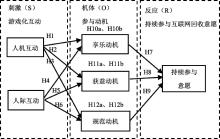
图1
研究模型"
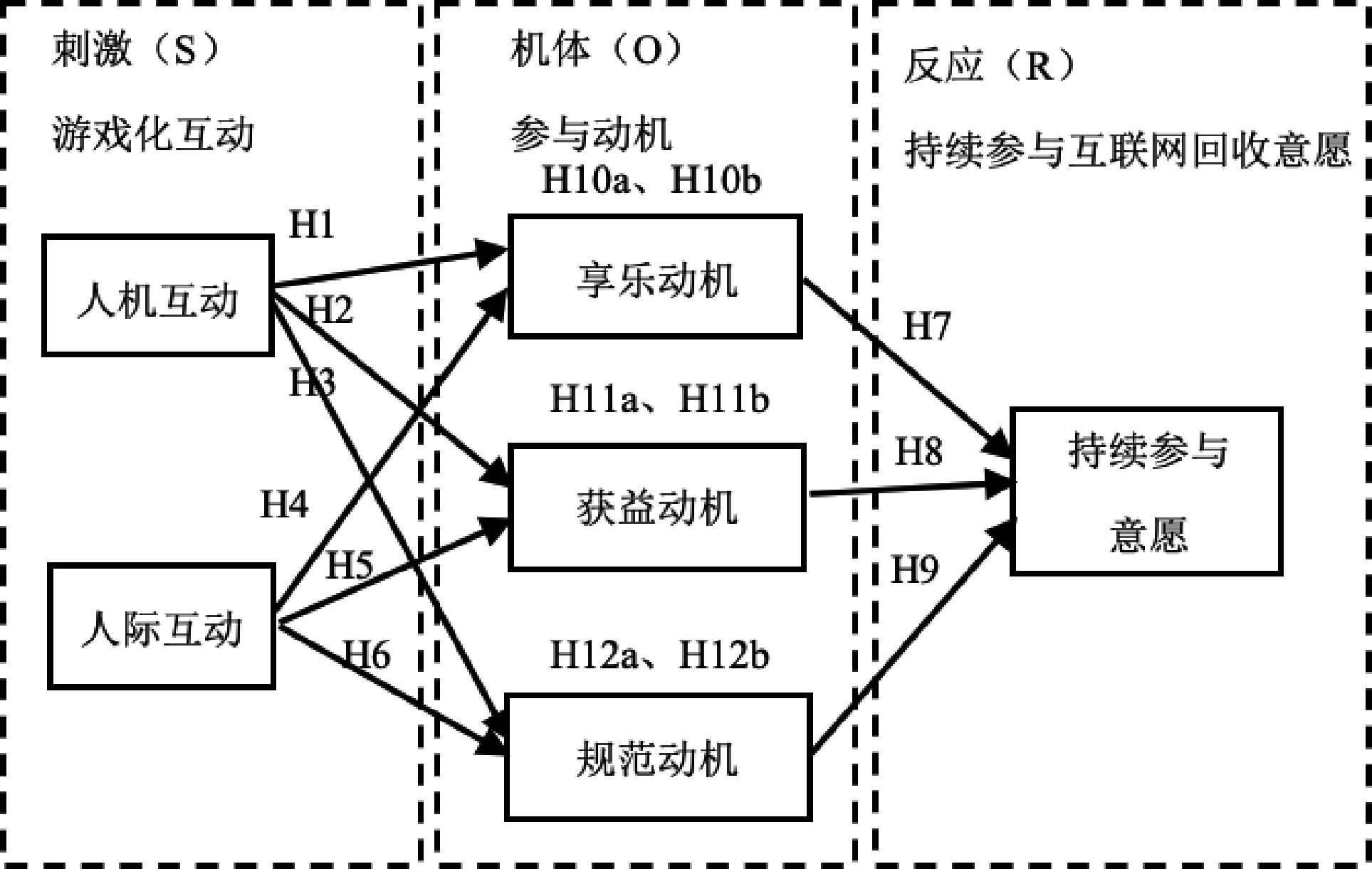
表2
方差解释率"
| 因子编号 | 特征根 | 旋转前方差解释率 | 旋转后方差解释率 | ||||||
|---|---|---|---|---|---|---|---|---|---|
| 特征根 | 方差解释率% | 累积% | 特征根 | 方差解释率% | 累积% | 特征根 | 方差解释率% | 累积% | |
| 1 | 7.831 | 34.046 | 34.046 | 7.831 | 34.046 | 34.046 | 3.499 | 15.212 | 15.212 |
| 2 | 2.160 | 9.393 | 43.439 | 2.160 | 9.393 | 43.439 | 3.345 | 14.545 | 29.757 |
| 3 | 1.741 | 7.569 | 51.007 | 1.741 | 7.569 | 51.007 | 2.689 | 11.689 | 41.446 |
| 4 | 1.514 | 6.584 | 57.592 | 1.514 | 6.584 | 57.592 | 2.234 | 9.714 | 51.161 |
| 5 | 1.483 | 6.446 | 64.037 | 1.483 | 6.446 | 64.037 | 2.205 | 9.588 | 60.749 |
| 6 | 1.426 | 6.199 | 70.237 | 1.426 | 6.199 | 70.237 | 2.182 | 9.488 | 70.237 |
表3
信度、结构效度和聚合效度检验结果汇总表"
| 变量 | 题项 | 因子载荷 | 删除项后的Cronbach’ α | Cronbach's α | AVE | CR |
|---|---|---|---|---|---|---|
| 人机互动 | HI1 | 0.737 | 0.824 | 0.889 | 0.628 | 0.893 |
| HI2 | 0.72 | 0.870 | ||||
| HI3 | 0.73 | 0.874 | ||||
| HI4 | 0.754 | 0.878 | ||||
| HI5 | 0.989 | 0.872 | ||||
| 人际互动 | II1 | 0.702 | 0.814 | 0.866 | 0.571 | 0.869 |
| II2 | 0.729 | 0.837 | ||||
| II3 | 0.738 | 0.842 | ||||
| II4 | 0.76 | 0.845 | ||||
| II5 | 0.841 | 0.849 | ||||
| 享乐动机 | HM1 | 0.796 | 0.690 | 0.815 | 0.607 | 0.822 |
| HM2 | 0.719 | 0.800 | ||||
| HM3 | 0.819 | 0.729 | ||||
| 获益动机 | GM1 | 0.744 | 0.737 | 0.826 | 0.551 | 0.83 |
| GM2 | 0.697 | 0.797 | ||||
| GM3 | 0.712 | 0.803 | ||||
| GM4 | 0.81 | 0.779 | ||||
| 规范动机 | NM1 | 0.742 | 0.682 | 0.818 | 0.61 | 0.824 |
| NM2 | 0.746 | 0.770 | ||||
| NM3 | 0.851 | 0.779 | ||||
| 持续参与意愿 | CPI1 | 0.785 | 0.679 | 0.825 | 0.628 | 0.834 |
| CPI2 | 0.712 | 0.814 | ||||
| CPI3 | 0.872 | 0.759 |
表4
区分效度"
| 变量 | 人机互动 | 人际互动 | 享乐动机 | 获益动机 | 规范动机 | 持续参与意愿 |
|---|---|---|---|---|---|---|
| 人机互动 | 0.793 | |||||
| 人际互动 | 0.366 | 0.755 | ||||
| 享乐动机 | 0.403 | 0.350 | 0.779 | |||
| 获益动机 | 0.400 | 0.402 | 0.396 | 0.742 | ||
| 规范动机 | 0.394 | 0.360 | 0.326 | 0.361 | 0.781 | |
| 持续参与意愿 | 0.381 | 0.373 | 0.348 | 0.379 | 0.336 | 0.793 |
表5
样本信息"
| 人口统计变量 | 分类标准 | 频数 | 百分比/% |
|---|---|---|---|
| 性别 | 男 | 219 | 47 |
| 女 | 243 | 53 | |
| 年龄 | 18岁及以下 | 0 | 0 |
| 18岁~25岁 | 158 | 34 | |
| 26岁~30岁 | 158 | 34 | |
| 30岁以上 | 146 | 32 | |
| 收入水平 | 2500元及以下 | 93 | 20 |
| 2500~5000 | 87 | 19 | |
| 5000~6500 | 102 | 22 | |
| 6500~8000 | 96 | 21 | |
| 8000元以上 | 84 | 18 | |
| 学历 | 初中及以下 | 83 | 18 |
| 高中或中专 | 82 | 18 | |
| 大专 | 91 | 20 | |
| 本科 | 104 | 23 | |
| 硕士及以上 | 102 | 22 | |
| 职业 | 企业从业人员 | 151 | 33 |
| 政府机关、事业单位人员 | 145 | 31 | |
| 学生 | 156 | 34 | |
| 自由职业者 | 4 | 1 | |
| 其他 | 6 | 1 | |
| 参与过的游戏化互联网回收活动平台 | 菜鸟裹裹 | 265 | 57 |
| 闲鱼 | 178 | 39 | |
| 微信公众号 | 142 | 31 | |
| 其他 | 63 | 14 | |
| 参与互联网回收活动的持续时间 | 不满1年 | 112 | 24 |
| 1~2年 | 124 | 27 | |
| 2~3年 | 119 | 26 | |
| 3年以上 | 107 | 23 |
表6
模型主效应检验"
| 路径 | 非标准路径系数 | 标准路径系数 | S.E. | C.R. | p |
|---|---|---|---|---|---|
| 人机互动→享乐动机 | 0.485 | 0.368 | 0.066 | 7.346 | *** |
| 人际互动→享乐动机 | 0.371 | 0.257 | 0.074 | 5.03 | *** |
| 人机互动→获益动机 | 0.39 | 0.311 | 0.061 | 6.384 | *** |
| 人际互动→获益动机 | 0.462 | 0.336 | 0.071 | 6.468 | *** |
| 人机互动→规范动机 | 0.317 | 0.323 | 0.05 | 6.394 | *** |
| 人际互动→规范动机 | 0.301 | 0.28 | 0.056 | 5.344 | *** |
| 享乐动机→持续参与意愿 | 0.158 | 0.147 | 0.059 | 2.665 | ** |
| 获益动机→持续参与意愿 | 0.189 | 0.167 | 0.063 | 3.007 | ** |
| 规范动机→持续参与意愿 | 0.188 | 0.13 | 0.078 | 2.415 | * |
| 人机互动→持续参与意愿 | 0.21 | 0.148 | 0.079 | 2.639 | ** |
| 人际互动→持续参与意愿 | 0.255 | 0.164 | 0.09 | 2.828 | ** |
表7
标准化Bootstrap(=5000)中介效应检验"
| 路径 | 效应 | Estimate | Lower | Upper | P | 结论 | ||||
|---|---|---|---|---|---|---|---|---|---|---|
| 人机互动 | → | 享乐动机 获益动机 规范动机 | → | 持续参与意愿 | 中介1(a*b) | 0.054 | 0.008 | 0.116 | 0.021 | 部分 中介 |
| 中介3(a*b) | 0.052 | 0.012 | 0.103 | 0.010 | ||||||
| 中介5(a*b) | 0.042 | 0.000 | 0.094 | 0.050 | ||||||
| 直接效应1(c’) | 0.148 | 0.008 | 0.292 | 0.038 | ||||||
| 总效应1(c) | 0.296 | 0.182 | 0.413 | 0.000 | ||||||
| 人际互动 | → | 享乐动机 获益动机 规范动机 | → | 持续参与意愿 | 中介2(a*b) | 0.038 | 0.008 | 0.086 | 0.015 | 部分 中介 |
| 中介4(a*b) | 0.056 | 0.012 | 0.115 | 0.011 | ||||||
| 中介6(a*b) | 0.036 | 0.000 | 0.086 | 0.047 | ||||||
| 直接效应2(c’) | 0.164 | 0.018 | 0.303 | 0.027 | ||||||
| 总效应2(c) | 0.294 | 0.176 | 0.418 | 0.000 | ||||||
| [1] | 许民利, 曹彩霞, 简惠云. “互联网+” 回收模式下顾客感知价值量表开发与实证检验[J]. 科技管理研究, 2021, 41(20): 169-175. |
| Xu M L, Cao C X, Jian H Y. Development and empirical test of customer perceived value scale under the “Internet +” recovery mode[J]. Science and Technology Management Research, 2021, 41(20): 169-175. | |
| [2] | de Wildt K K, Meijers M H C. Time spent on separating waste is never wasted: Fostering people’s recycling behavior through the use of a mobile application[J]. Computers in Human Behavior, 2023, 139: 107541. |
| [3] | Annamdevula S, Nudurupati S S, Pappu R P, et al. Moral obligation for recycling among youth: Extended models of the theory of planned behaviour[J]. Young Consumers, 2023, 24(2): 165-183. |
| [4] | 王昶, 吕夏冰, 孙桥. 居民参与“互联网+回收”意愿的影响因素研究[J]. 管理学报, 2017, 14(12): 1847-1854. |
| Wang C, Lv X B, Sun Q. A study on the influencing factors of residents’ participation in “online collection”[J]. Chinese Journal of Management, 2017, 14(12): 1847-1854. | |
| [5] | 魏洁, 王琳. 再生资源“互联网+”回收意愿影响因素分析[J]. 科技管理研究, 2020, 40(2): 246-251. |
| Wei J, Wang L. Analysis on influencing factors of recycling intention of renewable resources “Internet +”[J]. Science and Technology Management Research, 2020, 40(2): 246-251. | |
| [6] | 姚海琳, 朱榕. “互联网+回收” 网站质量会影响消费者线上回收参与意愿吗?[J]. 现代城市研究, 2021(10): 125-132. |
| Yao H L, Zhu R. Dose the “Internet + recycling” website quality affect customers' intention to participate in online recycling?[J]. Modern Urban Research, 2021(10): 125-132. | |
| [7] | 许民利, 倪永坚, 简惠云. 考虑价值共创和企业社会责任的逆向供应链决策[J]. 管理评论, 2023, 35(6): 301-310. |
| Xu M L, Ni Y J, Jian H Y. Decision making of reverse supply chain considering value co-creation and corporate social responsibility[J]. Management Review, 2023, 35(6): 301-310. | |
| [8] | 倪明, 唐李钰, 杨善林. “双碳” 目标下多因素驱动废旧智能手机回收路径研究[J]. 软科学, 2024, 38(7): 95-100+106. |
| Ni M, Tang L Y, Yang S L. Recycling path of waste smart phones driven by multiple factors under the carbon peaking and carbon neutrality goals[J]. Soft Science, 2024, 38(7): 95-100+106. | |
| [9] | Tang Y, Chen S, Yuan Z. The effects of hedonic, gain, and normative motives on sustainable consumption: Multiple mediating evidence from China[J]. Sustainable Development, 2020, 28(4): 741-750. |
| [10] | Lindenberg S, Steg L. Normative, gain and hedonic goal frames guiding environmental behavior[J]. Journal of Social Issues, 2007, 63(1): 117-137. |
| [11] | Steg L, Vlek C. Encouraging pro-environmental behaviour: An integrative review and research agenda[J]. Journal of Environmental Psychology, 2009, 29(3): 309-317. |
| [12] | Hofacker C F, de Ruyter K, Lurie N H, et al. Gamification and mobile marketing effectiveness[J]. Journal of Interactive Marketing, 2016, 34(1): 25-36. |
| [13] | 周志民, 吕嘉祺, 郑玲. 游戏化应用互动性对移动APP用户持续使用意愿的影响——感知一致性的调节作用[J]. 财经论丛, 2019(2): 96-104. |
| Zhou Z M, Lv J Q, Zheng L. The impact of interactivity of gamified-application on the continued use intention of mobile APP[J]. Collected Essays on Finance and Economics, 2019(2): 96-104. | |
| [14] | Moon J W, Kim Y G. Extending the TAM for a world-wide-web context[J]. Information & Management, 2001, 38(4): 217-230. |
| [15] | 靳闵, 王全胜. 游戏元素对消费者参与行为影响的研究述评与展望[J]. 北京工商大学学报(社会科学版), 2019, 34(4): 46-59. |
| Jin M, Wang Q S. The effects of game elements on consumer participation behavior: Review and future prospects[J]. Journal of Beijing Technology and Business University (Social Sciences), 2019, 34(4): 46-59. | |
| [16] | Xi N, Hamari J. Does gamification affect brand engagement and equity? A study in online brand communities[J].Journal of Business Research,2020,109: 449-460. |
| [17] | 焦媛媛, 高雪, 张丹. 电商平台情境下顾客黏性构念开发及其形成机制研究[J]. 管理工程学报, 2023, 37(4): 67-84. |
| Jiao Y Y, Gao X, Zhang D. Construct development and formation mechanism of customer stickiness in the e-commerce platform[J]. Journal of Industrial Engineering and Engineering Management, 2023, 37(4): 67-84. | |
| [18] | 佘升翔,李事成,侯治平,等.数字化绿色行为溢出的助推策略及其机理——基于蚂蚁森林情境的研究[J].外国经济与管理,2024,46(7):38-52. |
| She S X, Li S C, Hou Z P, et al. Promotion strategies and mechanisms of digital green behavior spillover: Based on the ant forest context[J]. Foreign Economics & Management, 2024, 46(7): 38-52. | |
| [19] | Aulia V R, Nadlifatin R, Subriadi A P. The effect of gamification elements on user buying intention in an on-demand service platform[J]. Procedia Computer Science, 2024, 234: 1004-1011. |
| [20] | Chen Y, Pu P. HealthyTogether: Exploring social incentives for mobile fitness applications[C]//Proceedings of the Second International Symposium of Chinese CHI, Toronto Ontario Canada, April 26-27, ACM, 2014: 25-34. |
| [21] | Vallerand R J. Toward a hierarchical model of intrinsic and extrinsic motivation[J]. Advances in Experimental Social Psychology,1997,29: 271-360. |
| [22] | 李宣. 移动营销中的游戏化及其规制研究——基于行为经济学的视角[J]. 四川师范大学学报(社会科学版), 2023, 50(6): 98-107. |
| Li X. Gamification in mobile marketing and its regulation: From the perspective of behavioral economics[J]. Journal of Sichuan Normal University (Social Sciences Edition), 2023, 50(6): 98-107. | |
| [23] | 张郁, 万心雨. 个体规范、社会规范对城市居民垃圾分类的影响研究[J]. 长江流域资源与环境, 2021, 30(7): 1714-1723. |
| Zhang Y, Wan X Y. Study on the influence of the personal norms and social norms on the urban residents' participation in garbage sorting[J]. Resources and Environment in the Yangtze Basin, 2021, 30(7): 1714-1723. | |
| [24] | Nakamoto K, Csikszentmihalyi M.Flow and the psychology of games: Engagement, motivation, and their implications for game design[J]. International Journal of Human-Computer Interaction,2013,29(3):160-170. |
| [25] | Koivisto J, Hamari J. The rise of motivational information systems: A review of gamification research[J]. International Journal of Information Management, 2019, 45: 191-210. |
| [26] | Vorderer P, Klimmt C, Ritterfeld U. Enjoyment: At the heart of media entertainment[J]. Communication Theory, 2004, 14(4): 388-408. |
| [27] | 杜松华, 徐嘉泓, 张德鹏, 等. 游戏化如何驱动电商用户绿色消费行为——基于蚂蚁森林的网络民族志研究[J]. 南开管理评论, 2022, 25(2): 191-202. |
| Du S H, Xu J H, Zhang D P, et al. How gamification drives E-commerce users’Green consumption behaviors: A netnography study of ant-forest[J]. Nankai Business Review, 2022, 25(2): 191-202. | |
| [28] | Rezvani Z, Jansson J, Bengtsson M. Consumer motivations for sustainable consumption: The interaction of gain, normative and hedonic motivations on electric vehicle adoption[J]. Business Strategy and the Environment, 2018, 27(8): 1272-1283. |
| [29] | 宁连举, 肖玉贤, 崔然. 基于说服原则的互联网产品的游戏化设计——以百词斩、Keep、蚂蚁森林为例[J]. 北京邮电大学学报(社会科学版), 2021, 23(3): 67-76. |
| Ning L J, Xiao Y X, Cui R. Gamification design of Internet products based on persuasion principles: Taking baicizhan, keep and ant forest as examples[J]. Journal of Beijing University of Posts and Telecommunications (Social Sciences Edition), 2021, 23(3): 67-76. | |
| [30] | Hamari J, Koivisto J, Sarsa H. Does gamification work?A literature review of empirical studies on gamification[C]//Proceedings of 2014 47th Hawaii International Conference on System Sciences, Waikoloa, HI, USA, January 6-9, IEEE, 2014: 3025-3034. |
| [31] | Dietrich T, Mulcahy R, Knox K. Gaming attribute preferences in social marketing programmes: Meaning matters more than rewards[J]. Journal of Social Marketing, 2018, 8(3): 280-296. |
| [32] | 王永贵, 马双. 虚拟品牌社区顾客互动的驱动因素及对顾客满意影响的实证研究[J]. 管理学报, 2013, 10(9): 1375-1383. |
| Wang Y G, Ma S. The key drivers of customer interactions and their effects on customer satisfaction: An empirical study in the context of virtual brand community[J]. Chinese Journal of Management, 2013, 10(9): 1375-1383. | |
| [33] | 李文超,邵婧.消费者环保服装购买行为的影响因素研究——基于计划行为理论和规范激活理论[J].中国管理科学,2025, 33(6): 233-244. |
| Li W C, Shao J. Research on influencing factors of consumers' environmentally friendly clothing purchase behavior: Based on theory of planned behavior and norm activation model[J]. Chinese Journal of Management Science, 2025, 33(6): 233-244. | |
| [34] | 郭清卉, 李昊, 李世平, 等. 个人规范对农户亲环境行为的影响分析——基于拓展的规范激活理论框架[J]. 长江流域资源与环境, 2019, 28(5): 1176-1184. |
| Guo Q H, Li H, Li S P, et al. Analysis of the influence of personal norms on farmers' pro-environmental behavior:Based on the extended theory of norm-activation[J]. Resources and Environment in the Yangtze Basin, 2019, 28(5): 1176-1184. | |
| [35] | Severo E A, de Guimarães J C F, Henri Dorion E C. Cleaner production, social responsibility and eco-innovation: Generations' perception for a sustainable future[J]. Journal of Cleaner Production, 2018, 186: 91-103. |
| [36] | Schwartz S H. Normative influences on altruism[M]//Berkowitz L.Advances in Experimental Social Psychology Volume 10.Amsterdam:Elsevier,1977: 221-279. |
| [37] | Liu X, Zhou Z, Yuen K F, et al. Green and gamified! An investigation of consumer participation in green last-mile from a gamification affordance perspective[J]. Journal of Retailing and Consumer Services, 2024, 79: 103808. |
| [38] | 廖文虎, 程志辉. 游戏化互动对移动app使用者亲环境行为的影响研究[J]. 湖北经济学院学报(人文社会科学版), 2021, 18(5): 82-86. |
| Liao W H, Cheng Z H. A study on the impact of gamified interaction on pro-environmental behavior of mobile App users [J]. Journal of Hubei University of Economics (Humanities and Social Sciences), 2021, 18(5): 82-86. | |
| [39] | Mullins J K, Sabherwal R. Gamification: A cognitive-emotional view[J]. Journal of Business Research, 2020, 106: 304-314. |
| [40] | Suh A, Wagner C. How gamification of an enterprise collaboration system increases knowledge contribution: An affordance approach[J]. Journal of Knowledge Management, 2017, 21(2): 416-431. |
| [41] | 孟韬, 何畅. 分享经济情境中顾客多重互动与公民行为倾向的关系——基于心理所有权的视角[J]. 旅游学刊, 2019, 34(7): 85-97. |
| Meng T, He C. Study on Customers’Multiple interaction and citizenship behavior intention in the sharing economy: The perspective of psychological ownership[J]. Tourism Tribune, 2019, 34(7): 85-97. | |
| [42] | 廖文虎. 众包平台中游戏化对接包者持续参与意愿的影响因素研究[J].企业经济,2021, 40(7): 102-112. |
| Liao W H. Impact of gamification on solvers' continued participation intention under crowdsourcing platform[J]. Enterprise Economy, 2021, 40(7): 102-112. | |
| [43] | Kim E H, Fan L, Lee S C,et al. Continuous usage intention of twitter's informations focus on elaboration likelihood model[J].Journal of the Korea Society of IT Services, 2012,11(3):49-65. |
| [44] | Onel N, Mukherjee A. Why do consumers recycle? A holistic perspective encompassing moral considerations, affective responses, and self-interest motives[J]. Psychology & Marketing, 2017, 34(10): 956-971. |
| [45] | 杨旸. 青年群体为何热衷于网络公益游戏——认知视角的动机分析[J]. 中国青年研究, 2021(10): 70-77+102. |
| Yang Y. Why are young people keen on online public welfare games? Motivation analysis from a cognitive perspective [J]. China Youth Study, 2021(10): 70-77+102. | |
| [46] | Bakhshandeh G, Sharifi S, Rezaei S M. Influence of personalisation and hedonic motivation on repurchase intention: The mediating role of customer experience and loyalty[J]. International Journal of Services, Economics and Management, 2023, 14(1): 42-57. |
| [47] | 李婷, 范丽娟, 王辰光. 互联网情境中青年低碳实践的游戏化驱动: 模型、演变机制与伦理反思[J]. 中国青年研究, 2023(6): 5-14. |
| Li T, Fan L J, Wang C G. The game drive of youth’s low-carbon practice in the Internet context: Model, evolution mechanism and ethical reflection[J]. China Youth Study, 2023(6): 5-14. | |
| [48] | 李维安,王琪,牛建波.企业绿色行为驱动因素研究述评与展望[J].华东经济管理,2023,37(12):1-10+137. |
| Li W A, Wang Q, Niu J B. Review and prospect on the driving factors of corporate green behavior [J]. East China Economic Management, 2023, 37(12): 1-10+137. | |
| [49] | 劳可夫. 消费者创新性对绿色消费行为的影响机制研究[J]. 南开管理评论, 2013, 16(4): 106-113+132. |
| Lao K F. Research on mechanism of consumer innovativeness influences green consumption behavior[J]. Nankai Business Review,2013,16(4):106-113+132. |
| [1] | 张紫琼, 吴玉婵, 叶强, 吴少辉. 数字人营销:理论框架、研究进展与未来方向[J]. 中国管理科学, 2025, 33(1): 259-272. |
| [2] | 何勇,庄贵军,丰超. 价值共创、分销商网络结构嵌入与合作绩效[J]. 中国管理科学, 2024, 32(8): 241-249. |
| [3] | 魏瑞锋, 庄贵军, 庞芳兰. 不平衡的渠道权力结构下强制性权力的使用:Z模型的检验[J]. 中国管理科学, 2023, 31(5): 132-140. |
| [4] | 李涛, 刘斌. 不同权力结构下竞争性供应链合作广告策略研究[J]. 中国管理科学, 2023, 31(4): 121-129. |
| [5] | 王欣, 朱虹, 赵英男, 陈晓威. 默认评论对消费者评论数量与评论长度的影响[J]. 中国管理科学, 2023, 31(2): 278-286. |
| [6] | 卢亭宇, 庄贵军. 道冲突与企业间协作:第三方介入的调节作用[J]. 中国管理科学, 2022, 30(10): 277-286. |
| [7] | 何迎朝, 徐以汎, 王凯. 店铺形象和店铺位置在O2O环境中还重要吗?[J]. 中国管理科学, 2020, 28(6): 171-181. |
| [8] | 任小静, 李琪. “负面偏见”对平台认证型评论感知有用性的影响[J]. 中国管理科学, 2019, 27(9): 149-159. |
| [9] | 张旭, 侯光明. 双口碑效应下新产品扩散研究——以电影为例[J]. 中国管理科学, 2018, 26(10): 79-88. |
| [10] | 郭燕, 吴价宝, 王崇, 卢珂. 多渠道零售环境下消费者渠道选择意愿形成机理研究——产品类别特征的调节作用[J]. 中国管理科学, 2018, 26(9): 158-169. |
| [11] | 许诗康, 廖成林. 基于顾客崇洋心理刻板印象的国内品牌产品洋化广告决策[J]. 中国管理科学, 2017, 25(7): 123-133. |
| [12] | 但斌, 田丽娜, 董绍辉. 考虑溢出效应的互补品企业间广告决策模型研究[J]. 中国管理科学, 2013, (2): 66-75. |
| [13] | 王毅, 赵平. 顾客满意对企业财务绩效的影响研究——基于中国部分上市公司的面板数据[J]. 中国管理科学, 2012, (1): 185-192. |
| [14] | 张德鹏, 陈少霞. 顾客忠诚对盈利能力的影响效应[J]. 中国管理科学, 2011, 19(4): 84-92. |
| [15] | 杨珺, 王玲, 郑娜, 杨超. 多用途易腐物品配送中心选址问题研究[J]. 中国管理科学, 2011, 19(1): 91-99. |
| 阅读次数 | ||||||
|
全文 |
|
|||||
|
摘要 |
|
|||||
|
||
