
主管:中国科学院
主办:中国优选法统筹法与经济数学研究会
中国科学院科技战略咨询研究院
主办:中国优选法统筹法与经济数学研究会
中国科学院科技战略咨询研究院

中国管理科学 ›› 2026, Vol. 34 ›› Issue (2): 10-24.doi: 10.16381/j.cnki.issn1003-207x.2023.2053cstr: 32146.14.j.cnki.issn1003-207x.2023.2053
刘业政1,2, 黄超1,2, 孙春华1,2( ), 刘春丽1,2
收稿日期:2023-12-06
修回日期:2024-02-14
出版日期:2026-02-25
发布日期:2026-02-04
通讯作者:
孙春华
E-mail:sunchunhua@hfut.edu.cn
基金资助:
Yezheng Liu1,2, Chao Huang1,2, Chunhua Sun1,2(), Chunli Liu1,2
Received:2023-12-06
Revised:2024-02-14
Online:2026-02-25
Published:2026-02-04
Contact:
Chunhua Sun
E-mail:sunchunhua@hfut.edu.cn
摘要:
改革开放以来,中国实现了从计划经济向社会主义市场经济的转型。基于辩证唯物主义文化观,社会变迁、文化和人类发展理论及文化认同理论,本文推断,市场化进程显著影响中国文化的传承与变迁。为此,本文进行了一项包含中国大陆31省份的研究,涉及5916名受访者的问卷调查,基于Hofstede文化模型绘制中国文化地图,并多层次分析市场化水平对文化价值观的影响及机制。研究表明,Hofstede有关国家(地区)文化维度的概念在中国情境下是有效的,验证了文化随着经济社会急剧转型、市场化进程的进一步深化呈现某些变化趋势的论点:由克制向放纵转变,人们强调追求幸福感和快乐等。与此同时,研究发现了中国独特文化传统持续存在甚至强化的证据:尊崇权威、集体主义、阳刚气质和低不确定性规避等。此外,研究证实个体感知的工商业文明水平在市场化水平与个体价值观的关系中发挥跨层次中介作用。这些结论为理解中国市场化转型背景下的文化传承与变迁提供了证据,对相关领域的学术研究和管理实践具有重要意义。
中图分类号:
刘业政,黄超,孙春华, 等. 市场化进程导致文化变迁还是强化文化传承[J]. 中国管理科学, 2026, 34(2): 10-24.
Yezheng Liu,Chao Huang,Chunhua Sun, et al. Does the Marketization Lead to Cultural Changes or Strengthen Cultural Inheritance[J]. Chinese Journal of Management Science, 2026, 34(2): 10-24.
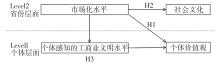
图1
文化价值观多层次研究模型及假设"
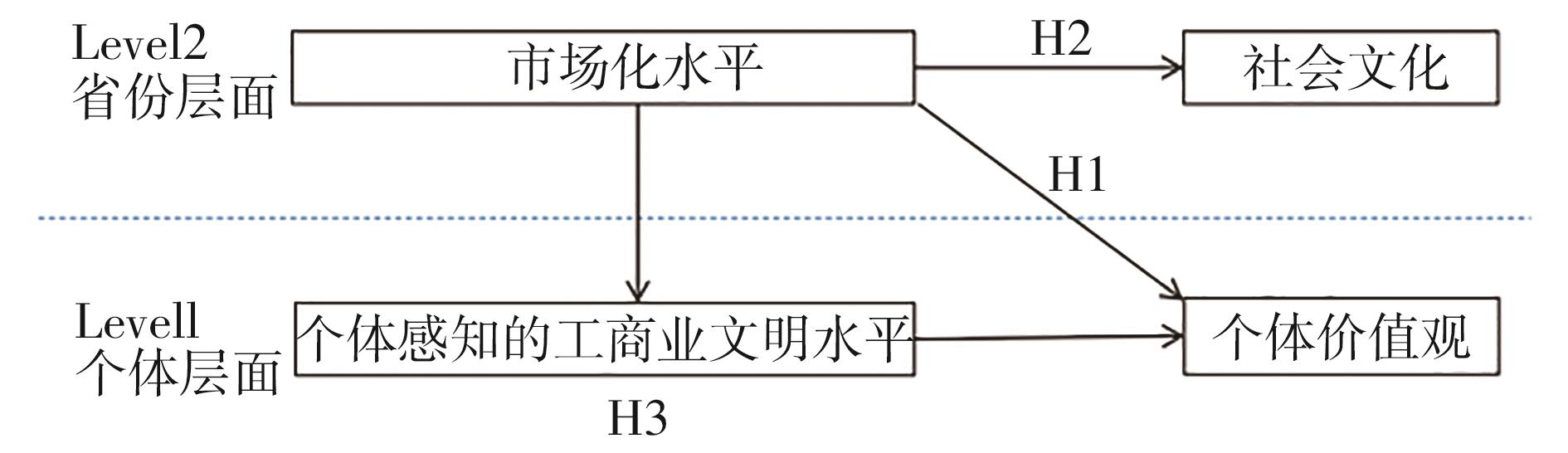

表1
变量介绍"
| 变量名称 | 变量符号 | 变量说明 | |
|---|---|---|---|
| 文化价值观 | 尊重权威 | PDI | 在Level2指社会文化,在Level1指个体价值观 |
| 个体/集体主义 | IDV | ||
| 阳刚/阴柔气质 | MAS | ||
| 不确定性规避 | UAI | ||
| 放纵/克制 | IVR | ||
| 市场化水平 | MINDEX | Level2变量,衡量省份市场化水平的综合性指标 | |
| 城镇化率 | UR | Level2变量,衡量省份市场化水平的替代自变量 | |
| 省会城市纬度 | LATI | Level2变量,衡量省份地理位置 | |
| 省会城市经度 | LONGI | Level2变量,衡量省份地理位置 | |
| 个体感知的工商业文明水平 | PC | Level1变量,个体主观感知的工商业文明水平 | |
| 性别 | GENDER | Level1变量,被试的性别 | |
| 是否独生子女 | ONECHILD | Level1变量,被试的独生子女状态 | |
| 代际 | GEN | Level1变量,被试的代际 | |
表2
研究样本主要特征表"
| 样本特征 | 类别 | 样本量 | 百分比 | 累积百分比 |
|---|---|---|---|---|
| 性别 | 男 | 3314 | 56.02 | 56.02 |
| 女 | 2602 | 43.98 | 100.00 | |
| 是否独生子女 | 是 | 2094 | 35.40 | 35.40 |
| 否 | 3822 | 64.60 | 100.00 | |
| 代际 | 00后:2000年及以后 | 682 | 11.53 | 11.53 |
| 90后:1990年-1999年 | 2194 | 37.09 | 48.61 | |
| 80后:1980年-1989年 | 1733 | 29.29 | 77.91 | |
| 70后:1970年-1979年 | 1012 | 17.11 | 95.01 | |
| 其他:1969年及以前 | 295 | 4.99 | 100.00 |
表3
主要变量描述性统计表"
| 变量 | 样本量 | 均值 | 标准差 | 最小值 | 最大值 |
|---|---|---|---|---|---|
| PC | 5916 | 3.15 | 1.03 | 1.00 | 5.00 |
| PDI | 5916 | 26.25 | 49.30 | -190.00 | 205.00 |
| IDV | 5916 | -10.92 | 48.42 | -280.00 | 245.00 |
| MAS | 5916 | 10.83 | 49.47 | -210.00 | 210.00 |
| UAI | 5916 | -33.47 | 63.49 | -235.00 | 210.00 |
| IVR | 5916 | 47.18 | 62.15 | -260.00 | 300.00 |
表4
省份层面主要变量汇总表"
| PID | 省份 | 样本量 | 自变量 | 因变量 | |||||||
|---|---|---|---|---|---|---|---|---|---|---|---|
| LATI | LONGI | MINDEX | UR | PDI | IDV | MAS | UAI | IVR | |||
| 1 | 安徽 | 222 | 31.51 | 117.18 | 6.58 | 0.58 | 25.20 | -11.04 | 3.31 | -34.73 | 47.52 |
| 2 | 北京 | 214 | 39.54 | 116.28 | 6.95 | 0.88 | 28.88 | -10.79 | 16.52 | -41.47 | 54.25 |
| 3 | 福建 | 154 | 26.05 | 119.18 | 7.62 | 0.69 | 30.88 | -13.64 | 13.86 | -43.31 | 57.50 |
| 4 | 甘肃 | 253 | 36.03 | 103.49 | 3.95 | 0.52 | 22.71 | -11.90 | 4.15 | -18.38 | 32.93 |
| 5 | 广东 | 167 | 23.08 | 113.15 | 8.37 | 0.74 | 29.31 | -13.83 | 15.72 | -34.25 | 47.34 |
| 6 | 广西 | 168 | 22.48 | 108.20 | 5.34 | 0.54 | 31.19 | -11.25 | 18.75 | -24.08 | 43.84 |
| 7 | 贵州 | 165 | 26.35 | 106.42 | 4.95 | 0.53 | 19.46 | -13.58 | 5.73 | -39.76 | 52.36 |
| 8 | 海南 | 210 | 20.02 | 110.20 | 4.27 | 0.60 | 13.38 | -5.50 | 5.17 | -35.29 | 45.95 |
| 9 | 河北 | 175 | 38.02 | 114.28 | 5.89 | 0.60 | 27.29 | -12.60 | 13.20 | -26.97 | 48.20 |
| 10 | 河南 | 148 | 34.48 | 113.42 | 6.39 | 0.55 | 30.20 | -18.92 | 14.90 | -35.68 | 50.78 |
| 11 | 黑龙江 | 159 | 45.45 | 126.41 | 4.67 | 0.66 | 26.54 | -12.55 | 17.39 | -42.86 | 44.59 |
| 12 | 湖北 | 192 | 30.37 | 114.21 | 6.54 | 0.63 | 26.93 | -15.50 | 14.04 | -35.47 | 43.83 |
| 13 | 湖南 | 227 | 28.11 | 113.00 | 6.13 | 0.59 | 23.04 | -8.79 | 12.03 | -30.29 | 41.67 |
| 14 | 吉林 | 162 | 43.52 | 125.19 | 4.96 | 0.63 | 21.45 | -19.66 | 1.08 | -43.40 | 46.94 |
| 15 | 江苏 | 218 | 32.02 | 118.50 | 8.51 | 0.73 | 23.03 | -12.84 | 12.84 | -46.54 | 52.62 |
| 16 | 江西 | 169 | 28.41 | 115.52 | 6.59 | 0.60 | 21.24 | -9.73 | 11.81 | -31.54 | 45.56 |
| 17 | 辽宁 | 160 | 41.50 | 123.24 | 6.37 | 0.72 | 29.53 | -10.72 | 6.56 | -28.28 | 48.06 |
| 18 | 内蒙古 | 184 | 40.49 | 111.48 | 4.29 | 0.67 | 29.57 | -4.38 | 13.89 | -35.73 | 51.36 |
| 19 | 宁夏 | 160 | 38.20 | 106.16 | 4.45 | 0.65 | 32.47 | -14.22 | 18.16 | -33.44 | 48.44 |
| 20 | 青海 | 195 | 36.38 | 101.45 | 3.35 | 0.60 | 23.97 | -9.15 | 3.95 | -25.85 | 36.64 |
| 21 | 山东 | 159 | 36.38 | 117.00 | 7.07 | 0.63 | 33.55 | -4.62 | 12.55 | -38.40 | 53.52 |
| 22 | 山西 | 162 | 37.52 | 112.34 | 4.80 | 0.63 | 35.93 | -14.69 | 7.99 | -27.59 | 44.29 |
| 23 | 陕西 | 278 | 34.16 | 108.54 | 5.72 | 0.63 | 28.65 | -10.32 | 13.60 | -31.35 | 42.52 |
| 24 | 上海 | 189 | 31.14 | 121.29 | 7.97 | 0.89 | 29.68 | -12.96 | 13.33 | -43.81 | 58.89 |
| 25 | 四川 | 160 | 30.39 | 104.05 | 6.19 | 0.57 | 24.84 | -15.09 | 14.00 | -39.47 | 55.22 |
| 26 | 天津 | 189 | 39.09 | 117.11 | 6.60 | 0.85 | 32.46 | -6.67 | 8.52 | -37.78 | 44.07 |
| 27 | 西藏 | 163 | 29.39 | 90.08 | 1.56 | 0.36 | 19.45 | -0.86 | 6.87 | -33.22 | 54.51 |
| 28 | 新疆 | 311 | 43.48 | 87.36 | 3.93 | 0.57 | 25.98 | -6.75 | 2.81 | -20.80 | 43.33 |
| 29 | 云南 | 228 | 25.00 | 102.41 | 5.16 | 0.50 | 20.20 | -2.76 | 15.81 | -28.84 | 45.11 |
| 30 | 浙江 | 172 | 30.14 | 120.09 | 7.95 | 0.72 | 26.83 | -15.47 | 10.38 | -40.03 | 55.09 |
| 31 | 重庆 | 203 | 29.32 | 106.32 | 6.87 | 0.69 | 27.34 | -16.38 | 14.83 | -27.22 | 42.14 |
表5
省份层面主要变量相关性分析"
| 1 | 2 | 3 | 4 | 5 | 6 | 7 | 8 | |
|---|---|---|---|---|---|---|---|---|
| PDI | 1 | |||||||
| IDV | -0.25 | 1 | ||||||
| MAS | 0.43* | -0.12 | 1 | |||||
| UAI | -0.01 | 0.24 | -0.21 | 1 | ||||
| IVR | 0.15 | -0.06 | 0.26 | -0.73** | 1 | |||
| MINDEX | 0.35* | -0.42* | 0.40* | -0.47** | 0.40* | 1 | ||
| LATI | 0.36* | -0.08 | -0.20 | 0.01 | -0.12 | -0.22 | 1 | |
| LONGI | 0.28 | -0.43* | 0.19 | -0.60** | 0.27 | 0.63** | 0.17 | 1 |
表6
个体层面主要变量相关性分析"
| 1 | 2 | 3 | 4 | 5 | 6 | 7 | 8 | 9 | |
|---|---|---|---|---|---|---|---|---|---|
| PDI | 1 | ||||||||
| IDV | -0.02 | 1 | |||||||
| MAS | 0.11** | -0.10** | 1 | ||||||
| UAI | 0.08** | -0.00 | -0.00 | 1 | |||||
| IVR | -0.04** | 0.02 | -0.00 | -0.41** | 1 | ||||
| PC | 0.03* | -0.01 | 0.07** | -0.05** | 0.07** | 1 | |||
| GENDER | -0.01 | 0.02 | 0.05** | 0.03* | -0.07** | -0.12 | 1 | ||
| ONECHILD | -0.04** | -0.01 | 0.01 | 0.01 | 0.04** | 0.11** | 0.05** | 1 | |
| GEN | 0.09** | 0.01 | -0.03* | 0.02 | -0.02 | -0.02 | 0.07** | -0.12** | 1 |
表7
尊重权威回归分析结果"
| PDI | 零模型 | 仅Level1 控制变量 | Level1控制变量+自变量 | Level1控制变量+Level2自变量 | 完整模型 | 社会文化OLS | |||
|---|---|---|---|---|---|---|---|---|---|
| 1 | 2 | 3 | 4 | 4r | 5 | 5r | 6 | 6r | |
| 固定效果 | |||||||||
| Level-1 | |||||||||
| Intercept,(G00) | 26.36** | 18.11** | 14.26** | 12.44** | 7.87* | 9.92** | 5.75 | ||
| GENDER,(G10) | -1.11 | -1.19 | -1.16 | -1.17 | -1.23 | -1.24 | |||
| ONECHILD,(G20) | -3.27** | -3.48** | -3.40** | -3.52** | -3.57** | -3.68** | |||
| GEN,(G30) | 3.76** | 3.73** | 3.71** | 3.65** | 3.69** | 3.64** | |||
| PC,(G40) | 1.28* | 1.12* | 1.08* | ||||||
| Level-2 | |||||||||
| Intercept | 20.20** | 14.98** | |||||||
| MINDEX,(G01) | 1.01* | 0.87 | 1.08* (R2=0.12) | ||||||
| UR,(G01’) | 17.47** | 15.59** | 18.92* (R2=0.20) | ||||||
| 方差成分 | |||||||||
| τ00,(u0) | 10.71** | 9.18** | 8.08* | 7.38* | 5.59 | 7.10* | 5.48 | ||
| σ2,(r) | 2420.48 | 2403.39 | 2402.76 | 2403.33 | 2403.44 | 2402.66 | 2402.76 | ||
| Deviance | 62899.15 | 62848.43 | 62841.59 | 62842.35 | 62834.77 | 62840.17 | 62832.81 | ||
表8
个体感知的工商业文明水平回归分析结果"
| PC | 零模型 | 仅Level1控制变量 | Level1控制变量+ Level2自变量 | |
|---|---|---|---|---|
| 1 | 2 | 3 | 3r | |
| 固定效果 | ||||
| Level-1 | ||||
| Intercept,(G00) | 3.16** | 3.03** | 2.26** | 1.98** |
| GENDER,(G10) | 0.06* | 0.06* | 0.06* | |
| ONECHILD,(G20) | 0.15** | 0.15** | 0.15** | |
| GEN,(G30) | 0.02 | 0.02 | 0.01 | |
| Level-2 | ||||
| Intercept | ||||
| MINDEX,(G01) | 0.13** | |||
| UR,(G01’) | 1.73** | |||
| 方差成分 | ||||
| τ00,(u0) | 0.07** | 0.07** | 0.03** | 0.03** |
| σ2,(r) | 0.99 | 0.99 | 0.99 | 0.99 |
| Deviance | 16827.08 | 16811.17 | 16788.17 | 16786.78 |
表9
个体/集体主义回归分析结果"
| IDV | 零模型 | 仅Level1 控制变量 | Level1控制变量+自变量 | Level1控制变量+Level2自变量 | 完整模型 | 社会文化OLS | |||
|---|---|---|---|---|---|---|---|---|---|
| 1 | 2 | 3 | 4 | 4r | 5 | 5r | 6 | 6r | |
| 固定效果 | |||||||||
| Level-1 | |||||||||
| Intercept,(G00) | -11.03** | -12.99** | -12.14** | -6.03* | -7.37 | -5.93 | -7.06 | ||
| GENDER,(G10) | 1.41 | 1.43 | 1.51 | 1.44 | 1.51 | 1.45 | |||
| ONECHILD,(G20) | -0.86 | -0.81 | -0.68 | -0.69 | -0.68 | -0.67 | |||
| GEN,(G30) | 0.56 | 0.56 | 0.61 | 0.62 | 0.61 | 0.62 | |||
| PC,(G40) | -0.28 | -0.04 | -0.16 | ||||||
| Level-2 | |||||||||
| Intercept | -4.23 | -5.75 | |||||||
| MINDEX,(G01) | -1.24** | -1.24** | -1.20* (R2=0.18) | ||||||
| UR,(G01’) | -9.65 | -9.38 | -8.96 (R2=0.05) | ||||||
| 方差成分 | |||||||||
| τ00,(u0) | 7.14* | 7.11* | 6.88* | 3.70 | 6.46* | 3.71 | 6.40* | ||
| σ2,(r) | 2337.56 | 2337.69 | 2338.14 | 2337.76 | 2337.72 | 2338.15 | 2338.13 | ||
| Deviance | 62688.43 | 62681.96 | 62679.03 | 62673.20 | 62672.47 | 62674.13 | 62673.34 | ||
表10
阳刚/阴柔气质回归分析结果"
| MAS | 零模型 | 仅Level1 控制变量 | Level1控制变量+自变量 | Level1控制变量 +Level2自变量 | 完整模型 | 社会文化OLS | |||
|---|---|---|---|---|---|---|---|---|---|
| 1 | 2 | 3 | 4 | 4r | 5 | 5r | 6 | 6r | |
| 固定效果 | |||||||||
| Level-1 | |||||||||
| Intercept,(G00) | 10.98** | 12.51** | 3.08 | 5.04 | 4.67 | -1.68 | -1.38 | ||
| GENDER,(G10) | 4.96** | 4.76** | 4.91** | 4.94** | 4.73** | 4.75** | |||
| ONECHILD,(G20) | 0.54 | -0.00 | 0.36 | 0.35 | -0.12 | -0.11 | |||
| GEN,(G30) | -1.69* | -1.76* | -1.76** | -1.77* | -1.82* | -1.82* | |||
| PC,(G40) | 3.14** | 2.98** | 3.05** | ||||||
| Level-2 | |||||||||
| Intercept | 3.86 | 3.89 | |||||||
| MINDEX,(G01) | 1.34** | 0.94* | 1.25* (R2=0.16) | ||||||
| UR,(G01’) | 13.37* | 8.13 | 11.83 (R2=0.08) | ||||||
| 方差成分 | |||||||||
| τ00,(u0) | 13.05** | 12.93** | 10.07** | 8.81* | 10.95** | 8.32* | 9.61** | ||
| σ2,(r) | 2434.46 | 2427.07 | 2418.90 | 2427.30 | 2427.26 | 2419.07 | 2419.06 | ||
| Deviance | 62935.98 | 62911.02 | 62883.85 | 62902.94 | 62900.37 | 62882.12 | 62878.65 | ||
表11
不确定性规避回归分析结果"
| UAI | 零模型 | 仅Level1 控制变量 | Level1控制变量+自变量 | Level1控制变量+ Level2自变量 | 完整模型 | 社会文化OLS | |||
|---|---|---|---|---|---|---|---|---|---|
| 1 | 2 | 3 | 4 | 4r | 5 | 5r | 6 | 6r | |
| 固定效果 | |||||||||
| Level-1 | |||||||||
| Intercept,(G00) | -33.86** | -39.70** | -30.87** | -26.10** | -20.03** | -20.11** | -14.74* | ||
| GENDER,(G10) | 3.41* | 3.60* | 3.51* | 3.49* | 3.66* | 3.65* | |||
| ONECHILD,(G20) | 1.81 | 2.26 | 1.94 | 2.10 | 2.36 | 2.49 | |||
| GEN,(G30) | 1.23 | 1.29 | 1.33 | 1.40 | 1.38 | 1.44 | |||
| PC,(G40) | -2.93** | -2.66** | -2.67** | ||||||
| Level-2 | |||||||||
| Intercept | -21.93** | -16.68* | |||||||
| MINDEX,(G01) | -2.40** | -2.04* | -2.09** (R2=0.22) | ||||||
| UR,(G01’) | -33.20** | -28.58** | -28.56** (R2=0.22) | ||||||
| 方差成分 | |||||||||
| τ00,(u0) | 32.54** | 34.04** | 29.94** | 20.07** | 20.19** | 20.13** | 19.82** | ||
| σ2,(r) | 3997.58 | 3993.71 | 3987.33 | 3994.23 | 3994.04 | 3987.81 | 3987.72 | ||
| Deviance | 65876.52 | 65863.25 | 65847.25 | 65851.28 | 65845.80 | 65841.21 | 65835.65 | ||
表12
放纵/克制回归分析结果"
| IVR | 零模型 | 仅Level1 控制变量 | Level1控制变量+自变量 | Level1控制变量+ Level2自变量 | 完整模型 | 社会文化OLS | |||
|---|---|---|---|---|---|---|---|---|---|
| 1 | 2 | 3 | 4 | 4r | 5 | 5r | 6 | 6r | |
| 固定效果 | |||||||||
| Level-1 | |||||||||
| Intercept,(G00) | 47.44** | 52.46** | 40.54** | 43.48** | 42.62** | 34.98** | 34.95** | ||
| GENDER,(G10) | -8.48** | -8.72** | -8.53** | -8.51** | -8.75** | -8.73** | |||
| ONECHILD,(G20) | 5.48** | 4.81* | 5.27** | 5.23** | 4.68* | 4.66* | |||
| GEN(,G30) | -0.85 | -0.95 | -0.95 | -0.96 | -1.02 | -1.03 | |||
| PC,(G40) | 3.97** | 3.76** | 3.84** | ||||||
| Level-2 | |||||||||
| Intercept | 39.12** | 38.57** | |||||||
| MINDEX,(G01) | 1.61* | 1.12 | 1.48* (R2=0.16) | ||||||
| UR,(G01’) | 16.82 (0.07) | 10.30 | 15.03 (0.11) (R2=0.09) | ||||||
| 方差成分 | |||||||||
| τ00,(u0) | 17.09** | 16.01** | 11.33* | 10.12* | 12.53* | 8.41 | 10.12* | ||
| σ2,(r) | 3845.37 | 3822.79 | 3810.09 | 3823.09 | 3823.25 | 3810.59 | 3810.56 | ||
| Deviance | 65637.28 | 65593.42 | 65565.43 | 65584.82 | 65582.06 | 65563.35 | 65559.73 | ||
| [1] | 吉尔特·霍夫斯泰德,格特·扬·霍夫斯泰德,迈克尔·明科夫.文化与组织-心理软件的力量[M].北京:电子工业出版社,2019. |
| Hofstede G, Hofstede G, Minkoff M. Cultures and organizations-Software of the mind [M]. Beijing: Publishing House of Electronics Industry, 2019. | |
| [2] | Xing Y, Liu Y, Froese F J, et al. Advancing Chinese leadership research: Review and future directions[J]. Asian Business & Management, 2023, 22(2): 493-508. |
| [3] | 杨皖苏, 杨善林, 杨希. 主动性-被动性员工创新行为: 基于分布式领导的作用机制研究[J]. 中国管理科学, 2020, 28(6): 182-192. |
| Yang W S, Yang S L, Yang X. Proactive-reactive innovation behavior of the employee: Based on the mechanism of distributed leadership[J]. Chinese Journal of Management Science, 2020, 28(6): 182-192. | |
| [4] | 陈国权. 领导和管理的时空理论[J]. 中国管理科学, 2017, 25(1): 181-196. |
| Chen G Q. Time-space theory of leadership and management[J]. Chinese Journal of Management Science, 2017, 25(1): 181-196. | |
| [5] | 丹尼尔·贝尔. 资本主义文化矛盾[M]. 北京: 三联书店, 1989. |
| Bell D. The cultural contradictions of capitalism[M]. Beijing: SDX Joint Publishing Company, 1989. | |
| [6] | 赵向阳, 李海, 孙川. 中国区域文化地图: “大一统”抑或“多元化”?[J]. 管理世界, 2015, 31(2): 101-119+187-188. |
| Zhao X Y, Li H, Sun C. The regional cultural map in China: Is it“the great unification”or“the diversification”?[J]. Management World, 2015, 31(2): 101-119+187-188. | |
| [7] | Hamamura T, Xu Y. Changes in Chinese culture as examined through changes in personal pronoun usage[J]. Journal of Cross-Cultural Psychology, 2015, 46(7): 930-941. |
| [8] | Talhelm T, Zhang X, Oishi S, et al. Large-scale psychological differences within China explained by rice versus wheat agriculture[J]. Science, 2014, 344(6184): 603-608. |
| [9] | 马欣然,任孝鹏,徐江.中国人集体主义的南北方差异及其文化动力[J].心理科学进展,2016,24(10):1551-1555. |
| Ma X R, Ren X P, Xu J. The difference of collectivism between north and south China and its cultural dynamics [J]. Advances in Psychological Science, 2016, 24(10): 1551-1555. | |
| [10] | Matthews S H, Kelemen T K, Bolino M C. How follower traits and cultural values influence the effects of leadership[J]. The Leadership Quarterly, 2021, 32(1): 101497. |
| [11] | Hamamura T. Are cultures becoming individualistic? a cross-temporal comparison of individualism-collectivism in the United States and Japan[J]. Personality and Social Psychology Review, 2012, 16(1): 3-24. |
| [12] | Tung R L. The cross-cultural research imperative: The need to balance cross-national and intra-national diversity[J]. Journal of International Business Studies, 2008, 39(1): 41-46. |
| [13] | Messner W. Cultural heterozygosity: Towards a new measure of within-country cultural diversity[J]. Journal of World Business, 2022, 57(4): 101346. |
| [14] | Taras V, Steel P, Kirkman B L. Does country equate with culture? beyond geography in the search for cultural boundaries[J]. Management International Review, 2016, 56(4): 455-487. |
| [15] | Greenfield P M. Social change, cultural evolution, and human development[J]. Current Opinion in Psychology, 2016, 8: 84-92. |
| [16] | Beugelsdijk S, Welzel C. Dimensions and dynamics of national culture: Synthesizing hofstede with inglehart[J]. Journal of Cross-Cultural Psychology, 2018, 49(10): 1469-1505. |
| [17] | 苏红, 任孝鹏. 个体主义的地区差异和代际变迁[J]. 心理科学进展, 2014, 22(6): 1006-1015. |
| Su H, Ren X P. Regional difference and cross-generational change of individualism[J]. Advances in Psychological Science, 2014, 22(6): 1006-1015. | |
| [18] | Leung K, Bhagat R S, Buchan N R, et al. Culture and international business: Recent advances and their implications for future research[J]. Journal of International Business Studies, 2005, 36(4): 357-378. |
| [19] | Inglehart R, Baker W E. Modernization, cultural change, and the persistence of traditional values [J]. American Sociological Review, 2000, 65(1): 19-51. |
| [20] | Varnum M E W, Grossmann I. Cultural change: The how and the why[J]. Perspectives on Psychological Science, 2017, 12(6): 956-972. |
| [21] | Ralston D A, Pounder J, Lo C W H, et al. Stability and change in managerial work values: A longitudinal study of China, Hong Kong, and the U.S[J]. Management and Organization Review, 2006, 2(1): 67-94. |
| [22] | 马克斯·韦伯.新教伦理与资本主义精神[M].北京:北京大学出版社,2012. |
| Weber M. The protestant ethic and the spirit of capitalism [M]. Beijing: Peking University Press, 2012. | |
| [23] | Roland G. The deep historical roots of modern culture: A comparative perspective[J]. Journal of Comparative Economics, 2020, 48(3): 483-508. |
| [24] | Webber R H. Convergence or divergence [J]. Columbia Journal of World Business, 1969, 4(3): 75-83. |
| [25] | Ralston D A, Holt D H, Terpstra R H, et al. The impact of natural culture and economic ideology on managerial work values: A study of the United States, Russia, Japan, and China[J]. Journal of International Business Studies, 1997, 28(1): 177-207. |
| [26] | Rokeach M. The nature of human values [M]. New York: Free Press, 1973. |
| [27] | 马克思,恩格斯.马克思恩格斯选集 第2卷[M].北京:人民出版社,2012. |
| Marx K, Engels F. Selected works of Marx and Engels, (Vol. 2) [M]. Beijing: People's Publishing House, 2012. | |
| [28] | 孙代尧,何海根.马克思恩格斯的文化观及其当代价值[J].理论学刊,2011(7):16-21. |
| Sun D Y, He H G. Culture outlook and its contemporary values of Marx and Engels[J]. Theory Journal, 2011(7):16-21. | |
| [29] | Greenfield P M. Linking social change and developmental change: Shifting pathways of human development[J]. Developmental Psychology, 2009, 45(2): 401-418. |
| [30] | Hall S. Cultural identity and diaspora [M]//Rutherford J. Identity: Community, Culture, Difference. London: Lawrence & Wishart, 1994: 222–237. |
| [31] | Zhang Z X, Chen G Z X, Chen Y R, et al. Business leadership in the Chinese context: Trends, findings, and implications[J]. Management and Organization Review, 2014, 10(2): 199-221. |
| [32] | 沈湘平. 中国式现代化道路的传统文化根基[J]. 中国社会科学, 2022(8): 109-123+206-207. |
| Shen X P. The underlying role of traditional Chinese culture in the uniquely Chinese path toward modernization[J]. Social Sciences in China, 2022(8): 109-123+206-207. | |
| [33] | Ralston D A, Egri C P, Karam C M, et al. Changes in work values across the regions of China[J]. Asia Pacific Journal of Management, 2018, 35(1): 145-179. |
| [34] | Zhou C, Yiu W Y V, Wu M S, et al. Perception of cross-generational differences in child behavior and parent socialization: A mixed-method interview study with grandmothers in China[J]. Journal of Cross-Cultural Psychology, 2018, 49(1): 62-81. |
| [35] | Xu Y, Hamamura T. Folk beliefs of cultural changes in China[J]. Frontiers in Psychology, 2014, 5: 1066. |
| [36] | Lindner T, Puck J, Doh J. Hierarchical modelling in international business research: Patterns, problems, and practical guidelines[J]. Journal of World Business, 2021, 56(4): 101224. |
| [37] | 利昂·费斯汀格.认知失调理论[M]. 杭州:浙江教育出版社,1999. |
| Festinger L. A theory of cognitive dissonance [M]. Hangzhou: Zhejiang Education Press, 1999. | |
| [38] | Kelly G A. The psychology of personal constructs. Vol. 1. A theory of personality. Vol. 2. Clinical diagnosis and psychotherapy[M]. Oxford, England: W. W. Norton, 1955. |
| [39] | 王小鲁, 胡李鹏, 樊纲. 中国分省份市场化指数报告(2021)[M]. 北京: 社会科学文献出版社, 2021. |
| Wang X L, Hu L P, Fan G. Report on marketization index of China province (2021)[M]. Beijing: Social Sciences Literature Publishing House, 2021. | |
| [40] | Herrera R, Duncan P A, Green M T, et al. The effect of gender on leadership and culture[J]. Global Business and Organizational Excellence, 2012, 31(2): 37-48. |
| [41] | Wang Y, Fong V L. Little emperors and the 4: 2: 1 generation: China’s singletons[J]. Journal of the American Academy of Child & Adolescent Psychiatry, 2009, 48(12): 1137-1139. |
| [42] | Tang N, Wang Y, Zhang K. Values of Chinese generation cohorts: Do they matter in the workplace?[J]. Organizational Behavior and Human Decision Processes, 2017, 143: 8-22. |
| [43] | Hofmann D. An overview of the logic and rationale of hierarchical linear models[J]. Journal of Management, 1997, 23(6): 723-744. |
| [44] | Hox J. Multilevel modeling: When and why [M]// Balderjahn I, Mathar R, Schader M. Classification, Data Analysis, and Data Highways. Berlin, Heidelberg: Springer, 1998: 147-154. |
| [45] | Eisinga R, te Grotenhuis M, Pelzer B. The reliability of a two-item scale: Pearson, Cronbach, or Spearman-Brown?[J]. International Journal of Public Health, 2013, 58(4): 637-642. |
| [46] | Zohar D. A group-level model of safety climate: Testing the effect of group climate on microaccidents in manufacturing jobs[J]. Journal of Applied Psychology, 2000, 85(4): 587-596. |
| [47] | Mathieu J E, Taylor S R. A framework for testing meso-mediational relationships in Organizational Behavior[J]. Journal of Organizational Behavior, 2007, 28(2): 141-172. |
| [48] | Li L, Cheng B. Hope and paradox in contemporary Chinese society: A moment for cultural transformation?[J]. The American Sociologist, 2023, 54(1): 101-122. |
| [49] | Leung K. Theorizing about Chinese organizational behavior: The role of cultural and social forces [M]//Huang X, Bond M H. Handbook of Chinese Organizational Behavior: Integrating Theory, Research and Practice. Cheltenham, UK: Edward Elgar Publishing, 2012:13-28. |
| [1] | 朱鹏飞, 卢团团, 魏宇, 林莎. 基于多小波降噪—分形标幅双集成法的股指期货套期保值比率估计研究[J]. 中国管理科学, 2026, 34(5): 21-34. |
| [2] | 俞乃畅, 程康, 李心丹, 杨学伟. 权证实现了股权分置改革对价支付功能吗?[J]. 中国管理科学, 2026, 34(3): 1-14. |
| [3] | 令狐大智, 彭源源, 武新丽, 朱帮助. 新发展理念视域下省际初始碳配额分配研究[J]. 中国管理科学, 2026, 34(2): 348-356. |
| [4] | 周辉宇, 李瑞敏, 徐猛. 重大铁路工程与区域经济、社会和文化发展——基于青藏铁路的双重差分检验[J]. 中国管理科学, 2025, 33(8): 90-99. |
| [5] | 沈嘉贤, 陈浩智, 张卫国. 基于知识图谱网络特征的中国外汇市场系统性风险测度研究[J]. 中国管理科学, 2025, 33(3): 45-61. |
| [6] | 胡骏翡, 陈环月. 碳交易机制下废弃物发电项目柔性投资决策研究[J]. 中国管理科学, 2025, 33(2): 320-331. |
| [7] | 陈荣达, 王宸, 潘陈新, 刘承. 数据要素市场化对企业绩效的影响:来自中国上市公司的经验证据[J]. 中国管理科学, 2025, 33(10): 1-11. |
| [8] | 郭宇宽, 张宏云, 冯耕中. 自在、自证到自为的中国本土管理学[J]. 中国管理科学, 2025, 33(1): 52-61. |
| [9] | 郑月龙,白春光,李登峰. 考虑市场化开发的产业共性技术供给决策研究[J]. 中国管理科学, 2024, 32(8): 127-138. |
| [10] | 杨坤, 魏宇, 马钱挺, 何建敏, 于文华. 中国原油期货的国际定价能力研究[J]. 中国管理科学, 2024, 32(11): 13-24. |
| [11] | 何枫,杜寒玉,郝晶. 中国股市存在互联网媒体关注溢价吗?[J]. 中国管理科学, 2024, 32(10): 20-29. |
| [12] | 闫达文,李存,迟国泰. 基于混频数据的中国上市公司财务困境动态预测研究[J]. 中国管理科学, 2024, 32(1): 1-12. |
| [13] | 李敏强, 冯海洋. 中国管理实践导向的管理科学与工程理论与方法[J]. 中国管理科学, 2022, 30(5): 15-20. |
| [14] | 陈小辉, 张红伟, 文佳, 吴永超. FinTech信贷规模能刺激金融机构提升涉农贷款占比吗?[J]. 中国管理科学, 2022, 30(5): 76-85. |
| [15] | 蒋崇辉, 刘林. 惯性因子跟踪策略的有效性:来自中国股票市场的证据[J]. 中国管理科学, 2022, 30(5): 86-97. |
| 阅读次数 | ||||||
|
全文 |
|
|||||
|
摘要 |
|
|||||
|
||
