
主管:中国科学院
主办:中国优选法统筹法与经济数学研究会
中国科学院科技战略咨询研究院
主办:中国优选法统筹法与经济数学研究会
中国科学院科技战略咨询研究院

中国管理科学 ›› 2026, Vol. 34 ›› Issue (11): 231-243.doi: 10.16381/j.cnki.issn1003-207x.2024.2389cstr: 32146.14.j.cnki.issn1003-207x.2024.2389
肖建华1,2, 张文雪1( ), 吕婉桐1,3, 高伯泉1
收稿日期:2024-12-31
修回日期:2025-04-18
出版日期:2026-11-25
发布日期:2026-11-10
通讯作者:
张文雪
E-mail:1120221336@mail.nankai.edu.cn
基金资助:
Jianhua Xiao1,2, Wenxue Zhang1(), Wantong Lv1,3, Boquan Gao1
Received:2024-12-31
Revised:2025-04-18
Online:2026-11-25
Published:2026-11-10
Contact:
Wenxue Zhang
E-mail:1120221336@mail.nankai.edu.cn
摘要:
随着城市建筑垃圾量的急剧增加,分类收运正逐渐成为建筑垃圾分类政策有效实施的关键。然而,在城市建筑垃圾收运过程中极易产生噪声污染。本文针对非混凝土建筑垃圾所具有的可多舱车收运、收运噪声污染大等特性,首次引入多舱车和道路噪声污染考量,以总成本和噪声污染最小化为目标,构建了分类收运模式下考虑噪声污染的城市建筑垃圾多舱车收运路径优化模型。针对问题特性,提出了一种基于组织型P系统的改进多目标进化(IMOEA/D)膜算法。在算法中,融合组织型P系统膜算法的并行计算特性,使得IMOEA/D算法能够结合多种分解策略并行求解。同时,在IMOEA/D算法中,提出了个体分类策略、差分进化算子自选择策略及邻域动态调整策略以提高求解效率。最后,通过不同规模算例和实际案例,验证了本文模型和算法的有效性及高效性。
中图分类号:
肖建华,张文雪,吕婉桐, 等. 分类收运模式下考虑噪声污染的城市建筑垃圾多舱车收运路径多目标优化研究[J]. 中国管理科学, 2026, 34(11): 231-243.
Jianhua Xiao,Wenxue Zhang,Wantong Lv, et al. Multi-objective Optimization of Collection Routes for Multi-compartment Vehicles Considering Noise Pollution in Urban Construction Waste Sorted Collection[J]. Chinese Journal of Management Science, 2026, 34(11): 231-243.
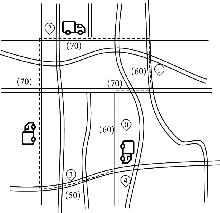
图1
建筑垃圾多舱车分类收运示意图"
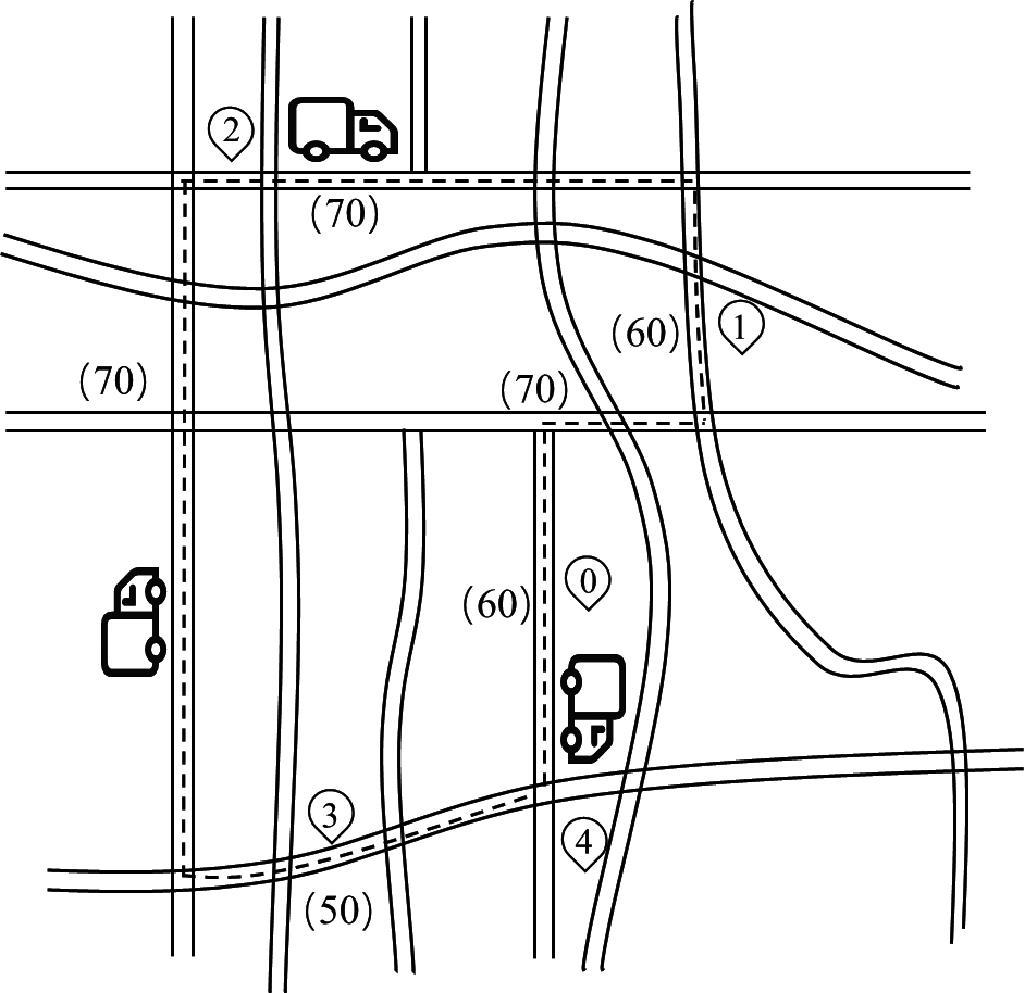

表1
相关符号及定义"
| 符号 | 定义 |
|---|---|
| 建筑垃圾中转站{0}及 | |
| 建筑垃圾点集合, | |
| 非混凝土建筑垃圾种类集合, | |
| 多舱车车型集合, | |
| 多舱车车辆集合, | |
| 表示建筑垃圾中转站或建筑垃圾点, | |
| 表示节点 | |
| 表示节点 | |
| 表示车型 | |
| 表示车型 | |
| 表示车型 | |
| 表示车型 | |
| 表示从节点 | |
| 表示从节点 | |
| 表示滚动噪音回归系数1 | |
| 表示滚动噪音回归系数2 | |
| 表示车辆行驶速度 | |
| 表示模型中采用的参考速度 | |
| 表示车轴数量 | |
| 表示模型中采用的参考轴数 | |
| 表示车型h的多舱车k从节点i行驶至节点j时的总噪声 | |
| 表示车型h的多舱车k从节点i行驶至节点j时的滚动噪声 | |
| 表示车型h的多舱车k从节点i行驶至节点j时的发动机噪声 | |
| 表示最佳发动机转速下的全油门发动机声功率级 | |
| 表示与发动机负荷相关的系数 | |
| 表示标准化发动机负荷 | |
| 表示滚动阻力的静态系数 | |
| 表示滚动阻力的动态系数 | |
| 表示空气密度 | |
| 表示车辆的正面横截面积 | |
| 表示气动阻力系数 | |
| 表示发动机功率 | |
| 表示传动效率系数 | |
| 0-1变量,当使用车型h的多舱车k从节点i行驶至节点j时,取值为1;否则,为0 | |
| 0-1变量,当使用车型h的多舱车k收运节点i的非混凝土建筑垃圾p时,取值为1;否则,为0 | |
| 0-1变量,表示车型h的多舱车k从节点i行驶至节点j时的总载重 | |
| 0-1变量,车型h的多舱车k在节点i收运非混凝土建筑垃圾p的垃圾量 |
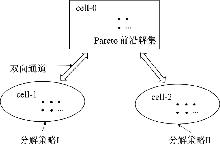
图2
IMOEA/D膜算法的组织型膜系统结构"
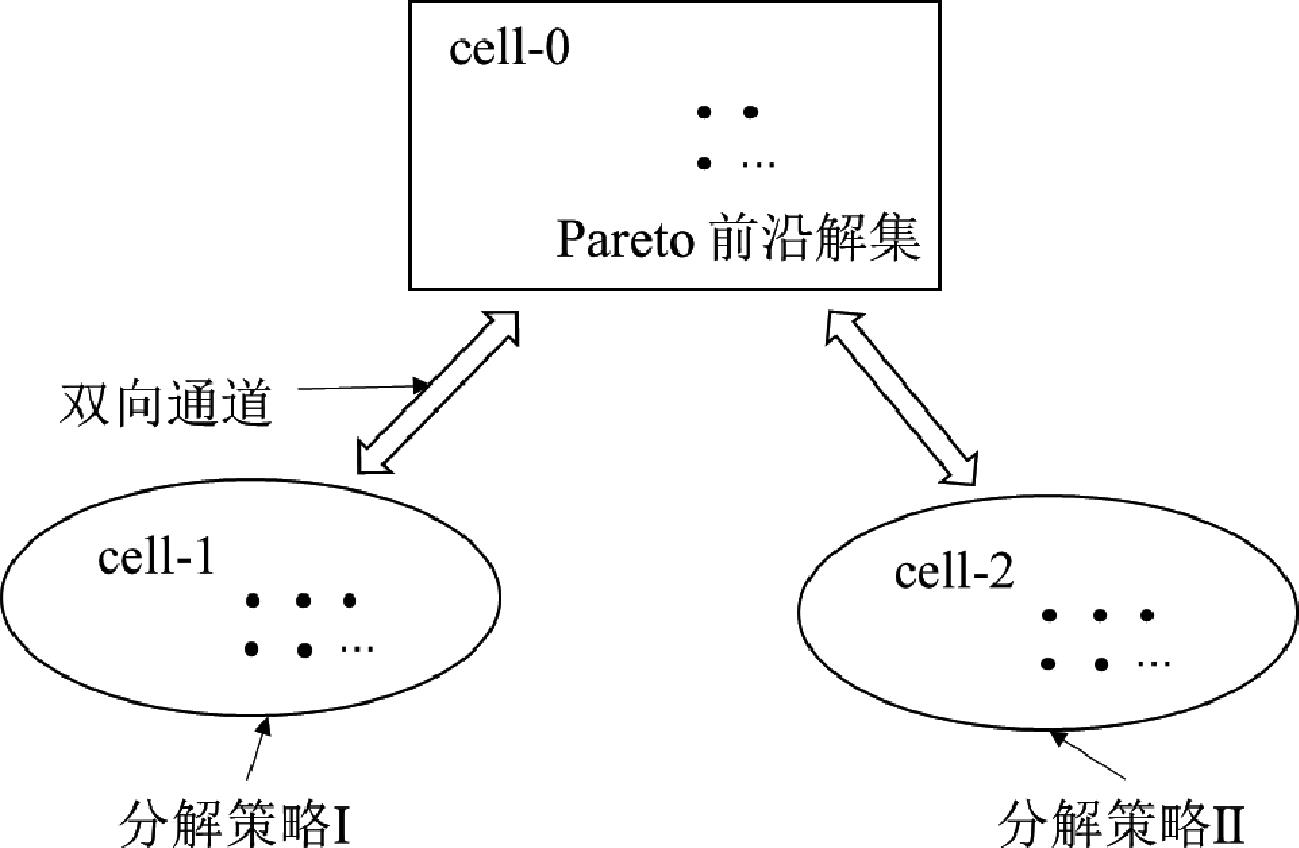
表2
算例规模相关参数"
| 建筑垃圾点数 | 非混凝土建筑垃圾种类数 | 算例总数 |
|---|---|---|
| 10 | 2 | 10 |
| 15 | 2 | 10 |
| 20 | 3 | 10 |
| 30 | 3 | 10 |
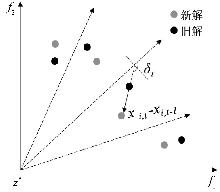
图3
进化状态评估图"
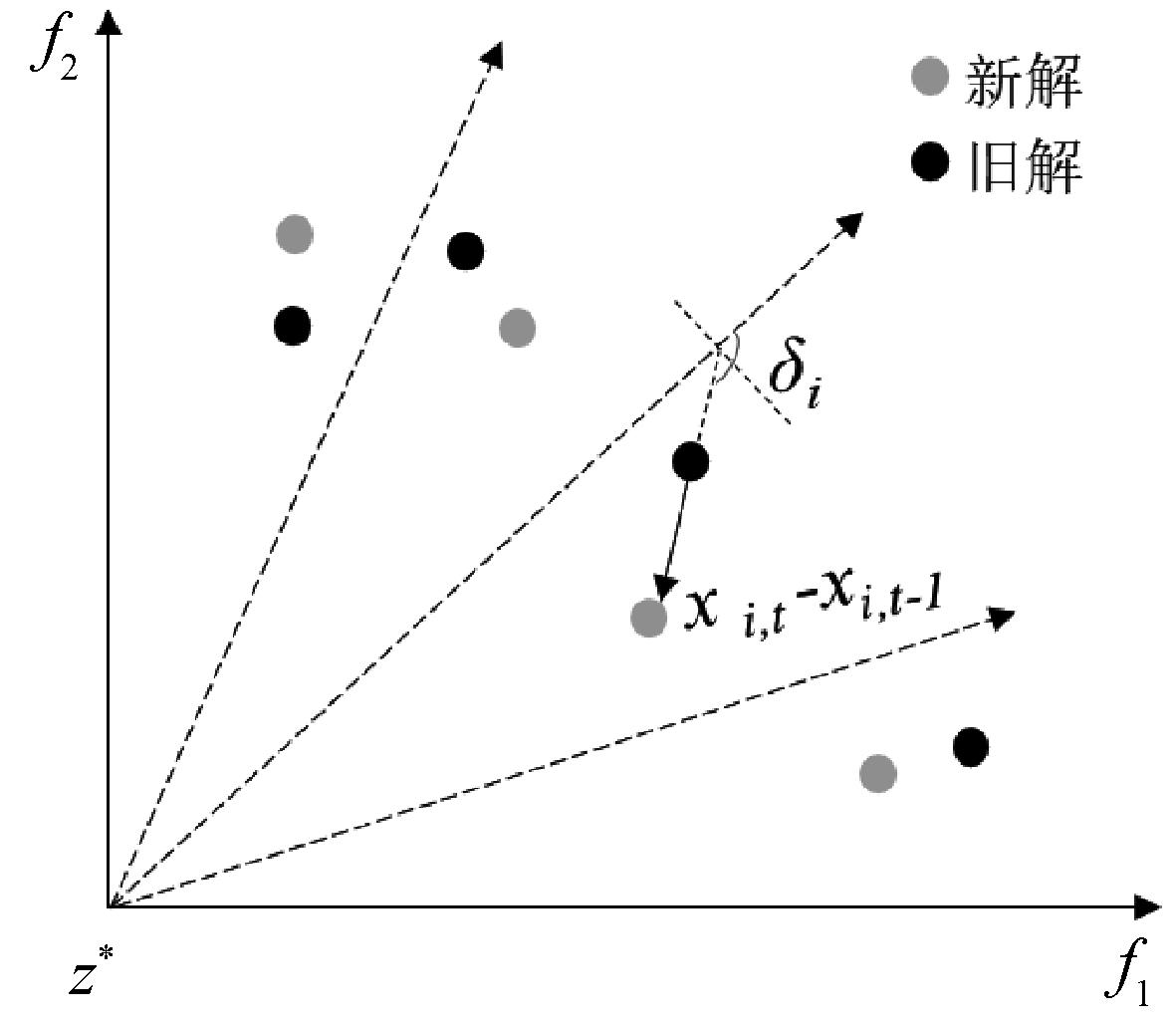
表3
车型配置及成本"
| 车辆类型 | 车容 | 车舱数量 | 车舱容量 | 派车成本 | 单位距离 运输成本 |
|---|---|---|---|---|---|
| I | 2.5 | 2 | 1.25+1.25 | 410 | 1.3 |
| II | 3.75 | 3 | 1.25+1.25+1.25 | 550 | 1.5 |
| III | 4.5 | 3 | 1.5+1.5+1.5 | 620 | 1.8 |
表4
膜算法有效性分析"
| 算例编号 | M-IMOEA/D | I-MOEA/D(WM) | I-MOEA/D(PBI) | ||||||
|---|---|---|---|---|---|---|---|---|---|
| Best | Worst | Mean | Best | Worst | Mean | Best | Worst | Mean | |
| 10-2-2 | 1.90×10⁶ | 6.35×10⁵ | 1.04×10⁶ | 8.66×10⁵ | 4.80×10⁵ | 6.69×10⁵ | 1.31×10⁶ | 3.95×10⁵ | 7.99×10⁵ |
| 10-2-4 | 1.41×10⁶ | 5.44×10⁵ | 9.71×10⁵ | 1.03×10⁶ | 5.87×10⁵ | 8.12×10⁵ | 1.35×10⁶ | 4.53×10⁵ | 9.00×10⁵ |
| 10-2-6 | 1.37×10⁶ | 6.60×10⁵ | 1.00×10⁶ | 8.14×10⁵ | 4.45×10⁵ | 6.33×10⁵ | 1.19×10⁶ | 5.56×10⁵ | 7.44×10⁵ |
| 15-2-2 | 3.95×10⁶ | 1.03×10⁶ | 2.41×10⁶ | 2.08×10⁶ | 1.00×10⁶ | 1.49×10⁶ | 2.52×10⁶ | 1.19×10⁵ | 1.83×10⁶ |
| 15-2-4 | 4.75×10⁶ | 1.45×10⁶ | 2.48×10⁶ | 2.34×10⁶ | 1.01×10⁶ | 1.57×10⁶ | 3.59×10⁶ | 1.30×10⁶ | 2.14×10⁶ |
| 15-2-6 | 3.43×10⁶ | 1.39×10⁶ | 2.24×10⁶ | 1.44×10⁶ | 1.01×10⁶ | 1.23×10⁶ | 3.26×10⁵ | 1.28×10⁵ | 2.28×10⁶ |
| 20-3-2 | 5.80×10⁶ | 2.43×10⁶ | 4.25×10⁶ | 3.21×10⁶ | 1.33×10⁶ | 2.36×10⁶ | 6.88×10⁶ | 2.68×10⁶ | 4.28×10⁶ |
| 20-3-4 | 6.38×10⁶ | 3.33×10⁶ | 4.63×10⁶ | 3.36×10⁶ | 1.41×10⁶ | 2.21×10⁶ | 5.54×10⁶ | 3.47×10⁶ | 4.31×10⁶ |
| 20-3-6 | 7.85×10⁶ | 2.79×10⁶ | 4.81×10⁶ | 2.64×10⁶ | 1.54×10⁶ | 2.02×10⁶ | 6.74×10⁶ | 2.63×10⁶ | 4.30×10⁶ |
| 30-3-2 | 8.66×10⁶ | 3.91×10⁶ | 6.21×10⁶ | 5.39×10⁶ | 3.16×10⁶ | 3.97×10⁶ | 7.14×10⁶ | 4.37×10⁶ | 6.35×10⁶ |
| 30-3-4 | 1.05×10⁷ | 4.36×10⁶ | 6.60×10⁶ | 4.10×10⁶ | 2.56×10⁶ | 3.26×10⁶ | 1.15×10⁶ | 4.43×10⁶ | 6.85×10⁶ |
| 30-3-6 | 1.10×10⁷ | 5.56×10⁶ | 7.67×10⁶ | 6.18×10⁶ | 3.05×10⁶ | 4.71×10⁶ | 1.05×10⁶ | 5.75×10⁶ | 7.48×10⁶ |
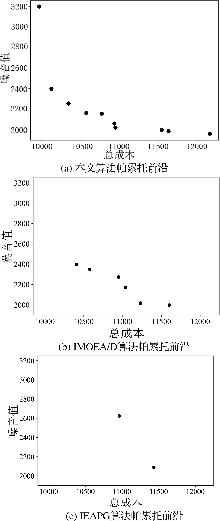
图4
三种算法帕累托前沿对比"
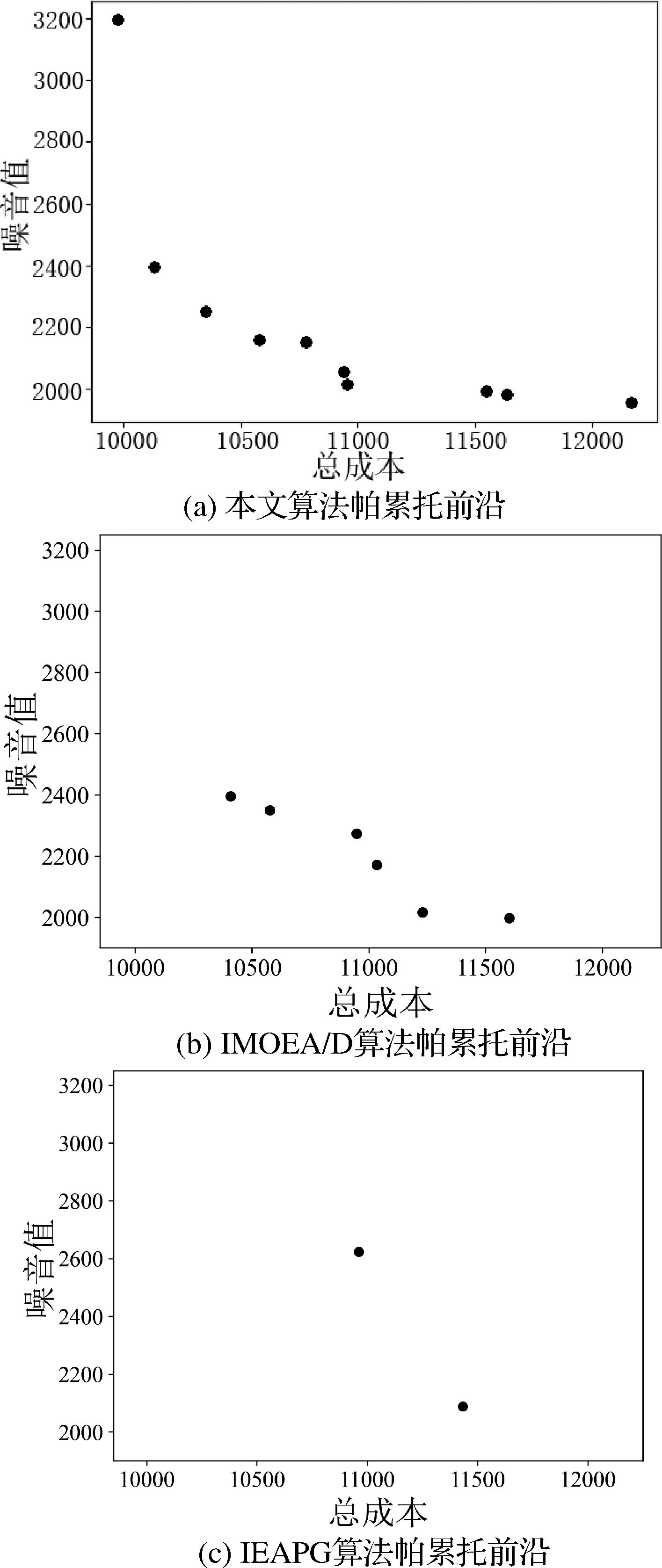
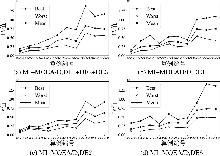
图5
DE算子有效性分析"
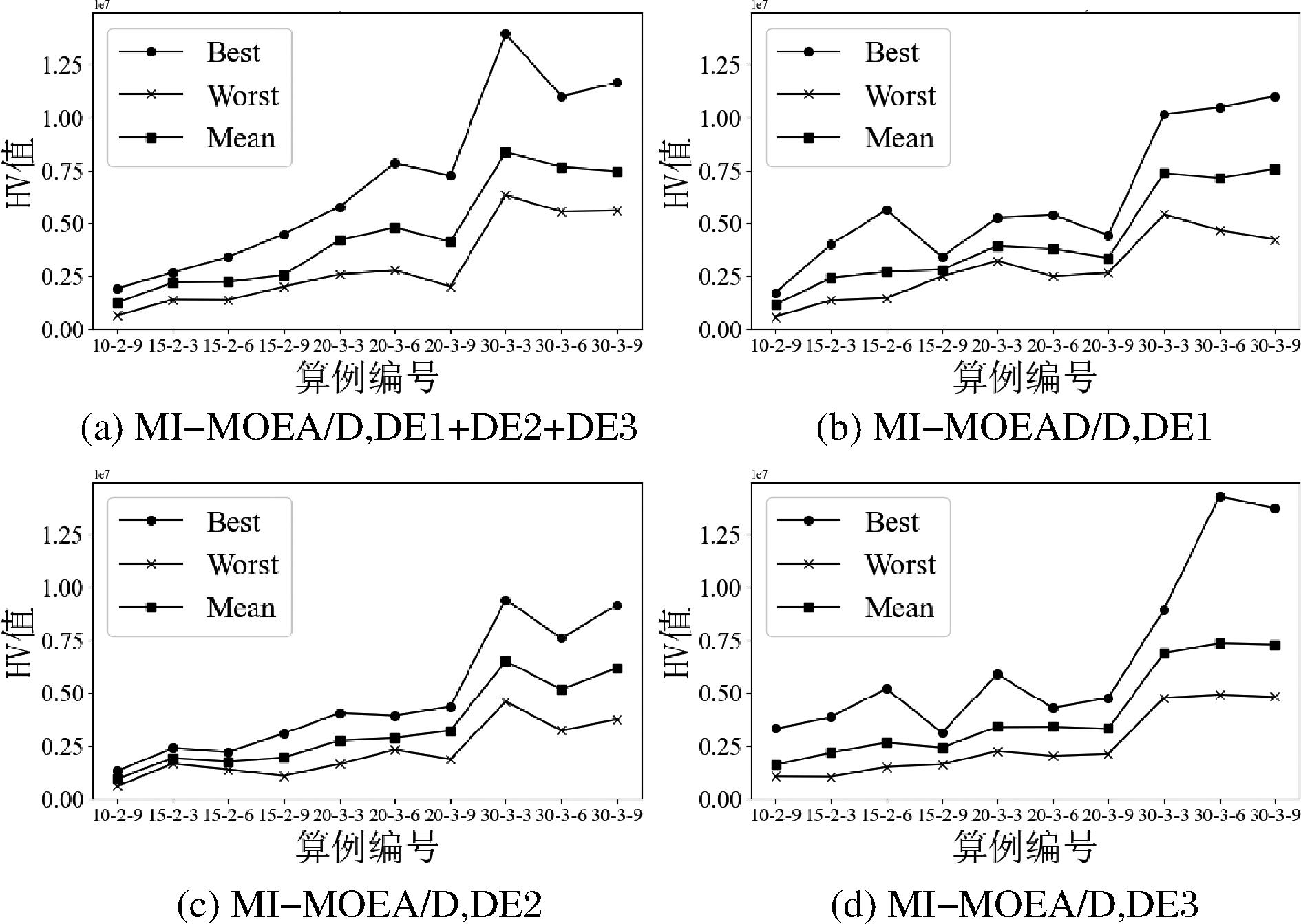
表5
模型对比分析"
| 算例编号 | 单目标模型 | 本文模型 | 总成本值Gap | 总噪声值Gap |
|---|---|---|---|---|
| 10-2-3 | (2552.62,864.60) | (2611.09,619.04) | -2.24% | 39.67% |
| 10-2-5 | (2489.65,745.35) | (2607.26,594.89) | -4.51% | 25.29% |
| 10-2-7 | (2462.89,724.17) | (2562.35,560.21) | -3.88% | 32.48% |
| 15-2-3 | (4050.38,1441.92) | (4096.21,1015.06) | -1.12% | 42.05% |
| 15-2-5 | (3428.19,1168.99) | (3665.70,965.16) | -6.48% | 21.12% |
| 15-2-7 | (4618.84,1435.60) | (4827.84,992.89) | -4.33% | 44.59% |
| 20-3-3 | (5428.86,1566.99) | (5833.63,1295.17) | -6.93% | 20.99% |
| 20-3-5 | (6244.33,1620.16) | (6746.53,1241.55) | -7.44% | 30.49% |
| 20-3-7 | (6358.82,1662.23) | (6635.52,1309.04) | -4.17% | 26.98% |
| 30-3-3 | (10415.23,2533.51) | (11000.47,2016.25) | -5.30% | 25.65% |
| 30-3-5 | (8906.57,2524.84) | (9825.02,1936.75) | -9.60% | 30.36% |
| 30-3-7 | (9992.86,2428.13) | (11625.86,1960.76) | -14.05% | 23.84% |
表6
单舱车与多舱车收运效果对比"
| 算例 | 单舱车 | 多舱车 | ||||
|---|---|---|---|---|---|---|
运输 距离 | 总成本 | 总噪声 | 运输 距离 | 总成本 | 总噪声 | |
| 10-2-1 | 1947 | 3761 | 1403 | 858 | 2565 | 595 |
| 10-2-2 | 1727 | 3994 | 1238 | 1333 | 2503 | 595 |
| 10-2-3 | 1774 | 4046 | 1379 | 860 | 2789 | 560 |
| 15-2-1 | 3318 | 6809 | 1859 | 1529 | 4613 | 840 |
| 15-2-2 | 3483 | 6855 | 1900 | 1515 | 4402 | 875 |
| 15-2-3 | 3165 | 7516 | 1860 | 1371 | 4025 | 1048 |
| 20-3-1 | 6872 | 16015 | 3811 | 2496 | 9274 | 1468 |
| 20-3-2 | 6302 | 14525 | 3733 | 2009 | 6433 | 1349 |
| 20-3-3 | 5368 | 11903 | 4117 | 1880 | 6387 | 1235 |
| 30-3-1 | 10000 | 20663 | 5494 | 3809 | 11185 | 2118 |
| 30-3-2 | 9564 | 20287 | 5809 | 4144 | 11157 | 2018 |
| 30-3-3 | 9053 | 20063 | 5510 | 4109 | 12113 | 2236 |
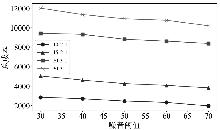
图6
噪声阈值灵敏度分析图"
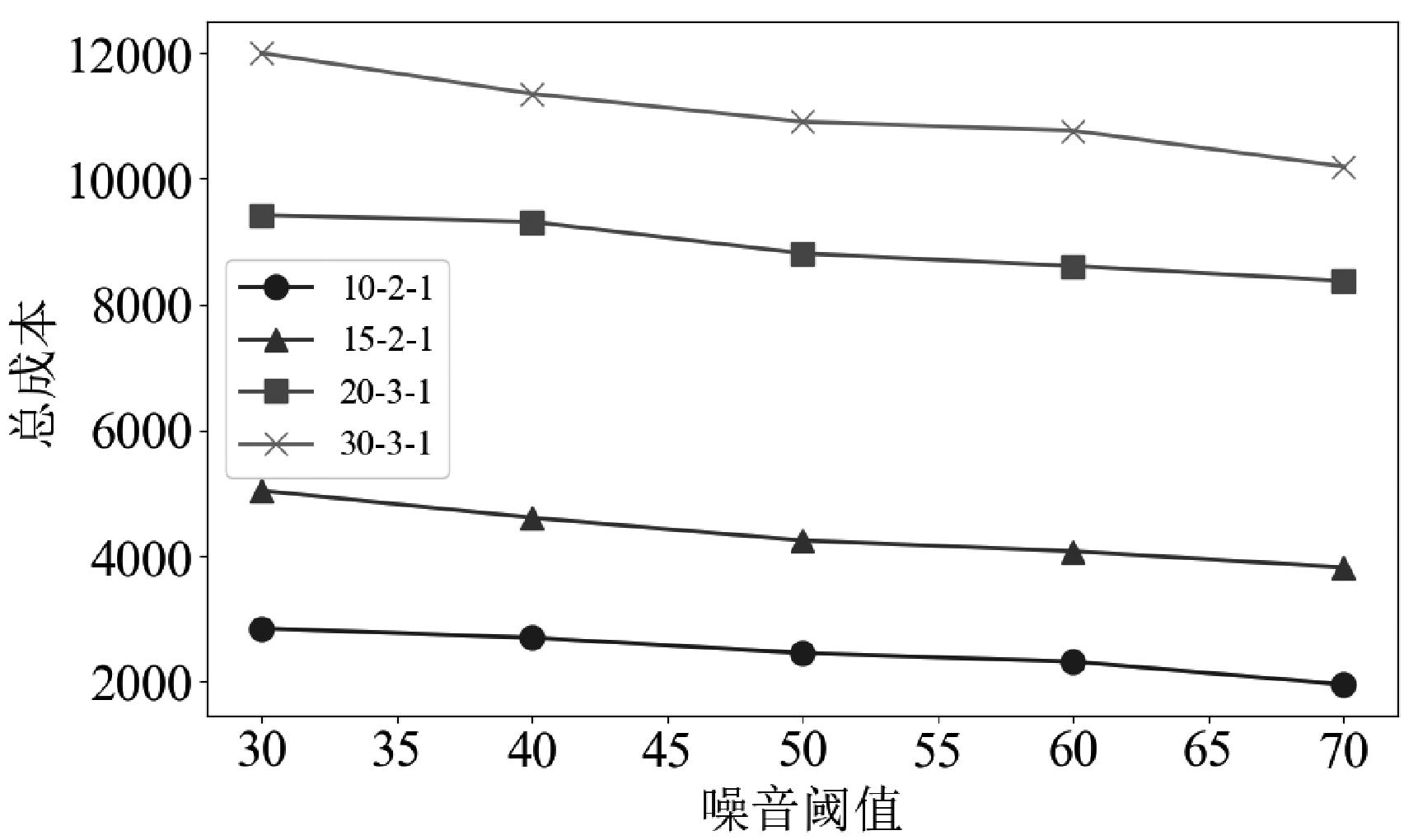

图7
三种算法帕累托解示意图"
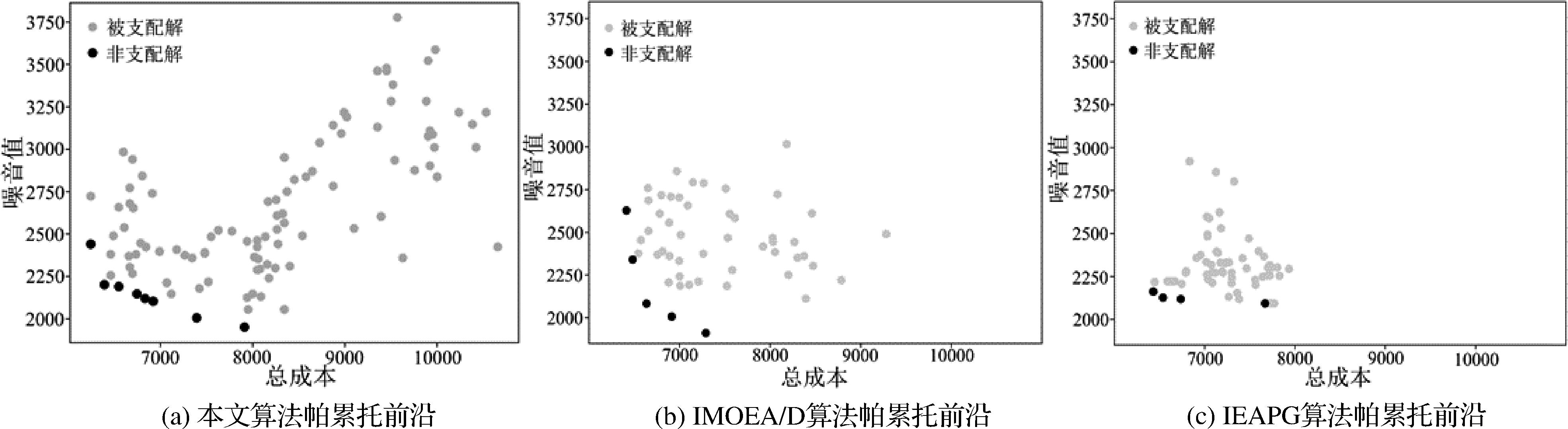
表7
非支配解各目标值"
| 非支配解编号 | 总成本 | 总噪声污染值 |
|---|---|---|
| 1 | 6241.84 | 2440.14 |
| 2 | 6392.78 | 2202.99 |
| 3 | 6554.35 | 2189.12 |
| 4 | 6747.20 | 2147.50 |
| 5 | 6837.98 | 2118.42 |
| 6 | 6921.65 | 2100.82 |
| 7 | 7391.21 | 2007.45 |
| 8 | 7912.66 | 1948.76 |
图8
建筑垃圾车辆收运路径"
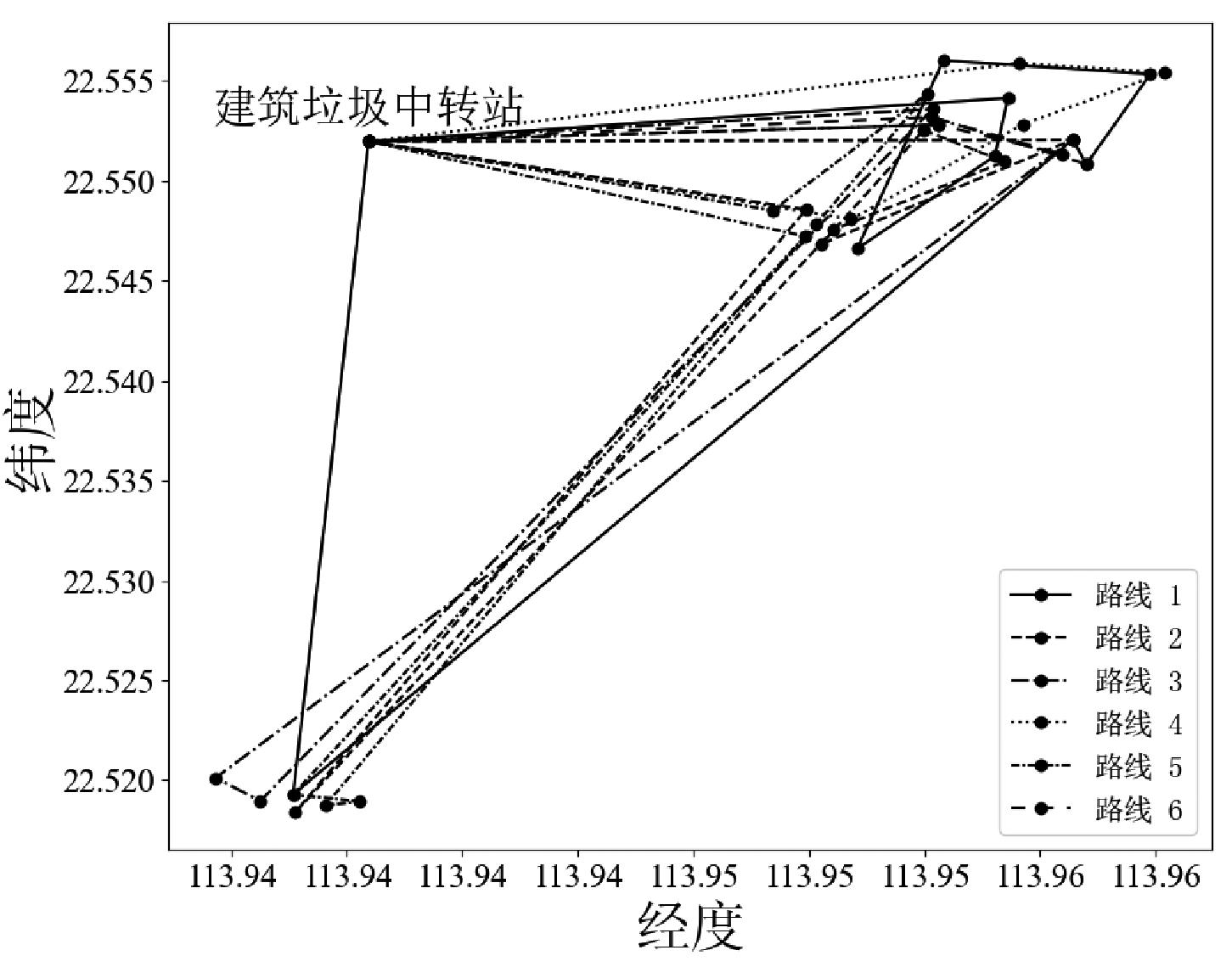
表8
垃圾收运计划"
| 车辆类型 | 车辆访问顺序 | 回收非混凝土建筑垃圾种类 | 总噪声污染值 | 总成本 |
|---|---|---|---|---|
| III | 0-26-16-3-1-20-23-2-24-0 | 玻璃、金属、竹木 | 466.84 | 1337.86 |
| III | 0-21-28-7-18-12-10-2-0 | 玻璃、金属、竹木 | 420.16 | 1316.25 |
| III | 0-14-29-30-2-23-4-8-0 | 玻璃、金属、竹木 | 373.47 | 1297.09 |
| III | 0-15-11-9-5-0 | 玻璃、金属、竹木 | 233.42 | 890.33 |
| III | 0-22-19-6-24-25-27-13-0 | 玻璃、金属、竹木 | 420.16 | 1238.11 |
| III | 0-8-17-4-0 | 玻璃、金属、竹木 | 186.73 | 841.98 |
| [1] | 李欣, 郑懿波, 杨柳, 等. 新背景下建筑垃圾处理产业发展思考与探讨[J/OL]. 施工技术(中英文), 2024.. |
| Li X, Zheng Y B, Yang L, et al. Reflections and discussions on the development of construction waste treatment industry under the new background[J/OL]. Construction Technology, 2024.. | |
| [2] | 邵志国, 李梦笛, 韩传峰, 等. 基于演化博弈的建筑垃圾处理协同机制及仿真[J]. 中国管理科学, 2024, 32(7): 324-334. |
| Shao Z G, Li M D, Han C F, et al. Simulation and cooperative mechanism of construction waste disposal based on evolutionary game[J]. Chinese Journal of Management Science, 2024, 32(7): 324-334. | |
| [3] | 陈鑫. 建筑垃圾高值化利用前景探讨[J]. 科技与创新, 2024(21): 194-196. |
| Chen X. Discussion on the prospect of high-value utilization of construction waste[J]. Science and Technology & Innovation, 2024(21): 194-196. | |
| [4] | Chen Q, Liao W. Collaborative routing optimization model for reverse logistics of construction and demolition waste from sustainable perspective[J]. International Journal of Environmental Research and Public Health, 2022, 19(12): 7366. |
| [5] | Wang H, Yi W, Liu Y. Optimal route design for construction waste transportation systems: Mathematical models and solution algorithms[J]. Mathematics, 2022, 10(22): 4340. |
| [6] | Erdem M. Optimisation of sustainable urban recycling waste collection and routing with heterogeneous electric vehicles[J]. Sustainable Cities and Society, 2022, 80: 103785. |
| [7] | Elbek M, Wøhlk S. A variable neighborhood search for the multi-period collection of recyclable materials[J]. European Journal of Operational Research, 2016, 249(2): 540-550. |
| [8] | Hong Y, Yan W, Ge Q. Designing sustainable logistics networks for classified municipal solid wastes collection and transferring with multi-compartment vehicles[J]. Sustainable Cities and Society, 2023, 99: 104921. |
| [9] | Mohammadi M, Rahmanifar G, Hajiaghaei-Keshteli M, et al. A dynamic approach for the multi-compartment vehicle routing problem in waste management[J]. Renewable and Sustainable Energy Reviews, 2023, 184: 113526. |
| [10] | Shang C, Ma L, Liu Y. Green location routing problem with flexible multi-compartment for source-separated waste: A Q-learning and multi-strategy-based hyper-heuristic algorithm[J]. Engineering Applications of Artificial Intelligence, 2023, 121: 105954. |
| [11] | Amine Masmoudi M, Baldacci R, Mancini S, et al. Multi-compartment waste collection vehicle routing problem with Bin washer[J]. Transportation Research Part E: Logistics and Transportation Review, 2024, 189: 103681. |
| [12] | Ben-Romdhane H, Ouertani N, Krichen S, et al. On optimizing healthcare waste routing systems using waste separation policies: A case study[J]. Applied Soft Computing, 2023, 146: 110615. |
| [13] | 肖建华, 张文雪, 潘钰雅, 等. 基于分类垃圾收运时效性的多周期多车舱路径优化研究[J]. 中国管理科学, 2025, 33(10): 86-97. |
| Xiao J H, Zhang W X, Pan Y Y, et al. A multi-period multi-compartment vehicle routing problem for sorted-waste collection with timeliness[J]. Chinese Journal of Management Science, 2025, 33(10): 86-97. | |
| [14] | 孙丽君, 周雅娴, 滕玥, 等. 多车舱车辆路径问题的研究现状与发展[J]. 系统工程理论与实践, 2021, 41(6): 1535-1546. |
| Sun L J, Zhou Y X, Teng Y, et al. Multi-compartment vehicle routing problem: Status and perspectives[J]. Systems Engineering —Theory & Practice, 2021, 41(6): 1535-1546. | |
| [15] | Anderluh A, Nolz P C, Hemmelmayr V C, et al. Multi-objective optimization of a two-echelon vehicle routing problem with vehicle synchronization and ‘grey zone’ customers arising in urban logistics[J]. European Journal of Operational Research, 2021, 289(3): 940-958. |
| [16] | Sawik B, Faulin J, Pérez-Bernabeu E. A multicriteria analysis for the green VRP: A case discussion for the distribution problem of a Spanish retailer[J]. Transportation Research Procedia, 2017, 22: 305-313. |
| [17] | Sawik B, Faulin J, Pérez-Bernabeu E. Multi-criteria optimization for fleet size with environmental aspects[J]. Transportation Research Procedia, 2017, 27: 61-68. |
| [18] | Shahmoradi-Moghadam H, Samani O, Schönberger J. A hybrid robust-stochastic optimization approach for the noise pollution routing problem with a heterogeneous vehicle fleet[M]//Freitag M,Haasis H D,Pannek J.Dynamics in Logistics. Cham: Springer,2020: 124-134. |
| [19] | Tan Q, Hou J, Li Y, et al. Exploring noise reduction strategies: Optimizing drone station placement for last-mile delivery[J]. Transportation Research Part D: Transport and Environment, 2024, 133: 104306. |
| [20] | Zhang Q, Li H. MOEA/D: A multiobjective evolutionary algorithm based on decomposition[J]. IEEE Transactions on Evolutionary Computation, 2007, 11(6): 712-731. |
| [21] | Lai C M, Chiu C C, Chen T L. A nondominated sorting simplified swarm optimization with local search mechanisms for multi-objective vehicle routing problems with time windows[J]. Applied Soft Computing, 2025, 174: 112989. |
| [22] | Lin Q, Tang C, Ma Y, et al. A novel adaptive control strategy for decomposition-based multiobjective algorithm[J]. Computers & Operations Research, 2017, 78: 94-107. |
| [23] | He L, Shang K, Ishibuchi H. Simultaneous use of two normalization methods in decomposition-based multi-objective evolutionary algorithms[J]. Applied Soft Computing, 2020, 92: 106316. |
| [24] | Zhu Y, Qin Y, Yang D, et al. An enhanced decomposition-based multi-objective evolutionary algorithm with a self-organizing collaborative scheme[J]. Expert Systems with Applications, 2023, 213: 118915. |
| [25] | Xue F, Chen Y, Dong T, et al. MOEA/D with adaptive weight vector adjustment and parameter selection based on Q-learning[J]. Applied Intelligence, 2025, 55(6): 399. |
| [26] | Nishida T Y. An application of P-systems: A new algorithm for NP-complete optimization problems[C]. The 8th World Multi-Conference on Systems, Cybernetics and Informatics, 2004, 109-112. |
| [27] | Cong D, Shi C, Cui Y, et al. Novel competing evolutionary membrane algorithm based on multiple reference points for multi-objective optimization of ethylene cracking processes[J]. Chemometrics and Intelligent Laboratory Systems, 2021, 217: 104389. |
| [28] | Niu Y, Zhang Y, Cao Z, et al. MIMOA: A membrane-inspired multi-objective algorithm for green vehicle routing problem with stochastic demands[J]. Swarm and Evolutionary Computation, 2021, 60: 100767. |
| [29] | Lai W, Zheng X, Song Q, et al. Multi-objective membrane search algorithm: A new solution for economic emission dispatch[J]. Applied Energy, 2022, 326: 119969. |
| [30] | Lai W, Song Q, Zheng X, et al. A new version of membrane search algorithm for hybrid renewable energy systems dynamic scheduling[J]. Renewable Energy, 2023, 209: 262-276. |
| [31] | Das S, Mullick S S, Suganthan P N. Recent advances in differential evolution-An updated survey[J]. Swarm and Evolutionary Computation, 2016, 27: 1-30. |
| [32] | Qin Y, Ren J, Yang D, et al. Decomposition-based multiobjective evolutionary algorithm with density estimation-based dynamical neighborhood strategy[J]. Applied Intelligence, 2023, 53(24): 29863-29901. |
| [33] | Zheng W, Tan Y, Meng L, et al. An improved MOEA/D design for many-objective optimization problems[J]. Applied Intelligence, 2018, 48(10): 3839-3861. |
| [34] | Yuan J, Liu H L, Yang S. An adaptive parental guidance strategy and its derived indicator-based evolutionary algorithm for multi- and many-objective optimization[J]. Swarm and Evolutionary Computation, 2024, 84: 101449. |
| [35] | 王丽萍, 任宇, 邱启仓, 等. 多目标进化算法性能评价指标研究综述[J]. 计算机学报, 2021, 44(8): 1590-1619. |
| Wang L P, Ren Y, Qiu Q C, et al. Survey on performance indicators for multi-objective evolutionary algorithms[J]. Chinese Journal of Computers, 2021, 44(8): 1590-1619. |
| [1] | 熊浩, 陈晓蝶, 鄢慧丽. 考虑骑手配送时效奖惩的外卖多目标路径优化研究[J]. 中国管理科学, 2026, 34(9): 209-224. |
| [2] | 孙华丽, 张怡翔, 刘硕. 应急设施选址—物资多周期调配的仿射可调整鲁棒优化研究[J]. 中国管理科学, 2026, 34(9): 142-152. |
| [3] | 于茹, 王晓丽, 许孝君, 王露. 基于多目标优化的中国纯电动汽车发展路径研究[J]. 中国管理科学, 2026, 34(8): 345-355. |
| [4] | 纪雅敏, 高锋, 祁明亮, 池宏. 安全裕度与综合效益权衡下的核电周边旅游规模优化研究[J]. 中国管理科学, 2026, 34(8): 104-114. |
| [5] | 王勇, 史亭亭, 苟梦圆, 蒋琼, 许茂增. 考虑时间窗指派的多中心开闭混合式车辆路径问题[J]. 中国管理科学, 2026, 34(7): 189-205. |
| [6] | 刘丽萍, 王蕊, 孙时磊, 甘晓凤, 范体军. 节点中断下考虑风险公平的危化品运输网络优化[J]. 中国管理科学, 2026, 34(6): 66-76. |
| [7] | 张珺, 杨惠晴, 田凌坤. 考虑通道工作量均衡的补货阶段移动机器人拣选系统储位分配问题研究[J]. 中国管理科学, 2026, 34(5): 184-194. |
| [8] | 陈闻鹤, 常志朋, 周涵婷, 程龙生, 文卜玉. 重大疫情下社区韧性治理能力深度迁移学习评价方法[J]. 中国管理科学, 2025, 33(8): 100-111. |
| [9] | 薛松, 陈旭, 李超, 丰景春. 考虑人力资源技能进化的服务类项目型企业小型多项目调度问题研究[J]. 中国管理科学, 2025, 33(6): 96-104. |
| [10] | 吴国滨, 孙亚晴, 李玉龙. 基于ESG框架的重大工程隧道洞渣综合利用优化研究[J]. 中国管理科学, 2025, 33(3): 174-185. |
| [11] | 夏西强, 李江文, 朱庆华, 马瑞尧. 再制造的发展历程与未来展望[J]. 中国管理科学, 2025, 33(1): 287-296. |
| [12] | 李铁克,苏艺璇,张文新,王柏琳. 加工时间不确定的炼钢-连铸区间多目标优化调度[J]. 中国管理科学, 2024, 32(8): 95-106. |
| [13] | 汪和平,赵登宇,陈梦凯,李艳. 基于MO-CGJaya/D算法的PC构件混流生产作业指派优化研究[J]. 中国管理科学, 2024, 32(7): 95-105. |
| [14] | 王付宇,谢昊轩,林钟高,王骏. 突发事件下高铁站应急疏散多目标优化模型与自适应量子蚁群算法[J]. 中国管理科学, 2024, 32(3): 188-197. |
| [15] | 陈雪龙,张钟,李悦. 临机决策视角下的非常规突发事件应急处置方案生成[J]. 中国管理科学, 2024, 32(10): 109-122. |
| 阅读次数 | ||||||
|
全文 |
|
|||||
|
摘要 |
|
|||||
|
||
