
主管:中国科学院
主办:中国优选法统筹法与经济数学研究会
中国科学院科技战略咨询研究院
主办:中国优选法统筹法与经济数学研究会
中国科学院科技战略咨询研究院

中国管理科学 ›› 2026, Vol. 34 ›› Issue (7): 218-228.doi: 10.16381/j.cnki.issn1003-207x.2024.1188
• • 上一篇
王贇1, 沙梦一2( ), 廉鹏3
收稿日期:2024-07-22
修回日期:2024-08-18
出版日期:2026-07-25
发布日期:2026-06-18
通讯作者:
沙梦一
E-mail:shamengyi@bupt.edu.cn
基金资助:
Yun Wang1, Mengyi Sha2(), Peng Lian3
Received:2024-07-22
Revised:2024-08-18
Online:2026-07-25
Published:2026-06-18
Contact:
Mengyi Sha
E-mail:shamengyi@bupt.edu.cn
摘要:
社区督查作为我国基层治理体系的核心环节,对于维护社会稳定、促进社区和谐发展起着至关重要的作用。随着社会的快速发展和城市化进程的不断推进,基层社区的复杂性和多样性日益凸显,对社区督查工作提出了更高的要求。通过有效的社区督查,能够及时发现和解决基层治理中的问题,为社区稳定发展奠定坚实的基础。本文分析督查组和督查对象属性对督查效果的影响,在该问题中,将带有二维属性的督查记录看作空间中的点,识别密集出现督查问题的属性值组合范围,抽象为二维属性空间中的频发子集搜索问题,为研究社区督查问题提供了新的视角和技术路径。本文首先利用逻辑回归识别督查组和督查对象的关键二维属性组合。然后,基于空间搜索的思想,构建非线性优化模型识别频发子集,并转化为混合整数二次规划模型。为了提高求解效率,利用McCormick不等式转化为线性规划模型求解,从而得到易出现督查问题的最小频发子集,使得督查对象和督查组的属性取值在频发子集范围内时,督查问题的出现次数达到一定比例。本文基于我国某地区基层社区督查台账数据,利用所提出的方法和模型,对案例进行说明分析,模型结果可以为提升社区督查效果提供有效的决策辅助。
中图分类号:
王贇,沙梦一,廉鹏. 基于空间搜索的基层社区督查效果影响因素分析[J]. 中国管理科学, 2026, 34(7): 218-228.
Yun Wang,Mengyi Sha,Peng Lian. Analytics of Influencing Factors of Community Governance Based on Spatial Search Method[J]. Chinese Journal of Management Science, 2026, 34(7): 218-228.

表1
督查对象和督查组属性"
| 一级指标 | 二级指标 | 三级指标 |
|---|---|---|
| 督查对象属性 | 人口属性 | 总人数、当地常住人口占比 |
| 经济属性 | 贫困人口数、人均年收入 | |
| 进驻社区工作队属性 | 工作组人数、党员比例、正处级及以上成员占比、大学及以上学历人员占比、来自经管法相关专业人数占比、35岁及以上成员占比、当地成员占比 | |
| 社区干部属性 | 社区干部人数、党员比例、大学及以上学历人员占比、35岁及以上成员占比、当地干部占比 | |
| 督查组属性 | 自然属性 | 成员数、督查时间、35岁及以上成员占比、当地成员占比 |
| 职级属性 | 正处级及以上成员占比、来自纪检委相关部门的人员比例、组长为正处级及以上成员占比、联络员为正处级及以上成员占比 | |
| 专业属性 | 从事纪检监察工作不低于四年人员比例、参加督查工作不低于三次的人员比例、来自经管法相关专业人员占比、大学及以上学历人员占比 |
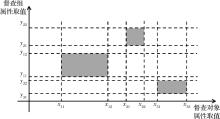
图1
二维属性空间中督查问题频发子集示意图"
表2
参数及变量定义"
| 符号 | 定义 | 符号 | 定义 |
|---|---|---|---|
| 第k个频发子集对应的督查对象属性值的最小值和最大值,即频发子集端点横坐标的范围 | |||
| 第k个频发子集对应的督查组属性值的最小值和最大值,即频发子集端点纵坐标的范围 | |||
| 第i条督查记录中督查对象的属性值 | 0-1变量,判断第i条督查记录中督查对象的属性值是否在第k个频发子集的范围内 | ||
| 第i条督查记录中督查组的属性值 | 0-1变量,判断第i条督查记录中督查组的属性值是否在第k个频发子集的范围内 | ||
| r1 | 针对二维关键属性中督查对象的属性,历史督查记录中属性值最大值与最小值的差 | 0-1辅助变量, | |
| r2 | 针对二维关键属性中督查组的属性,历史督查记录中属性值最大值与最小值的差 | 辅助变量,分别代表第k个频发子集和第k1个频发子集顶点横坐标、纵坐标的最大值和最小值 | |
| 频发子集内出现督查问题占总问题数目的最低比例 | 0-1辅助变量,用于分析第k个频发子集和第k1个频发子集的位置关系 | ||
| 每个频发子集内督查记录占所有督查记录的最低比例 | 辅助变量 | ||
| M | 取值足够大的常数 |
表3
针对社区人员管理问题的逻辑回归模型表现"
| 准确率 | 召回率 | 精确率 | F1 | AUC |
|---|---|---|---|---|
| 0.76 | 0.76 | 0.708 | 0.659 | 0.612 |
表4
针对社区帮扶问题的逻辑回归模型表现"
| 准确率 | 召回率 | 精确率 | F1 | AUC |
|---|---|---|---|---|
| 0.82 | 0.82 | 0.724 | 0.739 | 0.641 |
表5
针对社区人员管理问题的频发子集识别结果"
| 频发子集包含问题记录的最小比例(%) | 频发子集 | 社区干部中党员占比(%) | 督查组中来自经管法相关专业人员占比(%) | ||
|---|---|---|---|---|---|
| 最小值 | 最大值 | 最小值 | 最大值 | ||
| 30 | k=1 | 57.00 | 87.50 | 83.33 | 94.44 |
| k=2 | 50.00 | 50.00 | 83.33 | 94.44 | |
| 40 | k=1 | 50.00 | 100.00 | 83.33 | 94.44 |
| k=2 | 60.00 | 88.89 | 80.00 | 80.00 | |
表6
村(社区 )总人数、督查组中来自各级纪检部门的成员比例与督查问题的关系"
| 频发子集包含问题记录的最小比例(%) | 频发子集 | 社区干部大学及以上学历人员占比(%) | 督查组中来自纪检委相关部门的成员比例(%) | ||
|---|---|---|---|---|---|
| 最小值 | 最大值 | 最小值 | 最大值 | ||
| 15 | k=1 | 0.57 | 37.50 | 84.62 | 95.00 |
| k=2 | 62.50 | 88.89 | 84.62 | 92.31 | |
| 20 | k=1 | 0.57 | 42.85 | 83.33 | 95.00 |
| k=2 | 60.00 | 92.30 | 84.62 | 95.00 | |
| [1] | 李芳, 张雪然, 高新. 近十年来国内基层治理体系研究回顾与展望[J]. 社会治理, 2023(6): 96-107. |
| Li F, Zhang X R, Gao X. Review and prospect of the research on domestic grassroots governance system in recent ten years[J]. Social Governance Review, 2023(6): 96-107. | |
| [2] | Goodnow F J. Politics and Administration: A Study in Government[M]. London: Routledge, 2017. |
| [3] | 李声宇. 从嵌入到独立: 督查机制的模式演化与政策匹配逻辑[J]. 华中科技大学学报(社会科学版), 2020, 34(1): 111-119. |
| Li S Y. From embeddedness to independence: The running modes and policy matching of inspection mechanism[J]. Journal of Huazhong University of Science and Technology (Social Science Edition), 2020, 34(1): 111-119. | |
| [4] | 贾群. 问题与对策: 我国当前政务督查工作研究[J]. 中国行政管理, 2005, 21(10): 23-26. |
| Jia Q. Problems and countermeasures: Research on current government supervision in China[J]. Chinese Public Administration, 2005, 21(10): 23-26. | |
| [5] | 盖威, 郭圣莉. 行政督查法治化的现实问题、理论依据及路径研究[J]. 中国行政管理, 2015, 31(2): 28-33. |
| Gai W, Guo S L. On legalization of administrative supervision: Practical issue, theoretical basis and realization path[J]. Chinese Public Administration, 2015, 31(2): 28-33. | |
| [6] | 万庄. 科学整治督查检查考核工作乱象的几点思考[J]. 中国行政管理, 2019, 35(6): 22-25. |
| Wan Z. Several points on regulating the chaos in government supervisions and inspections[J]. Chinese Public Administration, 2019, 35(6): 22-25. | |
| [7] | 蔡丽. 地方政府政务督查研究—以济宁市市中区为例[D]. 济南: 山东大学, 2012. |
| Cai L. The study of local government supervision—taking Jining City as an example[D]. Jinan: Shandong University, 2012. | |
| [8] | 王宇峰. G县政府政务督查效果评估研究[D]. 西安: 西北大学, 2019. |
| Wang Y F. Study on the evaluation of the effectiveness of government supervision in G county[D]. Xi’an: Northwest University, 2019. | |
| [9] | 李文韬. 地方政府政务督查绩效评估体系构建研究[D]. 天津: 天津大学, 2012. |
| Li W T. The Research on local government supervision performance system construction evaluation[D]. Tianjin: Tianjin University, 2012. | |
| [10] | 丁煌, 梁满艳. 地方政府公共政策执行力测评指标设计——基于地方政府合法性的视角[J]. 江苏行政学院学报, 2014(4): 99-106. |
| Ding H, Liang M Y. Designing evaluation indicators system for measuring local government’s capacity in executing public policy: From the perspective of legitimacy of local government[J]. The Journal of Jiangsu Administration Institute, 2014(4): 99-106. | |
| [11] | Alawneh A, Al-Refai H, Batiha K. Measuring user satisfaction from e-Government services: Lessons from Jordan[J]. Government Information Quarterly, 2013, 30(3): 277-288. |
| [12] | Alcaraz-Quiles F J, Navarro-Galera A, Ortiz-Rodríguez D. Factors determining online sustainability reporting by local governments[J]. International Review of Administrative Sciences, 2015, 81(1): 79-109. |
| [13] | Chen H, Yang M, Tang X. Association rule mining of aircraft event causes based on the Apriori algorithm[J]. Scientific Reports, 2024, 14: 13440. |
| [14] | Xu R, Luo F. Risk prediction and early warning for air traffic controllers’ unsafe acts using association rule mining and random forest[J]. Safety Science, 2021, 135: 105125. |
| [15] | Weng J, Zhu J Z, Yan X, et al. Investigation of work zone crash casualty patterns using association rules[J]. Accident Analysis & Prevention, 2016, 92: 43-52. |
| [16] | Verma A, Dhalmahapatra K, Maiti J. Forecasting occupational safety performance and mining text-based association rules for incident occurrences[J]. Safety Science, 2023, 159: 106014. |
| [17] | Dong X, Hao F, Zhao L, et al. An efficient method for pruning redundant negative and positive association rules[J]. Neurocomputing, 2020, 393: 245-258. |
| [18] | 张玲玲, 周全亮, 唐广文, 等. 基于领域知识和聚类的关联规则深层知识发现研究[J]. 中国管理科学, 2015, 23(2): 154-161. |
| Zhang L L, Zhou Q L, Tang G W, et al. Research on algorithm of post-processing association rules based on clustering and domain knowledge[J]. Chinese Journal of Management Science, 2015, 23(2): 154-161. | |
| [19] | 庞素琳, 蔡牧夫. 基于大数据的城中村C2I2O设计与警力配备模型[J]. 系统工程理论与实践, 2018, 38(2): 458-471. |
| Pang S L, Cai M F. Design on C2I2O in the city and police equipment models based on big data[J]. Systems Engineering — Theory & Practice, 2018, 38(2): 458-471. | |
| [20] | 余乐安, 张有德. 基于关联规则赋权特征选择集成的信用分类研究[J].系统工程理论与实践,2020,40(2): 366-372. |
| Yu L A, Zhang Y D. Weight-selected attribute bagging based on association rules for credit dataset classification[J]. Systems Engineering —Theory & Practice, 2020, 40(2): 366-372. | |
| [21] | 李靖宇, 郭湘媛, 谢启伟, 等. 基于随机森林融合的金融机构风险关联影响因素研究[J]. 系统工程理论与实践, 2024, 44(1): 296-315. |
| Li J Y, Guo X Y, Xie Q W, et al. Influencing factors of the risk correlation of financial institutions: Evidence from random forest fusion[J]. Systems Engineering-Theory & Practice, 2024, 44(1): 296-315. | |
| [22] | 许保光, 王蓓蓓, 池宏, 等. 基于贝叶斯网络的航空安全中不安全信息分析[J]. 中国管理科学, 2020, 28(12): 118-129. |
| Xu B G, Wang B B, Chi H, et al. Insecurity information analysis in civil aviation safety based on Bayesian network[J]. Chinese Journal of Management Science, 2020, 28(12): 118-129. | |
| [23] | 臧宁宁, 池宏, 邵雪焱, 等. 返航备降航班高风险频发子集搜索模型[J].运筹与管理,2012,21(3): 105-113. |
| Zang N N, Chi H, Shao X Y, et al. The search model on the high frequent risk subsets of the diversion or turning back flights[J]. Operations Research and Management Science, 2012, 21(3): 105-113. | |
| [24] | Jha K, Saha S. Incorporation of multimodal multiobjective optimization in designing a filter based feature selection technique[J]. Applied Soft Computing, 2021, 98: 106823. |
| [25] | Pintas J T, Fernandes L A F, Garcia A C B. Feature selection methods for text classification: A systematic literature review[J]. Artificial Intelligence Review, 2021, 54(8): 6149-6200. |
| [26] | Dhal P, Azad C. A comprehensive survey on feature selection in the various fields of machine learning[J]. Applied Intelligence, 2022, 52(4): 4543-4581. |
| [27] | Dumitrescu E, Hué S, Hurlin C, et al. Machine learning for credit scoring: Improving logistic regression with non-linear decision-tree effects[J]. European Journal of Operational Research, 2022, 297(3): 1178-1192. |
| [28] | 周生彬, 黄叶金. 基于互信息的变量选择方法[J]. 统计与决策, 2020, 36(1): 20-23. |
| Zhou S B, Huang Y J. Variable selection method based on mutual information[J]. Statistics and Decision, 2020, 36(1): 20-23. | |
| [29] | 沈隆, 周颖. 基于大数据变量最优组合的违约预测模型——以中国小企业为例[J]. 系统工程理论与实践, 2024, 44(3): 912-931. |
| Shen L, Zhou Y. Default prediction model based on optimal combination of big data variables: A case study of Chinese small enterprises[J]. Systems Engineering-Theory & Practice, 2024, 44(3): 912-931. |
| [1] | 李建斌, 于红洁, 陶智颖, 王启飞. 双积分政策下汽车企业最优贴标生产策略及协调机制研究[J]. 中国管理科学, 2026, 34(6): 117-132. |
| [2] | 翟运开, 李正英, 乔岩, 翟梦博. 互联网医院线上线下一体化门诊流程优化[J]. 中国管理科学, 2026, 34(5): 231-241. |
| [3] | 孙燕红, 林晓霞, 韩小花. 考虑模仿竞争的奖励型众筹产品定价与广告策略研究[J]. 中国管理科学, 2026, 34(5): 332-341. |
| [4] | 王乐, 王璐瑶, 张紫琼, 李忠平. 社交媒体环境下泄露他人隐私意向和行为的增强与反转机制研究[J]. 中国管理科学, 2026, 34(5): 97-108. |
| [5] | 江烨, 肖条军. 平台型新产品预告信息发布顺序策略研究[J]. 中国管理科学, 2026, 34(2): 226-238. |
| [6] | 章琦, 陈敬贤, 梁樑. 平台自营渠道能驱赶销售劣质产品的第三方卖家吗?[J]. 中国管理科学, 2026, 34(1): 167-177. |
| [7] | 彭丽芳, 赵楠楠. 考虑心理成本的应急物流选址路径问题[J]. 中国管理科学, 2026, 34(1): 234-243. |
| [8] | 王伟明, 徐海燕, 朱建军, 周声海. 基于CWPHM算子和C-DEMATEL的语言型多属性决策方法[J]. 中国管理科学, 2026, 34(1): 94-103. |
| [9] | 曹端阳, 张旭梅, 但斌. 考虑订单可拆分的第三方共享制造平台产能匹配策略[J]. 中国管理科学, 2025, 33(10): 225-235. |
| [10] | 冯宇, 党耀国, 王俊杰, 杨章程. 基于2-可加Choquet积分的混合信息灰关联决策方法及其应用[J]. 中国管理科学, 2025, 33(9): 189-200. |
| [11] | 戢守峰, 刘红玉, 王丽洁, 戢媛媛. PI环境下考虑保鲜努力的冷链产品生产-库存-运输联合优化模型与求解[J]. 中国管理科学, 2025, 33(8): 166-176. |
| [12] | 毛照昉, 袁锐莹, 张清然. 考虑捆绑销售的在线课程免费试听策略研究[J]. 中国管理科学, 2025, 33(8): 238-249. |
| [13] | 陈晓红, 杨志慧, 胡东滨. 数字化全渠道客户行为:研究热点与知识框架[J]. 中国管理科学, 2025, 33(7): 1-10. |
| [14] | 刘嘉, 袁欣, 阮伟乔, 白晋宇. 呼吸道传染病疫情下地铁站行人感染风险控制[J]. 中国管理科学, 2025, 33(5): 236-246. |
| [15] | 丁黎黎, 赵忠超, 张凯旋. 感知价值对个人碳账户绿色信贷发展的作用机制研究[J]. 中国管理科学, 2025, 33(5): 344-355. |
| 阅读次数 | ||||||
|
全文 |
|
|||||
|
摘要 |
|
|||||
|
||
