
主管:中国科学院
主办:中国优选法统筹法与经济数学研究会
中国科学院科技战略咨询研究院
主办:中国优选法统筹法与经济数学研究会
中国科学院科技战略咨询研究院

Chinese Journal of Management Science ›› 2025, Vol. 33 ›› Issue (12): 146-159.doi: 10.16381/j.cnki.issn1003-207x.2023.0973
Previous Articles Next Articles
Hua He1,2, Zhengwen He1,2,3, Fangfang Cao4( ), Nengmin Wang1,2,3
Received:2023-06-13
Revised:2023-10-19
Online:2025-12-25
Published:2025-12-25
Contact:
Fangfang Cao
E-mail:fangfangcao@xust.edu.cn
CLC Number:
Hua He,Zhengwen He,Fangfang Cao, et al. Max-NPV Multi-project Scheduling Optimization under Dual Resource Constraints[J]. Chinese Journal of Management Science, 2025, 33(12): 146-159.

"
| 文献 | 目标函数 | 资源约束 | 活动执行模式 | ||||||
|---|---|---|---|---|---|---|---|---|---|
| 工期 | 成本 | 净现值 | 其他 | 可重复使用资源 (全局共享)约束 | 不可重复使用资源 (局部非共享)约束 | 双重资 源约束 | 单模式 | 多模式 | |
| Amirian和Sahraeian(2017)[ | √ | √ | √ | √ | |||||
| Fu和Zhou(2021)[ | √ | √ | √ | ||||||
| Ahmeti和Musliu(2021)[ | √ | √ | √ | ||||||
| Wauters等(2015)[ | √ | √ | √ | ||||||
| Geiger(2017)[ | √ | √ | √ | ||||||
| 于懿宁等(2020)[ | √ | √ | √ | ||||||
| 于懿宁等(2023)[ | √ | √ | √ | ||||||
| Adhau等(2012)[ | √ | √ | √ | √ | |||||
| Adhau等(2013)[ | √ | √ | √ | ||||||
| 张静文等(2017)[ | √ | √ | √ | ||||||
| 刘婉君等(2017)[ | √ | √ | √ | ||||||
| Browning和Yassine(2010)[ | √ | √ | √ | ||||||
| Chakrabortty等(2017)[ | √ | √ | √ | ||||||
| Vázquez等(2015)[ | √ | √ | √ | ||||||
| Chiu和Tsai(2002)[ | √ | √ | √ | ||||||
| Can和Ulusoy(2014)[ | √ | √ | √ | ||||||
| Cui等(2021)[ | √ | √ | √ | ||||||
| Beşikci等(2017)[ | √ | √ | √ | ||||||
| 赵松等(2021)[ | √ | √ | √ | √ | |||||
| Wauters等(2016)[ | √ | √ | √ | ||||||
| Voß和Witt(2007)[ | √ | √ | √ | ||||||
| Sprecher和Drexl[ | √ | √ | √ | ||||||
| Asta等(2016)[ | √ | √ | √ | ||||||
| 本文 | √ | √ | √ | ||||||
"
| 符号 | 定义 | 符号 | 定义 |
|---|---|---|---|
| q | 项目序号,q=1, 2, …, Q,Q为项目总数 | Ω | 多项目进度计划安排,Ω=(Ω1, Ω2,…, ΩQ ) |
| Nq | 项目q网络节点集合,由项目活动构成 | NPVq | 项目q的净现值,NPVq =NPV+q ‒NPV‒q |
| Aq | 项目q网络箭线集合,由活动优先关系构成 | NPV | 所有Q个项目的净现值总和 |
| nq | 项目q中的实活动总数 | CPLq | 项目q活动网络关键路径的长度 |
| BTq | 项目q规定的开始时间 | 项目q对不可重复使用本地资源w的需求量下界 | |
| DTq | 项目q规定的截止时间 | 项目q对不可重复使用本地资源w的需求量上界 | |
| i, j | 项目活动序号,i, j∈Nq | ζq | 项目q对承包商收益的贡献度 |
| o | 项目活动执行模式序号,o=1, 2, …, Oi | init_Rv | 算法上层模块的问题初始解 |
| k | 可重复使用全局资源序号,k=1, 2, …, K | curr_Rv | 算法上层模块的问题当前解 |
| w | 不可重复使用本地资源序号,w=1, 2, …, W | neig_Rv | 算法上层模块的问题邻点解 |
| 活动i以模式o执行时对可重复使用全局资源k的需求量 | TLLupp | 算法上层模块的禁忌列表长度 | |
| 活动i以模式o执行时对不可重复使用本地资源w的需求量 | 算法上层模块需探测可行Rv 的总数 | ||
| dio | 活动i以模式o执行时的工期 | init_Πq | 算法中层模块的问题初始解 |
| cio | 活动i以模式o执行时的成本 | curr_Πq | 算法中层模块的问题当前解 |
| vi | 活动i的挣值 | neig_Πq | 算法中层模块的问题邻点解 |
| TCPq | 项目q的合同总价格 | TLLmid | 算法中层模块的禁忌列表长度 |
| 项目q的预付款比例 | 算法中层模块需探测可行Πq 的总数 | ||
| θq | 项目q的中间支付比例 | init_Sq | 算法下层模块的问题初始解 |
| Mq | 项目q的里程碑活动数 | curr_Sq | 算法下层模块的问题当前解 |
| 可重复使用全局资源k的总可用量 | neig_Sq | 算法下层模块的问题邻点解 | |
| 不可重复使用本地资源w的总可用量 | TLLlow | 算法下层模块的禁忌列表长度 | |
| 分配给项目q的不可重复使用资源w的可用量 | 算法下层模块需探测可行Sq 的总数 | ||
| Rv | 不可重复使用本地资源分配结果向量 | NBS | 算法得到与已知最好解相同的满意解的数量 |
| oi | 决策变量,活动i的执行模式 | ARD | 算法得到的满意解与已知最好解的平均相对偏差 |
| Πq | 项目q的活动执行模式向量,Πq = | MRD | 算法得到的满意解与已知最好解的最大相对偏差 |
| si | 决策变量,活动i的开始时间 | ACT | 算法得到的满意解的平均计算时间 |
| Sq | 项目q的活动开始时间向量,Sq = | MCT | 算法得到的满意解的最大计算时间 |
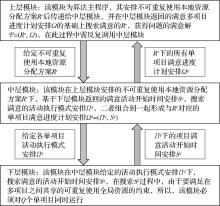
"

"
| 算例参数 | 取值设置 |
|---|---|
| 项目数Q | 3 |
| 单项目中的非虚活动数nq | 10,20,30 |
| 单项目中的开始和结束活动数 | 从2、3和4中按等概率随机选取 |
| 单项目中的最大紧前紧后活动数 | 4 |
| 可重复使用全局资源种类数K | 2 |
| 不可重复使用本地资源种类数W | 2 |
| 活动执行模式数Oi | 2 |
| 执行模式1下的di1,ci1, | 从U[ |
| 执行模式2下的活动工期di2 | λd ·di1,其中,λd 为生成di2的专用参数,取值从U[0.7, 0.9]中随机选取 |
| 执行模式2下的活动成本ci2 | λc ·ci1,其中,λc 为生成ci2的专用参数,取值从U[1.1, 1.3]中随机选取 |
| 执行模式2下的可重复使用全局资源需求量 | |
| 执行模式2下的不可重复使用本地资源需求量 | |
| 活动挣值vi | λv ·(ci1+ci2)/2,其中,ρv 为生成vi 的专用参数,取值从U[1.5, 1.8]中随机选取 |
| 资源因子RF | 0.5,0.75,1 |
| 资源强度RS | 0.5,0.75,1,基于两种执行模式下的资源需求的平均值计算 |
| 不可重复使用本地资源总量 | |
| 单项目里程碑活动数Mq | 3,4,5,里程碑活动从项目的非虚活动中按等概率随机选取 |
| 单项目预付款比例γq | 0.05,0.1,0.15 |
| 单项目中间支付比例θq | 0.8,0.85,0.9 |
| 单项目开始时间BTq | 从U[0, 5]中随机选取 |
| 折现率α | 0.006,0.008,0.010 |
| 单项目截止时间DTq | BTq +ρD ·( |
"
| nq | TS-IM | TS-NIM | ||||||||
|---|---|---|---|---|---|---|---|---|---|---|
| NBS | ARD | MRD | ACT | MCT | NBS | ARD | MRD | ACT | MCT | |
| 10 | 4439 | 0.08 | 0.50 | 4077.37 | 6874.8 | 2075 | 0.12 | 0.66 | 3488.54 | 5277.42 |
| 20 | 5291 | 0.05 | 0.64 | 8199.18 | 10061.44 | 1254 | 0.17 | 0.87 | 7910.32 | 9378.36 |
| 30 | 5982 | 0.01 | 0.51 | 13776.4 | 14088.52 | 579 | 0.25 | 0.91 | 12743.17 | 13982.13 |
| 所有算例 | 15712 | 0.05 | 0.64 | 8684.32 | 14088.52 | 3908 | 0.18 | 0.91 | 8047.34 | 13982.13 |
| nq | MSII | RS | ||||||||
| NBS | ARD | MRD | ACT | MCT | NBS | ARD | MRD | ACT | MCT | |
| 10 | 47 | 0.19 | 0.92 | 3033.03 | 4488.84 | 0 | 0.28 | 0.99 | 2555.32 | 3932.79 |
| 20 | 16 | 0.26 | 0.99 | 5377.24 | 6318.75 | 0 | 0.31 | 0.99 | 4655.11 | 6076.11 |
| 30 | 0 | 0.37 | 1 | 10010.01 | 10382.97 | 0 | 0.44 | 1 | 9432.43 | 9642.74 |
| 所有算例 | 63 | 0.27 | 1 | 6140.09 | 10382.97 | 0 | 0.34 | 1 | 5547.62 | 9642.74 |
"
| n | TS-IM | TS-NIM | MSII | ||||||
|---|---|---|---|---|---|---|---|---|---|
| NBS | ARD | ACT | NBS | ARD | ACT | NBS | ARD | ACT | |
| 20 | 62 | 0.043 | 7616.78 | 18 | 0.099 | 7408.35 | 1 | 0.191 | 5180.74 |
| n | RS | GRBH | RRBH | ||||||
| NBS | ARD | ACT | NBS | ARD | ACT | NBS | ARD | ACT | |
| 20 | 0 | 0.318 | 4454.85 | 0 | 0.201 | 5023.46 | 0 | 0.285 | 4697.01 |
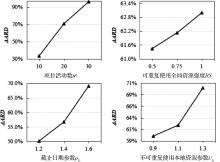
"

"
| 参数 | 取值 | NPV | 参数 | 取值 | NPV | 参数 | 取值 | NPV | 参数 | 取值 | NPV |
|---|---|---|---|---|---|---|---|---|---|---|---|
| RF | 0.5 | 115.98 | RS | 0.5 | 102.10 | ρD | 1 | 103.57 | 0.9 | 100.98 | |
| 0.75 | 106.26 | 0.75 | 106.18 | 1.2 | 112.84 | 1.1 | 109.72 | ||||
| 1 | 103.55 | 1 | 107.52 | 1.4 | 115.27 | 1.3 | 115.34 | ||||
| Mq | 3 | 102.10 | γq | 0.05 | 99.44 | θq | 0.8 | 100.67 | α | 0.006 | 109.41 |
| 4 | 106.89 | 0.1 | 105.89 | 0.85 | 104.12 | 0.008 | 105.95 | ||||
| 5 | 110.27 | 0.15 | 110.23 | 0.90 | 106.31 | 0.010 | 103.48 |
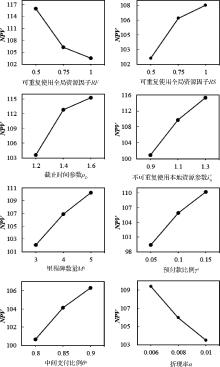
"

"
| 参数 | 平方和 | 自由度 | 均方 | F | p | 参数 | 平方和 | 自由度 | 均方 | F | p |
|---|---|---|---|---|---|---|---|---|---|---|---|
| RF | 6240.54 | 2 | 3120.27 | 525.47 | 0.00** | Mq | 7374.42 | 2 | 3687.21 | 620.94 | 0.00** |
| RS | 4416.65 | 2 | 2208.33 | 371.89 | 0.00** | γq | 2216.88 | 2 | 1108.44 | 186.67 | 0.00** |
| ρD | 4396.85 | 2 | 2198.43 | 1370.22 | 0.00** | θq | 2881.08 | 2 | 11440.54 | 5242.59 | 0.00** |
| 6448.90 | 2 | 3224.45 | 543.01 | 0.00** | α | 92667.09 | 2 | 46333.54 | 7802.75 | 0.00** | |
| **p<0.01 | |||||||||||
| [1] | Kolisch R, Padman R. An integrated survey of deterministic project scheduling[J]. Omega, 2001, 29(3): 249-272. |
| [2] | Amirian H, Sahraeian R. Solving a grey project selection scheduling using a simulated shuffled frog leaping algorithm[J]. Computers & Industrial Engineering, 2017, 107: 141-149. |
| [3] | Fu F, Zhou H. A combined multi-agent system for distributed multi-project scheduling problems[J]. Applied Soft Computing, 2021, 107: 107402. |
| [4] | Ahmeti A, Musliu N. Hybridizing constraint programming and meta-heuristics for multi-mode resource-constrained multiple projects scheduling Problem[J]. Journal of Heuristics, 2025, 31(1): 1-37. |
| [5] | Wauters T, Kinable J, Smet P, et al. The multi-mode resource-constrained multi-project scheduling problem[J]. Journal of Scheduling, 2016, 19(3): 271-283. |
| [6] | Geiger M J. A multi-threaded local search algorithm and computer implementation for the multi-mode, resource-constrained multi-project scheduling problem[J]. European Journal of Operational Research, 2017, 256(3): 729-741. |
| [7] | 于懿宁, 徐哲, 刘东宁. 考虑多技能人力资源的分布式多项目调度问题[J]. 系统工程理论与实践, 2020, 40(11): 2921-2933. |
| Yu Y N, Xu Z, Liu D N. Distributed multi-project scheduling problem with multi-skilled staff[J]. Systems Engineering-Theory & Practice, 2020,40(11): 2921-2933. | |
| [8] | 于懿宁, 徐哲, 赵松, 等. 考虑员工请假情形的多技能分布式资源受限多项目反应型调度优化[J]. 中国管理科学, 2025, 33(8): 131-143. |
| Yu Y N, Xu Z, Zhao S, et al. Research on the distributed resource-constrained multi-project reactive scheduling problem considering multi-skilled staff leave[J]. Chinese Journal of Management Science, 2025, 33(8): 131-143. | |
| [9] | Adhau S, Mittal M L, Mittal A. A multi-agent system for distributed multi-project scheduling: An auction-based negotiation approach[J]. Engineering Applications of Artificial Intelligence, 2012, 25(8): 1738-1751. |
| [10] | Adhau S, Mittal M L, Mittal A. A multi-agent system for decentralized multi-project scheduling with resource transfers[J]. International Journal of Production Economics, 2013, 146(2): 646-661. |
| [11] | 张静文, 刘婉君, 李琦. 基于关键链改进搜索的遗传算法求解分布式多项目调度[J]. 运筹与管理, 2021, 30(3): 123-129. |
| Zhang J W, Liu W J, Li Q. An adapted genetic algorithm based on the critical chain with improving search to solve the decentralized resource-constrained multi-project scheduling problem[J]. Operations Research and Management Science, 2021, 30(3): 123-129. | |
| [12] | 刘婉君, 张静文, 刘万琳. 基于拍卖机制的资源转移时间型动态分布式多项目调度[J]. 中国管理科学, 2022, 30(8): 117-129. |
| Liu W J, Zhang J W, Liu W L. Dynamic decentralized resource-constrained multi-project scheduling problem with transfer times based on auction mechanism[J]. Chinese Journal of Management Science, 2022, 30(8): 117-129. | |
| [13] | Browning T R, Yassine A A. Resource-constrained multi-project scheduling: Priority rule performance revisited[J]. International Journal of Production Economics, 2010, 126(2): 212-228. |
| [14] | Chakrabortty R K, Sarker R A, Essam D L. Resource constrained multi-project scheduling: A priority rule based evolutionary local search approach[C]//Proceedings of Intelligent and Evolutionary Systems: The 20th Asia Pacific Symposium, IES 2016, Canberra, Australia, November, Cham: Springer International Publishing, 2016. |
| [15] | Vázquez E P, Calvo M P, Ordóñez P M. Learning process on priority rules to solve the RCMPSP[J]. Journal of Intelligent Manufacturing, 2015, 26(1): 123-138. |
| [16] | Chiu H N, Tsai D M. An efficient search procedure for the resource-constrained multi-project scheduling problem with discounted cash flows[J]. Construction Management and Economics, 2002, 20(1): 55-66. |
| [17] | Węglarz J, Józefowska J, Mika M, et al. Project scheduling with finite or infinite number of activity processing modes–A survey[J]. European Journal of Operational Research, 2011, 208(3): 177-205. |
| [18] | Hartmann S, Briskorn D. An updated survey of variants and extensions of the resource-constrained project scheduling problem[J]. European Journal of Operational Research, 2022, 297(1): 1-14. |
| [19] | Schwindt C, Zimmermann J. Handbook on project management and scheduling Vol.1[M]. Cham: Springer International Publishing, 2015. |
| [20] | Can A, Ulusoy G. Multi-project scheduling with two-stage decomposition[J]. Annals of Operations Research, 2014, 217(1): 95-116. |
| [21] | Cui L, Liu X, Lu S, et al. A variable neighborhood search approach for the resource-constrained multi-project collaborative scheduling problem[J]. Applied Soft Computing, 2021, 107: 107480. |
| [22] | Beşikci U, Bilge Ü, Ulusoy G. Multi-mode resource constrained multi-project scheduling and resource portfolio problem[J]. European Journal of Operational Research, 2015, 240(1): 22-31. |
| [23] | 赵松, 徐哲, 刘东宁, 等. 地域分散型多项目时间/成本权衡问题[J].中国管理科学,2023, 31(9): 62-72. |
| Zhao S, Xu Z, Liu D N, et al. Time/cost trade-off problem in decentralized multi-project scheduling[J]. Chinese Journal of Management Science, 2023, 31(9): 62-72. | |
| [24] | Wauters T, Kinable J, Smet P, et al. The multi-mode resource-constrained multi-project scheduling problem[J]. Journal of Scheduling, 2016, 19(3): 271-283. |
| [25] | Voß S, Witt A. Hybrid flow shop scheduling as a multi-mode multi-project scheduling problem with batching requirements: A real-world application[J]. International Journal of Production Economics, 2007, 105(2): 445-458. |
| [26] | Sprecher A, Drexl A. Multi-mode resource-constrained project scheduling by a simple, general and powerful sequencing algorithm 1[J]. European Journal of Operational Research, 1998, 107(2): 431-450. |
| [27] | Asta S, Karapetyan D, Kheiri A, et al. Combining Monte-Carlo and hyper-heuristic methods for the multi-mode resource-constrained multi-project scheduling problem[J]. Information Sciences, 2016, 373: 476-498. |
| [28] | Schwindt C, Zimmermann J. Handbook on project management and scheduling Vol.1[M]. Cham: Springer International Publishing, 2015. |
| [29] | Movahedian A O, Esmaelian M, Mohammadi Z D. Multi-mode resource constrained multi-project selecting and scheduling problem to maximize net present value[J]. Journal of Industrial Management Perspective, 2016, 20(5): 79-100. |
| [30] | Mika M, Waligóra G, Węglarz J. Tabu search for multi-mode resource-constrained project scheduling with schedule-dependent setup times[J]. European Journal of Operational Research, 2008, 187(3): 1238-1250. |
| [31] | Waligóra G. Discrete-continuous project scheduling with discounted cash flows—a tabu search approach[J]. Computers & Operations Research, 2008, 35(7): 2141-2153. |
| [32] | Kolisch R, Sprecher A, Drexl A. Characterization and generation of a general class of resource-constrained project scheduling problems[J]. Management Science, 1995, 41(10): 1693-1703. |
| [33] | Kolisch R, Sprecher A. PSPLIB - A project scheduling problem library[J]. European Journal of Operational Research, 1997, 96(1): 205-216. |
| [1] | Yukang He, Tao Jia, Weibo Zheng. Decentralized Resource Allocation Based Multi-project Scheduling Optimization to Dynamically Balance Cash Flows [J]. Chinese Journal of Management Science, 2026, 34(2): 144-155. |
| [2] | Zhe Xu, Weibao You, Song Zhao, Songqing Guo, Yixuan Su. Robust Scheduling Optimization for the Distributed Resource-constrained Multi-project Scheduling Problem with Transfer time [J]. Chinese Journal of Management Science, 2026, 34(2): 89-102. |
| [3] | Baofeng Tian, Jingwen Zhang, Lubo Li, Junjie Chen. Integrated Resource-constrained Project Scheduling and Material Ordering Problem with Limited Storage Space [J]. Chinese Journal of Management Science, 2025, 33(8): 144-155. |
| [4] | Xiao Cui, Zhengwen He, Nengmin Wang. Optimization of Reactive Project Scheduling with Stochastic Resource Requirements Considering Information Handling Input [J]. Chinese Journal of Management Science, 2025, 33(8): 218-229. |
| [5] | Song Xue, Xu Chen, Chao Li, Jingchun Feng. Research on Miniature Multi-Project Scheduling of Service Project Enterprises Considering the Evolution of Human Resources Skills [J]. Chinese Journal of Management Science, 2025, 33(6): 96-104. |
| [6] | Yanting Wang, Weibo Zheng, Zhiqiang Ma, Zhengwen He. Robustness Threshold-based Max-NPV Project Scheduling Optimization on Different Clients’ Payment Modes [J]. Chinese Journal of Management Science, 2025, 33(4): 185-196. |
| [7] | Lei Zhu, Yaofeng Cui, Jiarui Wang, Jiahao Wu. Dynamic Optimization Model for Renewable Resource Development: An Example of Onshore Wind [J]. Chinese Journal of Management Science, 2025, 33(11): 336-344. |
| [8] | Yidan He,Zhengwen He,Nengmin Wang,Zhiqiang Ma. Resource-constrained Max-NPV Multi-project Scheduling Optimization under Sharing Economy Environment [J]. Chinese Journal of Management Science, 2024, 32(9): 260-270. |
| [9] | Jingchun Feng,Yaqi Yan,Ke Zhang,Daisong Hu. Robust Optimization Model of Water Environment Treatment Portfolio of Big Rivers for Maximizing Enterprise Income——Taking Yangtze River Protection as an Example [J]. Chinese Journal of Management Science, 2024, 32(6): 323-334. |
| [10] | Song ZHAO, Zhe XU, Dong-ning LIU. Time/Cost Trade-off Problem in Decentralized Multi-project Scheduling [J]. Chinese Journal of Management Science, 2023, 31(9): 62-72. |
| [11] | Wu-liang PENG,Liang-wei CHEN. A Program Cascade Optimization Scheduling Method [J]. Chinese Journal of Management Science, 2023, 31(10): 146-152. |
| [12] | GE Xian-long, WEN Peng-zhe, XUE Gui-qin. Two-echelon Dynamic Vehicle Routing Problem with Request Forecasting [J]. Chinese Journal of Management Science, 2022, 30(8): 210-220. |
| [13] | MA Zhi-qiang, XU Xiao-feng, HE Zheng-wen, WANG Neng-min. Robust Scheduling Optimization of Project Resources with Activity Splitting under Complex and Uncertain Environments [J]. Chinese Journal of Management Science, 2022, 30(3): 117-130. |
| [14] | ZHEN Lu, TAN Zhe-yi, XIAO Li-yang, MA Cheng-le. Research on Parcel Sorting Optimization Model and Algorithm for Double-layer Automatic Sorting Systems [J]. Chinese Journal of Management Science, 2021, 29(7): 171-180. |
| [15] | ZHANG Meng-ling, WANG Jing, HUANG Jun. Research on Robust Optimization of Emergency Resource Allocation Based on Supplier Participation Mechanism under Uncertain Demand [J]. Chinese Journal of Management Science, 2020, 28(7): 102-111. |
| Viewed | ||||||
|
Full text |
|
|||||
|
Abstract |
|
|||||
|
||
