
主管:中国科学院
主办:中国优选法统筹法与经济数学研究会
中国科学院科技战略咨询研究院
主办:中国优选法统筹法与经济数学研究会
中国科学院科技战略咨询研究院

Chinese Journal of Management Science ›› 2026, Vol. 34 ›› Issue (1): 85-93.doi: 10.16381/j.cnki.issn1003-207x.2023.0901
Previous Articles Next Articles
Qiang Zheng1, Decui Liang1( ), Yuanyuan Fu2, Zeshui Xu3
Received:2023-06-01
Revised:2023-09-28
Online:2026-01-25
Published:2026-01-29
Contact:
Decui Liang
E-mail:decuiliang@126.com
CLC Number:
Qiang Zheng,Decui Liang,Yuanyuan Fu, et al. Consensus Model of Group Decision Making Based on Three-way Conflict Analysis Considering Conflict Perception[J]. Chinese Journal of Management Science, 2026, 34(1): 85-93.
"
"

"
| 级别 | |||
|---|---|---|---|
| — | — | — | |
| — | — | — | |
| 策略 3.a | 策略2.a | — | |
| 策略 3.a | — | — | |
| — | — | — | |
| 策略 1 | 策略2.b | — | |
| 策略 3.b | 策略2.a | — | |
| 策略 1 | 策略2.b | — | |
| — | — | — |
"
| 考虑冲突调整策略 | 不考虑冲突调整策略 | ||
|---|---|---|---|
| 结束条件触发时间 | 3 | 1 | |
| 是否达成共识 | 是 | 否 | |
| 意见整体调整度 | 170.5 | 13.5 | |
"
| 考虑冲突调整策略 | 不考虑冲突调整策略 | ||
|---|---|---|---|
| 结束条件触发时间 | 3 | 6 | |
| 是否达成共识 | 是 | 是 | |
| 意见整体调整度 | 173.9 | 198.9 | |
"
| 对象 | 0.75 | 0.85 | ||
|---|---|---|---|---|
| -1 | -1 | -1 | -1 | |
| -1 | -1 | -1 | 0 | |
| 1 | 1 | 1 | 0 | |
| 0 | 0 | 0 | 0 | |
| 1 | 1 | 1 | 0 | |
| 0 | -1 | 0 | 0 | |
| -1 | -1 | -1 | 0 | |
| -1 | -1 | -1 | 0 | |
| 1 | 1 | 1 | 1 | |
| 0 | 0 | 0 | 0 | |
| 1 | 1 | 1 | 1 | |
| 1 | 1 | 1 | 1 | |
| 1 | 1 | 1 | 1 | |
| 1 | 1 | 1 | 1 | |
| -1 | -1 | -1 | 0 | |
| 1 | 1 | 1 | 1 | |
| 1 | 1 | 1 | 1 | |
| 0 | 0 | 0 | 0 | |
| -1 | -1 | -1 | -1 | |
| 0 | 0 | 0 | 0 |
"
| 考虑冲突调整策略 | 不考虑冲突调整策略 | ||
|---|---|---|---|
| 结束条件触发时间 | 3 | 2 | |
| 是否达成共识 | 是 | 否 | |
| 意见整体调整度 | 187.1 | 13.6 | |
"
| 考虑冲突调整策略 | 不考虑冲突调整策略 | ||
|---|---|---|---|
| 结束条件触发时间 | 3 | 7 | |
| 是否达成共识 | 是 | 是 | |
| 意见整体调整度 | 187.4 | 200.1 | |

"

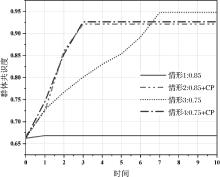
"

"
| 对象 | 0.75 | 0.85 | ||
|---|---|---|---|---|
| -1 | -1 | -1 | -1 | |
| -1 | -1 | -1 | -1 | |
| 0 | 0 | 0 | 0 | |
| -1 | -1 | -1 | 0 | |
| 1 | 1 | 1 | 1 | |
| 1 | 1 | 1 | 1 | |
| -1 | -1 | -1 | -1 | |
| 1 | 1 | 1 | 1 | |
| 0 | 0 | 0 | 0 | |
| 0 | 1 | 1 | 0 | |
| 1 | 1 | 1 | 1 | |
| -1 | -1 | -1 | 0 | |
| -1 | -1 | -1 | 0 | |
| 0 | 0 | 0 | 0 | |
| -1 | -1 | -1 | -1 | |
| 1 | 1 | 1 | 1 | |
| -1 | -1 | -1 | -1 | |
| -1 | -1 | -1 | 0 | |
| 1 | 1 | 1 | 1 | |
| 0 | 0 | 0 | 0 |
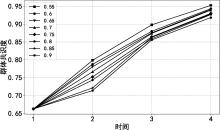
"
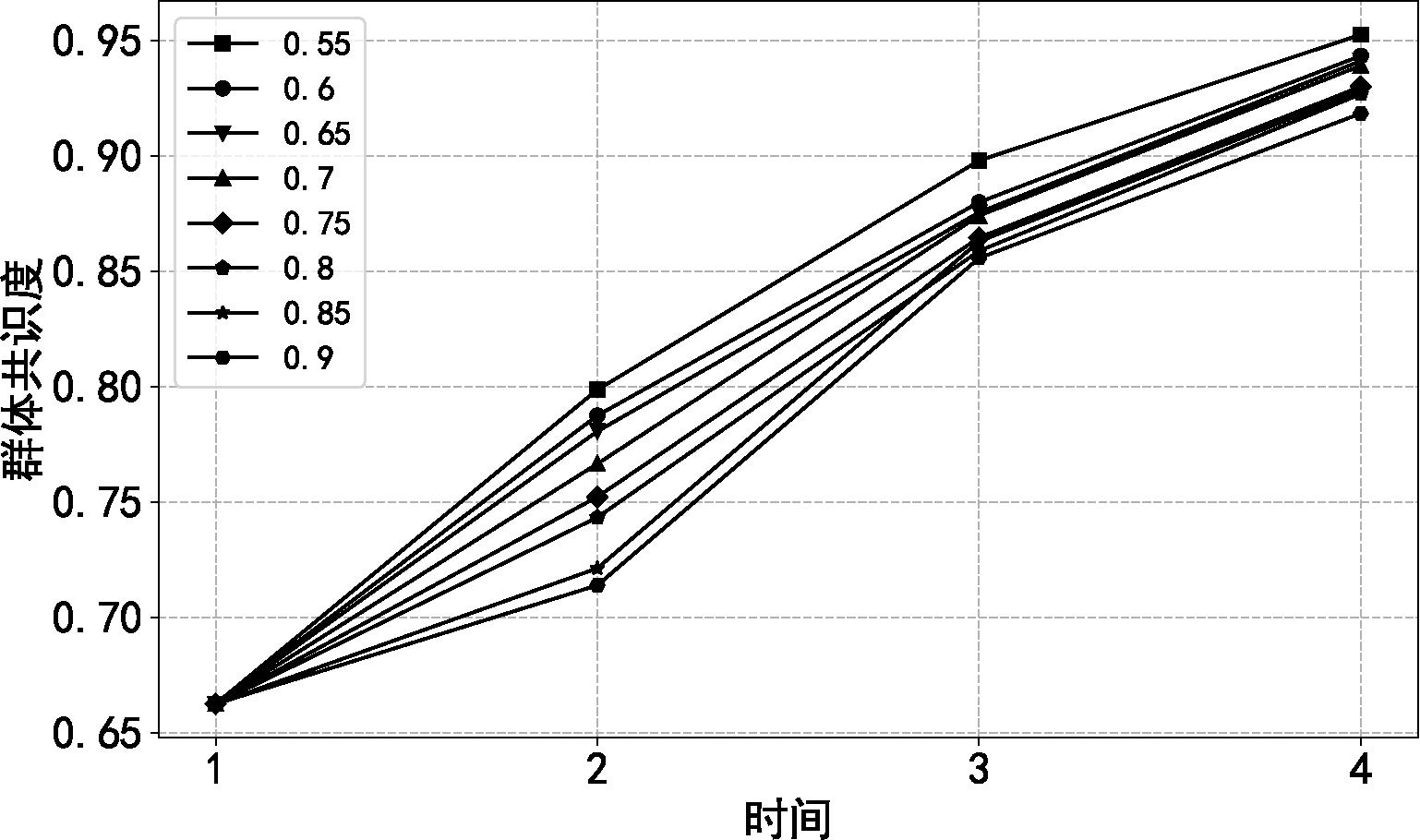
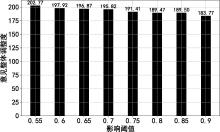
"
"
| [1] | Gou X J, Xu Z S, Liao H C. Hesitant fuzzy linguistic possibility degree-based linear assignment method for multiple criteria decision-making[J]. International Journal of Information Technology & Decision Making (IJITDM), 2019, 18(1): 35-63. |
| [2] | Liao H C, Gou X J, Xu Z S, et al. Hesitancy degree-based correlation measures for hesitant fuzzy linguistic term sets and their applications in multiple criteria decision making[J]. Information Sciences, 2020, 508: 275-292. |
| [3] | Ren Z L, Xu Z S, Wang H. Multi-criteria group decision-making based on quasi-order for dual hesitant fuzzy sets and professional degrees of decision makers[J]. Applied Soft Computing, 2018, 71: 20-35. |
| [4] | 高俊山, 谷冬元, 徐章艳, 等. 一个Pawlak粗糙集冲突分析模型的改进[J]. 中国管理科学, 2008, 16(2): 150-156. |
| Gao J S, Gu D Y, Xu Z Y, et al. New conflict analysis model based on rough set theory[J]. Chinese Journal of Management Science, 2008, 16(2): 150-156. | |
| [5] | 朱建军, 王翯华, 胡宏宇, 等. 群决策中指标冲突问题的证据推理决策模型[J]. 中国管理科学, 2012, 20(S1): 101-107. |
| Zhu J J, Wang H H, Hu H Y, et al. Evidence reasoning model of index conflict problem in group decision[J]. Chinese Journal of Management Science, 2012, 20(S1): 101-107. | |
| [6] | 张慧敏, 李小南. 基于冲突分析的犹豫模糊多属性决策[J]. 模式识别与人工智能, 2020, 33(7): 610-618. |
| Zhang H M, Li X N. Hesitant fuzzy multi-attribute decision making based on conflict analysis[J]. Pattern Recognition and Artificial Intelligence, 2020, 33(7): 610-618. | |
| [7] | Wu J, Dai L F, Chiclana F, et al. A minimum adjustment cost feedback mechanism based consensus model for group decision making under social network with distributed linguistic trust[J]. Information Fusion, 2018, 41: 232-242. |
| [8] | Wang M W, Liang D C, Xu Z S. Sequential three-way multiple attribute group decisions with individual attributes and its consensus achievement based on social influence[J]. Information Sciences, 2020, 518: 286-308. |
| [9] | Gou X J, Xu Z S, Wang X X, et al. Managing consensus reaching process with self-confident double hierarchy linguistic preference relations in group decision making[J]. Fuzzy Optimization and Decision Making, 2021, 20(1): 51-79. |
| [10] | Zhang Z, Gao Y, Li Z L. Consensus reaching for social network group decision making by considering leadership and bounded confidence[J]. Knowledge-Based Systems, 2020, 204: 106240. |
| [11] | 熊国强, 张婷, 王海涛. 情绪影响下群体性冲突的RDEU博弈模型分析[J]. 中国管理科学, 2015, 23(9): 162-170. |
| Xiong G Q, Zhang T, Wang H T. The RDEU game model analysis of group conflict influenced by emotion[J]. Chinese Journal of Management Science, 2015, 23(9): 162-170. | |
| [12] | Pessoa L, Medina L, Desfilis E. Refocusing neuroscience: Moving away from mental categories and towards complex behaviours[J]. Philosophical Transactions of the Royal Society B: Biological Sciences, 2022, 377(1844): 20200534. |
| [13] | Holley R A, Liggett T M. Ergodic theorems for weakly interacting infinite systems and the voter model[J]. The Annals of Probability, 1975,3(4): 643-663. |
| [14] | Berger R L. A necessary and sufficient condition for reaching a consensus using DeGroot’s method[J]. Journal of the American Statistical Association, 1981, 76(374): 415-418. |
| [15] | DeGroot M H. Reaching a consensus[J]. Journal of the American Statistical Association, 1974, 69(345): 118-121. |
| [16] | Friedkin N E, Johnsen E C. Social influence and opinions[J]. The Journal of Mathematical Sociology, 1990, 15(3-4): 193-206. |
| [17] | Friedkin N E, Proskurnikov A V, Tempo R, et al. Network science on belief system dynamics under logic constraints[J]. Science, 2016, 354(6310): 321-326. |
| [18] | Hegselmann R, Krause U. Opinion dynamics and bounded confidence: Models, analysis and simulation[J]. Journal of Artificial Societies and Social Simulation, 2002, 5: 8130429. |
| [19] | Hegselmann R, König S, Kurz S, et al. Optimal opinion control: The campaign problem[J]. Journal of Artificial Societies and Social Simulation, 2015, 18(3): 18. |
| [20] | Weisbuch G, Deffuant G, Amblard F, et al. Meet, discuss, and segregate![J]. Complexity, 2002, 7(3): 55-63. |
| [21] | Pawlak Z. An inquiry into anatomy of conflicts[J]. Information Sciences, 1998, 109(1-4): 65-78. |
| [22] | Yao Y Y. Three-way conflict analysis: Reformulations and extensions of the Pawlak model[J]. Knowledge-Based Systems, 2019, 180: 26-37. |
| [23] | Lang G M, Miao D Q, Cai M J. Three-way decision approaches to conflict analysis using decision-theoretic rough set theory[J]. Information Sciences, 2017, 406: 185-207. |
| [24] | Lang G M, Miao D Q, Fujita H. Three-way group conflict analysis based on Pythagorean fuzzy set theory[J]. IEEE Transactions on Fuzzy Systems, 2020, 28(3): 447-461. |
| [25] | Sun B Z, Chen X T, Zhang L Y, et al. Three-way decision making approach to conflict analysis and resolution using probabilistic rough set over two universes[J]. Information Sciences, 2020, 507: 809-822. |
| [26] | Yao Y Y. Symbols-Meaning-Value (SMV) space as a basis for a conceptual model of data science[J]. International Journal of Approximate Reasoning, 2022, 144: 113-128. |
| [27] | Nanay B. Perception, cognition, action[J].Oxford Bibliographies,2016,DOI:10.1093/OBO/9780195396577-0326 . |
| [28] | Liang D C, Yi B C, Xu Z S. Opinion dynamics based on infectious disease transmission model in the non-connected context of Pythagorean fuzzy trust relationship[J]. Journal of the Operational Research Society, 2021, 72(12): 2783-2803. |
| [29] | Yao Y Y. Three-way decisions with probabilistic rough sets[J]. Information Sciences, 2010, 180(3): 341-353. |
| [30] | Yao Y Y. Three-way decision and granular computing[J]. International Journal of Approximate Reasoning, 2018, 103: 107-123. |
| Viewed | ||||||
|
Full text |
|
|||||
|
Abstract |
|
|||||
|
||
