
主管:中国科学院
主办:中国优选法统筹法与经济数学研究会
中国科学院科技战略咨询研究院
主办:中国优选法统筹法与经济数学研究会
中国科学院科技战略咨询研究院

Chinese Journal of Management Science ›› 2026, Vol. 34 ›› Issue (10): 14-27.doi: 10.16381/j.cnki.issn1003-207x.2024.1765
Previous Articles Next Articles
Xuan Zhang1,2, Yujie Wei1, Fengzhang Guo1, Xusheng Sun1, Gang Wang1,2( )
)
Received:2024-09-30
Revised:2025-01-07
Online:2026-10-25
Published:2026-10-09
Contact:
Gang Wang
E-mail:wgedison@gmail.com
CLC Number:
Xuan Zhang,Yujie Wei,Fengzhang Guo, et al. Financial Statement Fraud Identification Model for Listed Companies Based on Multimodal Graph Representation Deep Learning[J]. Chinese Journal of Management Science, 2026, 34(10): 14-27.
"
"

"
| 方法 | AUC | Type I | Type II | |||
|---|---|---|---|---|---|---|
| Mean | Std | Mean | Std | Mean | Std | |
| LR | 0.5266 | 0.0533 | 0.2636 | 0.1943 | 0.4734 | 0.3007 |
| SVM | 0.5675 | 0.0087 | 0.1544 | 0.0154 | 0.4325 | 0.0236 |
| Bagging | 0.5718 | 0.0085 | 0.1370 | 0.0248 | 0.4282 | 0.0313 |
| XGBoost | 0.5821 | 0.0034 | 0.1211 | 0.0195 | 0.4137 | 0.0186 |
| RF | 0.6267 | 0.0108 | 0.1433 | 0.0230 | 0.3733 | 0.0340 |
| MLP | 0.6681 | 0.0079 | 0.2578 | 0.0167 | 0.4712 | 0.0150 |
| SAE | 0.7044 | 0.0023 | 0.1685 | 0.0084 | 0.4302 | 0.0105 |
| DLM_MGR | 0.7720 | 0.0158 | 0.1553 | 0.0122 | 0.3166 | 0.0397 |
"
| 方法 | AUC | Type I | Type II | |||
|---|---|---|---|---|---|---|
| Mean | Std | Mean | Std | Mean | Std | |
| LR | 0.5050 | 0.0069 | 0.2521 | 0.0388 | 0.4950 | 0.0402 |
| SVM | 0.5186 | 0.0077 | 0.2541 | 0.0339 | 0.4814 | 0.0267 |
| Bagging | 0.5276 | 0.0098 | 0.1641 | 0.0254 | 0.4724 | 0.0211 |
| XGBoost | 0.5322 | 0.0075 | 0.1699 | 0.0130 | 0.4918 | 0.0193 |
| RF | 0.5761 | 0.0106 | 0.1606 | 0.0211 | 0.4239 | 0.0250 |
| MLP | 0.6223 | 0.0067 | 0.2884 | 0.0152 | 0.5165 | 0.0148 |
| LSTM | 0.6727 | 0.0026 | 0.2106 | 0.0069 | 0.4446 | 0.0065 |
| Transformer | 0.6925 | 0.0217 | 0.2035 | 0.0197 | 0.4355 | 0.0109 |
| DLM_MGR | 0.7025 | 0.0151 | 0.2289 | 0.0210 | 0.3935 | 0.0490 |
"
| 方法 | AUC | Type I | Type II | |||
|---|---|---|---|---|---|---|
| Mean | Std | Mean | Std | Mean | Std | |
| LR | 0.5699 | 0.0099 | 0.1607 | 0.0202 | 0.4301 | 0.0217 |
| SVM | 0.5758 | 0.0043 | 0.1449 | 0.0191 | 0.4299 | 0.0190 |
| Bagging | 0.5900 | 0.0062 | 0.1322 | 0.0158 | 0.4101 | 0.0243 |
| XGBoost | 0.5842 | 0.0095 | 0.1507 | 0.0057 | 0.4058 | 0.0179 |
| RF | 0.6548 | 0.0036 | 0.1347 | 0.0128 | 0.3452 | 0.0106 |
| MLP | 0.7414 | 0.0048 | 0.2109 | 0.0167 | 0.4318 | 0.0138 |
| FSAE-TLSTM | 0.7797 | 0.0167 | 0.1592 | 0.0098 | 0.2977 | 0.0263 |
| FSAE-Transformer | 0.7955 | 0.0115 | 0.1558 | 0.0120 | 0.2795 | 0.0348 |
| FT-Cross-attention | 0.8067 | 0.0428 | 0.1532 | 0.0245 | 0.2763 | 0.0423 |
| DLM_MGR | 0.8399 | 0.0055 | 0.1211 | 0.0129 | 0.1963 | 0.0173 |
"
| 方法 | AUC | Type I | Type II | |||
|---|---|---|---|---|---|---|
| Mean | Std | Mean | Std | Mean | Std | |
| LR | 0.5799 | 0.0059 | 0.1575 | 0.0248 | 0.4201 | 0.0267 |
| SVM | 0.5966 | 0.0107 | 0.1174 | 0.2504 | 0.4034 | 0.2406 |
| Bagging | 0.6041 | 0.0060 | 0.1146 | 0.0122 | 0.3959 | 0.0182 |
| XGBoost | 0.6018 | 0.0114 | 0.1043 | 0.0183 | 0.3982 | 0.0241 |
| RF | 0.6285 | 0.0078 | 0.1379 | 0.0304 | 0.3715 | 0.0321 |
| MLP | 0.6633 | 0.0171 | 0.1810 | 0.0209 | 0.4439 | 0.0190 |
| FSAE-TLSTM | 0.7008 | 0.0017 | 0.1687 | 0.0048 | 0.3456 | 0.0047 |
| FSAE-Transformer | 0.7128 | 0.0030 | 0.1523 | 0.0053 | 0.3180 | 0.0078 |
| FT-Cross-attention | 0.7286 | 0.0019 | 0.1449 | 0.0039 | 0.3071 | 0.0041 |
| DLM_MGR | 0.7935 | 0.0067 | 0.1594 | 0.0219 | 0.2160 | 0.0251 |
"
| 方法 | AUC | Type I | Type II | |||
|---|---|---|---|---|---|---|
| Mean | Std | Mean | Std | Mean | Std | |
| LR | 0.5653 | 0.0054 | 0.1609 | 0.0330 | 0.4347 | 0.0331 |
| SVM | 0.5786 | 0.0051 | 0.1354 | 0.0311 | 0.4214 | 0.0291 |
| Bagging | 0.5809 | 0.0199 | 0.1402 | 0.0368 | 0.4191 | 0.0481 |
| XGBoost | 0.5936 | 0.0054 | 0.1165 | 0.0356 | 0.4064 | 0.0353 |
| RF | 0.6162 | 0.0049 | 0.1461 | 0.0256 | 0.3838 | 0.0294 |
| MLP | 0.6236 | 0.0140 | 0.2293 | 0.0351 | 0.4505 | 0.0285 |
| FSAE-TLSTM | 0.6802 | 0.0002 | 0.1834 | 0.0060 | 0.3403 | 0.0059 |
| FSAE-Transformer | 0.7023 | 0.0017 | 0.1723 | 0.0088 | 0.3211 | 0.0077 |
| FT-Cross-attention | 0.7165 | 0.0002 | 0.1644 | 0.0064 | 0.3133 | 0.0062 |
| DLM_MGR | 0.7671 | 0.0073 | 0.1607 | 0.0266 | 0.2493 | 0.0312 |
"
| 方法 | 财务图表示 | 文本图表示 | 融合模块 | AUC |
|---|---|---|---|---|
| SWC | × | × | × | 0.5719 |
| FWC | √ | × | × | 0.7886 |
| STC | × | √ | × | 0.7106 |
| SWM | × | × | √ | 0.6471 |
| FTC | √ | √ | × | 0.8094 |
| FWM | √ | × | √ | 0.7897 |
| STM | × | √ | √ | 0.7116 |
| DLM_MGR | √ | √ | √ | 0.8399 |
"
"

"
"
"
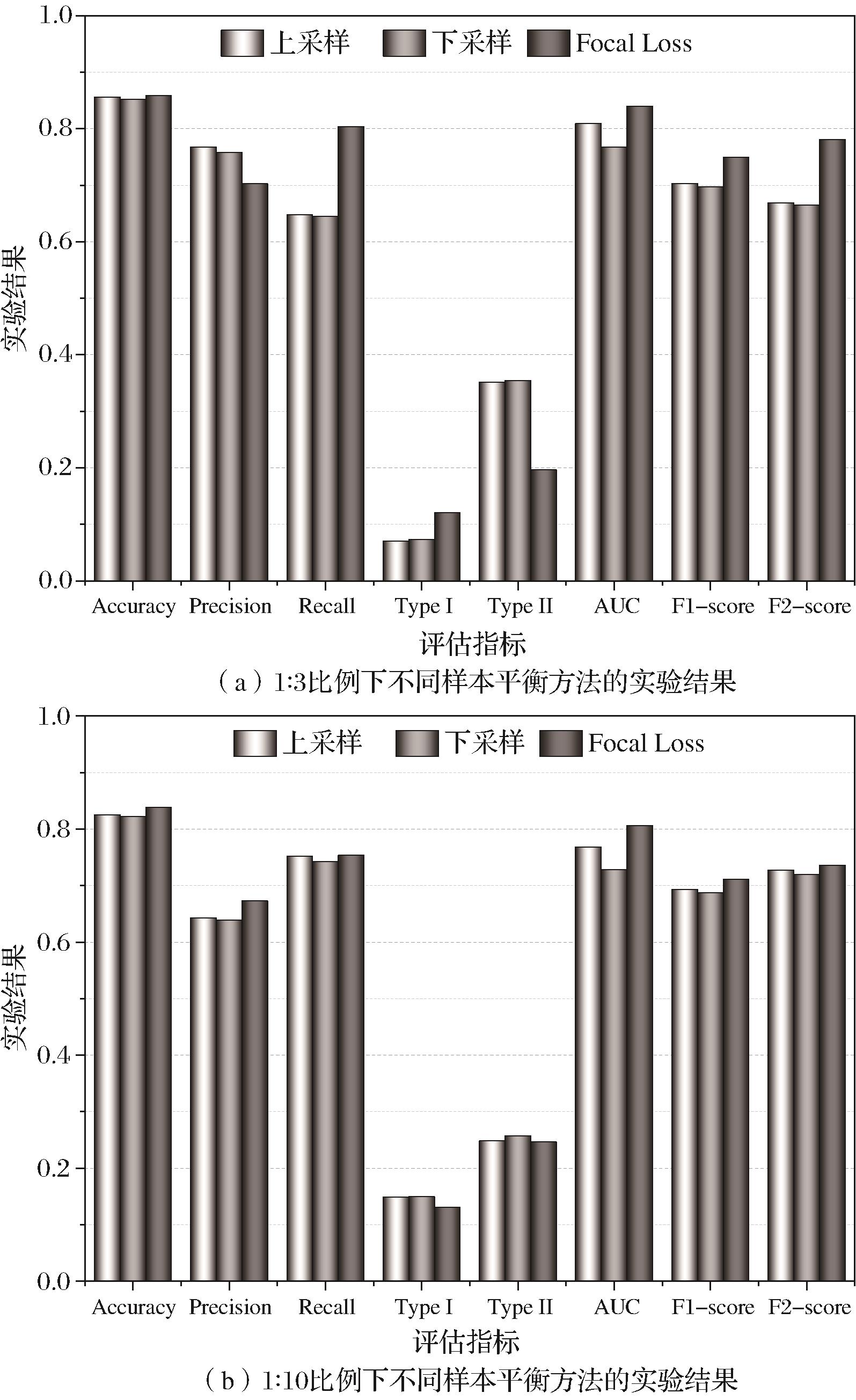
"
| 方法 | 时间复杂度 | 空间复杂度 | ||
|---|---|---|---|---|
| 训练时间 | 测试时间 | FLOPs | 参数 | |
| MLP | 1.2987 s | 0.3222 s | 120.064K | 120.578K |
| FSAE-TLSTM | 1.5178 s | 0.3228 s | 119.722M | 852.150K |
| FSAE-Transformer | 3.1115 s | 0.4015 s | 318.448M | 1.483M |
| FT-Cross-attention | 1.4556 s | 0.3117 s | 10.293M | 424.374K |
| DLM_MGR | 1.5077 s | 0.2455 s | 10.359M | 489.910K |
| [1] | 叶钦华, 叶凡, 黄世忠. 财务舞弊识别框架构建——基于会计信息系统论及大数据视角[J]. 会计研究, 2022(3): 3-16. |
| Ye Q H, Ye F, Huang S Z. Financial fraud detection framework building: From the perspective of accounting information system theory and big data[J]. Accounting Research, 2022(3): 3-16. | |
| [2] | 李建平, 孙灏, 常闫芃, 等. 考虑审计要素多重语义关联的财务欺诈识别[J]. 管理科学学报, 2024, 27(3): 58-70. |
| Li J P, Sun H, Chang Y P, et al. Financial statement fraud identification considering the multiple-dimensional semantic associations of auditing elements[J]. Journal of Management Sciences in China, 2024, 27(3): 58-70. | |
| [3] | 李建平, 徐伟宣, 吴登生. 风险科学: 一门新的跨学科科学[J]. 中国管理科学, 2025, 33(1): 98-110. |
| Li J P, Xu W X, Wu D S. Risk science: A new interdisciplinary science[J]. Chinese Journal of Management Science, 2025, 33(1): 98-110. | |
| [4] | Lou Y I, Wang M L. Fraud risk factor of the fraud triangle assessing the likelihood of fraudulent financial reporting[J]. Journal of Business & Economics Research (JBER), 2009, 7(2): 61-78. |
| [5] | Xu X, Xiong F, An Z. Using machine learning to predict corporate fraud: Evidence based on the GONE framework[J]. Journal of Business Ethics, 2023, 186(1): 137-158. |
| [6] | Persons O S. Using financial statement data to identify factors associated with fraudulent financial reporting[J]. Journal of Applied Business Research (JABR), 1995, 11(3): 38-46. |
| [7] | 刘云菁, 伍彬, 张敏. 上市公司财务舞弊识别模型设计及其应用研究——基于新兴机器学习算法[J]. 数量经济技术经济研究, 2022, 39(7): 152-175. |
| Liu Y J, Wu B, Zhang M. Financial fraud recognition model and application[J]. The Journal of Quantitative & Technical Economics, 2022, 39(7): 152-175. | |
| [8] | Humpherys S L, Moffitt K C, Burns M B, et al. Identification of fraudulent financial statements using linguistic credibility analysis[J]. Decision Support Systems, 2011, 50(3): 585-594. |
| [9] | Minhas S, Hussain A. From spin to swindle: Identifying falsification in financial text[J]. Cognitive Computation, 2016, 8(4): 729-745. |
| [10] | Baltrušaitis T, Ahuja C, Morency L P. Multimodal machine learning: A survey and taxonomy[J]. IEEE Transactions on Pattern Analysis and Machine Intelligence, 2019, 41(2): 423-443. |
| [11] | Lahat D, Adali T, Jutten C. Multimodal data fusion: An overview of methods, challenges, and prospects[J]. Proceedings of the IEEE, 2015, 103(9): 1449-1477. |
| [12] | Ronzani M, Gatzweiler M K. The lure of the visual: Multimodality, simplification, and performance measurement visualizations in a megaproject[J]. Accounting, Organizations and Society, 2022, 97: 101296. |
| [13] | Cecchini M, Aytug H, Koehler G J, et al. Making words work: Using financial text as a predictor of financial events[J]. Decision Support Systems, 2010, 50(1): 164-175. |
| [14] | Hajek P, Henriques R. Mining corporate annual reports for intelligent detection of financial statement fraud–A comparative study of machine learning methods[J]. Knowledge-Based Systems, 2017, 128: 139-152. |
| [15] | Spathis C T. Detecting false financial statements using published data: Some evidence from Greece[J]. Managerial Auditing Journal, 2002, 17(4): 179-191. |
| [16] | 周卫华, 翟晓风, 谭皓威. 基于XGBoost的上市公司财务舞弊预测模型研究[J]. 数量经济技术经济研究, 2022, 39(7): 176-196. |
| Zhou W H, Zhai X F, Tan H W. Research on financial frauds prediction model of Chinese public companies with XGBoost[J]. Journal of Quantitative & Technological Economics, 2022, 39(7): 176-196. | |
| [17] | Craja P, Kim A, Lessmann S. Deep learning for detecting financial statement fraud[J]. Decision Support Systems, 2020, 139: 113421. |
| [18] | Wang G, Ma J, Chen G. Attentive statement fraud detection: Distinguishing multimodal financial data with fine-grained attention[J]. Decision Support Systems, 2023, 167: 113913. |
| [19] | Smiti S, Soui M. Bankruptcy prediction using deep learning approach based on borderline SMOTE[J]. Information Systems Frontiers, 2020, 22(5): 1067-1083. |
| [20] | Sun Q, Ge Z. Gated stacked target-related autoencoder: A novel deep feature extraction and layerwise ensemble method for industrial soft sensor application[J]. IEEE Transactions on Cybernetics, 2022, 52(5): 3457-3468. |
| [21] | Xiao Z, Xing H, Qu R, et al. Densely knowledge-aware network for multivariate time series classification[J]. IEEE Transactions on Systems, Man, and Cybernetics: Systems, 2024, 54(4): 2192-2204. |
| [22] | Singhal A. Modern information retrieval: A brief overview[J]. Bulletin of the IEEE Computer Society Technical Committee on Data Engineering, 2001, 24(4): 35-43. |
| [23] | 张忠良, 费秦君, 陈愉予, 等. 基于BERT模型和动态集成选择的多分类文本情感识别研究[J]. 中国管理科学, 2024, 32(6): 140-150. |
| Zhang Z L, Fei Q J, Chen Y Y, et al. Researchon multi-class sentiment classification based on BERT and dynamic ensemble selection[J]. Chinese Journal of Management Science, 2024, 32(6): 140-150. | |
| [24] | Huang L, Ma D, Li S, et al. Text level graph neural network for text classification[C]//Proceedings of the 2019 Conference on Empirical Methods in Natural Language Processing and the 9th International Joint Conference on Natural Language Processing (EMNLP-IJCNLP), Hong Kong, China, November 3-7 , ACL,2019: 3444-3450. |
| [25] | 魏伟, 孟祥主, 郭崇慧. 考虑文本空间结构的单篇文本特征词排序方法[J]. 系统工程理论与实践, 2020, 40(5): 1293-1303. |
| Wei W, Meng X Z, Guo C H. A word ranking method considering the text space structure for a single document[J]. Systems Engineering-Theory & Practice, 2020, 40(5): 1293-1303. | |
| [26] | Fang Q, Wang Z. Cross-modality attentive feature fusion for object detection in multispectral remote sensing imagery[J]. Pattern Recognition, 2022, 130: 108786. |
| [27] | Yuan F, Li K, Wang C, et al. A lightweight network for smoke semantic segmentation[J]. Pattern Recognition, 2023, 137: 109289. |
| [28] | Liu T, Luo W, Ma L, et al. Coupled network for robust pedestrian detection with gated multi-layer feature extraction and deformable occlusion handling[J]. IEEE Transactions on Image Processing, 2021, 30: 754-766. |
| [29] | 杨莲, 石宝峰. 基于Focal Loss修正交叉熵损失函数的信用风险评价模型及实证[J]. 中国管理科学, 2022, 30(5): 65-75. |
| Yang L, Shi B F. Credit risk evaluation model and empirical research based on focal loss modified cross—Entropy loss function[J]. Chinese Journal of Management Science, 2022, 30(5): 65-75. | |
| [30] | Beasley M S. An empirical analysis of the relation between the board of director composition and financial statement fraud[J]. The Accounting Review, 1996, 71(4): 443-465. |
| [31] | 洪文洲, 王旭霞, 冯海旗. 基于Logistic回归模型的上市公司财务报告舞弊识别研究[J]. 中国管理科学, 2014, 22(S1): 351-356. |
| Hong W Z, Wang X X, Feng H Q. Research on the financial report fraud detection of listed companies based on logistic regression model[J]. Chinese Journal of Management Science, 2014, 22(S1): 351-356. | |
| [32] | Cai S, Xie Z. Explainable fraud detection of financial statement data driven by two-layer knowledge graph[J]. Expert Systems with Applications, 2024, 246: 123126. |
| [33] | Ravisankar P, Ravi V, Raghava Rao G, et al. Detection of financial statement fraud and feature selection using data mining techniques[J]. Decision Support Systems, 2011, 50(2): 491-500. |
| [34] | Wang R, Asghari V, Hsu S C, et al. Detecting corporate misconduct through random forest in China’s construction industry[J]. Journal of Cleaner Production, 2020, 268: 122266. |
| [35] | Liu R, Huang J, Zhang Z. Tracking disclosure change trajectories for financial fraud detection[J]. Production and Operations Management, 2023, 32(2): 584-602. |
| [36] | Matin R, Hansen C, Hansen C, et al. Predicting distresses using deep learning of text segments in annual reports[J]. Expert Systems with Applications, 2019, 132: 199-208. |
| [37] | Suzuki M, Sakaji H, Hirano M, et al. Constructing and analyzing domain-specific language model for financial text mining[J]. Information Processing & Management, 2023, 60(2): 103194. |
| [38] | Zhu P, Li Y, Hu Y, et al. MCI-GRU: Stock prediction model based on multi-head cross-attention and improved GRU[J]. Neurocomputing, 2025, 638: 130168. |
| [39] | 黄世忠, 叶钦华, 徐珊, 等. 2010—2019年中国上市公司财务舞弊分析[J].财会月刊,2020,41(14): 153-160. |
| Huang S Z, Ye Q H, Xu S, et al. Analysis of financial fraud of listed companies in China from 2010 to 2019[J]. Finance and Accounting Monthly, 2020, 41(14): 153-160. |
| [1] | Weilan Suo, Wenjie Xu, Xiaolei Sun. Research on Modeling the Failure Risk of Urban Critical Infrastructures under Multi-hazard Coupling Scenarios [J]. Chinese Journal of Management Science, 2026, 34(7): 166-176. |
| [2] | Yidong Chai, Haoxin Liu, Yuanchun Jiang, Yezheng Liu. Graph Neural Network Recommendation System Adversarial Attack Method Based on Importance Maximization and Community Partition [J]. Chinese Journal of Management Science, 2025, 33(2): 95-104. |
| [3] | HU Chunhua, DENG Ao, TONG Xiaoqin, MIAO He, WANG Zongrun. A Graph Neural Network Recommendation Study Combining Trust and Reputation in Social E-commerce [J]. Chinese Journal of Management Science, 2021, 29(10): 202-212. |
| Viewed | ||||||
|
Full text |
|
|||||
|
Abstract |
|
|||||
|
||
