
主管:中国科学院
主办:中国优选法统筹法与经济数学研究会
中国科学院科技战略咨询研究院
主办:中国优选法统筹法与经济数学研究会
中国科学院科技战略咨询研究院

Chinese Journal of Management Science ›› 2026, Vol. 34 ›› Issue (6): 202-214.doi: 10.16381/j.cnki.issn1003-207x.2024.1529
Previous Articles Next Articles
Yingying Chen1,4, He Luo1,4( ), Xiangcai Xiao2, Zhiming Cai3
Received:2024-09-03
Revised:2024-11-04
Online:2026-06-25
Published:2026-05-22
Contact:
He Luo
E-mail:luohe@hfut.edu.cn
CLC Number:
Yingying Chen,He Luo,Xiangcai Xiao, et al. Research on Integrated Production and Maritime Transportation Scheduling Problem with Batch Delivery Limits[J]. Chinese Journal of Management Science, 2026, 34(6): 202-214.
"

"
| 符号 | 定义 |
|---|---|
| 集合 | |
| 参数 | |
| 如果订单 | |
| 订单 | |
| 订单 | |
| 运输批次 | |
| 第 | |
| 第 | |
| 装载运输批次 | |
| 订单 | |
| 订单 | |
| 订单 | |
| 机器装置由生产订单 | |
| 两个较大的正数 | |
| 决策变量 | |
| 如果订单 | |
| 订单 | |
| 如果运输批次 | |
| 如果运输批次 | |
"
"
"
"
"
| 参数 | 分布特征 |
|---|---|
| U(0,1) | |
| U(200,800) | |
| U(1.5,6.5) | |
| U(3,6) | |
| U(1800,2400) | |
| U(3500,4500) | |
| 250 | |
| U(20,31)-U(0,2) | |
| U(20,31)+U(0,2) | |
| U(0.1,0.15) | |
| 100 | |
| 100 |
"
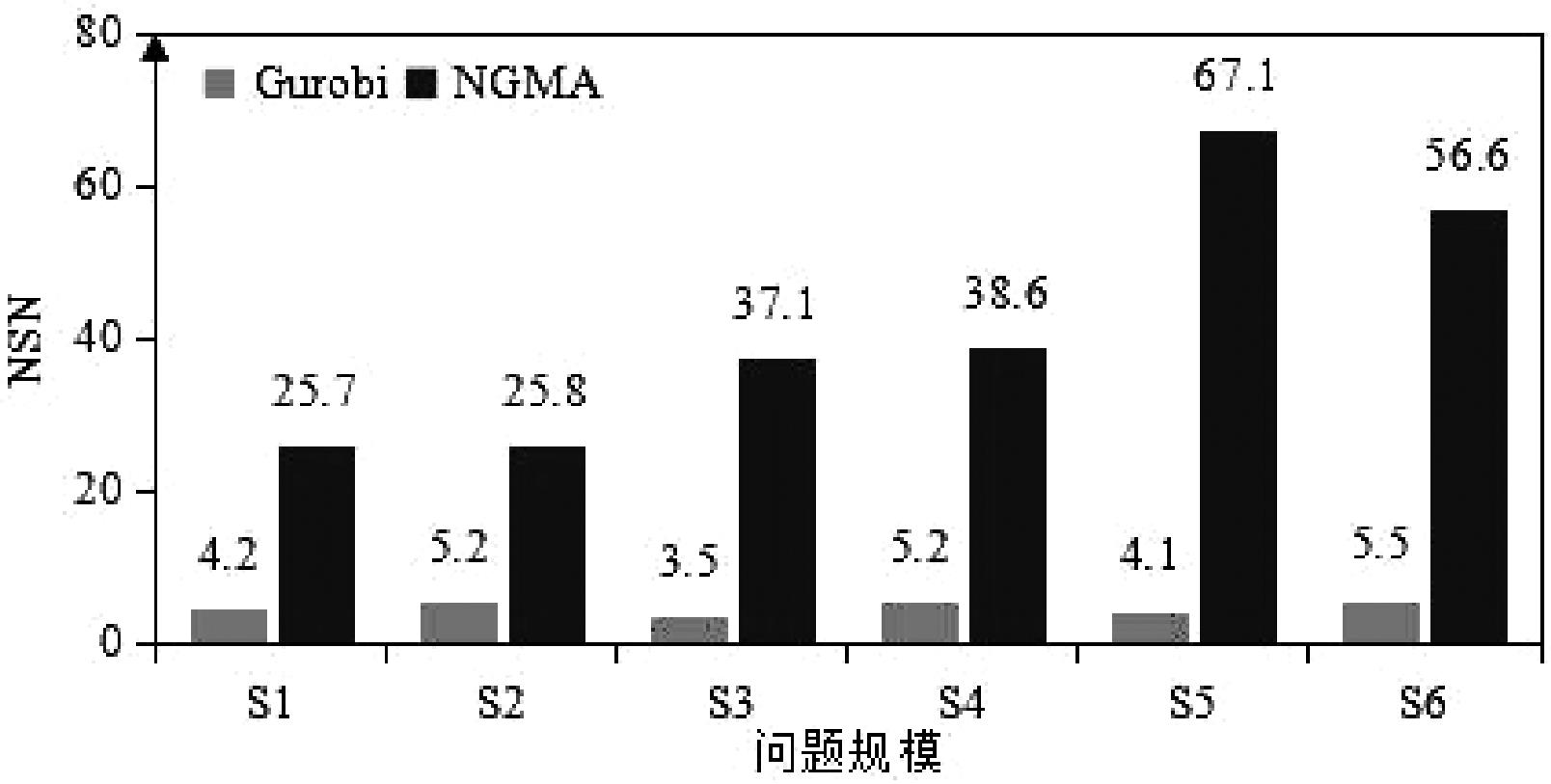
"
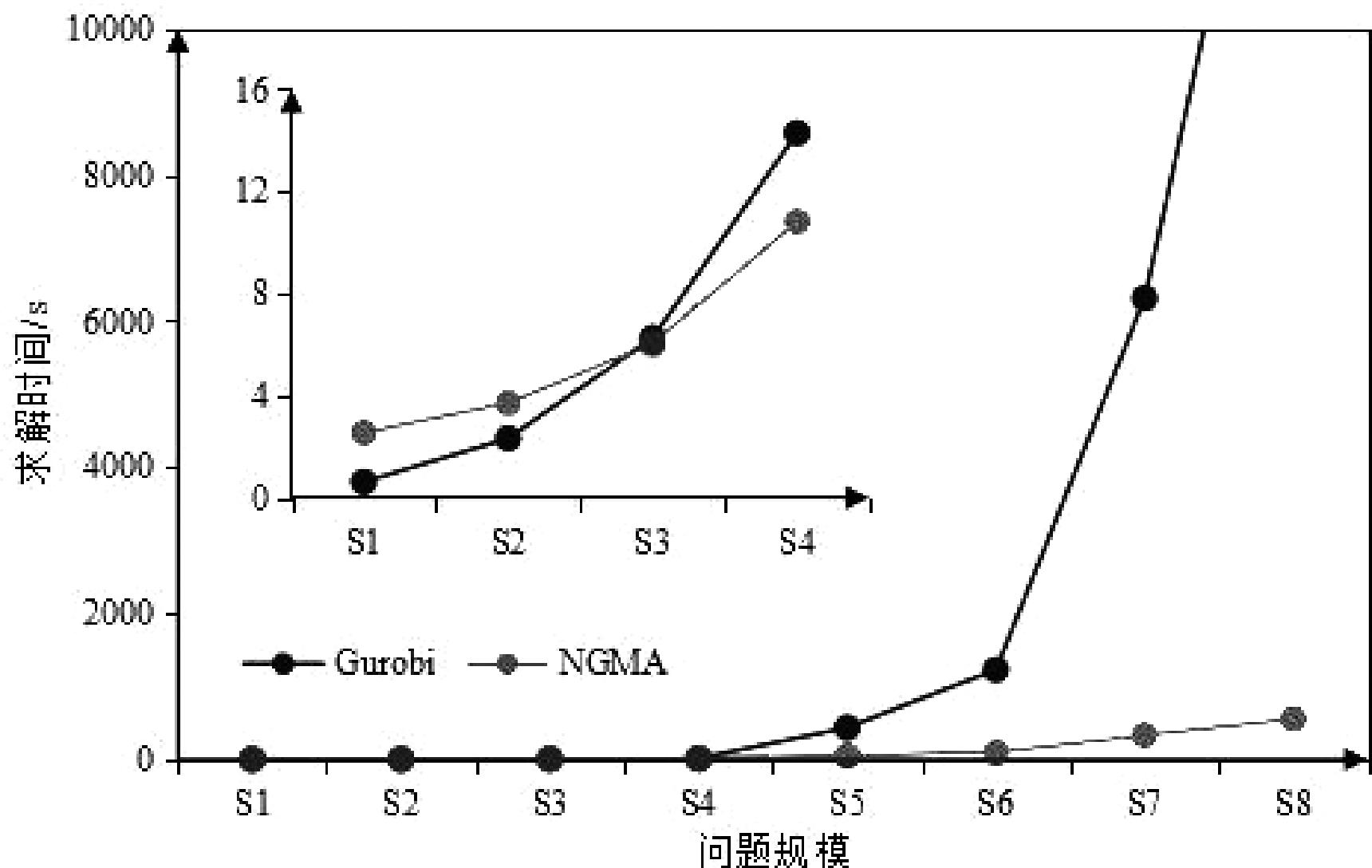
"
"
| 参数 | NGMA | NSGA-II | RVEA | AWGA |
|---|---|---|---|---|
| 种群规模 | 150 | 200 | 200 | 200 |
| 迭代次数 | 60 | 100 | 100 | 100 |
| 交叉概率 | 0.8 | 0.2 | 0.8 | 0.8 |
| 变异概率 | 0.2 | 0.2 | 0.2 | 0.6 |
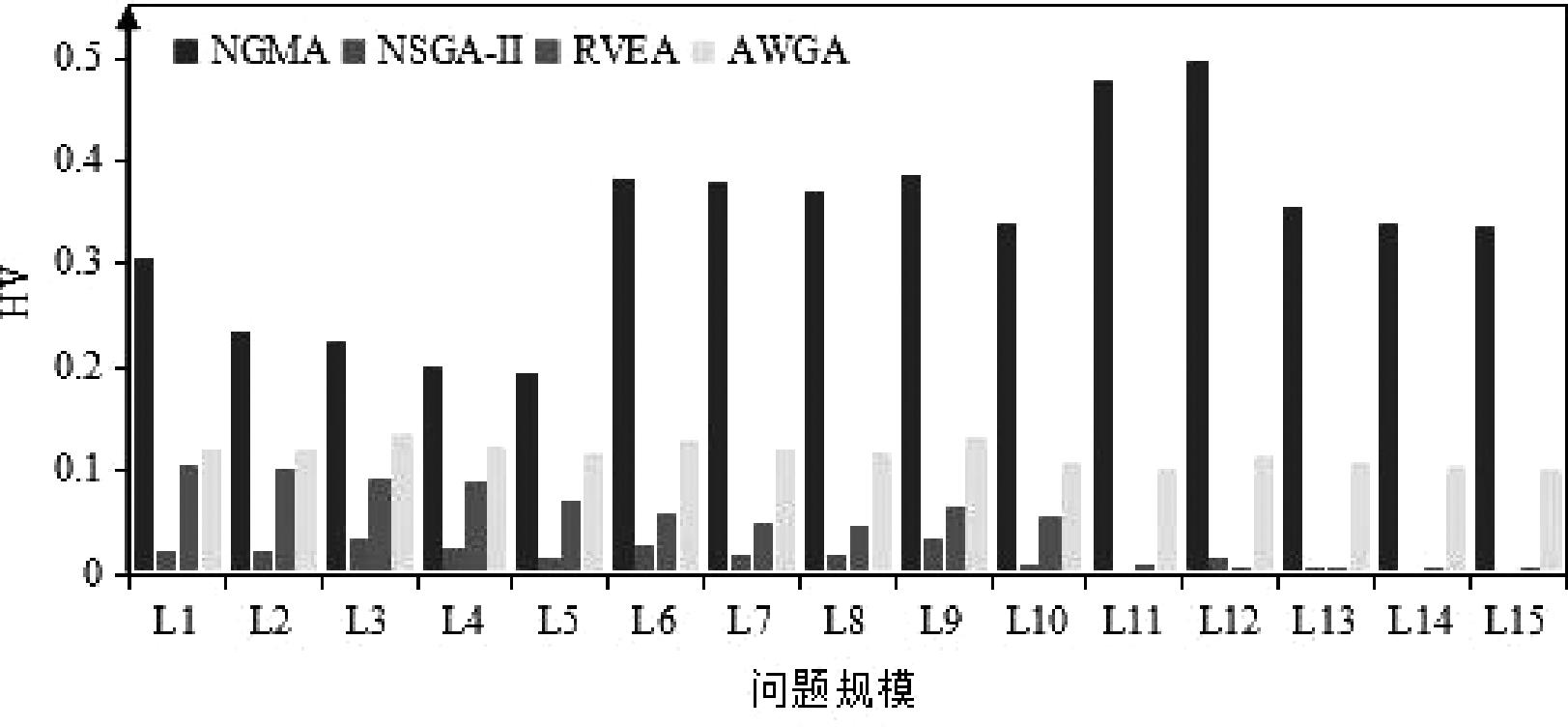
"
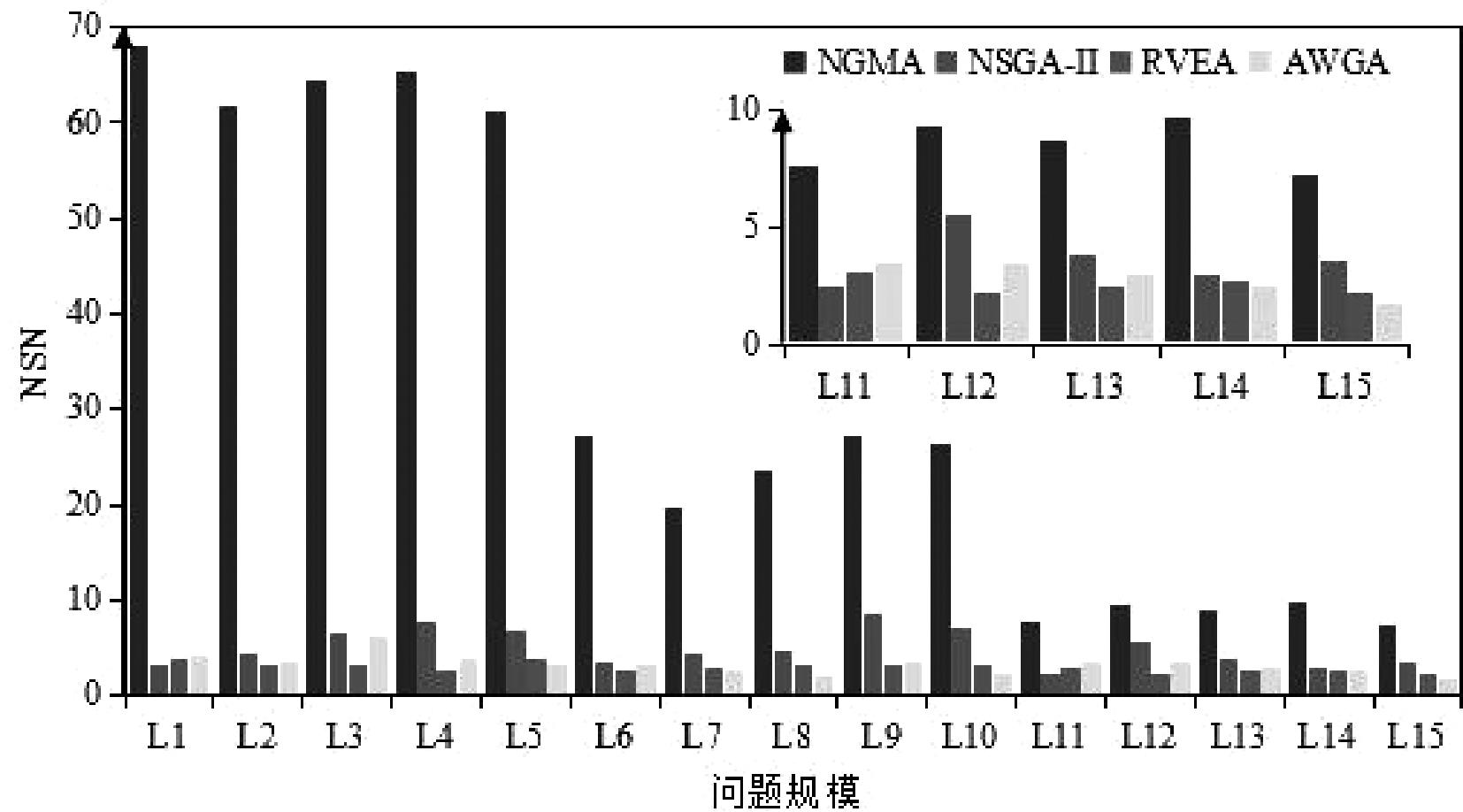
"
"
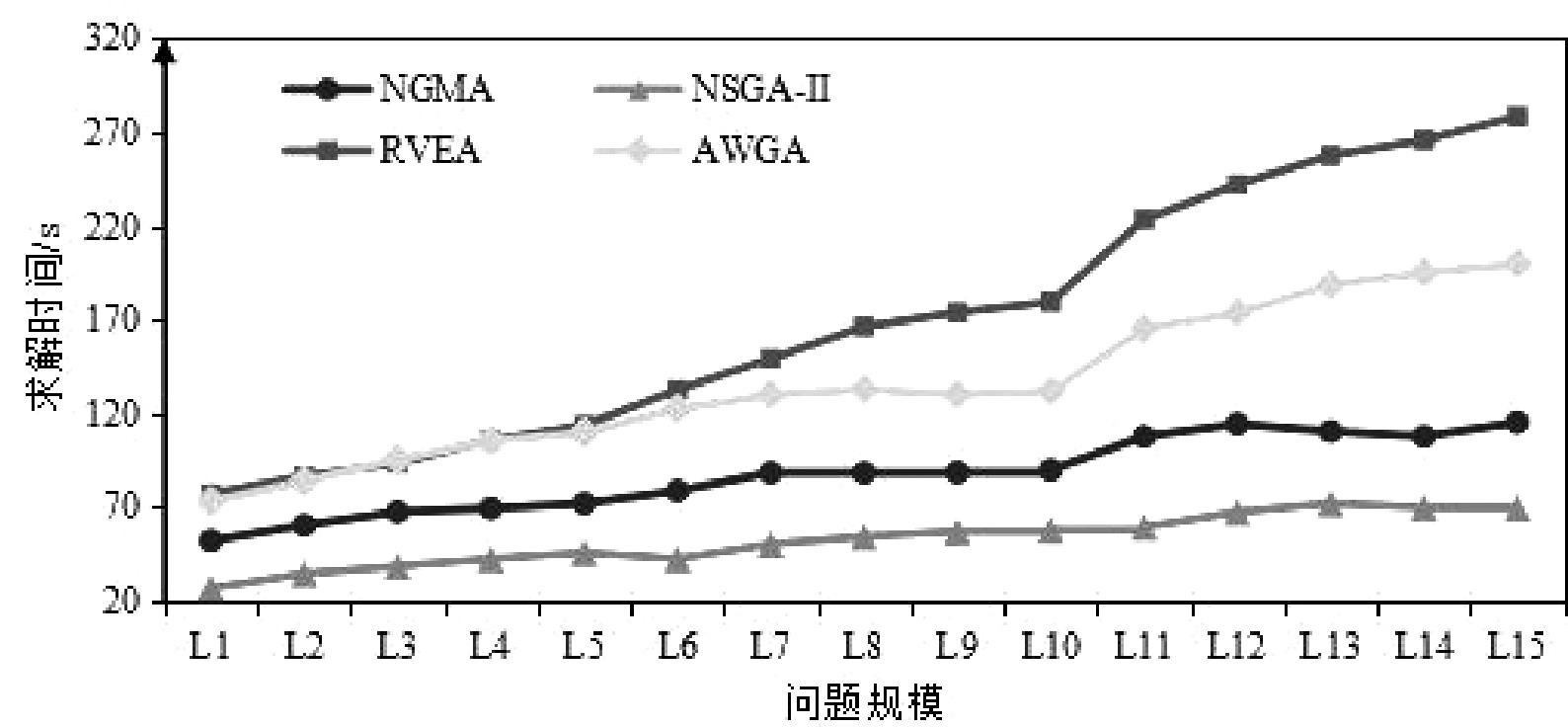
"
| 规模 | HV指标 | NSN指标 | 求解时间 | ||||||||||
|---|---|---|---|---|---|---|---|---|---|---|---|---|---|
NG MA | NGMA-IP | NGMA-SE | NGMA-PA | NG MA | NGMA-IP | NGMA-SE | NGMA-PA | NG MA | NGMA-IP | NGMA-SE | NGMA-PA | ||
| L1 | 2.82 | 1.72 | 2.80 | 1.94 | 74.48 | 36.00 | 5.84 | 65.56 | 20.22 | 17.88 | 18.4 | 15.97 | |
| L2 | 2.30 | 1.53 | 2.24 | 2.08 | 70.76 | 14.68 | 4.80 | 73.16 | 23.01 | 20.10 | 22.16 | 18.03 | |
| L3 | 2.02 | 1.27 | 2.03 | 1.61 | 70.20 | 15.32 | 5.64 | 69.32 | 25.00 | 22.52 | 24.88 | 20.24 | |
| L4 | 1.11 | 0.83 | 1.06 | 1.03 | 65.88 | 9.92 | 3.68 | 73.84 | 27.74 | 24.78 | 27.62 | 22.21 | |
| L5 | 0.79 | 0.54 | 0.77 | 0.7 | 80.00 | 11.12 | 8.36 | 76.24 | 30.37 | 26.93 | 30.29 | 24.23 | |
| L6 | 1.65 | 1.34 | 1.63 | 1.59 | 12.52 | 4.44 | 4.76 | 10.64 | 43.11 | 39.78 | 40.35 | 35.60 | |
| L7 | 1.62 | 1.00 | 1.69 | 1.50 | 11.84 | 4.08 | 4.88 | 10.36 | 46.16 | 43.63 | 45.93 | 39.04 | |
| L8 | 1.57 | 0.87 | 1.31 | 1.51 | 16.32 | 3.56 | 4.40 | 18.44 | 50.80 | 47.33 | 50.69 | 42.38 | |
| L9 | 1.08 | 0.72 | 1.03 | 1.03 | 15.32 | 3.96 | 4.80 | 15.88 | 54.37 | 50.93 | 54.66 | 45.55 | |
| L10 | 0.57 | 0.34 | 0.47 | 0.56 | 12.20 | 3.96 | 4.28 | 9.00 | 58.23 | 54.65 | 58.59 | 48.78 | |
| L11 | 1.09 | 0.86 | 0.92 | 1.08 | 4.28 | 2.72 | 2.88 | 3.76 | 74.24 | 72.87 | 73.47 | 65.39 | |
| L12 | 1.31 | 0.83 | 1.13 | 1.18 | 6.32 | 3.56 | 5.08 | 5.56 | 80.48 | 78.08 | 80.92 | 69.87 | |
| L13 | 0.95 | 0.56 | 0.83 | 0.91 | 5.28 | 2.80 | 4.16 | 5.16 | 85.34 | 82.97 | 86.45 | 74.45 | |
| L14 | 0.65 | 0.36 | 0.63 | 0.66 | 6.28 | 3.56 | 4.84 | 6.56 | 90.92 | 87.97 | 92.17 | 78.89 | |
| L15 | 0.45 | 0.17 | 0.33 | 0.42 | 6.32 | 3.48 | 4.08 | 5.96 | 96.67 | 93.16 | 98.00 | 83.52 | |
"
| 30 | 3 | 0 | 15.39 | 69.23 |
| 20 | 15.76 | 57.14 | ||
| 40 | 16.12 | 60.71 | ||
| 60 | 16.45 | 54.17 | ||
| 30 | 6 | 0 | 12.17 | 58.33 |
| 20 | 13.46 | 27.27 | ||
| 40 | 15.78 | 44.44 | ||
| 60 | 16.01 | 98.63 | ||
| 30 | 9 | 0 | 21.68 | 31.82 |
| 20 | 22.45 | 68.75 | ||
| 40 | 24.97 | 52.17 | ||
| 60 | 27.55 | 57.69 | ||
| 30 | 12 | 0 | 25.44 | 27.78 |
| 20 | 26.12 | 23.53 | ||
| 40 | 26.78 | 57.89 | ||
| 60 | 28.53 | 87.53 | ||
| 30 | 15 | 0 | 27.61 | 50.75 |
| 20 | 27.98 | 33.33 | ||
| 40 | 28.32 | 42.86 | ||
| 60 | 29.73 | 14.29 |
"
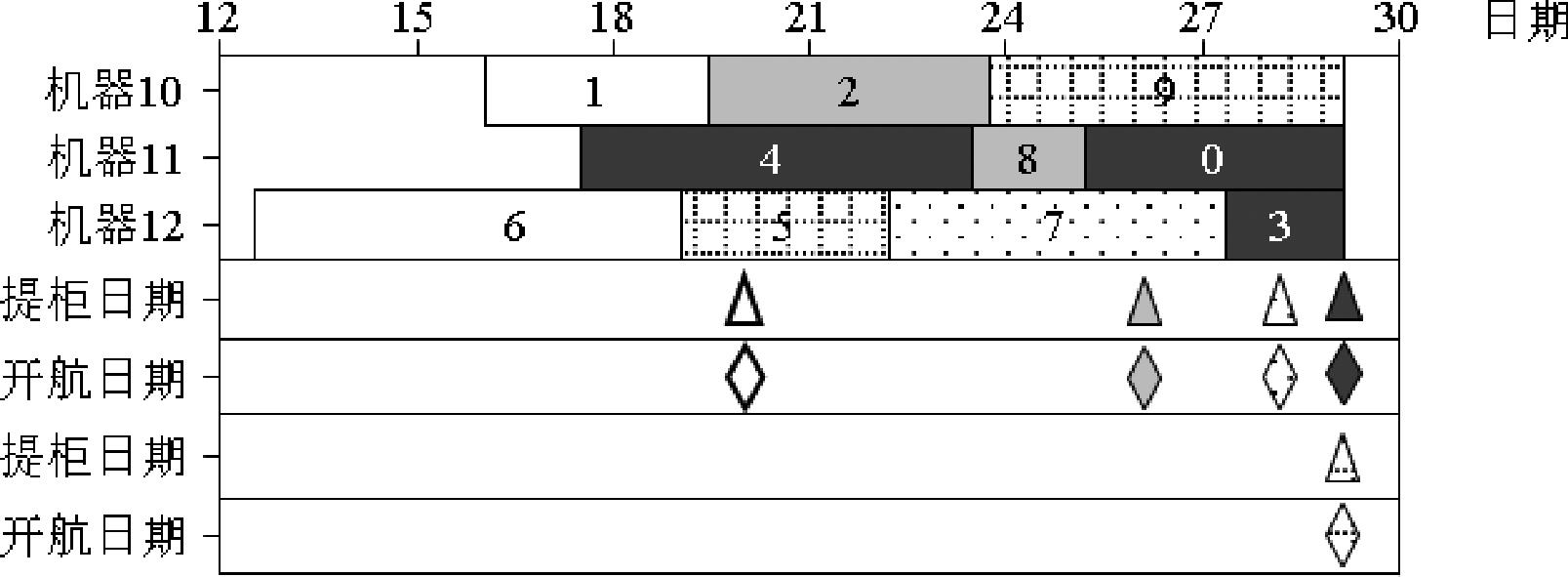
"
"
"
| [1] | 陈金晓, 陈剑. 从优化到重塑——大变局中的供应链高质量发展[J]. 系统工程理论与实践, 2022, 42(3): 545-558. |
| Chen J X, Chen J. From optimization to reinvention: High-quality development of supply chains in great changes[J]. Systems Engineering-Theory & Practice, 2022, 42(3): 545-558. | |
| [2] | 何珮洋, 李昆鹏, 田倩南. 基于3D打印技术的备件生产与运输协同调度问题研究[J]. 中国管理科学, 2023, 31(4): 239-249. |
| He P Y, Li K P, Tian Q N. The integrated production and transportation scheduling problem based on 3D printing technology[J]. Chinese Journal of Management Science, 2023, 31(4): 239-249. | |
| [3] | Elmi Z, Singh P, Meriga V K, et al. Uncertainties in liner shipping and ship schedule recovery: A state-of-the-art review[J]. Journal of Marine Science and Engineering, 2022, 10(5): 563. |
| [4] | Zhang A, Zheng Z, Teo C P. Schedule reliability in liner shipping timetable design: A convex programming approach[J]. Transportation Research Part B: Methodological, 2022, 155: 499-525. |
| [5] | Ksciuk J, Kuhlemann S, Tierney K, et al. Uncertainty in maritime ship routing and scheduling: A Literature review[J]. European Journal of Operational Research, 2023, 308(2): 499-524. |
| [6] | Wang Y, Gu Y, Wang T, et al. A risk-averse approach for joint contract selection and slot allocation in liner container shipping[J]. Transportation Research Part E: Logistics and Transportation Review, 2022, 164: 102781. |
| [7] | Meng L, Ge H, Wang X, et al. Optimization of ship routing and allocation in a container transport network considering port congestion: A variational inequality model[J]. Ocean & Coastal Management, 2023, 244: 106798. |
| [8] | Moons S, Ramaekers K, Caris A, et al. Integrating production scheduling and vehicle routing decisions at the operational decision level: A review and discussion[J]. Computers & Industrial Engineering,2017,104: 224-245. |
| [9] | Chen Z L, Vairaktarakis G L. Integrated scheduling of production and distribution operations[J]. Management Science, 2005, 51(4): 614-628. |
| [10] | Qin H, Li T, Teng Y, et al. Integrated production and distribution scheduling in distributed hybrid flow shops[J]. Memetic Computing, 2021, 13(2): 185-202. |
| [11] | Zhong W, Chen Z L, Chen M. Integrated production and distribution scheduling with committed delivery dates[J]. Operations Research Letters, 2010, 38(2): 133-138. |
| [12] | Yağmur E, Kesen S E. Integrated production scheduling and vehicle routing problem with energy efficient strategies: Mathematical formulation and metaheuristic algorithms[J]. Expert Systems with Applications, 2024, 237: 121586. |
| [13] | Chagas G O, Coelho L C, Darvish M, et al. Modeling and solving the waste valorization production and distribution scheduling problem[J]. European Journal of Operational Research, 2023, 306(1): 400-417. |
| [14] | 刘建军, 李钦颂, 曾创锋, 等. 柔性装配流水车间调度与分批配送集成问题研究[J]. 计算机集成制造系统, 2025, 31(11): 4026-4043. |
| Liu J J, Li Q S, Zeng C F, et al. Flexible assembly flowshop scheduling with batch delivery[J]. Computer Integrated Manufacturing Systems, 2025, 31(11): 4026-4043. | |
| [15] | 唐捷凯, 胡蓉, 钱斌, 等. 混合帝国竞争算法求解带多行程批量配送的多工厂集成调度问题[J]. 电子学报, 2022, 50(7): 1621-1630. |
| Tang J K, Hu R, Qian B, et al. Hybrid imperialist competitive algorithm for solving multi-factory integrated scheduling problem with multi-trip batch delivery[J]. Acta Electronica Sinica, 2022, 50(7): 1621-1630. | |
| [16] | Chen J, Huang G Q, Wang J Q. Synchronized scheduling of production and outbound shipping using bilevel-based simulated annealing algorithm[J]. Computers & Industrial Engineering, 2019, 137: 106050. |
| [17] | Yang X, Li F, Liu Z, et al. New exact and heuristic algorithms for general production and delivery integration[J]. European Journal of Operational Research, 2024, 316(2): 419-442. |
| [18] | Li F, Xu Z, Chen Z L. Production and transportation integration for commit-to-delivery mode with general shipping costs[J]. INFORMS Journal on Computing, 2020, 32(4): 1012-1029. |
| [19] | Sun X T, Chung S H, Chan F T S. Integrated scheduling of a multi-product multi-factory manufacturing system with maritime transport limits[J]. Transportation Research Part E: Logistics and Transportation Review, 2015, 79: 110-127. |
| [20] | Hou Y, Wang H, Fu Y, et al. Multi-Objective brain storm optimization for integrated scheduling of distributed flow shop and distribution with maximal processing quality and minimal total weighted earliness and tardiness[J]. Computers & Industrial Engineering, 2023, 179: 109217. |
| [21] | Zhang Z, Fu Y, Gao K, et al. A cooperative evolutionary algorithm with simulated annealing for integrated scheduling of distributed flexible job shops and distribution[J]. Swarm and Evolutionary Computation, 2024, 85: 101467. |
| [22] | Rabet R, Ganji M, Fathi M. A simheuristic approach towards supply chain scheduling: Integrating production, maintenance and distribution[J]. Applied Soft Computing, 2024, 153: 111264. |
| [23] | Ishibuchi H, Yoshida T, Murata T. Balance between genetic search and local search in memetic algorithms for multiobjective permutation flowshop scheduling[J]. IEEE Transactions on Evolutionary Computation, 2003, 7(2): 204-223. |
| [24] | Xu L, Zhang C, Xiao F, et al. A robust approach to airport gate assignment with a solution-dependent uncertainty budget[J]. Transportation Research Part B: Methodological, 2017, 105: 458-478. |
| [25] | Deb K, Pratap A, Agarwal S, et al. A fast and elitist multiobjective genetic algorithm: NSGA-II[J]. IEEE Transactions on Evolutionary Computation, 2002, 6(2): 182-197. |
| [26] | Zitzler E, Thiele L. Multiobjective evolutionary algorithms: A comparative case study and the strength Pareto approach[J]. IEEE Transactions on Evolutionary Computation, 1999, 3(4): 257-271. |
| [27] | Van Veldhuizen D A, Lamont G B. On measuring multiobjective evolutionary algorithm performance[C]//Proceedings of the 2000 Congress on Evolutionary Computation. CEC 00. La Jolla, CA, USA, July 16-19, IEEE, 2002: 204-211. |
| [28] | Yang Z, Cai X, Fan Z. Epsilon constrained method for constrained multiobjective optimization problems: Some preliminary results[C]//Proceedings of the Companion Publication of the 2014 Annual Conference on Genetic and Evolutionary Computation. Vancouver, BC, Canada,July 12 - 16, ACM, 2014: 1181-1186. |
| [29] | Cheng R, Jin Y, Olhofer M, et al. A reference vector guided evolutionary algorithm for many-objective optimization[J]. IEEE Transactions on Evolutionary Computation, 2016, 20(5): 773-791. |
| [30] | Gen M, Cheng R. Genetic algorithms and engineering optimization[M]. New York: John Wiley & Sons, 1999. |
| [1] | Tieke Li,Yixuan Su,Wenxin Zhang,Bailin Wang. Interval Multi-objective Optimal Scheduling for Steelmaking-continuous Casting with Processing Time Uncertainty [J]. Chinese Journal of Management Science, 2024, 32(8): 95-106. |
| [2] | CUI Wei-wei, TAN Xin-lin. Modeling and Approach for the Energy-aware Production Scheduling Problem under TOU Tariff [J]. Chinese Journal of Management Science, 2021, 29(5): 147-156. |
| [3] | WANG Xu-ping, ZHANG Jun, YI Cai-yu. Integrated Scheduling of Order Picking and Delivery Under B2C E-commerce [J]. Chinese Journal of Management Science, 2016, 24(7): 101-109. |
| [4] | LI Tie-ke, SU Zhi-xiong. Two-Stage Genetic Algorithm for SM-CC Production Scheduling [J]. Chinese Journal of Management Science, 2009, 17(5): 68-74. |
| Viewed | ||||||
|
Full text |
|
|||||
|
Abstract |
|
|||||
|
||
