
主管:中国科学院
主办:中国优选法统筹法与经济数学研究会
中国科学院科技战略咨询研究院
主办:中国优选法统筹法与经济数学研究会
中国科学院科技战略咨询研究院

Chinese Journal of Management Science ›› 2026, Vol. 34 ›› Issue (6): 356-368.doi: 10.16381/j.cnki.issn1003-207x.2024.0626
Zeshui Xu, Mei Chang, Xunjie Gou( )
)
Received:2024-04-23
Revised:2024-08-08
Online:2026-06-25
Published:2026-05-22
Contact:
Xunjie Gou
E-mail:gouxunjie@scu.edu.cn
CLC Number:
Zeshui Xu,Mei Chang,Xunjie Gou. An Analysis of Inter-provincial Carbon Emission Efficiency and Its Influencing Factors in China: A Multi-period Cross-efficiency Approach[J]. Chinese Journal of Management Science, 2026, 34(6): 356-368.
"

"
| DMU | 目标DMU | 最终交叉效率 | |||
|---|---|---|---|---|---|
"
| 省份 | 本文模型 | Kao和Liu的模型 | ||
|---|---|---|---|---|
| 碳排放效率 | 排名 | 碳排放效率 | 排名 | |
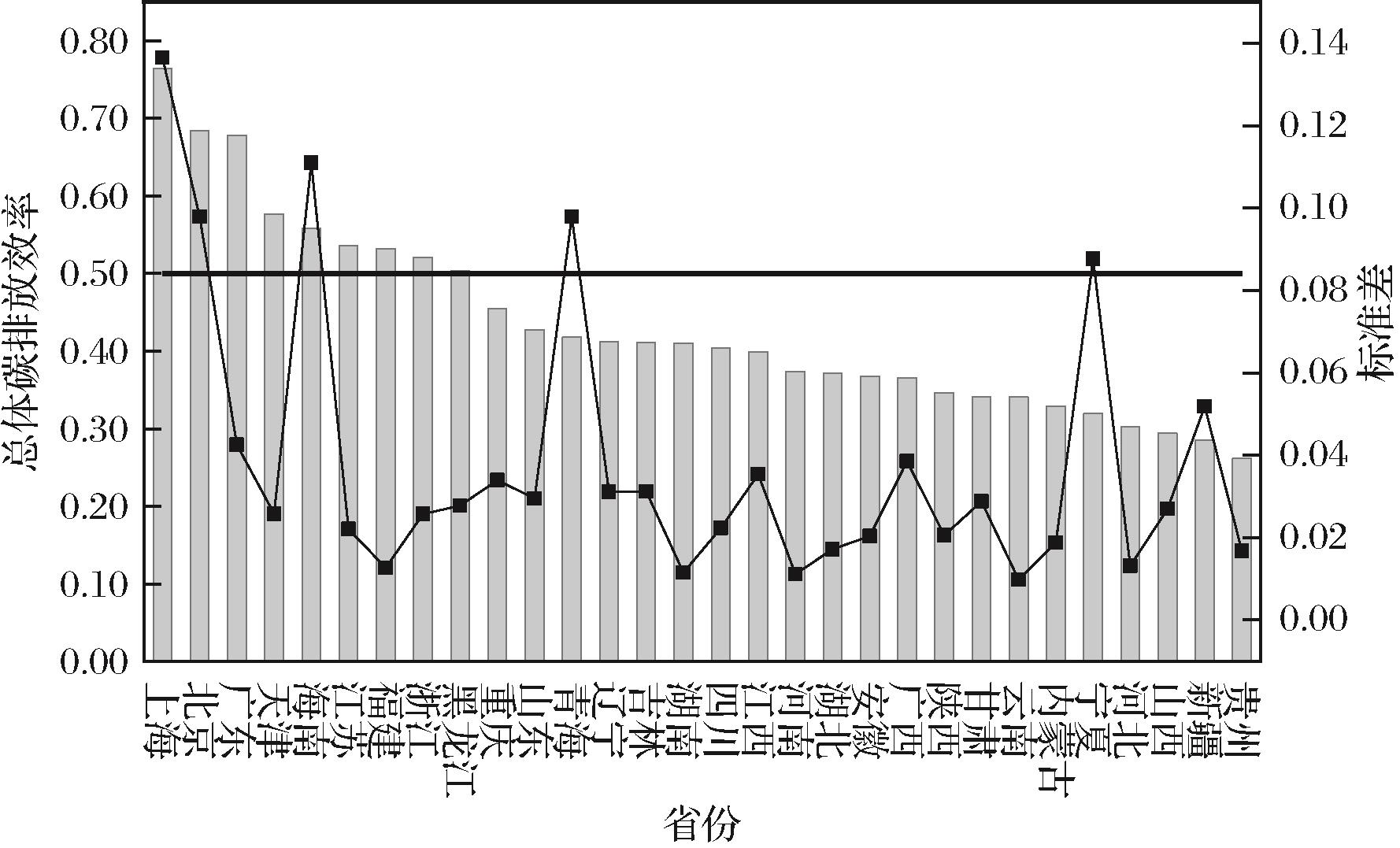
| 北京 | 0.6847 | 2 | 0.7443 | 4 |
| 天津 | 0.5764 | 4 | 0.7425 | 5 |
| 河北 | 0.3024 | 27 | 0.3656 | 29 |
| 山西 | 0.2942 | 28 | 0.4107 | 23 |
| 内蒙古 | 0.3290 | 25 | 0.4119 | 22 |
| 辽宁 | 0.4117 | 13 | 0.4781 | 14 |
| 吉林 | 0.4107 | 14 | 0.4480 | 18 |
| 黑龙江 | 0.5043 | 9 | 0.5769 | 11 |
| 上海 | 0.7649 | 1 | 0.8806 | 1 |
| 江苏 | 0.5364 | 6 | 0.6165 | 9 |
| 浙江 | 0.5210 | 8 | 0.6024 | 10 |
| 安徽 | 0.3678 | 20 | 0.4451 | 20 |
| 福建 | 0.5320 | 7 | 0.6174 | 8 |
| 江西 | 0.3992 | 17 | 0.4846 | 13 |
| 山东 | 0.4273 | 11 | 0.4711 | 15 |
| 河南 | 0.3738 | 18 | 0.4452 | 19 |
| 湖北 | 0.3714 | 19 | 0.4106 | 24 |
| 湖南 | 0.4105 | 15 | 0.4613 | 16 |
| 广东 | 0.6786 | 3 | 0.7719 | 3 |
| 广西 | 0.3653 | 21 | 0.4318 | 21 |
| 海南 | 0.5586 | 5 | 0.7076 | 7 |
| 重庆 | 0.4551 | 10 | 0.5148 | 12 |
| 四川 | 0.4040 | 16 | 0.4585 | 17 |
| 贵州 | 0.2613 | 30 | 0.2904 | 30 |
| 云南 | 0.3405 | 24 | 0.3874 | 26 |
| 陕西 | 0.3464 | 22 | 0.3879 | 25 |
| 甘肃 | 0.3405 | 23 | 0.3867 | 27 |
| 青海 | 0.4180 | 12 | 0.8688 | 2 |
| 宁夏 | 0.3197 | 26 | 0.7309 | 6 |
| 新疆 | 0.2848 | 29 | 0.3667 | 28 |
"
"
"
| 变量 | 模型1 | 模型2 | 模型3 | 模型4 |
|---|---|---|---|---|
| 0.4883*** (3.919) | 0.1165*** (2.751) | 0.2212***(3.282) | 0.5940***(4.952) | |
| 0.5993***(10.575) | 0.5964*** (10.116) | 0.5794***(9.744) | 0.5777***(10.219) | |
| -0.2375***(-7.632) | -0.1962***(-6.823) | -0.2572***(-7.217) | -0.2696***(-8.263) | |
| -0.0848**(-2.590) | -0.0957***(-2.888) | -0.1019***(-3.072) | -0.0888***(-2.741) | |
| 0.0696***(2.700) | 0.0580**(2.205) | 0.0736***(2.834) | 0.0703***(2.753) | |
| 0.1165***(3.439) | 0.1312***(3.872) | 0.1490***(4.388) | 0.1203***(3.608) | |
| 0.1077*** (14.358) | 0.1035***(13.160) | 0.1036***(13.389) | 0.1054***(14.140) | |
| 0.0762*** (3.941) | 0.0794***(4.074) | 0.0967***(4.771) | 0.0847***(4.419) | |
| _cons | -0.2140***(-3.609) | -0.0572(-1.375) | -0.1128**(-2.422) | -0.2492***(-4.346) |
| 调整R2 | 0.9601 | 0.9594 | 0.9597 | 0.9609 |
| [1] | Chang M, Xu Z, Gou X. Does advanced human capital structure improve carbon emission performance in China? Empirical research from a spatial spillover perspective[J]. Journal of Cleaner Production, 2024, 481: 144152. |
| [2] | 李金铠, 马静静, 魏伟. 中国八大综合经济区能源碳排放效率的区域差异研究[J]. 数量经济技术经济研究, 2020, 37(6): 109-129. |
| Li J K, Ma J J, Wei W. Study on regional differences of energy carbon emission efficiency in eight economic areas of China[J]. The Journal of Quantitative & Technical Economics, 2020, 37(6): 109-129. | |
| [3] | Ferreira A, Pinheiro M D, de Brito J, et al. Combined carbon and energy intensity benchmarks for sustainable retail stores[J]. Energy, 2018, 165: 877-889. |
| [4] | Vujović T, Petković Z, Pavlović M, et al. Economic growth based in carbon dioxide emission intensity[J]. Physica A: Statistical Mechanics and Its Applications, 2018, 506: 179-185. |
| [5] | Fan M, Shao S, Yang L. Combining global Malmquist–Luenberger index and generalized method of moments to investigate industrial total factor CO2 emission performance: A case of Shanghai (China)[J]. Energy Policy, 2015, 79: 189-201. |
| [6] | Chen Y, Wong C W Y, Yang R, et al. Optimal structure adjustment strategy, emission reduction potential and utilization efficiency of fossil energies in China[J]. Energy, 2021, 237: 121623. |
| [7] | Li Z, Meng N, Yao X. Sustainability performance for China’s transportation industry under the environmental regulation[J]. Journal of Cleaner Production, 2017, 142: 688-696. |
| [8] | 刘海英, 王钰. 基于历史法和零和DEA方法的用能权与碳排放权初始分配研究[J]. 中国管理科学, 2020, 28(9): 209-220. |
| Liu H Y, Wang Y. Research on initial allocation of energy-consuming right and CO2-emission right based on historical method and ZSG-DEA method[J]. Chinese Journal of Management Science, 2020, 28(9): 209-220. | |
| [9] | 王星, 张乾翔. 经济增长压力下金融集聚对碳排放效率的影响[J]. 中国人口·资源与环境, 2022, 32(3): 11-20. |
| Wang X, Zhang Q X. Impact of financial agglomeration on carbon emission efficiency under the economic growth pressure[J]. China Population, Resources and Environment, 2022, 32(3): 11-20. | |
| [10] | Zhou P, Ang B W, Wang H. Energy and CO2 emission performance in electricity generation: A non-radial directional distance function approach[J]. European Journal of Operational Research, 2012, 221(3): 625-635. |
| [11] | Teng X, Liu F P, Chiu Y H. The change in energy and carbon emissions efficiency after afforestation in China by applying a modified dynamic SBM model[J]. Energy, 2021, 216: 119301. |
| [12] | 陈晓红, 易国栋, 刘翔. 基于三阶段SBM-DEA模型的中国区域碳排放效率研究[J]. 运筹与管理, 2017, 26(3): 115-122. |
| Chen X H, Yi G D, Liu X. Analysis of the low carbon economy efficiency in China: Based on a method of three stage SBM-DEA model with undesirable outputs[J]. Operations Research and Management Science, 2017, 26(3): 115-122. | |
| [13] | 邵帅, 范美婷, 杨莉莉. 经济结构调整、绿色技术进步与中国低碳转型发展——基于总体技术前沿和空间溢出效应视角的经验考察[J]. 管理世界, 2022, 38(2): 46-69+4-10. |
| Shao S, Fan M T, Yang L L. Economic restructuring, green technical progress, and low-carbon transition development in China: An empirical investigation based on the overall technology frontier and spatial spillover effect[J]. Journal of Management World, 2022, 38(2): 46-69+4-10. | |
| [14] | Zheng H, Wu Y, He H, et al. Urbanization and urban energy eco-efficiency: A meta-frontier super EBM analysis based on 271 cities of China[J]. Sustainable Cities and Society, 2024, 101: 105089. |
| [15] | 程幼明, 王慧颖, 张孝琪. 基于群决策考虑属性效用一致性的DEA他评交叉效率公共权重排序法[J]. 控制与决策, 2021, 36(9): 2279-2289. |
| Cheng Y M, Wang H Y, Zhang X Q. A common-weight ranking method for DEA peer-efficiency based on group decision-making and considering the consistency of attribute utility[J]. Control and Decision, 2021, 36(9): 2279-2289. | |
| [16] | Kao C, Liu S T. Multi-period efficiency measurement in data envelopment analysis: The case of Taiwan residents commercial banks[J].Omega,2014, 47: 90-98. |
| [17] | 刘志华, 徐军委, 张彩虹. 科技创新、产业结构升级与碳排放效率——基于省际面板数据的PVAR分析[J]. 自然资源学报, 2022, 37(2): 508-520. |
| Liu Z H, Xu J W, Zhang C H. Technological innovation, industrial structure upgrading and carbon emissions efficiency: An analysis based on PVAR model of panel data at provincial level[J].Journal of Natural Resources, 2022, 37(2): 508-520. | |
| [18] | Xu L, Fan M, Yang L, et al. Heterogeneous green innovations and carbon emission performance: Evidence at China’s city level[J]. Energy Economics, 2021, 99: 105269. |
| [19] | Zhang W, Liu X, Zhao S, et al. Does green finance agglomeration improve carbon emission performance in China? A perspective of spatial spillover[J]. Applied Energy, 2024, 358: 122561. |
| [20] | Zhang W, Liu X, Wang D, et al. Digital economy and carbon emission performance: Evidence at China’s city level[J]. Energy Policy, 2022, 165: 112927. |
| [21] | Zhu Y, Yang F, Wei F, et al. Measuring environmental efficiency of the EU based on a DEA approach with fixed cost allocation under different decision goals[J]. Expert Systems with Applications, 2022, 208: 118183. |
| [22] | Dakpo K H, Jeanneaux P, Latruffe L. Modelling pollution-generating technologies in performance benchmarking: Recent developments, limits and future prospects in the nonparametric framework[J]. European Journal of Operational Research, 2016, 250(2): 347-359. |
| [23] | Du J, Chen Y, Huang Y. A modified malmquist-luenberger productivity index: Assessing environmental productivity performance in China[J]. European Journal of Operational Research, 2018, 269(1): 171-187. |
| [24] | Tone K, Tsutsui M. Dynamic DEA: A slacks-based measure approach[J]. Omega, 2010, 38(3-4): 145-156. |
| [25] | Tavana M, Izadikhah M, Di Caprio D, et al. A new dynamic range directional measure for two-stage data envelopment analysis models with negative data[J]. Computers & Industrial Engineering, 2018, 115: 427-448. |
| [26] | 郭海红, 刘新民. 中国农业绿色全要素生产率时空演变[J]. 中国管理科学, 2020, 28(9): 66-75. |
| Guo H H, Liu X M. Time-space evolution of China’s agricultural green total factor productivity[J]. Chinese Journal of Management Science, 2020, 28(9): 66-75. | |
| [27] | 单豪杰. 中国资本存量K的再估算: 1952—2006年[J]. 数量经济技术经济研究, 2008, 25(10): 17-31. |
| Shan H J. Reestimating the capital stock of China: 1952-2006[J]. The Journal of Quantitative & Technical Economics, 2008, 25(10): 17-31. | |
| [28] | Liu Z, Guan D, Wei W, et al. Reduced carbon emission estimates from fossil fuel combustion and cement production in China[J]. Nature, 2015, 524(7565): 335-338. |
| [29] | Dong F, Li X, Long R, et al. Regional carbon emission performance in China according to a stochastic frontier model[J]. Renewable and Sustainable Energy Reviews, 2013, 28: 525-530. |
| [30] | Parent O, LeSage J P. Using the variance structure of the conditional autoregressive spatial specification to model knowledge spillovers[J]. Journal of Applied Econometrics, 2008, 23(2): 235-256. |
| [31] | 干春晖, 郑若谷, 余典范. 中国产业结构变迁对经济增长和波动的影响[J]. 经济研究, 2011, 46(5): 4-16+31. |
| Gan C H, Zheng R G, Yu D F. An empirical study on the effects of industrial structure on economic growth and fluctuations in China[J]. Economic Research Journal, 2011, 46(5): 4-16+31. | |
| [32] | 何维达, 温家隆, 张满银. 数字经济发展对中国绿色生态效率的影响研究——基于双向固定效应模型[J]. 经济问题, 2022(1): 1-8+30. |
| He W D, Wen J L, Zhang M Y. Research on the impact of digital economy development on China’s green ecological efficiency: Based on two-way fixed effects model[J]. On Economic Problems, 2022(1): 1-8+30. |
| [1] | Zhanxin Ma, Pengbo Hou. Meaning of Super-efficiency, Projection Reliability, and Robust Production Frontiers [J]. Chinese Journal of Management Science, 2026, 34(3): 146-158. |
| [2] | Jiang Li, Hecheng Wu, Liwen Wang. A Robust Data Envelopment Analysis Model with Common Weights Considering Uncertainty and Its Application [J]. Chinese Journal of Management Science, 2026, 34(3): 333-344. |
| [3] | Lei Chen, Xu Guo, Yingming Wang. Determination of Optimal Endogenous Direction and Improvement Path in Directional Distance Function [J]. Chinese Journal of Management Science, 2025, 33(9): 89-96. |
| [4] | Shuya Yan, Guotao Yang, Xun Liang, Zhenyu Guan, Ziyan Liu. Comprehensive Efficiency Evaluation of China’s Economic Development Quality Based on Parallel Two-stage Network DEA Model [J]. Chinese Journal of Management Science, 2025, 33(7): 139-150. |
| [5] | Ren Mu, Lining Hao, Ankang Li, Shuyi Zhang, Wei Cui. Group Ranking Data Envelopment Analysis Model [J]. Chinese Journal of Management Science, 2025, 33(7): 24-32. |
| [6] | Zhanxin Ma, guga Suri. Study of DEA-Malmquist Index Method Based on Frontier Surface Modification [J]. Chinese Journal of Management Science, 2025, 33(3): 118-127. |
| [7] | Yao Wen, Qingxian An, Yongli Li. Cost DEA Game and Cost Allocation Method Considering the Relative Competitiveness of Decision-making Units [J]. Chinese Journal of Management Science, 2025, 33(2): 71-83. |
| [8] | Guangyu Wan,Feiyan Pu,Zichun Li,Yu Cao. Impact of Marketing Capability and Production Operation Capability on Firms' Financial Performance [J]. Chinese Journal of Management Science, 2024, 32(5): 275-285. |
| [9] | ZHOU Zhen, JIAN Hong-yu, HUANG Jia-pei, LIN Yun. The Influence of E-marketing on Cinema Performance Based on DEA and Grey Entropy [J]. Chinese Journal of Management Science, 2023, 31(5): 240-248. |
| [10] | Qian-zhi DAI,Xiao-chi XU,Xi-yang LEI,Qian ZHAO. Cost Compensation Method for Incentives Based on Dynamic Non-cooperative Game and Super-efficiency DEA [J]. Chinese Journal of Management Science, 2023, 31(12): 185-192. |
| [11] | Yan HUANG,Li-ye CHEN,Nan WU,Ying-ming WANG,Yong-wu DAI. Study on Interval Benchmarking Based on Efficiency Compensation Mechanism——Taking Forest Carbon Sink Efficiency as An Example [J]. Chinese Journal of Management Science, 2023, 31(12): 317-328. |
| [12] | Feng LI,Yue WANG,Liang LIANG,Gang KOU. A Two-stage Data Envelopment Analysis Approach for Evaluating Decision-making Units with Fixed-sum Shared Outputs [J]. Chinese Journal of Management Science, 2023, 31(11): 268-278. |
| [13] | Xiao-lei WANG,Ren MU,Li ZHOU,Jin-quan DONG. An Evaluation Method of Input-output Performance of Decision Making Units Considering Efficiency and Effect [J]. Chinese Journal of Management Science, 2023, 31(10): 128-135. |
| [14] | LI Mei-juan, , LU Jin-cheng. A New Cross-efficiency Evaluation Method Based on Double Frontier and Its Application [J]. Chinese Journal of Management Science, 2023, 31(1): 168-175. |
| [15] | REN Teng, LI Shu-xuan, ZHOU Zhong-bao, LI Si-di, XIAO He-lu. Study on Efficiency Evaluation of Regional Sustainable Development System Based on BLP-DEA and Satisfaction Degree [J]. Chinese Journal of Management Science, 2022, 30(7): 99-109. |
| Viewed | ||||||
|
Full text |
|
|||||
|
Abstract |
|
|||||
|
||
