
主管:中国科学院
主办:中国优选法统筹法与经济数学研究会
中国科学院科技战略咨询研究院
主办:中国优选法统筹法与经济数学研究会
中国科学院科技战略咨询研究院

Chinese Journal of Management Science ›› 2026, Vol. 34 ›› Issue (3): 80-92.doi: 10.16381/j.cnki.issn1003-207x.2023.1809
Previous Articles Next Articles
Yang Wu1,2, Haixiang Guo3,4, Yong Shi3,4( ), Wenkai Zhang5, Lei Wang6
Received:2023-10-31
Revised:2024-01-26
Online:2026-03-25
Published:2026-03-06
Contact:
Yong Shi
E-mail:shiyong@cug.edu.cn
CLC Number:
Yang Wu,Haixiang Guo,Yong Shi, et al. Differential Allocation Decision and Subsidy Effect of Limited Infectious Disease Vaccination Subsidy: Based on a Modified SIR Model[J]. Chinese Journal of Management Science, 2026, 34(3): 80-92.

"


"
"

"

"
| 参数 | 描述与解释 |
|---|---|
| j | 人群分组索引,j=1, 2, …, J |
| t | 时间,t=0表示疫情初始 |
| T | 感染人数达到峰值的时间 |
| M | 疫苗接种补贴总预算 |
| N | 区域人口总数 |
| 疫苗保护效果 | |
| 易感染者转变为感染者的概率 | |
| 某一个体在单位时间内的人际交往频次 | |
| 分组j的个体在单位时间内的人际交往频次 | |
| 对分组j的个体进行疫苗接种动员的成本 | |
| 某一补贴方案下,分组j的个体得到的人均接种 | |
| 易感染者与感染者接触后被感染的概率 | |
| 在接种疫苗前,分组j的易感染者与感染者接触后被感染的概率 | |
| 在接种疫苗后,分组j的易感染者与感染者接触后被感染的概率 | |
| 状态变量 | |
| t时刻分组j的易感染者与感染者接触后被感染的期望概率 | |
| t时刻的易感染者数量 | |
| t时刻分组j中的易感染者数量 | |
| t时刻分组j中的易感染者数量变化 | |
| t时刻的感染者数量 | |
| t时刻分组j中的感染者数量 | |
| t时刻分组j中的感染者数量变化 | |
| t时刻的康复者数量 | |
| t时刻分组j中的康复者数量 | |
| t时刻分组j中的康复者数量变化 | |
| t时刻分组j中接种疫苗个体的比例 | |
| 决策变量 | |
| 分配给分组j易感者的疫苗接种补贴 | |
"
| 分组索引 | 年龄范围 | 动员成本 | 人际接触频次(人) | 基础接种意愿 | 基础感染概率 | 感染后康复概率 |
|---|---|---|---|---|---|---|
| 1 | 0~17岁 | - | 12 | - | 0.0179 | 0.4 |
| 2 | 18~29岁 | 100 | 24 | 24.5% | 0.0525 | 0.3 |
| 3 | 30~59岁 | 300 | 10 | 29.6% | 0.0525 | 0.2 |
| 4 | ≥60岁 | 200 | 6 | 30.9% | 0.0772 | 0.1 |
"
| 年龄范围 | 整体数量(人) | 感染后康复数量(人) | 感染后死亡数量(人) | 初始易感人群 | 初始感染人群 | 初始康复人群 |
|---|---|---|---|---|---|---|
| 0~17岁 | 2000872 | 5473 | 9 | 1995390 | 0 | 5473 |
| 18~29岁 | 2108107 | 15082 | 23 | 2093002 | 0 | 15082 |
| 30~59岁 | 6093142 | 33472 | 907 | 6058763 | 0 | 33472 |
| ≥60岁 | 2124397 | 9609 | 3574 | 2111214 | 0 | 9609 |

"
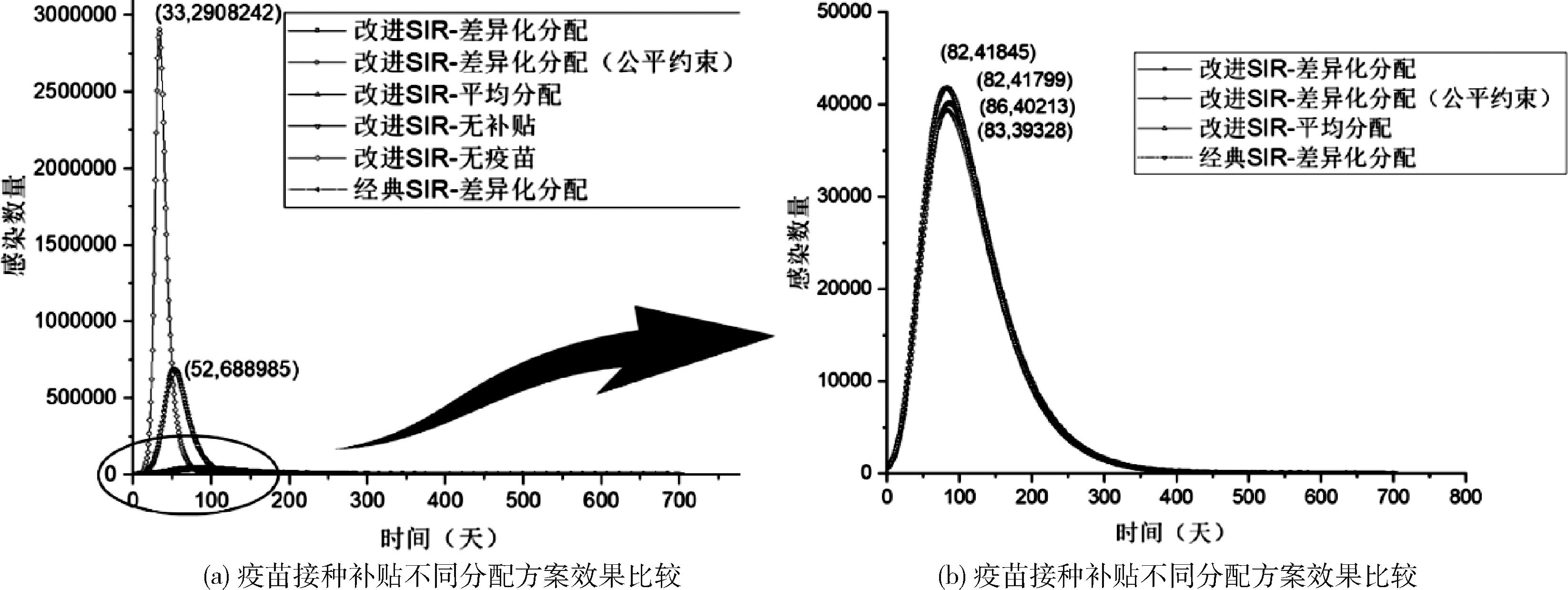
"
| 疫苗接种补贴分配模式 | T (天) | 感染峰值 (人) | 相对极差 | 分组“18~29岁” | 分组“30~59岁” | 分组“≥60岁” | |||||||
|---|---|---|---|---|---|---|---|---|---|---|---|---|---|
(元) | (元) | (元) | |||||||||||
| 基于改进SIR模型 | 差异化分配 | 86 | 40,213 | 0.86 | 51.5 | 90.85 | 270.83 | 27.52 | 40.63 | 111.79 | 20.98 | 57.57 | 172.63 |
| 差异化分配+公平约束 | 83 | 39,328 | 0.19 | 31.77 | 74.45 | 203.87 | 47.73 | 46.36 | 169.91 | 20.5 | 57.15 | 169.92 | |
| 平均分配 | 82 | 41,799 | 0 | 25.90 | 68.66 | 180.24 | 51.74 | 47.38 | 180.24 | 22.36 | 58.74 | 180.24 | |
| 无补贴 | 52 | 688,985 | 0 | 0 | 24.5 | 0 | 0 | 29.6 | 0 | 0 | 30.9 | 0 | |
| 无疫苗 | 33 | 2,908,242 | 0 | 0 | 0 | 0 | 0 | 0 | 0 | 0 | 0 | 0 | |
| 经典SIR模型+差异化分配 | 82 | 41,845 | 0.05 | 26.00 | 68.76 | 180.66 | 52.74 | 47.63 | 182.74 | 21.26 | 57.82 | 174.22 | |

"
"
| 疫苗接种补贴预算金额(元) | 疫苗接种补贴分配方案(元) | 疫情仿真达峰时间(天) | 峰值感染人数(人) | ||
|---|---|---|---|---|---|
| 18~29岁 | 30~59岁 | ≥60岁 | |||
| 107 | 2000862 (20%) | 5651156 (56.51%) | 2347982 (24.48%) | 53 | 661642 |
| 108 | 22855529 (22.85%) | 53358256 (53.36%) | 23786215 (23.79%) | 57 | 468509 |
| 109 | 317676844 (31.77%) | 477297198 (47.73%) | 205025958 (20.5%) | 83 | 39328 |
| 1.8×10⁹ | 587434621 (32.64%) | 821885500 (45.66%) | 390679879 (21.70%) | 88 | 9474 |
| 1.9×10⁹ | 633649714 (33.35%) | 854518616 (44.97%) | 411831670 (21.68%) | 88 | 8155 |
| 2×10⁹ | 644944770 (32.25%) | 862969740 (43.15%) | 492085490 (24.60%) | 89 | 7204 |
| 2.1×10⁹ | 644977770 (30.71%) | 969437103 (46.16%) | 485585128 (23.12%) | 88 | 6234 |
| 2.2×10⁹ | 644969277 (28.04%) | 1073757425 (46.69%) | 581273298 (25.27%) | 87 | 4967 |
| 3×10⁹ | 575651894 (19.19%) | 1549638405 (51.65%) | 874709701 (29.16%) | 81 | 2623 |
| 5,912,234,360 | 644986331 (11%) | 4323009276 (73.12%) | 944238753 (15.97%) | 1 | 606 |
"
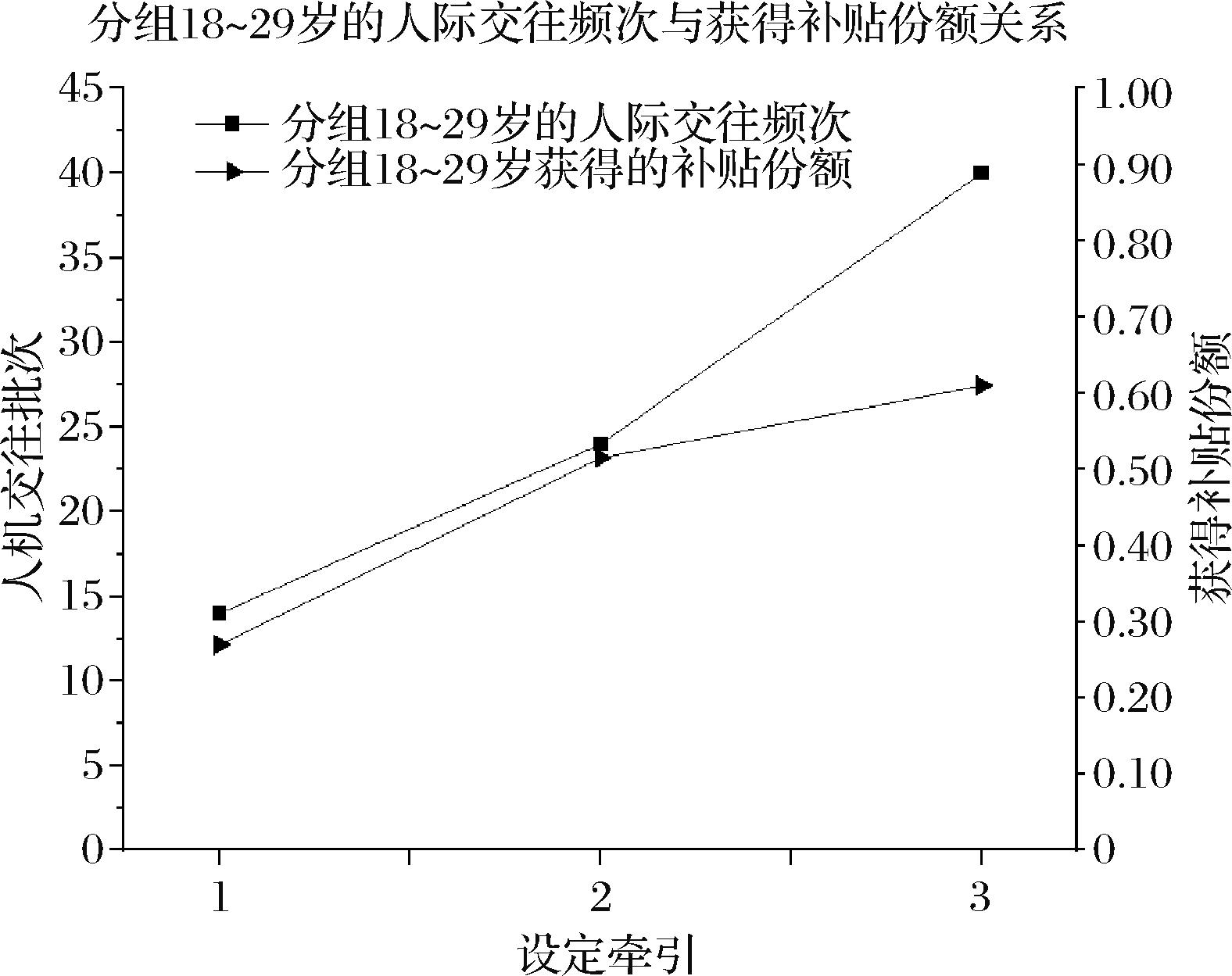
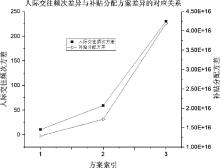
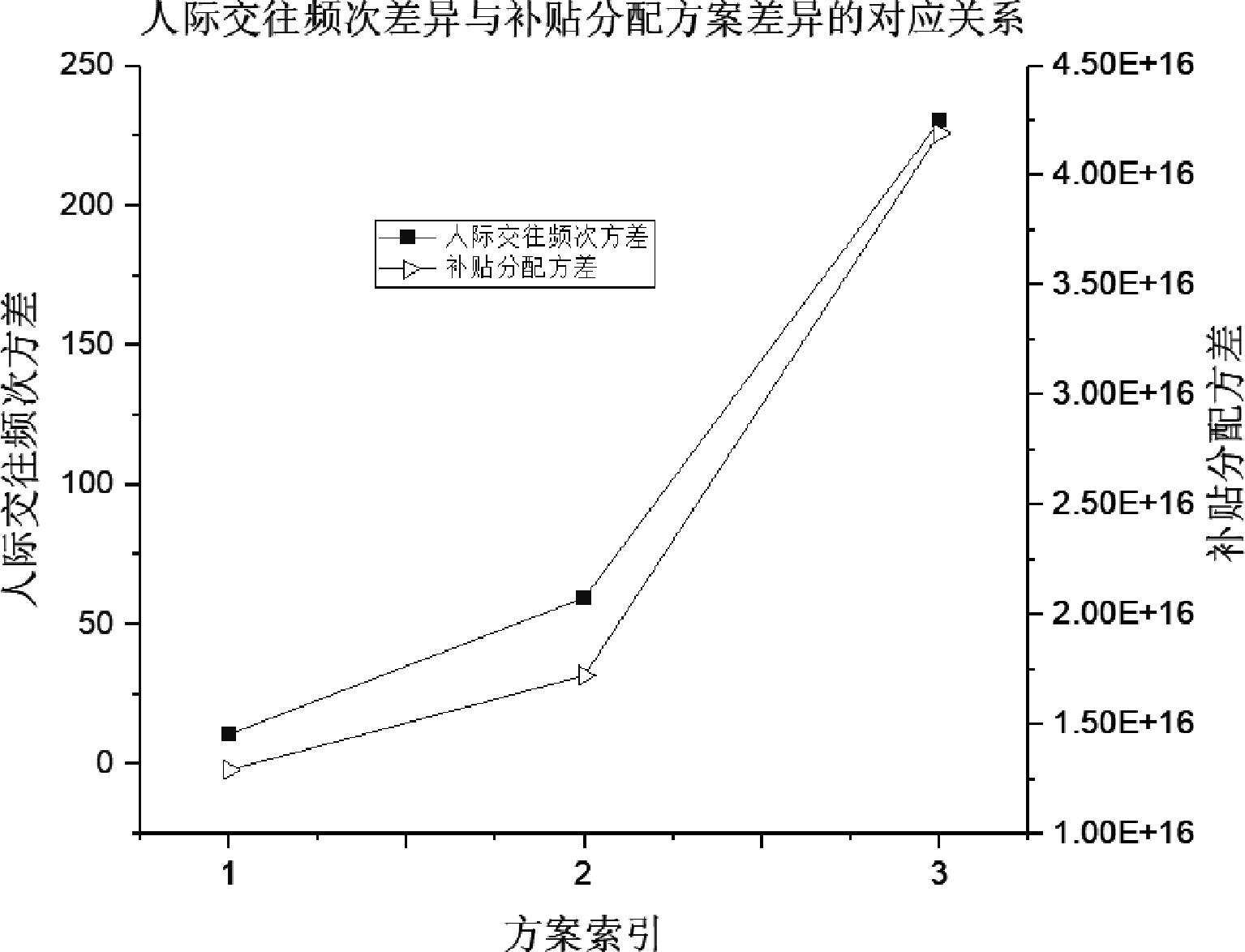
| 索引 | 人际交往频次设定 | 人际交往频次方差 | 补贴分配方案 | 不同分组获得补贴方差 | |||||
|---|---|---|---|---|---|---|---|---|---|
| 0~17岁 | 18~29岁 | 30~59岁 | ≥60岁 | 18~29岁 | 30~59岁 | ≥60岁 | |||
| 1 | 12 | 14 | 10 | 6 | 4.75 | 269892312 (26.99%) | 492885182 (49.29%) | 237222506 (23.72%) | 1.29E+16 |
| 2 | 12 | 24 | 10 | 6 | 45 | 514997802 (51.5%) | 275187091 (27.52%) | 209815107 (20.99%) | 1.72E+16 |
| 3 | 12 | 40 | 10 | 6 | 152 | 609937048 (60.99%) | 269214975 (26.92%) | 120847977 (12.08%) | 4.19E+16 |
"
"
"
疫苗保护效力估计 (偏差) | 0.476 (-30%) | 0.544 (-20%) | 0.612 (-10%) | 0.68 (标准) | 0.748 (+10%) | 0.816 (+20%) | 0.884 (+30%) | ||
|---|---|---|---|---|---|---|---|---|---|
| 补贴分配方案 | 18~29岁 | 占比(%) | 32.31 | 33.38 | 32.51 | 31.77 | 31.50 | 30.18 | 34.1 |
| 偏差(%) | +1.69 | +5.06 | +2.33 | 0 | -0.85 | -4.99 | +7.35 | ||
| 30~59岁 | 占比(%) | 46.01 | 45.15 | 46.44 | 47.73 | 46.52 | 49.10 | 43.97 | |
| 偏差(%) | -3.6 | -5.4 | -2.7 | 0 | -2.54 | +2.87 | -7.89 | ||
| ≥60岁 | 占比(%) | 21.68 | 21.47 | 21.05 | 20.5 | 21.98 | 20.72 | 21.93 | |
| 偏差(%) | +5.76 | +4.74 | +2.67 | 0 | +7.22 | +1.06 | +6.97 | ||
"
输入性疫情规模 (偏差) | 350 (-30%) | 400 (-20%) | 450 (-10%) | 500 (标准) | 550 (+10%) | 600 (+20%) | 650 (+30%) | ||
|---|---|---|---|---|---|---|---|---|---|
| 补贴分配方案 | 18~29岁 | 占比(%) | 31.24 | 30.63 | 31.37 | 31.77 | 30.75 | 31.48 | 30.80 |
| 偏差(%) | -1.65 | -3.58 | -1.25 | 0 | -3.2 | -0.93 | -3.06 | ||
| 30~59岁 | 占比(%) | 48.96 | 47.69 | 48.63 | 47.73 | 46.82 | 46.32 | 47.37 | |
| 偏差(%) | +2.57 | -0.08 | +1.89 | 0 | -1.91 | -2.95 | -0.76 | ||
| ≥60岁 | 占比(%) | 19.80 | 21.68 | 19.99 | 20.5 | 22.43 | 22.20 | 21.83 | |
| 偏差(%) | -3.42 | +5.73 | -2.47 | 0 | +9.40 | -8.3 | +6.5 | ||
| [1] | 刘明, 曹杰, 章定. 数据驱动的疫情应急物流网络动态调整优化[J]. 系统工程理论与实践, 2020, 40(2): 437-448. |
| Liu M, Cao J, Zhang D. Dynamic adjustment method for optimizing epidemic-logistics network based on data-driven[J]. Systems Engineering-Theory & Practice, 2020, 40(2): 437-448. | |
| [2] | 杨华磊, 吴远洋, 蔺雪钰. 新冠状病毒肺炎、人口迁移与疫情扩散防控[J].中国管理科学,2020,28(3): 1-10. |
| Yang H L, Wu Y Y, Lin X Y. New coronavirus pneumonia, population migration and epidemic prevention and control[J]. Chinese Journal of Management Science, 2020, 28(3): 1-10. | |
| [3] | 陈晓红, 杨柠屹, 周艳菊. 后疫情时代新能源车产业的供应链共建策略研究[J]. 中国管理科学, 2024,DOI:10.16381/j.cnki.issn1003-207x.2023.0430 . |
| Chen X H, Yang N Y, Zhou Y J. Co-construction strategy of new energy vehicle industry in the post-epidemic era[J]. Chinese Journal of Management Science, 2024, DOI:10.16381/j.cnki.issn1003-207x.2023.0430 . | |
| [4] | Ni L, Chen Y W, de Brujin O. Towards understanding socially influenced vaccination decision making: An integrated model of multiple criteria belief modelling and social network analysis[J]. European Journal of Operational Research, 2021, 293(1): 276-289. |
| [5] | 刘瑞环, 赵程伟, 谭春桥. 区块链平台不同收费情形下疫苗供应链博弈模型及协调策略[J]. 中国管理科学,2024,DOI:10.16381/j.cnki.issn1003-207x.2023.0631 . |
| Liu R H, Zhao C W, Tan C Q. Game models and coordination strategies of blockchain-based vaccine supply chain under different charging scenarios[J]. Chinese Journal of Management Science, 2024, DOI:10.16381/j.cnki.issn1003-207x.2023.0631 . | |
| [6] | 朱宏淼, 闫辛, 齐佳音, 等. 社会民众新冠病毒疫苗接种意识传播模型与干预策略研究[J]. 中国管理科学, 2023, 31(8): 269-277. |
| Zhu H M, Yan X, Qi J Y, et al. Research on communication model and intervention strategy of COVID-19 vaccination consciousness among public[J]. Chinese Journal of Management Science,2023,31(8): 269-277. | |
| [7] | Pan Y, Ng C T, Cheng T C E. Effect of free-riding behavior on vaccination coverage with customer regret[J]. Computers & Industrial Engineering, 2021, 159: 107494. |
| [8] | 单海燕, 郭青青. 社交网络结构对COVID-19疫苗接种意愿的影响[J]. 系统工程, 2023, 41(2): 15-25. |
| Shan H Y, Guo Q Q. The impact of social network structure on COVID-19 vaccination willingness[J]. Systems Engineering, 2023, 41(2): 15-25. | |
| [9] | Adida E, Dey D, Mamani H. Operational issues and network effects in vaccine markets[J]. European Journal of Operational Research, 2013, 231(2): 414-427. |
| [10] | Jecker N S. Cash incentives, ethics, and COVID-19 vaccination[J]. Science, 2021, 374(6569): 819-820. |
| [11] | Wan Q, Xu X, Hunt K, et al. Stay home or not? Modeling individuals’ decisions during the COVID-19 pandemic[J].Decision Analysis,2022,19(4): 319-336. |
| [12] | Das S, Bose I, Sarkar U K. Predicting the outbreak of epidemics using a network-based approach[J]. European Journal of Operational Research, 2023, 309(2): 819-831. |
| [13] | Pellis L, Cauchemez S, Ferguson N M, et al. Systematic selection between age and household structure for models aimed at emerging epidemic predictions[J]. Nature Communications, 2020, 11: 906. |
| [14] | Dan Y, Gavious A. Incentives' effect in influenza vaccination policy[J]. Management Science, 2013, 59(12): 2667-2686. |
| [15] | Dan Y, Jones F K, DeVincenzo J P, et al. Vaccination strategies against respiratory syncytial virus[J]. Proceedings of the National Academy of Sciences of the United States of America, 2016, 113(46): 13239-13244. |
| [16] | Sun K S, Lam T P, Kwok K W, et al. Seasonal influenza vaccine uptake among Chinese inHong Kong: Barriers, enablers and vaccination rates[J]. Human Vaccines & Immunotherapeutics, 2020, 16(7): 1675-1684. |
| [17] | Ando T, Ibuka Y, Goto R, et al. Effect of influenza vaccine subsidies for older adults on vaccination coverage and mortality before and during the COVID-19 pandemic: An ecological study in Japan[J]. Public Health, 2023, 224: 152-158. |
| [18] | Meng X, Han S, Wu L, et al. Analysis of epidemic vaccination strategies by node importance and evolutionary game on complex networks[J]. Reliability Engineering & System Safety, 2022, 219: 108256. |
| [19] | Wells C R, Klein E Y, Bauch C T. Policy resistance undermines superspreader vaccination strategies for influenza[J]. PLoS Computational Biology, 2013, 9(3): e1002945. |
| [20] | Tanaka M, Tanimoto J. Is subsidizing vaccination with hub agent priority policy really meaningful to suppress disease spreading?[J]. Journal of Theoretical Biology, 2020, 486: 110059. |
| [21] | Zhang H F, Shu P P, Wang Z, et al. Preferential imitation can invalidate targeted subsidy policies on seasonal-influenza diseases[J]. Applied Mathematics and Computation, 2017, 294: 332-342. |
| [22] | Ding H, Xu J H, Wang Z, et al. Subsidy strategy based on history information can stimulate voluntary vaccination behaviors on seasonal diseases[J]. Physica A: Statistical Mechanics and Its Applications, 2018, 503: 390-399. |
| [23] | Tatsukawa Y, Arefin M R, Tanaka M, et al. Free ticket, discount ticket or intermediate of the best of two worlds-Which subsidy policy is socially optimal to suppress the disease spreading?[J]. Journal of Theoretical Biology, 2021, 520: 110682. |
| [24] | Wang L, Zhang Y, Wang Z, et al. The impact of human location-specific contact pattern on the sir epidemic transmission between populations[J]. International Journal of Bifurcation and Chaos, 2013, 23(5): 1350095. |
| [25] | Zhang Z, Wang H, Wang C, et al. Modeling epidemics spreading on social contact networks[J]. IEEE Transactions on Emerging Topics in Computing, 2015, 3(3): 410-419. |
| [26] | 赵新刚, 周颖. 重大突发公共卫生事件中社会群体行为演化的计算实验: 以新冠疫情为例[J]. 中国管理科学, 2024, 32(5): 207-217. |
| Zhao X G, Zhou Y. Computational experiment on the evolution of social group behavior in major public health emergencies: A case study of COVID-19 epidemic[J]. Chinese Journal of Management Science, 2024, 32(5): 207-217. | |
| [27] | 贾芳菊, 周坤, 李廉水. 突发公共卫生事件协同防控策略的随机演化决策分析[J]. 中国管理科学, 2024, 32(3): 237-247. |
| Jia F J, Zhou K, Li L S. Stochastic evolutionary decision analysis of collaborative prevention and control strategies for public health emergencies[J]. Chinese Journal of Management Science,2024,32(3): 237-247. | |
| [28] | Yang Z, Zeng Z, Wang K, et al. Modified SEIR and AI prediction of the epidemics trend of COVID-19 in China under public health interventions[J]. Journal of Thoracic Disease, 2020, 12(3): 165-174. |
| [29] | Davies N G, Klepac P, Liu Y, et al. Age-dependent effects in the transmission and control of COVID-19 epidemics[J]. Nature Medicine, 2020, 26(8): 1205-1211. |
| [30] | Feehan D M, Mahmud A S. Quantifying population contact patterns in the United States during the COVID-19 pandemic[J]. Nature Communications, 2021, 12(1): 893. |
| [31] | Jentsch P C, Anand M, Bauch C T. Prioritising COVID-19 vaccination in changing social and epidemiological landscapes: A mathematical modelling study[J]. The Lancet Infectious Diseases, 2021, 21(8): 1097-1106. |
| [32] | Zhang H F, Wu Z X, Xu X K, et al. Impacts of subsidy policies on vaccination decisions in contact networks[J]. Physical Review E -Statistical, Nonlinear, and Soft Matter Physics, 2013, 88: 012813. |
| [33] | Luyten J, Dorgali V, Hens N, et al. Public preferences over efficiency, equity and autonomy in vaccination policy: An empirical study[J]. Social Science & Medicine, 2013, 77: 84-89. |
| [34] | Field R I, Caplan A L. Evidence-based decision making for vaccines: The need for an ethical foundation[J]. Vaccine, 2012, 30(6): 1009-1013. |
| [35] | Vahdani B, Mohammadi M, Thevenin S, et al. Fair-split distribution of multi-dose vaccines with prioritized age groups and dynamic demand: The case study of COVID-19[J]. European Journal of Operational Research, 2023, 310(3): 1249-1272. |
| [36] | Zhang Z, Kundu S, Tripathi J P, et al. Stability and Hopf bifurcation analysis of an SVEIR epidemic model with vaccination and multiple time delays[J]. Chaos, Solitons & Fractals, 2020, 131: 109483. |
| [1] | Dong Cheng, Jianlin Hou, Faxin Cheng. Maximum Utility Consensus Models with Interacting Attributes under Budget Constraints [J]. Chinese Journal of Management Science, 2025, 33(4): 120-130. |
| [2] | CHENG Bin-hong. Soft Budget Constraints and Transformation of the State-Owned Enterprise:Factor Input Analysis [J]. Chinese Journal of Management Science, 2007, 15(2): 15-20. |
| [3] | WANG Yan, LI Chu-lin. Asymmetric Multiple-Object Auctions [J]. Chinese Journal of Management Science, 2003, (6): 61-65. |
| Viewed | ||||||
|
Full text |
|
|||||
|
Abstract |
|
|||||
|
||
