
主管:中国科学院
主办:中国优选法统筹法与经济数学研究会
中国科学院科技战略咨询研究院
主办:中国优选法统筹法与经济数学研究会
中国科学院科技战略咨询研究院

Chinese Journal of Management Science ›› 2026, Vol. 34 ›› Issue (5): 86-96.doi: 10.16381/j.cnki.issn1003-207x.2023.1370
Previous Articles Next Articles
Wenrong Lv1, Erfang Shan2( ), Tao Liu3, Jianlin Lv4
Received:2023-08-18
Revised:2025-01-07
Online:2026-05-25
Published:2026-04-21
Contact:
Erfang Shan
E-mail:efshan@shu.edu.cn
CLC Number:
Wenrong Lv,Erfang Shan,Tao Liu, et al. Consistency of the Banzhaf Value with Coalition Structure and Its Application in Innovation Benefit Allocation of the Industrial Alliance[J]. Chinese Journal of Management Science, 2026, 34(5): 86-96.
"
"

"
| 企业 | R&D经费投入 | 产出系数 | 成本系数 |
|---|---|---|---|
| 1 | 22 | 9 | 0.35 |
| 2 | 9 | 12 | 0.24 |
| 3 | 16 | 3 | 0.17 |
| 4 | 19 | 6 | 0.36 |
| 5 | 2 | 5 | 0.65 |
| 6 | 12 | 10 | 0.53 |
"
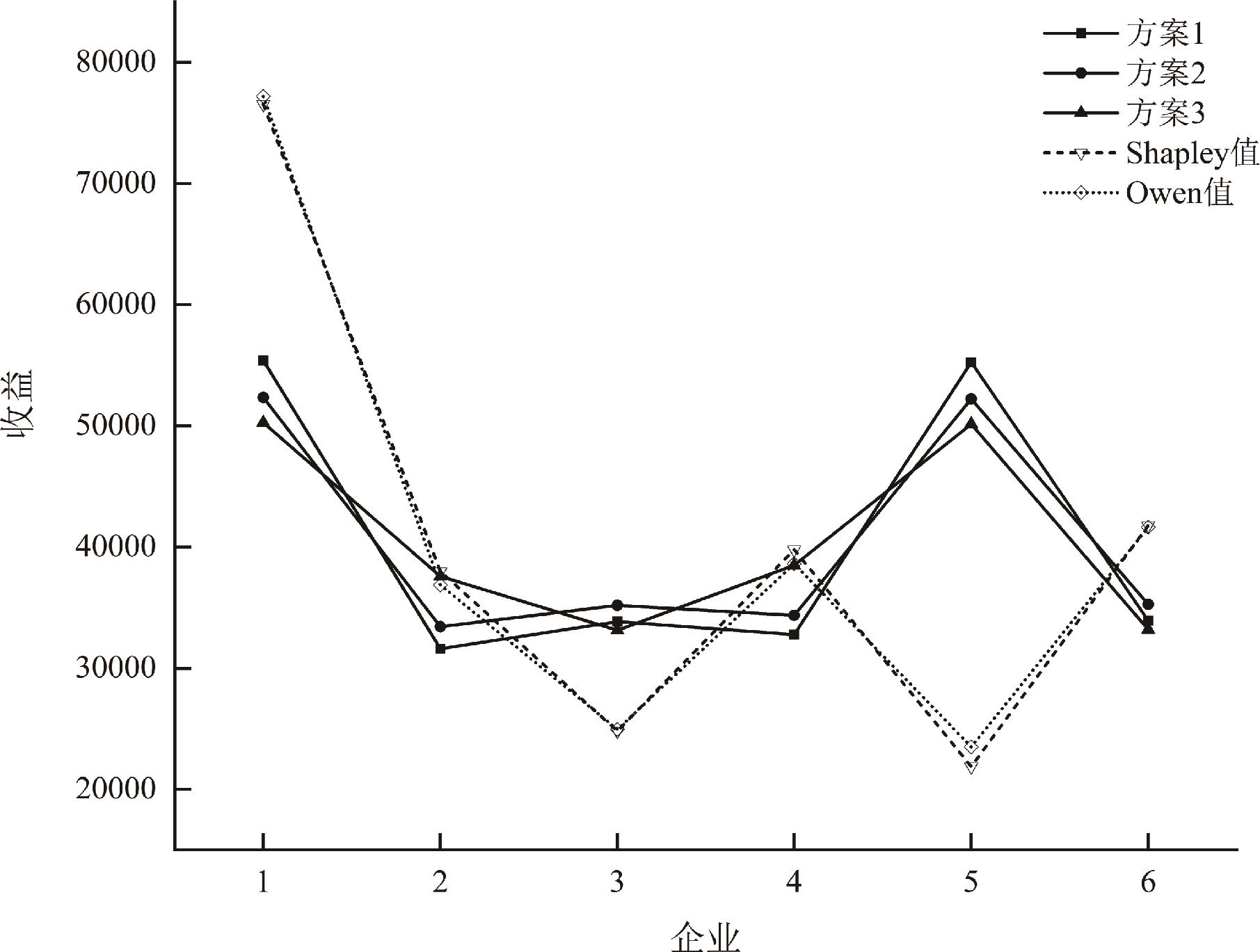
| 序号 | 联盟Banzhaf值 | 方案1 | 方案2 | 方案3 | Shapley值 | Banzhaf值 | Owen值 |
|---|---|---|---|---|---|---|---|
| 1 | 44031.129 | 55396.622 | 52332.129 | 50256.879 | 76543.700 | 79154.816 | 77195.113 |
| 2 | 25122.701 | 31607.473 | 33423.701 | 37574.201 | 37972.680 | 38690.421 | 36876.030 |
| 3 | 26888.579 | 33829.168 | 35189.579 | 33114.329 | 24796.640 | 24870.881 | 24950.240 |
| 4 | 26042.556 | 32764.765 | 34343.556 | 38494.05 | 39788.220 | 40597.536 | 38602.770 |
| 5 | 43912.871 | 55247.838 | 52213.871 | 50138.621 | 21871.875 | 21803.184 | 23497.763 |
| 6 | 26955.919 | 33913.889 | 35256.919 | 33181.669 | 41786.640 | 42692.481 | 41637.840 |
| 总和 | 192953.755 | 242759.755 | 242759.755 | 242759.755 | 242759.755 | 247809.319 | 242759.755 |
"
| [1] | Kash D E, Rycroft R. Emerging patterns of complex technological innovation[J]. Technological Forecasting and Social Change, 2002, 69(6): 581-606. |
| [2] | 周晓晗, 张江华, 徐进. 基于序贯博弈的企业研发合作动机研究[J]. 管理科学学报, 2021, 24(2): 111-126. |
| Zhou X H, Zhang J H, Xu J. Research on the motivation for R & D cooperation between firms based on sequential game[J]. Journal of Management Sciences in China, 2021, 24(2): 111-126. | |
| [3] | 武建龙, 鲍萌萌, 陈劲, 等. 产业联盟创新生态系统升级路径研究[J]. 科研管理, 2022, 43(9): 20-31. |
| Wu J L, Bao M M, Chen J, et al. The upgrading paths of the innovation ecosystem of industry alliances[J]. Science Research Management, 2022, 43(9): 20-31. | |
| [4] | 杨震宁, 杜双, 侯一凡. 目标期望与实现匹配效应如何影响联盟稳定——对中国高技术产业联盟的考察[J]. 管理世界, 2022, 38(12): 122-143. |
| Yang Z N, Du S, Hou Y F. How the matching effects of alliance goal aspiration and achievement influence alliance stability: An investigation based on the high-tech industry alliance in China[J]. Journal of Management World, 2022, 38(12): 122-143. | |
| [5] | 李庆满, 杨皎平, 赵宏霞. 集群内外竞争、标准网络外部性对标准联盟组建意愿和创新绩效的影响[J]. 管理科学, 2018, 31(2): 45-58. |
| Li Q M, Yang J P, Zhao H X. Research of how the competition of intra-cluster and inter-cluster, network externality of standard influence the willingness to form a standard alliance and its innovation performance[J]. Journal of Management Science, 2018, 31(2): 45-58. | |
| [6] | 柴国荣, 徐渝, 叶小青. 技术入股合作创新的市场均衡模型及其管理含义[J]. 科学学与科学技术管理, 2005, 26(3): 34-37. |
| Chai G R, Xu Y, Ye X Q. Market-equilibrium model of technology-stock based cooperation innovation and its management implications[J]. Science of Science and Management of S & T, 2005, 26(3): 34-37. | |
| [7] | 范波, 孟卫东, 代建生. 具有协同效应的合作研发利益分配模型[J]. 系统工程学报, 2015, 30(1): 34-43. |
| Fan B, Meng W D, Dai J S. Profit allocation of collaborative R & D with synergistic effect[J]. Journal of Systems Engineering, 2015, 30(1): 34-43. | |
| [8] | 鲍新中, 王道平. 产学研合作创新成本分摊和收益分配的博弈分析[J].研究与发展管理,2010, 22(5): 75-81. |
| Bao X Z, Wang D P. A game analysis on cost and profit allocation in enterprise-university-research cooperative innovation[J].R&D Management,2010,22(5): 75-81. | |
| [9] | Shapley L S. A value for n-person games[M]//Tucker A W, Kuhn H W. Contributions to the Theory of Games II.Princeton:Princeton University Press,1953: 307-317. |
| [10] | Hart S, Mas-Colell A. Potential, value, and consistency[J]. Econometrica, 1989, 57(3): 589-614. |
| [11] | 张瑜, 菅利荣, 刘思峰, 等. 基于优化Shapley值的产学研网络型合作利益协调机制研究——以产业技术创新战略联盟为例[J].中国管理科学, 2016, 24(9): 36-44. |
| Zhang Y, Jian L R, Liu S F, et al. Interests coordination mechanism of university-industry network cooperation based on optimized shapley value:A case study in industrial technology innovation strategy alliance[J]. Chinese Journal of Management Science, 2016, 24(9): 36-44. | |
| [12] | 王大澳, 菅利荣, 王慧, 等. 基于限制合作博弈的产业集群企业利益分配研究[J]. 中国管理科学, 2019, 27(4): 171-178. |
| Wang D A, Jian L R, Wang H, et al. Study on profit allocation of industrial cluster based on restricted cooperative game[J]. Chinese Journal of Management Science, 2019, 27(4): 171-178. | |
| [13] | Banzhaf J F. Weighted voting does not work: A mathematical analysis[J]. Rutgers Law Review, 1965, 19: 317-343. |
| [14] | Dragan I. New mathematical properties of the Banzhaf value[J]. European Journal of Operational Research, 1996, 95(2): 451-463. |
| [15] | 夏美霞, 李海涛, 丁雪莹, 等. 基于矩阵方法的Banzhaf值的计算及应用[J]. 控制理论与应用, 2020, 37(2): 446-452. |
| Xia M X, Li H T, Ding X Y, et al. Matrix approach to calculation of Banzhaf value with applications[J]. Control Theory & Applications, 2020, 37(2): 446-452. | |
| [16] | 徐选华, 赵程伟, 何继善, 等. 多型异构数据下关联变权空间多属性决策方法[J]. 系统工程理论与实践, 2020, 40(7): 1895-1905. |
| Xu X H, Zhao C W, He J S, et al. Association variable weight space multi-attribute decision method under multi-type heterogeneous data[J].Systems Engineering- Theory & Practice, 2020, 40(7): 1895-1905. | |
| [17] | 姜琳, 朱建军. 考虑双参照点和Choquet积分的新型研发机构绩效评估方法及应用[J]. 运筹与管理, 2022, 31(2): 141-147. |
| Jiang L, Zhu J J. Performance evaluation method and application of new R & D institutions considering double reference points and choquet integral[J]. Operations Research and Management Science, 2022, 31(2): 141-147. | |
| [18] | Aumann R J, Dreze J H. Cooperative games with coalition structures[J]. International Journal of Game Theory, 1974, 3(4): 217-237. |
| [19] | Kamijo Y. A two-step shapley value for cooperative games with coalition structures[J]. International Game Theory Review (IGTR), 2009, 11(2): 207-214. |
| [20] | 单而芳, 吕文蓉, 史纪磊. 具有联盟结构的Banzhaf值[J]. 运筹与管理, 2023, 32(4): 93-97. |
| Shan E F, Lyu W R, Shi J L. The banzhaf value with coalition structures[J]. Operations Research and Management Science, 2023, 32(4): 93-97. | |
| [21] | Driessen T S H. A survey of consistency properties in cooperative game theory[J]. SIAM Review, 1991, 33(1): 43-59. |
| [22] | Calleja P, Llerena F. Consistency, weak fairness, and the Shapley value[J]. Mathematical Social Sciences, 2020, 105: 28-33. |
| [23] | Calleja P, Llerena F. Path monotonicity, consistency and axiomatizations of some weighted solutions[J]. International Journal of Game Theory, 2019, 48(1): 287-310. |
| [24] | 张根明, 杨思涵. 技术入股型产学研合作创新的利益分配研究——基于技术价值不确定性的新视角[J]. 软科学, 2017, 31(10): 1-5. |
| Zhang G M, Yang S H. Research on the benefit distribution of industry-university-research cooperation innovation through technology share: New perspective of the technology value uncertainty[J]. Soft Science, 2017, 31(10): 1-5. | |
| [25] | 陈邑早, 黄诗华, 王圣媛. 我国区域创新生态系统运行效率: 基于创新价值链视角[J]. 科研管理, 2022, 43(7): 11-19. |
| Chen Y Z, Huang S H, Wang S Y. The operational efficiency of the regional innovation ecosystem in China: A study based on the perspective of innovation value chain[J]. Science Research Management, 2022, 43(7): 11-19. | |
| [26] | 代建生, 范波. 基于纳什谈判的合作研发利益分配模型[J]. 研究与发展管理, 2015, 27(1): 35-43. |
| Dai J S, Fan B. Profit distribution model of collaborative R & D based on Nash bargaining[J]. R&D Management, 2015, 27(1): 35-43. | |
| [27] | 蒋兴华, 汪玲芳, 范心雨. 基于合作博弈的跨组织技术创新利益分配机制[J]. 科技管理研究, 2021, 41(16): 185-198. |
| Jiang X H, Wang L F, Fan X Y. Benefit distribution mechanism of cross-organizational technological innovation based on cooperative game[J]. Science and Technology Management Research, 2021, 41(16): 185-198. | |
| [28] | Owen G. Values of games with a priori unions[M]//Henn R,Moeschlin Q.Mathematical Economics and Game Theory. Berlin, Heidelberg: Springer, 1977: 76-88. |
| [1] | Lei Zhang, Keke Han, Xin Ye. Emergency Decision-making Method Considering the Influence of Expert and the Consistency of Valuation from the Perspective of Generalized Z-numbers Evidence [J]. Chinese Journal of Management Science, 2025, 33(6): 160-170. |
| [2] | Yang Jiao,Gang Li,Jianping Li,Bin Wang,Zhipeng Zhang. Research on the Weighting Method for Group Decision Considering Effective Information of Experts [J]. Chinese Journal of Management Science, 2024, 32(8): 107-116. |
| [3] | Rongqing Yang,Xiaoan Tang,Qiang Zhang,Ting Huang. Best-worst Multi-criteria Decision-making Method with Decision Maker's Preference Adjustment Willingness under Distributed Multiplicative Preference Environment [J]. Chinese Journal of Management Science, 2024, 32(7): 65-75. |
| [4] | Xi Chen, Wenbo Zhang, Meixia Zhang, Qing Guo. Intelligent Diagnosis Decision Method Based on Multi-source Fusion of Patient Behavior Information [J]. Chinese Journal of Management Science, 2024, 32(11): 214-221. |
| [5] | JIN Fei-fei, NI Zhi-wei, CHEN Hua-you, ZHU Xu-hui, WU Wen-ying. Linguistic Preference Decision-Making Model Based on Consistency Local Adjustment Algorithm and DEA [J]. Chinese Journal of Management Science, 2019, 27(12): 152-163. |
| [6] | MIAO Rui, XU Jian. The Impact of Rating Inconsistency on Online Review Helpfulness: A Perspective on Attribution Theory [J]. Chinese Journal of Management Science, 2018, 26(5): 178-186. |
| [7] | LIU Wen-li, WANG Ying-ming, LV Shu-long. Ranking Decision Making Units Based on Cross-efficiency and Cooperative Game [J]. Chinese Journal of Management Science, 2018, 26(4): 163-170. |
| [8] | LI Ai-hua, SU Jie, JIA Chuan-liang. The Coordinated Development and Consistent Model Between Economic Growth and Carbon Emissions [J]. Chinese Journal of Management Science, 2017, 25(4): 1-6. |
| [9] | SHI Liang, LU Yao-bin, YANG Shui-qing. The Effect of Consistency Perception on Consumer Mobile-shopping Behavior: A Perspective on Cross Channel of Web-Mobile [J]. Chinese Journal of Management Science, 2017, 25(4): 70-77. |
| [10] | DING Tao, WU Hua-qing, LIANG Liang. A Weight Adjustment Method in 360-degree Evaluation System [J]. Chinese Journal of Management Science, 2016, 24(7): 149-154. |
| [11] | SHI Xiao-jing, LIANG Xun, SUN Xiao-lei. Rater Utility Mechanism Research Based On Online Rating and Comment [J]. Chinese Journal of Management Science, 2016, 24(5): 149-157. |
| [12] | LI Mei-juan, XU Lin-ming, CHEN Guo-hong. A Dynamic Combined Evaluation Method Based on Consistency [J]. Chinese Journal of Management Science, 2016, 24(10): 149-155. |
| [13] | WANG Hong-Bo, LUO He, YANG Shan-Lin. Inconsistency Judgment Matrix Ranking Method Based on Manifold Learning [J]. Chinese Journal of Management Science, 2015, 23(10): 147-155. |
| [14] | ZOU Zi-ran, CHEN Shou, YANG Yan, ZHANG Hong-hao. The Optimization and Decision-making of Principal-agent Problem Based on Time-inconsistency Preference [J]. Chinese Journal of Management Science, 2013, 21(4): 27-34. |
| [15] | GUO Ya-jun, MA Zan-fu, ZHANG Fa-ming. Validity Analysis of Several Kinds of Combination Evaluation Methods [J]. Chinese Journal of Management Science, 2009, 17(2): 125-130. |
| Viewed | ||||||
|
Full text |
|
|||||
|
Abstract |
|
|||||
|
||
