
主管:中国科学院
主办:中国优选法统筹法与经济数学研究会
中国科学院科技战略咨询研究院
主办:中国优选法统筹法与经济数学研究会
中国科学院科技战略咨询研究院

中国管理科学 ›› 2026, Vol. 34 ›› Issue (8): 12-27.doi: 10.16381/j.cnki.issn1003-207x.2024.2113cstr: 32146.14.j.cnki.issn1003-207x.2024.2113
姚海祥1,2, 何妃婷1, 杨晓光3,4( )
)
收稿日期:2024-11-23
修回日期:2025-11-18
出版日期:2026-08-25
发布日期:2026-07-14
通讯作者:
杨晓光
E-mail:xgyang@iss.ac.cn
基金资助:
Haixiang Yao1,2, Feiting He1, Xiaoguang Yang3,4()
Received:2024-11-23
Revised:2025-11-18
Online:2026-08-25
Published:2026-07-14
Contact:
Xiaoguang Yang
E-mail:xgyang@iss.ac.cn
摘要:
在世界动荡、经济逆全球化加剧的背景下,考察不同重大冲击下全球外汇市场的风险传染机制,对于维护全球汇率稳定具有重要意义。本文基于2005—2023年全球27种主要货币,分别构建R-Vine Copula模型和Elastic Net-VAR模型,从联动网络与溢出网络两个维度出发,综合探究不同极端事件冲击下全球汇率市场间的风险传染效应。研究发现,美元与沙特里亚尔始终是全球汇率风险联动网络中的重要节点,在溢出网络中也表现出了强烈的风险输送特征。同时,汇率市场间的风险联动网络与风险溢出网络变迁均具有事件驱动特征,极端事件的冲击更易引发汇率风险在不同地理区域的货币之间交叉感染。特别地,俄乌冲突爆发后,整体汇率格局开始呈现区块化趋势,经济逆全球化对全球汇率格局的影响逐渐凸显,欧亚货币间的跨区域联动与风险溢出有所减弱,美元对其他地理区域的货币表现出强劲的风险溢出特征,跨区域风险联动与溢出更多存在于具有合作关系、经济体量相近或地理位置邻近的地区之间。此外,风险溢出网络的拓扑分组还进一步表明,新冠疫情期间的跨区域风险溢出效应最为显著,其次为次贷危机,最后为俄乌冲突。
中图分类号:
姚海祥,何妃婷,杨晓光. 极端事件冲击下全球外汇市场的风险传染效应研究[J]. 中国管理科学, 2026, 34(8): 12-27.
Haixiang Yao,Feiting He,Xiaoguang Yang. Research on the Risk Contagion Effect of Global Foreign Exchange Rate Markets under Extreme Event Shocks[J]. Chinese Journal of Management Science, 2026, 34(8): 12-27.

表1
各国汇率变量说明"
| 货币名称 | 简称(货币代码) | 货币名称 | 简称(货币) |
|---|---|---|---|
| 丹麦克朗 | DKK | 英镑 | GBP |
| 挪威克朗 | NOK | 人民币 | CNY |
| 波兰兹罗提 | PLN | 印度卢比 | INR |
| 新加坡元 | SGD | 墨西哥比索 | MXN |
| 瑞典克朗 | SEK | 巴西雷亚尔 | BRL |
| 瑞士法朗 | CHF | 韩元 | KRW |
| 新西兰元 | NZD | 土耳其里拉 | TRY |
| 泰铢 | THB | 南非兰特 | ZAR |
| 马来西亚林吉特 | MYR | 美元 | USD |
| 港币 | HKD | 澳大利亚元 | AUD |
| 俄罗斯卢布 | RUB | 日元 | JPY |
| 印尼卢比 | IDR | 沙特里亚尔 | SAR |
| 欧元 | EUR | 阿根廷比索 | ARS |
| 加拿大元 | CAD |
表2
第一层树R-藤Copula模型参数表"
| edge | copula | edge | copula | ||||||||||
|---|---|---|---|---|---|---|---|---|---|---|---|---|---|
| Panel A.平稳期 | Panel B.次贷危机时期 | ||||||||||||
| AUD,NZD | G | 1.40 | - | 0.29 | 0.36 | - | EUR,INR | F | -2.63 | - | -0.27 | - | - |
| DKK,GBP | N | -0.32 | - | -0.21 | - | - | EUR,DKK | t | 0.96 | 3.47 | 0.81 | 0.76 | 0.76 |
| NOK,SEK | t | 0.22 | 14.79 | 0.14 | 0.01 | 0.01 | HKD,RUB | G | 1.43 | - | 0.30 | 0.37 | - |
| THB,MYR | t | 0.31 | 8.16 | 0.20 | 0.06 | 0.06 | HKD,KRW | t | 1.00 | 30.00 | 0.99 | 0.97 | 0.97 |
| JPY,IDR | t | -0.34 | 11.88 | -0.22 | 0 | 0 | NZD,SGD | t | 0.47 | 6.60 | 0.31 | 0.14 | 0.14 |
| EUR,INR | t | -0.44 | 12.65 | -0.29 | 0 | 0 | AUD,NZD | t | 0.75 | 8.59 | 0.54 | 0.27 | 0.27 |
| THB,JPY | N | -0.36 | - | -0.24 | - | - | SAR,EUR | t | -0.79 | 3.85 | -0.58 | 0 | 0 |
| SAR,THB | t | 0.43 | 7.43 | 0.29 | 0.10 | 0.10 | SAR,HKD | t | 0.94 | 3.55 | 0.77 | 0.72 | 0.72 |
| HKD,KRW | t | 1.00 | 7.99 | 0.96 | 0.93 | 0.93 | JPY,GBP | t | -0.23 | 6.32 | -0.15 | 0.01 | 0.01 |
| HKD,SGD | t | -0.42 | 6.63 | -0.28 | 0 | 0 | JPY,IDR | t | -0.51 | 6.17 | -0.34 | 0 | 0 |
| EUR,CHF | F | 3.42 | - | 0.34 | - | - | JPY,CHF | t | 0.64 | 3.99 | 0.44 | 0.34 | 0.34 |
| SAR,HKD | t | 0.97 | 2.48 | 0.83 | 0.82 | 0.82 | THB,MYR | N | 0.37 | - | 0.24 | - | - |
| DKK,RUB | t | -0.42 | 17.33 | -0.28 | 0 | 0 | USD,PLN | G270 | -1.53 | - | -0.35 | - | - |
| EUR,DKK | t | 0.97 | 3.79 | 0.84 | 0.79 | 0.79 | CNY,THB | t | 0.61 | 5.97 | 0.41 | 0.23 | 0.23 |
| USD,PLN | t | -0.43 | 19.40 | -0.28 | 0 | 0 | SAR,CNY | t | 0.84 | 3.36 | 0.63 | 0.56 | 0.56 |
| CAD,NOK | t | 0.37 | 17.11 | 0.24 | 0.01 | 0.01 | TRY,JPY | t | -0.63 | 8.76 | -0.43 | 0 | 0 |
| CAD,AUD | t | 0.48 | 14.04 | 0.32 | 0.04 | 0.04 | BRL,MXN | t | 0.60 | 16.46 | 0.41 | 0.05 | 0.05 |
| ZAR,TRY | F | 3.56 | - | 0.35 | - | - | ZAR,TRY | t | 0.68 | 10.22 | 0.48 | 0.17 | 0.17 |
| MXN,ZAR | t | 0.56 | 7.09 | 0.38 | 0.17 | 0.17 | BRL,ZAR | t | 0.59 | 13.99 | 0.40 | 0.07 | 0.07 |
| ARS,BRL | F | -5.47 | - | -0.48 | - | - | USD,NOK | t | -0.50 | 8.51 | -0.34 | 0 | 0 |
| USD,ARS | F | 4.43 | - | 0.42 | - | - | USD,SEK | F | -3.29 | - | -0.33 | - | - |
| USD,CAD | t | -0.60 | 23.37 | -0.41 | 0 | 0 | USD,CAD | t | -0.64 | 6.19 | -0.45 | 0 | 0 |
| USD,MXN | t | -0.57 | 11.33 | -0.39 | 0 | 0 | USD,SAR | t | 0.90 | 5.12 | 0.71 | 0.59 | 0.59 |
| SAR,EUR | t | -0.57 | 8.26 | -0.39 | 0 | 0 | ARS,BRL | t | -0.72 | 13.46 | -0.51 | 0 | 0 |
| SAR,CNY | t | 0.72 | 2.10 | 0.51 | 0.52 | 0.52 | ARS,USD | t | 0.62 | 5.00 | 0.42 | 0.28 | 0.28 |
| SAR,USD | t | 0.91 | 3.40 | 0.73 | 0.67 | 0.67 | ARS,AUD | t | -0.61 | 7.10 | -0.41 | 0 | 0 |
| Panel C.新冠疫情时期 | Panel D.俄乌冲突时期 | ||||||||||||
| JPY,THB | t | -0.27 | 6.22 | -0.17 | 0.01 | 0.01 | USD,SEK | N | -0.53 | - | -0.36 | - | - |
| JPY,IDR | t | -0.36 | 5.99 | -0.24 | 0.01 | 0.01 | JPY,CHF | SC | 0.33 | - | 0.14 | 0.12 | - |
| JPY,CHF | F | 3.81 | - | 0.37 | - | - | CNY,JPY | t | -0.35 | 8.92 | -0.22 | 0 | 0 |
| DKK,RUB | t | -0.61 | 2.00 | -0.42 | 0.04 | 0.04 | EUR,CNY | G270 | -1.41 | -0.29 | - | - | |
| EUR,DKK | t | 0.96 | 20.25 | 0.82 | 0.52 | 0.52 | EUR,DKK | t | 0.92 | 10.03 | 0.74 | 0.51 | 0.51 |
| AUD,NOK | t | 0.80 | 3.98 | 0.59 | 0.49 | 0.49 | USD,PLN | t | -0.49 | 10.50 | -0.32 | 0 | 0 |
| AUD,CAD | t | 0.84 | 4.62 | 0.63 | 0.51 | 0.51 | AUD,SGD | N | 0.40 | - | 0.27 | - | - |
| NZD,GBP | t | 0.41 | 8.00 | 0.27 | 0.08 | 0.08 | NZD,GBP | F | 2.85 | - | 0.29 | - | - |
| SAR,MYR | t | 0.77 | 2.00 | 0.56 | 0.58 | 0.58 | AUD,NZD | N | 0.71 | - | 0.50 | - | - |
| CNY,JPY | t | -0.44 | 5.43 | -0.29 | 0.01 | 0.01 | TRY,EUR | t | -0.62 | 7.64 | -0.43 | 0 | 0 |
| SAR,PLN | t | -0.66 | 12.23 | -0.46 | 0 | 0 | USD,TRY | t | 0.74 | 3.25 | 0.53 | 0.47 | 0.47 |
| EUR,CNY | t | -0.65 | 2.99 | -0.45 | 0.01 | 0.01 | USD,INR | t | 0.55 | 4.74 | 0.37 | 0.24 | 0.24 |
| EUR,TRY | N | -0.70 | - | -0.50 | - | - | CAD,NOK | t | 0.58 | 14.11 | 0.39 | 0.06 | 0.06 |
| HKD,KRW | N | 1.00 | - | 0.97 | - | - | AUD,CAD | t | 0.70 | 11.80 | 0.49 | 0.15 | 0.15 |
| SAR,HKD | F | 27.78 | - | 0.86 | - | - | USD,MXN | G270 | -1.33 | - | -0.25 | - | - |
| EUR,INR | N | -0.69 | - | -0.48 | - | - | USD,AUD | t | -0.59 | 7.38 | -0.40 | 0 | 0 |
| SAR,EUR | t | -0.64 | 2.38 | -0.44 | 0.02 | 0.02 | SAR,THB | N | -0.29 | -0.19 | - | - | |
| USD,SAR | t | 0.99 | 3.57 | 0.89 | 0.86 | 0.86 | HKD,KRW | t | 1.00 | 26.13 | 0.95 | 0.85 | 0.85 |
| MXN,ZAR | t | 0.92 | 6.96 | 0.75 | 0.59 | 0.59 | SAR,HKD | t | 0.97 | 4.46 | 0.85 | 0.80 | 0.80 |
| ARS,BRL | t | -0.89 | 3.62 | -0.70 | 0 | 0 | SAR,MYR | t | 0.51 | 2.24 | 0.34 | 0.38 | 0.38 |
| USD,ARS | F | 9.63 | - | 0.66 | - | - | SAR,RUB | F | 2.34 | - | 0.25 | - | - |
| USD,MXN | t | -0.91 | 3.27 | -0.73 | 0 | 0 | SAR,IDR | SG | 1.23 | - | 0.19 | - | 0.25 |
| USD,SEK | N | -0.63 | - | -0.43 | - | - | USD,ZAR | t | -0.47 | 10.50 | -0.31 | 0 | 0 |
| AUD,NZD | F | 7.46 | - | 0.58 | - | - | USD,SAR | t | 0.96 | 3.73 | 0.83 | 0.78 | 0.78 |
| AUD,SGD | t | 0.75 | 3.42 | 0.54 | 0.47 | 0.47 | ARS,BRL | t | -0.65 | 5.59 | -0.45 | 0 | 0 |
| AUD,USD | t | -0.83 | 4.76 | -0.63 | 0 | 0 | ARS,USD | G | 2.14 | - | 0.53 | 0.62 | - |
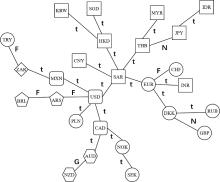
图1
平稳期汇率风险相依结构"
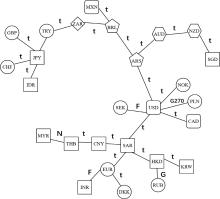
图2
次贷危机时期汇率风险相依结构"
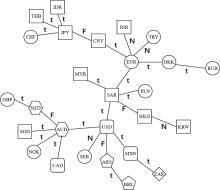
图3
疫情时期汇率风险相依结构"
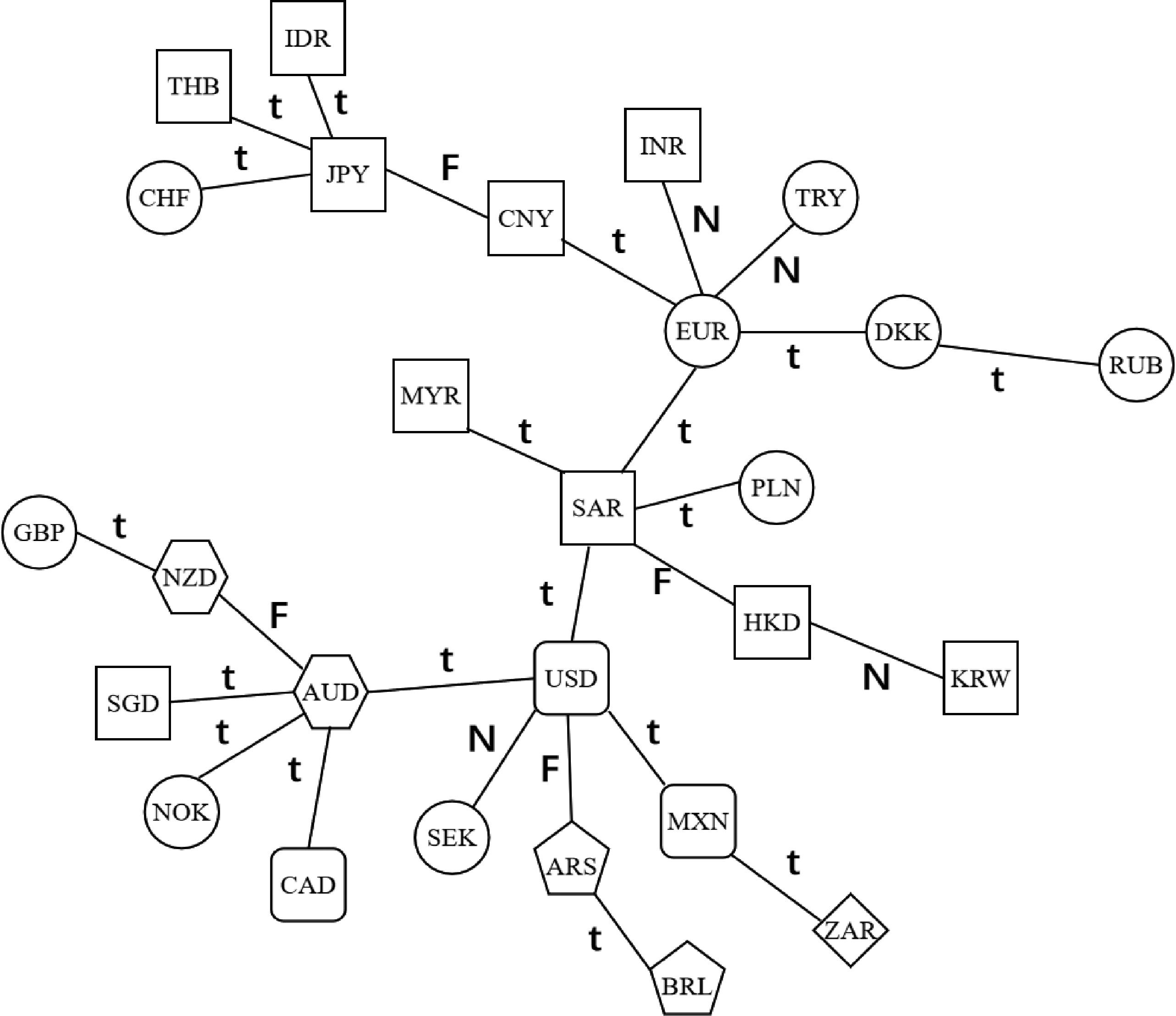
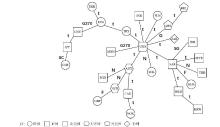
图4
俄乌冲突时期汇率风险相依结构"
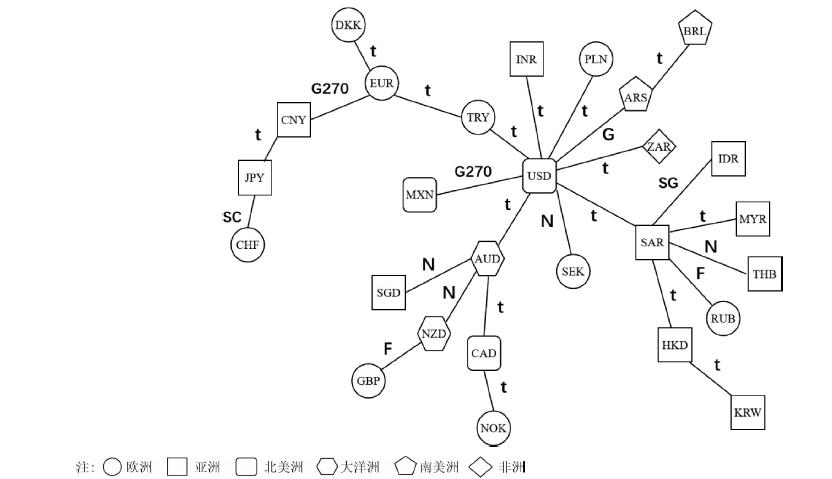
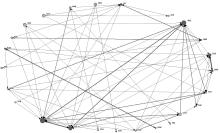
图5
平稳时期风险传染的静态网络"
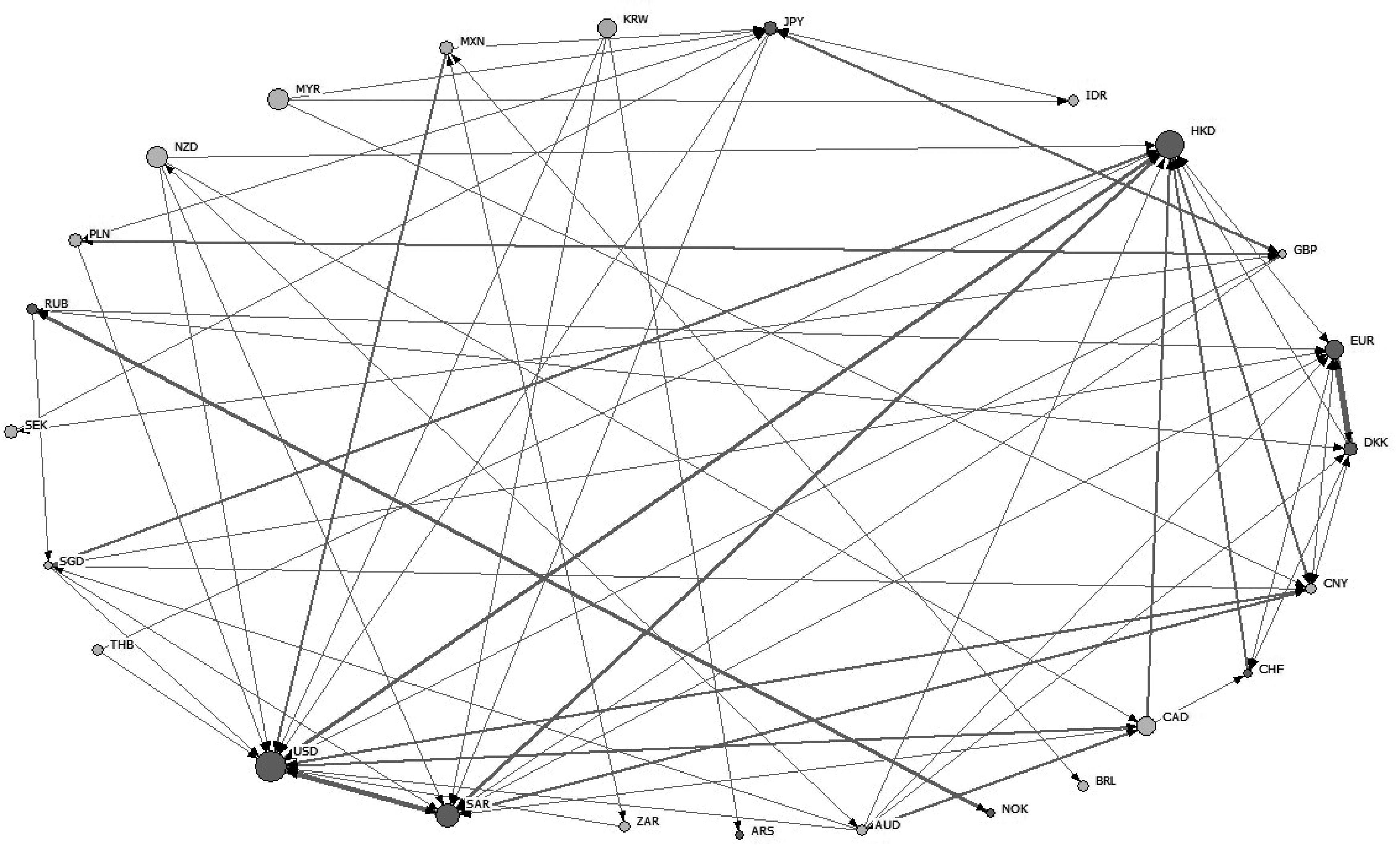

图6
次贷危机时期风险传染的静态网络"
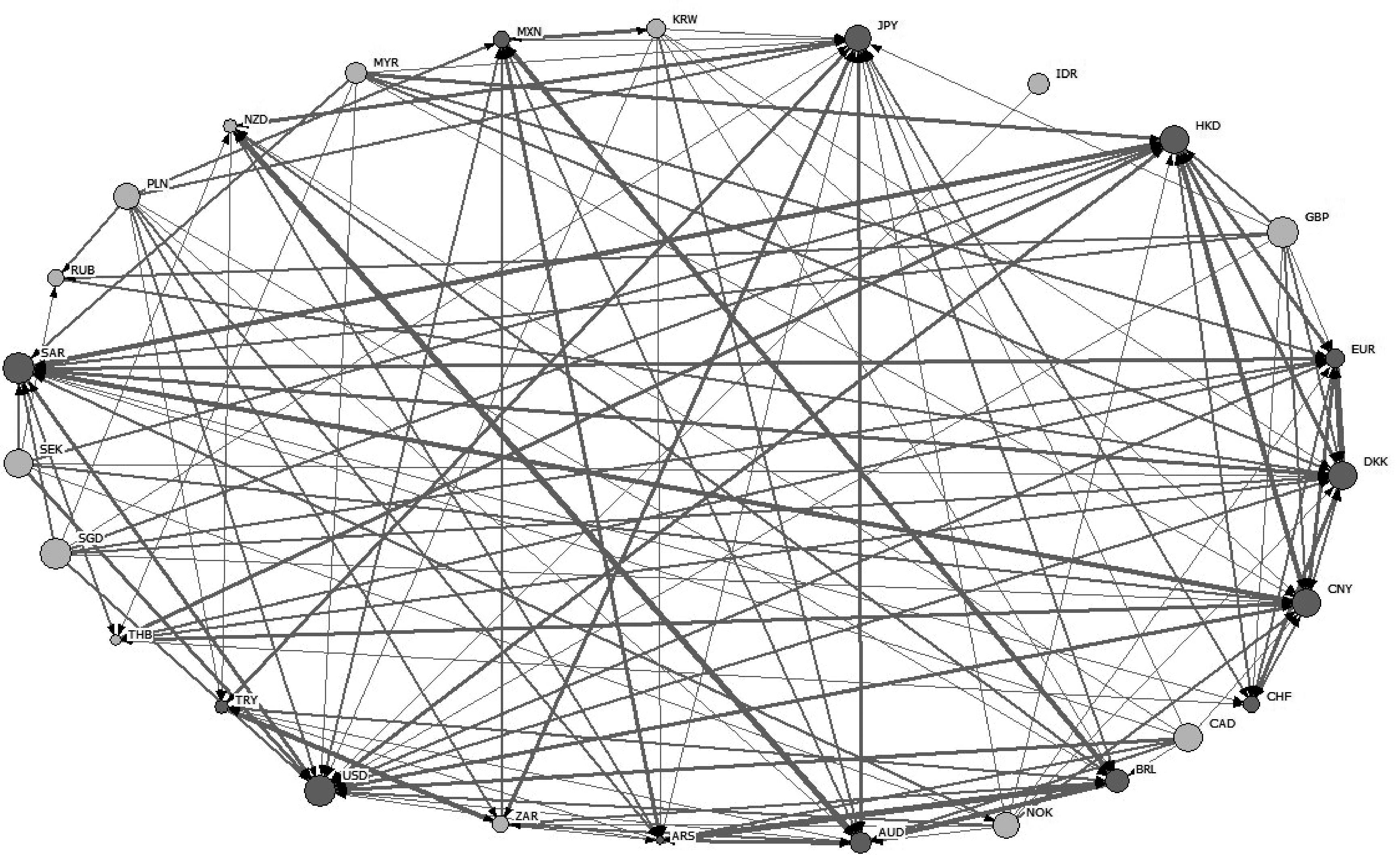
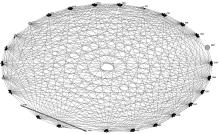
图7
疫情时期风险传染的静态网络"
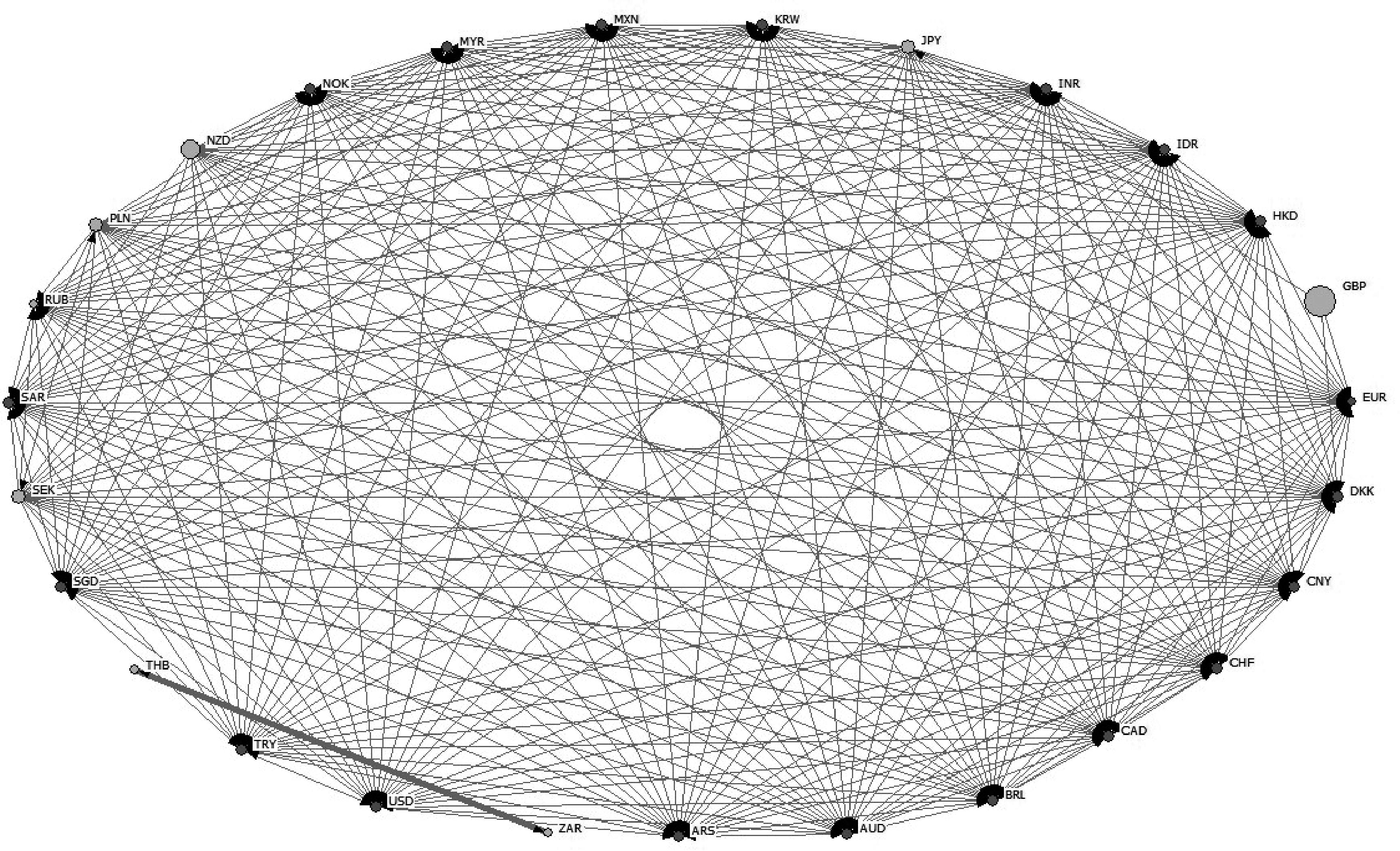
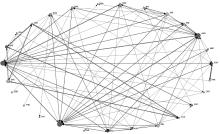
图8
俄乌冲突时期风险传染的静态网络"

表3
各时期全球汇率市场风险净溢出值"
| 平稳期 | 次贷危机时期 | 疫情时期 | 俄乌冲突时期 | ||||
|---|---|---|---|---|---|---|---|
| 币种 | 净溢出 | 币种 | 净溢出 | 币种 | 净溢出 | 币种 | 净溢出 |
| USD | 50.9 | SAR | 50.8 | USD | 10.3 | USD | 90.4 |
| HKD | 43.0 | USD | 50.6 | CAD | 9.6 | SAR | 83.7 |
| SAR | 34.1 | CNY | 47.3 | INR | 9.3 | HKD | 74.8 |
| EUR | 23.1 | DKK | 46.8 | ARS | 9.2 | RUB | 42.4 |
| DKK | 15.5 | HKD | 44.6 | SAR | 9.0 | EUR | 18.2 |
| JPY | 15.3 | JPY | 37.2 | SGD | 8.9 | ARS | 15.2 |
| RUB | 6.2 | BRL | 35.4 | BRL | 8.9 | CHF | 10.5 |
| ARS | 3.4 | AUD | 30.2 | CHF | 8.6 | PLN | -3.8 |
| NOK | 2.2 | EUR | 25.0 | IDR | 8.6 | MXN | -4.9 |
| CHF | 2.1 | MXN | 15.4 | NOK | 8.0 | TRY | -5.1 |
| GBP | -2.9 | CHF | 14.8 | HKD | 7.8 | ZAR | -5.2 |
| SGD | -3.5 | TRY | 13.3 | CNY | 7.4 | AUD | -6.3 |
| CNY | -5.2 | ARS | 0.1 | MXN | 7.3 | JPY | -8.9 |
| IDR | -5.5 | THB | -3.2 | AUD | 7.3 | IDR | -11.1 |
| THB | -6.2 | NZD | -11.1 | MYR | 7.0 | SGD | -11.6 |
| BRL | -6.5 | ZAR | -15.5 | KRW | 6.3 | CNY | -11.7 |
| AUD | -6.6 | RUB | -15.6 | DKK | 4.8 | CAD | -12.0 |
| INR | -6.9 | INR | -18.1 | TRY | 3.9 | GBP | -12.5 |
| TRY | -8.1 | KRW | -23.2 | EUR | 2.1 | THB | -13.7 |
| ZAR | -9.8 | MYR | -26.1 | THB | -0.2 | DKK | -16.0 |
| PLN | -10.9 | IDR | -28.4 | ZAR | -0.2 | NZD | -16.3 |
| SEK | -11.2 | NOK | -38.8 | RUB | -2.9 | NOK | -19.5 |
| MXN | -11.8 | PLN | -41.5 | SEK | -14.2 | KRW | -21.2 |
| CAD | -21.6 | CAD | -43.4 | PLN | -15.4 | MYR | -24.5 |
| KRW | -23.4 | SEK | -46.7 | JPY | -16.6 | INR | -38.3 |
| NZD | -26.8 | GBP | -49.7 | NZD | -28.6 | BRL | -44.6 |
| MYR | -28.7 | SGD | -50.3 | GBP | -66.2 | SEK | -48.1 |
表4
全球汇率市场风险的网络拓扑分析(基于地理区域的分组)"
| Panel A.平稳期 | Panel B.次贷危机时期 | ||||||||||||||||
|---|---|---|---|---|---|---|---|---|---|---|---|---|---|---|---|---|---|
IFO- mean | OTO- mean | IFO- mean | OTO- mean | ||||||||||||||
| a | 亚洲 | 欧洲 | 大洋洲 | 北美洲 | 南美洲 | 非洲 | a | 亚洲 | 欧洲 | 大洋洲 | 北美洲 | 南美洲 | 非洲 | ||||
| b | b | ||||||||||||||||
| 亚洲 | 7.348 | 1.348 | 1.060 | 3.337 | 0.620 | 0.960 | 1.556 | 1.635 | 亚洲 | 6.266 | 2.289 | 2.290 | 2.653 | 1.650 | 0.850 | 2.194 | 2.378 |
| 欧洲 | 1.377 | 8.954 | 0.622 | 1.119 | 0.200 | 0.567 | 1.074 | 1.174 | 欧洲 | 2.758 | 5.867 | 1.933 | 2.811 | 2.111 | 3.189 | 2.627 | 2.052 |
| 大洋洲 | 1.815 | 1.322 | 28.300 | 3.617 | 0.550 | 1.350 | 1.734 | 1.056 | 大洋洲 | 1.855 | 1.522 | 18.375 | 3.550 | 8.650 | 3.000 | 2.528 | 2.914 |
| 北美洲 | 3.130 | 1.185 | 2.600 | 16.367 | 0.767 | 2.167 | 2.119 | 2.304 | 北美洲 | 2.587 | 1.756 | 4.733 | 11.733 | 6.117 | 1.433 | 2.700 | 3.019 |
| 南美洲 | 0.440 | 0.367 | 0.600 | 1.250 | 42.800 | 1.750 | 0.576 | 0.516 | 南美洲 | 1.335 | 1.456 | 7.125 | 5.117 | 20.175 | 3.550 | 2.384 | 3.092 |
| 非洲 | 1.500 | 0.722 | 1.200 | 2.133 | 1.500 | 62.800 | 1.281 | 1.054 | 非洲 | 1.460 | 2.833 | 4.100 | 3.300 | 6.150 | 29.700 | 2.712 | 2.100 |
| Panel C.疫情时期 | Panel D.俄乌冲突时期 | ||||||||||||||||
IFO- mean | OTO- mean | IFO- mean | OTO- mean | ||||||||||||||
| a | 亚洲 | 欧洲 | 大洋洲 | 北美洲 | 南美洲 | 非洲 | a | 亚洲 | 欧洲 | 大洋洲 | 北美洲 | 南美洲 | 非洲 | ||||
| b | b | ||||||||||||||||
| 亚洲 | 3.995 | 3.212 | 3.135 | 3.967 | 3.960 | 4.980 | 3.528 | 3.762 | 亚洲 | 7.409 | 0.857 | 1.220 | 3.833 | 1.785 | 0.590 | 1.518 | 1.625 |
| 欧洲 | 3.688 | 3.884 | 3.461 | 4.248 | 4.233 | 0.011 | 3.612 | 3.119 | 欧洲 | 1.220 | 7.940 | 2.606 | 2.630 | 1.411 | 0.378 | 1.583 | 1.373 |
| 大洋洲 | 3.730 | 3.528 | 4.675 | 4.367 | 4.300 | 0.000 | 3.630 | 3.034 | 大洋洲 | 1.420 | 3.433 | 17.425 | 4.767 | 2.475 | 0.750 | 2.604 | 2.148 |
| 北美洲 | 3.840 | 3.574 | 3.550 | 4.511 | 4.450 | 0.000 | 3.607 | 3.860 | 北美洲 | 2.400 | 2.070 | 4.567 | 14.144 | 2.683 | 0.500 | 2.401 | 3.421 |
| 南美洲 | 3.395 | 3.106 | 1.350 | 3.000 | 2.325 | 0.000 | 2.944 | 3.986 | 南美洲 | 2.880 | 1.328 | 1.900 | 4.717 | 20.350 | 0.700 | 2.376 | 1.786 |
| 非洲 | 4.990 | 0.033 | 0.000 | 0.000 | 0.000 | 49.800 | 1.931 | 1.919 | 非洲 | 0.840 | 0.411 | 0.550 | 1.133 | 1.100 | 81.100 | 0.723 | 0.527 |
表5
全球汇率市场风险的网络拓扑分析(基于资本开放程度的分组)"
| Panel A.平稳期 | Panel B.次贷危机时期 | ||||||||||
|---|---|---|---|---|---|---|---|---|---|---|---|
| IFO-mean | OTO-mean | IFO-mean | OTO-mean | ||||||||
| a | 高度 | 中高 | 中低 | a | 高度 | 中高 | 中低 | ||||
| b | b | ||||||||||
| 高度 | 5.843 | 0.859 | 0.955 | 1.396 | 1.702 | 高度 | 4.754 | 3.548 | 2.281 | 2.574 | 2.499 |
| 中高 | 2.888 | 16.333 | 1.047 | 2.121 | 2.281 | 中高 | 3.002 | 9.767 | 2.873 | 2.949 | 3.288 |
| 中低 | 1.346 | 1.463 | 7.673 | 1.367 | 0.971 | 中低 | 2.349 | 2.923 | 5.835 | 2.450 | 2.386 |
| Panel C.疫情时期 | Panel D.俄乌冲突时期 | ||||||||||
| IFO-mean | OTO-mean | IFO-mean | OTO-mean | ||||||||
| a | 高度 | 中高 | 中低 | a | 高度 | 中高 | 中低 | ||||
| b | b | ||||||||||
| 高度 | 3.915 | 3.940 | 3.336 | 3.476 | 3.190 | 高度 | 5.356 | 2.924 | 1.623 | 1.923 | 2.041 |
| 中高 | 3.764 | 4.356 | 3.433 | 3.626 | 3.638 | 中高 | 2.160 | 18.311 | 1.487 | 1.879 | 2.921 |
| 中低 | 3.018 | 3.213 | 4.807 | 3.052 | 3.354 | 中低 | 2.006 | 2.917 | 6.308 | 2.166 | 1.599 |
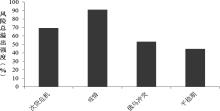
图9
各时期的风险溢出总效应对比"
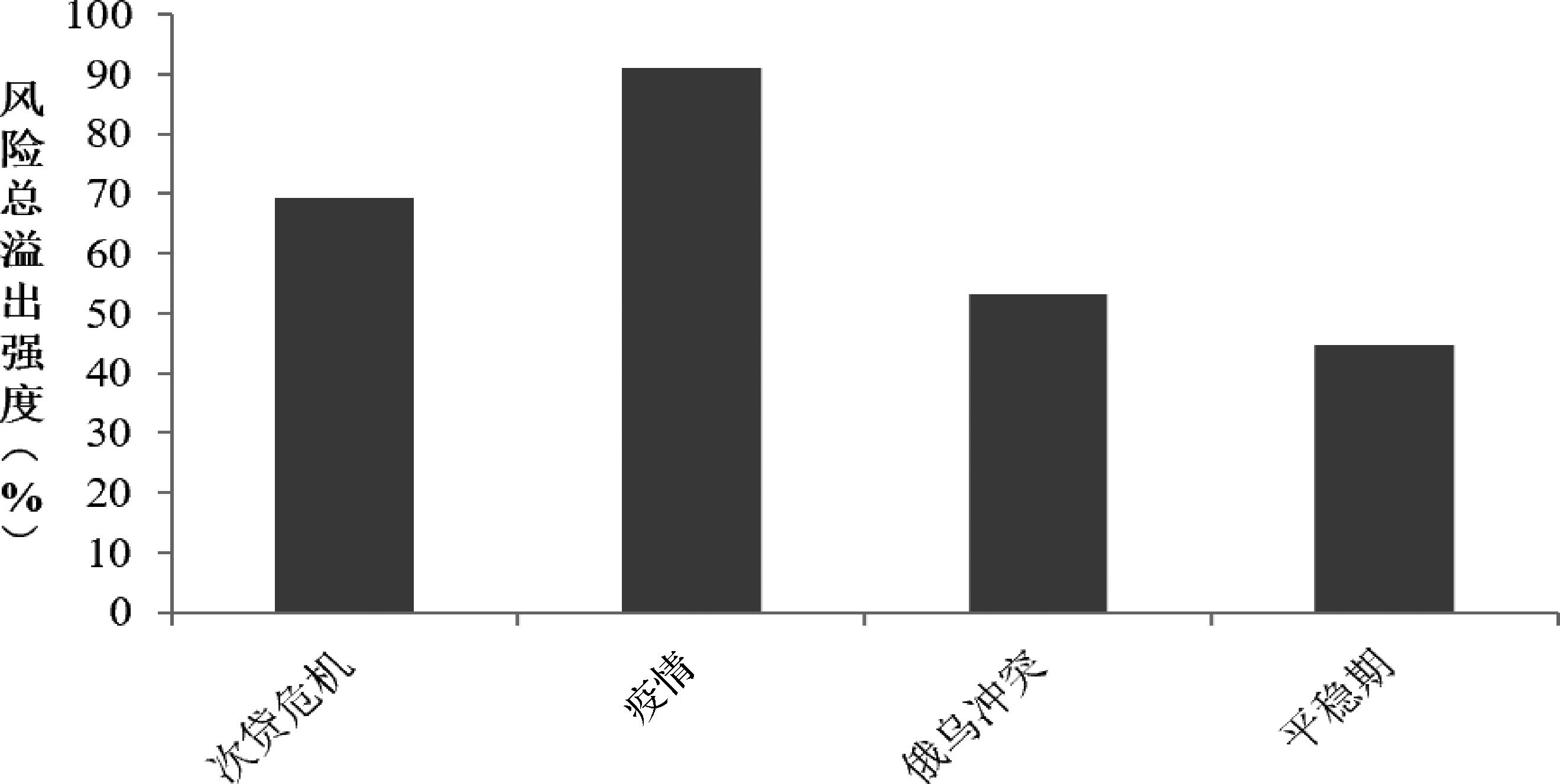
表6
风险联动网络与高维风险溢出网络的结论比较"
| 平稳期 | 次贷危机时期 | 疫情时期 | 俄乌冲突时期 | |
|---|---|---|---|---|
| 联动网络 | (1)美元是全球货币连接的关键节点,沙特里亚尔是美元与欧亚货币之间重要的风险传导枢纽。 (2)风险相依结构大体呈地理区域聚集特征。 | (1)美元是全球货币连接的关键节点,沙特里亚尔是美元与欧亚货币之间重要的风险传导枢纽。 (2)风险相依结构杂乱,产生较多的跨区域风险联动,跨区域联结广泛存在于全球各经济体汇率市场之间。 | (1)美元是全球货币连接的关键节点,沙特里亚尔是美元与欧亚货币之间重要的风险传导枢纽。 (2)风险相依结构杂乱,产生较多的跨区域风险联动,跨区域联结广泛存在于全球各经济体汇率市场之间。 | (1)美元是全球货币连接的关键节点,沙特里亚尔是美元与欧亚货币之间重要的风险传导枢纽。 (2)跨区域风险联动发生在局部,主要体现在以美元为中心节点与部分亚洲货币、欧洲货币、大洋洲货币之间的跨区域联结,而欧洲货币与亚洲货币的联动明显减少。 |
| 溢出网络 | (1)美元与沙特里亚尔是整个汇率网络的风险净输出核心。 (2)较高水平的风险溢出主要集中于同区域的汇率市场内部。 | (1)美元与沙特里亚尔是整个汇率网络的风险净输出核心。 (2)相比于新冠疫情,同区域货币内部的风险溢出与跨区域货币的风险溢出,高强度溢出水平的值较多。 (3)根据网络拓扑分组,相比于平稳期,各组跨地理区域或跨资本开放程度类型的风险溢出强度会增强。 | (1)美元与沙特里亚尔是整个汇率网络的风险净输出核心。 (2)该网络中的溢出关系是四个阶段中最为复杂的,跨区域风险溢出的范围比次贷危机更广泛,并且整个系统内货币之间的风险溢出均达到中高强度水平。同时,该时期整个系统的风险溢出总效应最高,其次是次贷危机时期、俄乌冲突时期、平稳时期。 (3)根据网络拓扑分组,相比于平稳期,各组跨地理区域或跨资本开放程度类型的风险溢出强度会增强,在疫情期间这种现象最为显著,其次为次贷危机,最后为俄乌冲突。 | (1)美元与沙特里亚尔是整个汇率网络的风险净输出核心。 (2)货币的跨区域风险溢出范围有限,主要体现在北美洲与欧洲之间、北美洲与亚洲之间、北美洲与大洋洲之间、北美洲与南美洲之间的货币跨区域风险溢出,其中美元作为最主要的风险驱动因素出现。 (3)根据网络拓扑分组,相比于平稳期,各组跨地理区域或跨资本开放程度类型的风险溢出强度会增大。 |
| [1] | 方意, 贾妍妍, 赵阳. 重大冲击下全球外汇市场风险的生成机理研究[J]. 财贸经济, 2021, 42(5): 76-92. |
| Fang Y, Jia Y Y, Zhao Y. On the risk formulation mechanism in the global foreign exchange market under large shocks[J]. Finance Trade Economics, 2021, 42(5): 76-92. | |
| [2] | 李政, 梁琪, 涂晓枫. 我国上市金融机构关联性研究——基于网络分析法[J]. 金融研究, 2016(8): 95-110. |
| Li Z, Liang Q, Tu X F. The connectedness of Chinese listed financial institutions: A study based on network analysis[J]. Journal of Financial Research, 2016(8): 95-110. | |
| [3] | Chuliá H, Gupta R, Uribe J M, et al. Impact of US uncertainties on emerging and mature markets: Evidence from a quantile-vector autoregressive approach[J]. Journal of International Financial Markets, Institutions and Money, 2017, 48: 178-191. |
| [4] | Dungey M, Flavin T J, Lagoa-Varela D. Are banking shocks contagious? Evidence from the eurozone[J]. Journal of Banking Finance, 2020, 112: 105386. |
| [5] | 梁琪, 李政, 郝项超. 中国股票市场国际化研究: 基于信息溢出的视角[J].经济研究,2015,50(4): 150-164. |
| Liang Q, Li Z, Hao X C. The internationalization of Chinese stock market: Based on information spillover[J]. Economic Research Journal, 2015, 50(4): 150-164. | |
| [6] | 杨子晖, 周颖刚. 全球系统性金融风险溢出与外部冲击[J]. 中国社会科学, 2018(12): 69-90+200+201. |
| Yang Z H, Zhou Y G. Global systemic financial risk spillovers and their external impact[J]. Social Sciences in China, 2018(12): 69-90+200+201. | |
| [7] | Yang Z, Zhou Y. Quantitative easing and volatility spillovers across countries and asset classes[J]. Management Science, 2017, 63(2): 333-354. |
| [8] | Aït-Sahalia Y, Cacho-Diaz J, Laeven R J A. Modeling financial contagion using mutually exciting jump processes[J]. Journal of Financial Economics, 2015, 117(3): 585-606. |
| [9] | Opie W, Riddiough S J. Global currency hedging with common risk factors[J]. Journal of Financial Economics, 2020, 136(3): 780-805. |
| [10] | 梁芹, 陆静. 国际金融危机期间的汇率风险传染效应研究[J]. 当代经济科学, 2013, 35(2): 1-10+124. |
| Liang Q, Lu J. On the contagious effect of exchange rate risk during international financial crisis[J]. Modern Economic Science, 2013, 35(2): 1-10+124. | |
| [11] | 万蕤叶, 陆静. 金融危机期间汇率风险传染研究[J]. 管理科学学报, 2018, 21(6): 12-28. |
| Wan R Y, Lu J. Contagion of exchange rate risk during financial crises[J]. Journal of Management Sciences in China, 2018, 21(6): 12-28. | |
| [12] | 王璐, 黄登仕, 马锋, 等. 重大突发事件对国际外汇市场影响分析: 基于英国脱欧公投事件[J]. 数理统计与管理, 2020, 39(1): 174-190. |
| Wang L, Huang D S, Ma F, et al. The impact of major emergency on international foreign exchange markets: The case of Britain vote to leave the EU in the referendum[J]. Jouranl of Applied Statistics and Management, 2020, 39(1): 174-190. | |
| [13] | 方意, 贾妍妍. 新冠肺炎疫情冲击下全球外汇市场风险传染与中国金融风险防控[J]. 当代经济科学, 2021, 43(2): 1-15. |
| Fang Y, Jia Y Y. Risk contagion in global foreign exchange market under COVID-19 and China’s financial risk prevention[J]. Modern Economic Science, 2021, 43(2): 1-15. | |
| [14] | 王纲金, 马欣宇, 谢赤. 基于尾部风险溢出网络的全球外汇市场关联性研究[J]. 中国管理科学, 2025, 33(3): 13-23. |
| Wang G J, Ma X Y, Xie C. Measuring interconnectedness of global foreign exchange markets using tail risk spillover network[J]. Chinese Journal of Management Science, 2025, 33(3): 13-23. | |
| [15] | 隋建利, 杨庆伟, 宋涛. 汇率网络结构变迁、人民币影响力与汇率波动传导——来自“一带一路”沿线国家的证据[J]. 国际金融研究, 2020(10): 75-85. |
| Sui J L, Yang Q W, Song T. Structural change of exchange rate network, influences of RMB and transmission of exchange rate volatility: Evidence from countries along the Belt and Road[J]. Studies of International Finance, 2020(10): 75-85. | |
| [16] | Wei Z, Luo Y, Huang Z, et al. Spillover effects of RMB exchange rate among BR countries: Before and during COVID-19 event[J]. Finance Research Letters, 2020, 37: 101782. |
| [17] | Song D M, Tumminello M, Zhou W X, et al. Evolution of worldwide stock markets, correlation structure, and correlation-based graphs[J]. Physical Review E, 2011, 84(2): 026108. |
| [18] | 黄飞雪, 谷静, 李延喜, 等. 金融危机前后的全球主要股指联动与动态稳定性比较[J]. 系统工程理论与实践, 2010, 30(10): 1729-1740. |
| Huang F X, Gu J, Li Y X, et al. Linkages and dynamic stability of the national of global primary stock index before and after the financial crisis[J]. Systems Engineering-Theory Practice, 2010, 30(10): 1729-1740. | |
| [19] | Diebold F X, Yılmaz K. On the network topology of variance decompositions: Measuring the connectedness of financial firms[J]. Journal of Econometrics, 2014, 182(1): 119-134. |
| [20] | Jung Y C, Das A, McFarlane A. The asymmetric relationship between the oil price and the US-Canada exchange rate[J]. The Quarterly Review of Economics and Finance, 2020, 76: 198-206. |
| [21] | 宫晓莉, 熊熊, 张维. 我国金融机构系统性风险度量与外溢效应研究[J].管理世界,2020, 36(8): 65-83. |
| Gong X L, Xiong X, Zhang W. Research on systemic risk measurement and spillover effect of financial institutions in China[J].Journal of Management World, 2020, 36(8): 65-83. | |
| [22] | Demirer M, Diebold F X, Liu L, et al. Estimating global bank network connectedness[J]. Journal of Applied Econometrics, 2018, 33(1): 1-15. |
| [23] | Gross C, Siklos P L. Analyzing credit risk transmission to the nonfinancial sector in Europe: A network approach[J]. Journal of Applied Econometrics, 2020, 35(1): 61-81. |
| [24] | 王姝黛, 杨子晖, 张平淼. 城投债信用风险传染的地理集聚、路径演变与驱动机制——基于前沿弹性网络收缩技术的研究[J]. 统计研究, 2023, 40(3): 32-42. |
| Wang S D, Yang Z H, Zhang P M. Geographical agglomeration, path evolution and driving mechanism for credit risk contagion of municipal investment bonds: Analysis based on elastic net shrinkage[J]. Statistical Research, 2023, 40(3): 32-42. | |
| [25] | Joe H. Multivariate Models and Multivariate Dependence Concepts[M]. London:Chapman and Hall/CRC, 1997. |
| [26] | 胡根华. 人民币与国外主要货币的尾部相依和联动[J]. 统计研究, 2015, 32(5): 40-46. |
| Hu G H. Tailed dependence and co-movements of RMB and foreign currencies[J]. Statistical Research, 2015, 32(5): 40-46. | |
| [27] | 邹玉梅, 范敬雅. 基于广义自回归得分模型的时变D-vine的应用[J]. 数理统计与管理, 2018, 37(1): 74-82. |
| Zou Y M, Fan J Y. Time-varying D-vine based on GAS model and application[J]. Jouranl of Applied Statistics and Management, 2018, 37(1): 74-82. | |
| [28] | Wu X, Zhu S, Wang S. Research on information spillover effect of the RMB exchange rate and stock market based on R-vine copula[J]. Complexity, 2020, 2020: 2492181. |
| [29] | 陈粘, 黄迅, 严晓凤. 结构突变下的高维汇率资产时变投资组合预测研究[J]. 中国管理科学, 2021, 29(11): 13-22. |
| Chen Z, Huang X, Yan X F. Dynamic portfolio forecasting of high-dimensions exchange rate assets under structure break[J]. Chinese Journal of Management Science, 2021, 29(11): 13-22. | |
| [30] | Nelsen R B. An Introduction to Copulas[M]. New York, NY: Springer New York, 1999. |
| [31] | Wang G J, Xie C, He K, et al. Extreme risk spillover network: Application to financial institutions[J]. Quantitative Finance, 2017, 17(9): 1417-1433. |
| [32] | 杨子晖, 王姝黛. 突发公共卫生事件下的全球股市系统性金融风险传染——来自新冠疫情的证据[J]. 经济研究, 2021, 56(8): 22-38. |
| Yang Z H, Wang S D. Systemic financial risk contagion of global stock market under public health emergency: Empirical evidence from COVID-19 epidemic[J]. Economic Research Journal, 2021, 56(8): 22-38. | |
| [33] | Yao H, Zhang W, Wu Z. Monetary policy rule under rare events: With implications by digital finance development[J]. Pacific-Basin Finance Journal, 2024, 85: 102376. |
| [1] | 徐涛, 陈庭强. 银行拆借偏好、网络结构演化与金融风险传染[J]. 中国管理科学, 2026, 34(6): 1-12. |
| [2] | 薛凯丽, 匡海波, 孟斌. 考虑多尺度多状态的原油市场与油轮市场动态相依性及风险传染研究[J]. 中国管理科学, 2025, 33(7): 54-67. |
| [3] | 文璐, 冯玲. 动态政府干预下银行风险传染与最优救助决策研究[J]. 中国管理科学, 2025, 33(6): 37-48. |
| [4] | 吴鑫育,谢海滨,马超群. 经济政策不确定性与人民币汇率波动率[J]. 中国管理科学, 2024, 32(8): 1-14. |
| [5] | 何汉,李思呈. 基于有向复杂网络的担保圈违约风险传染建模研究[J]. 中国管理科学, 2024, 32(6): 22-33. |
| [6] | 张雪彤,张卫国,王超. 发达市场与新兴市场的尾部风险[J]. 中国管理科学, 2024, 32(4): 14-25. |
| [7] | 黄云洲,黄炯豪,夏晓华. 比特币价格风险、宏观经济波动与股市风险传染[J]. 中国管理科学, 2024, 32(4): 26-37. |
| [8] | 刘映琳, 方艳, 杨金强. 我国粮食与能源的跨市场风险传染及外部冲击[J]. 中国管理科学, 2024, 32(11): 103-114. |
| [9] | 陈强, 许万紫. 奈特不确定、汇率波动与外商直接投资[J]. 中国管理科学, 2023, 31(6): 12-24. |
| [10] | 刘金培, 罗瑞, 陈华友, 陶志富. 非结构化数据驱动的混合二次分解汇率区间多尺度组合预测[J]. 中国管理科学, 2023, 31(6): 60-70. |
| [11] | 李冰清, 张潇元. 基于网络结构的企业集团内部风险传染机制研究[J]. 中国管理科学, 2023, 31(5): 20-28. |
| [12] | 林娟, 吴春晓, 张明. 上海黄金是人民币汇率风险的对冲工具和安全港吗?——基于常量和动态Copula模型[J]. 中国管理科学, 2023, 31(5): 104-115. |
| [13] | 吴金宴, 王鹏. 基于协高阶矩检验体系的中国资本市场开放与风险传染效应研究[J]. 中国管理科学, 2023, 31(1): 37-46. |
| [14] | 吴金宴, 王鹏. 哪些因素影响了股市风险传染?——来自行业数据的证据[J]. 中国管理科学, 2022, 30(8): 57-68. |
| [15] | 王磊, 李守伟, 陈庭强, 何建敏. 基于企业行为偏好的企业间信用担保网络与风险传染研究[J]. 中国管理科学, 2022, 30(2): 80-93. |
| 阅读次数 | ||||||
|
全文 |
|
|||||
|
摘要 |
|
|||||
|
||
