
主管:中国科学院
主办:中国优选法统筹法与经济数学研究会
中国科学院科技战略咨询研究院
主办:中国优选法统筹法与经济数学研究会
中国科学院科技战略咨询研究院

中国管理科学 ›› 2026, Vol. 34 ›› Issue (7): 22-32.doi: 10.16381/j.cnki.issn1003-207x.2024.0928
李舒霏1( ), 程冲2, 刘威汉2
收稿日期:2024-06-06
修回日期:2025-03-09
出版日期:2026-07-25
发布日期:2026-06-18
通讯作者:
李舒霏
E-mail:hy1402@163.com
基金资助:
Shufei Li1(), Chong Cheng2, Weihan Liu2
Received:2024-06-06
Revised:2025-03-09
Online:2026-07-25
Published:2026-06-18
Contact:
Shufei Li
E-mail:hy1402@163.com
摘要:
基于期望效用最大化的几乎随机占优(ASD)准则,本文分析了中美股票与10年期国债市场在不同经济周期和持有期下的表现。研究发现,中国理性投资者更关注资产稳定性,决策受市场变化影响较小,表现出风险规避特征;而美国理性投资者更关注收益,风险偏好相对中性,决策随市场调整。社会政治稳定性、政府信任、文化心理、金融教育与金融科技是导致两国投资者决策差异的关键因素。随着中国市场发展成熟,中美资本市场差异缩小,但中国理性投资者仍不会转变为风险中性,仅在可控范围内适度降低风险规避程度。
中图分类号:
李舒霏,程冲,刘威汉. 基于几乎随机占优准则的中美理性投资者决策差异研究[J]. 中国管理科学, 2026, 34(7): 22-32.
Shufei Li,Chong Cheng,Weihan Liu. The Study of Decision-Making Differences between Rational Investors in China and the United States Based on the Almost Stochastic Dominance Criterion[J]. Chinese Journal of Management Science, 2026, 34(7): 22-32.

表1
平稳期中美资本市场的描述性统计分析"
| 参数 | 月度持有期 | 季度持有期 | ||||||
|---|---|---|---|---|---|---|---|---|
| 中国 | 美国 | 中国 | 美国 | |||||
| SSE | 10TB | SPY | 10TB | SSE | 10TB | SPY | 10TB | |
| 期望收益率(%) | 0.13 | -0.04 | 0.97 | -0.39 | 0.53 | -0.22 | 2.69 | -1.52 |
| 标准差(%) | 6.67 | 3.95 | 3.70 | 9.68 | 12.07 | 7.41 | 7.32 | 19.87 |
| 偏度 | -0.05 | 0.85 | -0.40 | 0.06 | 0.40 | 0.37 | -1.17 | -0.24 |
| 峰度 | 1.87 | 1.00 | 0.38 | 0.94 | 1.96 | 0.22 | 1.57 | 2.00 |
表2
危机期中美资本市场的描述性统计分析"
| 参数 | 月度持有期 | 季度持有期 | ||||||
|---|---|---|---|---|---|---|---|---|
| 中国 | 美国 | 中国 | 美国 | |||||
| SSE | 10TB | SPY | 10TB | SSE | 10TB | SPY | 10TB | |
| 期望收益率(%) | 0.31 | 0.16 | 0.94 | 4.95 | 1.28 | -5.83 | 11.01 | 13.37 |
| 标准差(%) | 4.56 | 3.96 | 6.17 | 16.34 | 6.79 | 6.74 | 13.52 | 38.43 |
| 偏度 | 0.22 | 0.42 | -0.31 | -0.40 | -0.85 | -0.70 | -0.60 | 0.04 |
| 峰度 | -0.52 | 0.11 | -0.51 | 0.49 | -0.44 | 0.63 | 0.66 | 0.51 |
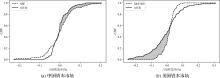
图1
平稳期中美资本市场一阶累积分布函数(CDF)位置关系注:一阶及高阶累积分布函数(CDF)相交代表相应阶数的传统随机占优“失效”;白色面积与灰色面积对应的收益率区域分别代表了10年期国债市场和股票市场的占优区域(下同);白色面积与总面积的比值形成股票市场的容忍度ε^n。"
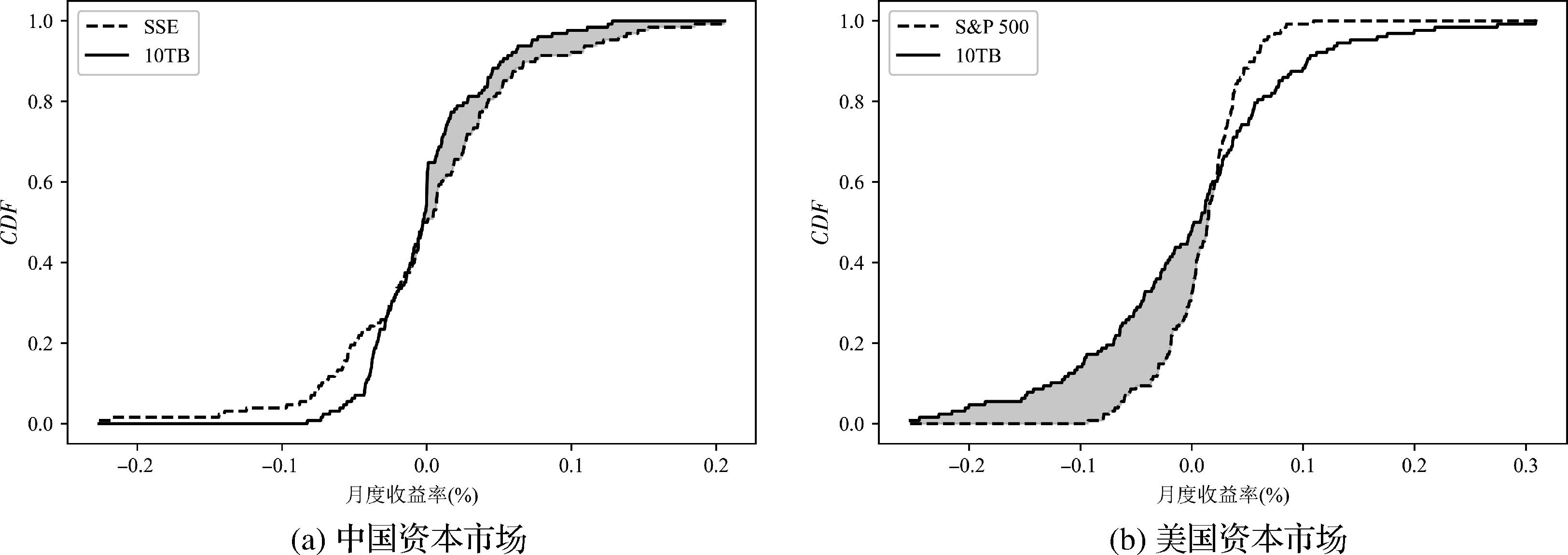
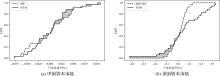
图2
危机期中美资本市场一阶累积分布函数(CDF)位置关系"
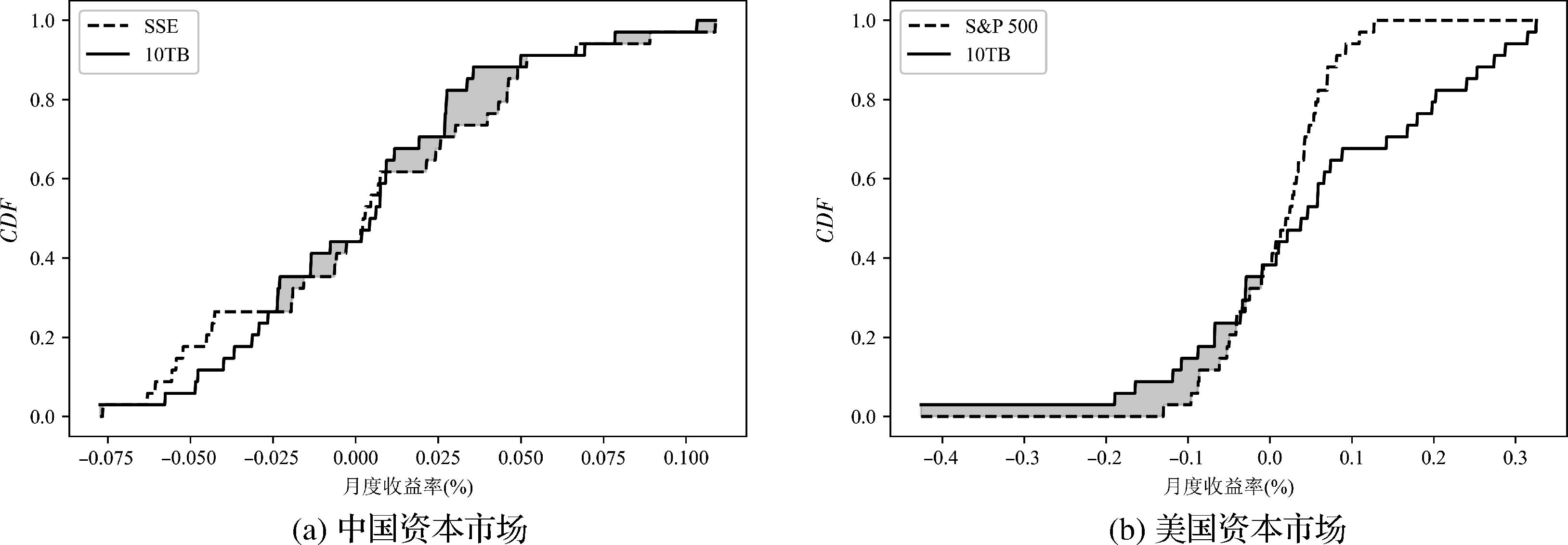
表3
股票市场一阶容忍度"
| 参数 | 经济平稳时期 | 经济危机时期 | ||
|---|---|---|---|---|
| 中国 | 美国 | 中国 | 美国 | |
| 0.45 | 0.35 | 0.41 | 0.76 | |
图3
平稳期中美资本市场二阶累积分布函数(CDF(2))位置关系"
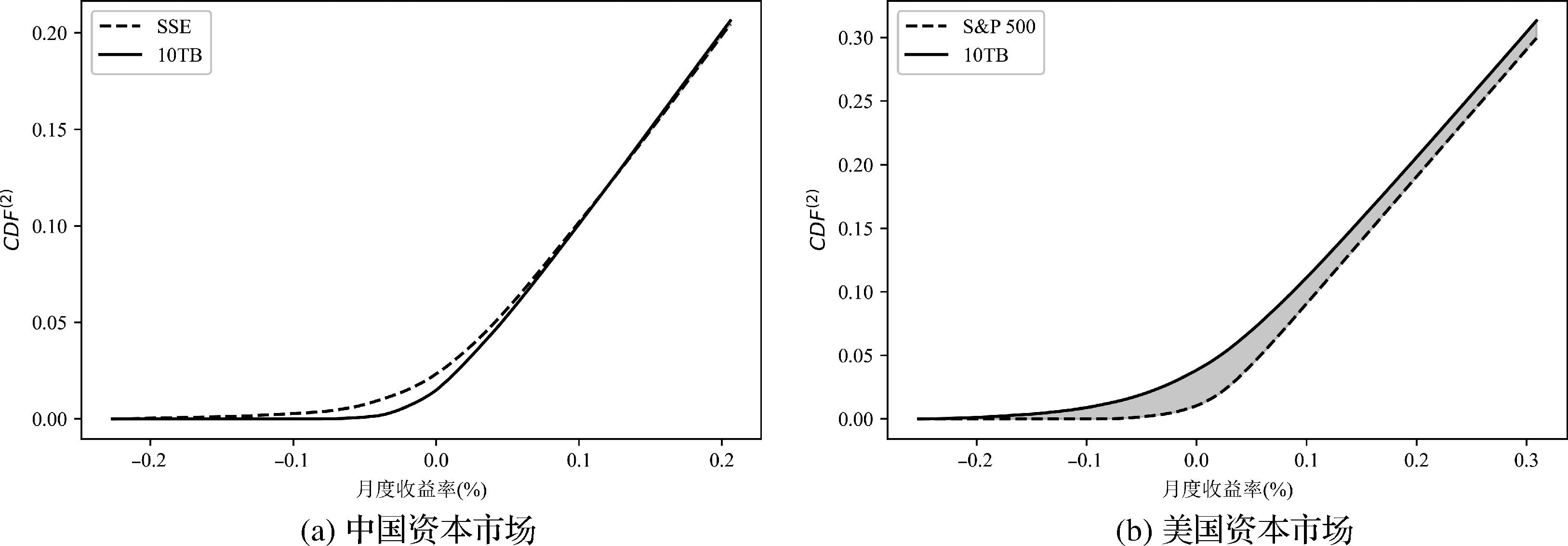
图4
危机期中美资本市场二阶累积分布函数(CDF(2))位置关系"
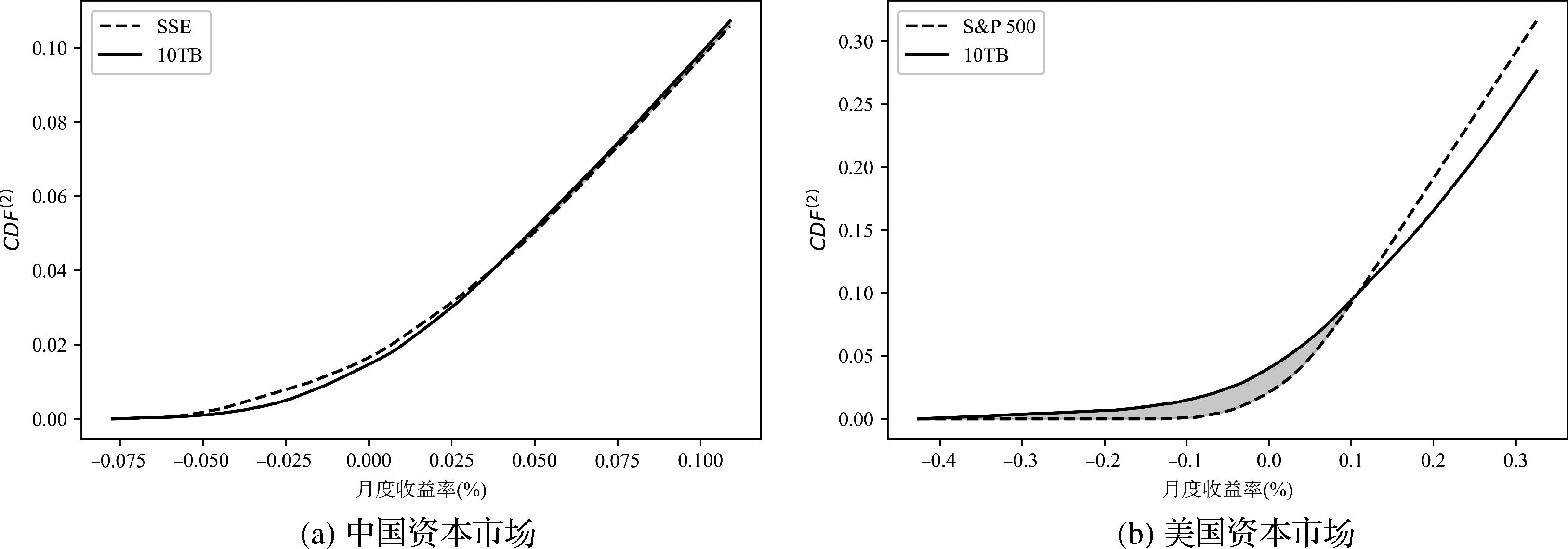
表4
股票市场二阶容忍度"
| 参数 | 经济平稳时期 | 经济危机时期 | ||
|---|---|---|---|---|
| 中国 | 美国 | 中国 | 美国 | |
| 0.92 | 0.00 | 0.69 | 0.54 | |
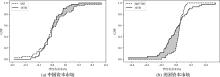
图5
平稳期中美资本市场一阶累积分布函数(CDF)位置关系"
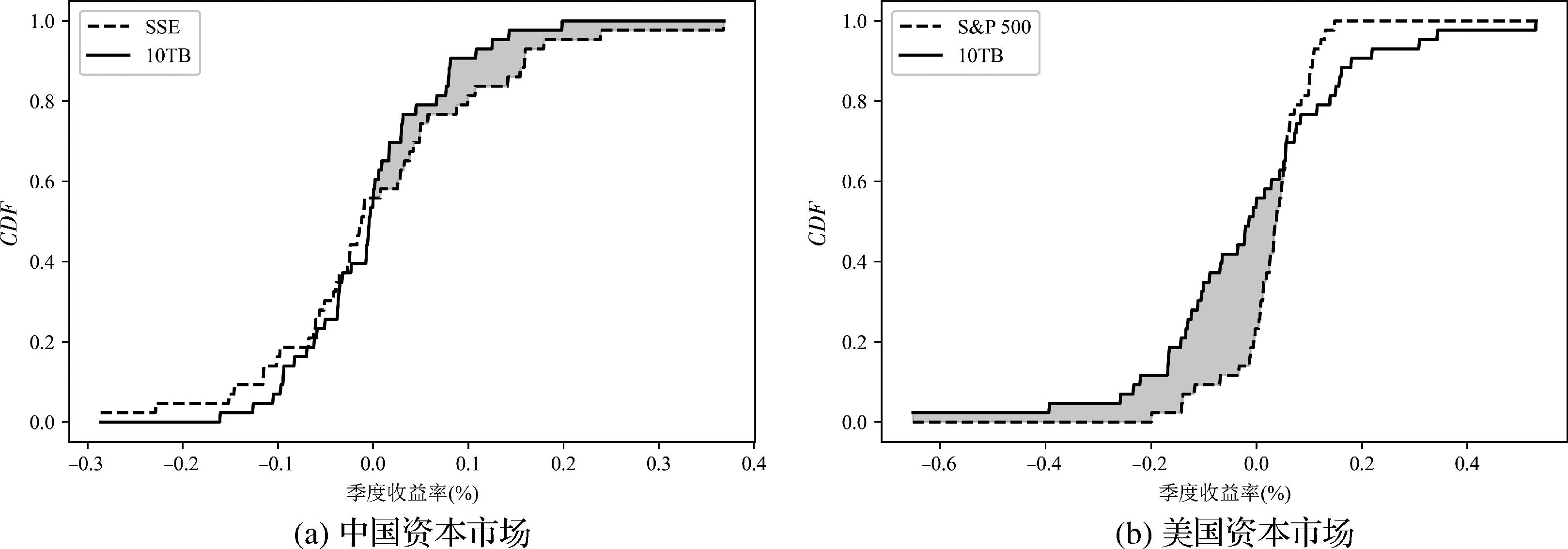
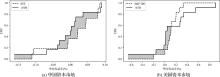
图6
危机期中美资本市场一阶累积分布函数(CDF)位置关系"
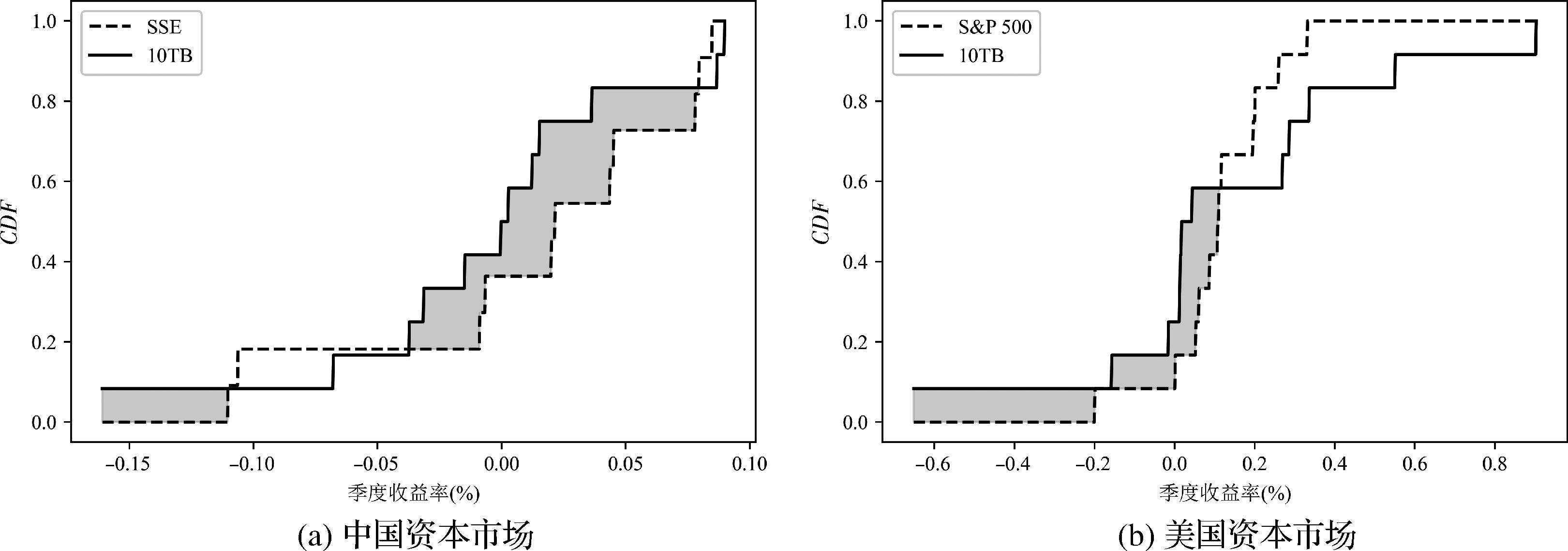
图7
平稳期中美资本市场二阶累积分布函数(CDF(2))位置关系"
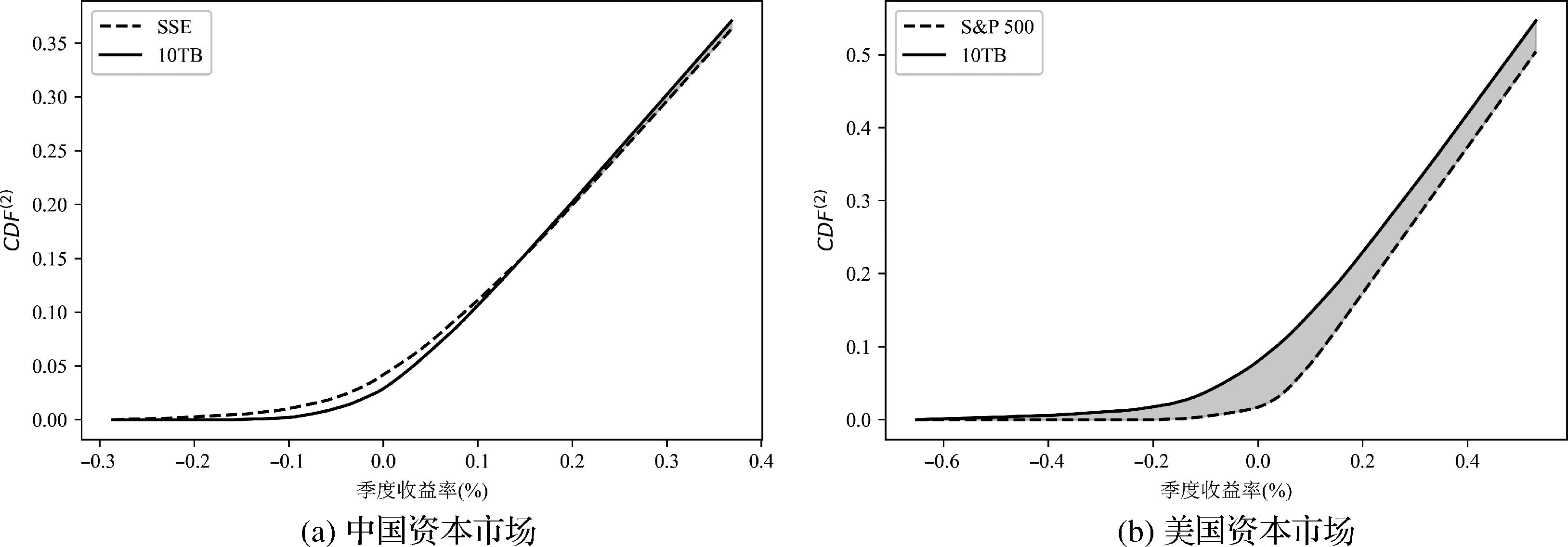
图8
危机期中美资本市场二阶累积分布函数(CDF(2))位置关系"
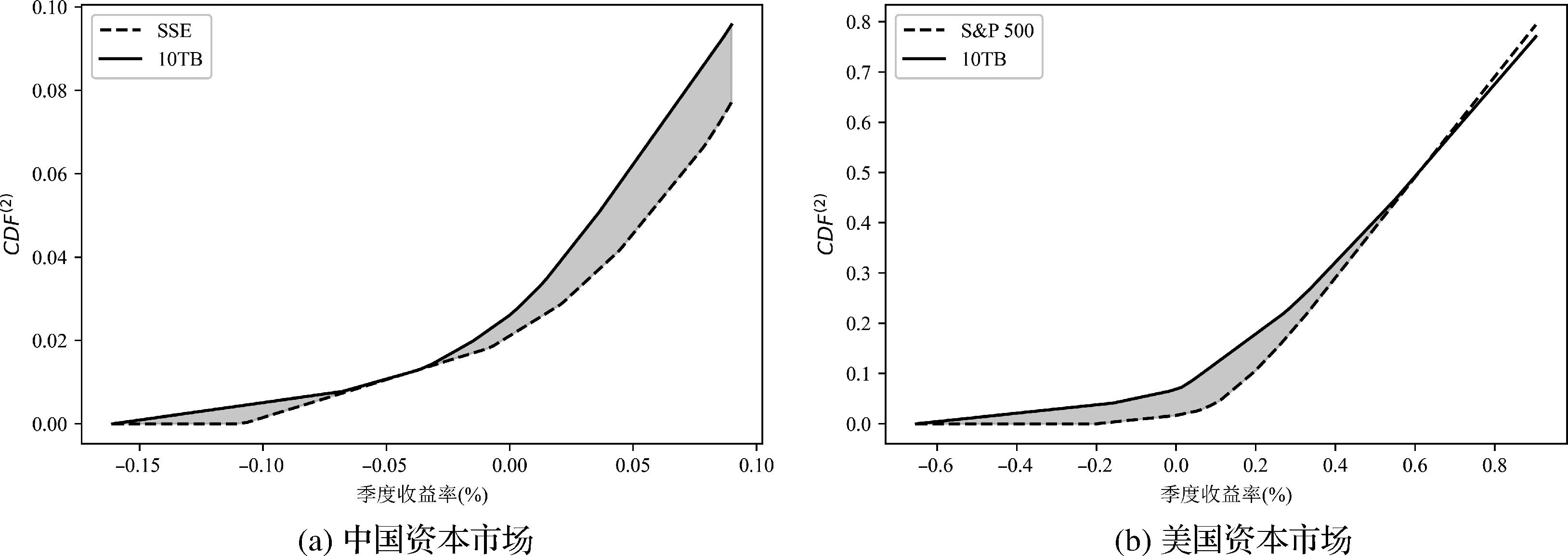
表5
股票市场容忍度"
| 参数 | 经济平稳时期 | 经济危机时期 | ||
|---|---|---|---|---|
| 中国 | 美国 | 中国 | 美国 | |
| 0.39 | 0.29 | 0.18 | 0.56 | |
| 0.72 | 0.00 | 0.00 | 0.07 | |
| [1] | De Long J B, Shleifer A, Summers L H, et al. Noise trader risk in financial markets[J]. Journal of Political Economy, 1990, 98(4): 703-738. |
| [2] | Corgnet B, Cornand C, Hanaki N. Negative tail events, emotions and risk taking[J]. The Economic Journal, 2024, 134(658): 538-578. |
| [3] | Chen Y, Kelly B, Wu W. Sophisticated investors and market efficiency: Evidence from a natural experiment[J]. Journal of Financial Economics, 2020, 138(2): 316-341. |
| [4] | Danso A, Lartey T, Amankwah-Amoah J, et al. Market sentiment and firm investment decision-making[J]. International Review of Financial Analysis, 2019, 66: 101369. |
| [5] | 王治. 理性投资与中国资本市场有效性研究——基于异质信念视角[J]. 学术论坛, 2013, 36(1): 137-140. |
| Wang Z. Research on rational investment and the efficiency of China capital market: Based on heterogeneous beliefs[J]. Academic Forum, 2013, 36(1): 137-140. | |
| [6] | Li Z. The impact of investor sentiment on corporate investment[J]. Frontiers in Business, Economics and Management, 2023, 11(2): 128-134. |
| [7] | Bouteska A, Harasheh M, Abedin M Z. Revisiting overconfidence in investment decision-making: Further evidence from the U.S. market[J]. Research in International Business and Finance, 2023, 66: 102028. |
| [8] | 李心丹, 王冀宁, 傅浩. 中国个体证券投资者交易行为的实证研究[J].经济研究, 2002, 37(11): 54-63+94. |
| Li X D, Wang J N, Fu H. Investigations on the transaction behaviors of Chinese individual securities investors[J]. Economic Research Journal, 2002, 37(11): 54-63+94. | |
| [9] | 裴平, 张谊浩. 中国股票投资者认知偏差的实证检验[J]. 管理世界, 2004, 20(12): 12-22. |
| Pei P, Zhang Y H. An empirical test of cognitive bias of stock investors in China[J].Journal of Management World, 2004, 20(12): 12-22. | |
| [10] | 李桃, 马书琴. 经济非正义之过——中国股票市场投资文化之于投机文化弱势探源[J]. 宏观经济研究, 2013(7): 3-10+61. |
| Li T, Ma S Q. The fault of economic injustice: A probe into the weakness of China stock market investment culture in speculative culture[J]. Macroeconomics, 2013(7): 3-10+61. | |
| [11] | 肖作平, 张欣哲. 制度和人力资本对家庭金融市场参与的影响研究——来自中国民营企业家的调查数据[J]. 经济研究, 2012, 47(S1): 91-104. |
| Xiao Z P, Zhang X Z. Research in the effects of institutions and human capital on market participation: Evidence from national private enterpriser survey[J]. Economic Research Journal, 2012, 47(S1): 91-104. | |
| [12] | Zhang Y, Lu X, Xiao J J. Can financial education improve consumer welfare in investment markets? Evidence from China[J]. Journal of the Asia Pacific Economy, 2023, 28(3): 1286-1312. |
| [13] | Brown M, Henchoz C, Spycher T. Culture and financial literacy: Evidence from a within-country language border[J]. Journal of Economic Behavior & Organization, 2018, 150: 62-85. |
| [14] | 郭霖麟. 政府“口头式”干预可以缓解投资者的危机情绪吗?[J]. 投资研究, 2021, 40(10): 150-159. |
| Guo L L. Can the “verbal” interventions of governments ease the crisis emotion of investors?[J]. Review of Investment Studies, 2021, 40(10): 150-159. | |
| [15] | Bonaparte Y, Korniotis G M, Kumar A, et al. Inflation, monetary policy, and portfolio decisions of U.S. households[J]. Management Science, 2024, 70(9): 6438-6460. |
| [16] | Andronie M, Iatagan M, Ută C, et al. Big data management algorithms in artificial internet of things-based fintech[J]. Oeconomia Copernicana, 2023, 14(3): 769-793. |
| [17] | Kanapickienė R, Vasiliauskaitė D, Keliuotytė-Staniulėnienė G, et al. A comprehensive review of behavioral biases in financial decision-making: From classical finance to behavioral finance perspectives[J]. Journal of Business Economics and Management, 2024, 25(5): 1006-1029. |
| [18] | Xia H, Chen S, Zhang J Z, et al. Superposition effect of online news on fintech platforms[J]. International Journal of Emerging Markets, 2025, 20(3): 1214-1234. |
| [19] | Abbasi K, Alam A, Du M A, et al. FinTech, SME efficiency and national culture: Evidence from OECD countries[J]. Technological Forecasting and Social Change, 2021, 163: 120454. |
| [20] | 严雨萌, 熊熊, 路磊, 等. 从“管中窥豹”到“高屋建瓴”: 大数据背景下的个人投资者行为[J]. 中国管理科学, 2023, 31(9): 244-254. |
| Yan Y M, Xiong X, Lu L, et al. From “a peek”to“a strategic view”: Individual investor behaviors in the age of big data[J]. Chinese Journal of Management Science, 2023, 31(9): 244-254. | |
| [21] | Gao X, Sun L. Modeling retirees’ investment behaviors in the presence of health expenditure risk and financial crisis risk[J]. Economic Modelling, 2021, 94: 442-454. |
| [22] | 尚煜, 许文浩. 基于经济周期的股票市场行业资产配置研究[J]. 经济问题, 2020(3): 25-34. |
| Shang Y, Xu W H. Research of industry allocation of stock market based on economic cycle[J]. On Economic Problems, 2020(3): 25-34. | |
| [23] | 熊熊, 刘慕涵, 陈舒宁. 投资者情绪和市场利率对证券市场指数收益影响特点的动态刻画[J]. 运筹与管理, 2018, 27(9): 156-169. |
| Xiong X, Liu M H, Chen S N. Dynamic characterization of the influence of investor sentiment and market rates of interest on stock market index returns[J]. Operations Research and Management Science, 2018, 27(9): 156-169. | |
| [24] | Paul P. A macroeconomic model with occasional financial crises[J]. Journal of Economic Dynamics and Control, 2020, 112: 103830. |
| [25] | Inklaar R, Yang J. The impact of financial crises and tolerance for uncertainty[J]. Journal of Development Economics, 2012, 97(2): 466-480. |
| [26] | Bayona A, Peia O. Financial contagion and the wealth effect: An experimental study[J]. Journal of Economic Behavior & Organization, 2022, 200: 1184-1202. |
| [27] | 何雨霖, 陈宪, 蒋一乐. 中国金融市场能够抵御外部冲击吗[J]. 新金融, 2020(12): 21-27. |
| He Y L, Chen X, Jiang Y L. Can China’s financial market resist external shock[J]. New Finance, 2020(12): 21-27. | |
| [28] | 文凤华, 杨鑫, 龚旭, 等. 金融危机背景下中美投资者情绪的传染性分析[J]. 系统工程理论与实践, 2015, 35(3): 623-629. |
| Wen F H, Yang X, Gong X, et al. The research on investor sentiment contagion between China and U.S.based on the background of financial crisis[J]. Systems Engineering —Theory & Practice, 2015, 35(3): 623-629. | |
| [29] | 许祥云, 廖佳, 吴松洋. 金融危机前后的中国股债关系分析——基于市场情绪变化的解释视角[J]. 经济评论, 2014(1): 130-140. |
| Xu X Y, Liao J, Wu S Y. The relationship between Chinese stock and bond market around financial crisis: A perspective of market sentiment[J]. Economic Review, 2014(1): 130-140. | |
| [30] | 耿志祥, 孙祁祥. 金融危机和自然灾害对保险股票市场的影响与溢出效应检验[J]. 金融研究, 2016(5): 65-81. |
| Geng Z X, Sun Q X. The impact of financial crisis and catastrophes on the insurer stock market and its testing of spillovers effects[J]. Journal of Financial Research, 2016(5): 65-81. | |
| [31] | Adjei F, Adjei M. Political cycles, investor sentiment, and stock market returns[J]. Journal of Finance and Economics, 2017, 5(1): 1-10. |
| [32] | 吕心阳, 张伟. 国际地缘政治风险对中国投资者信心的影响[J]. 统计与决策, 2021, 37(15): 140-144. |
| Lv X Y, Zhang W. The impact of international geopolitical risks on investor confidence in China[J]. Statistics & Decision, 2021, 37(15): 140-144. | |
| [33] | 谢霏, 后青松, 朱秀丽. 政府放权影响机构投资者的持股决策吗[J]. 山西财经大学学报, 2017, 39(10): 32-43. |
| Xie F, Hou Q S, Zhu X L. Does government decentralization affect the decision-making of institutional investors on shareholding[J]. Journal of Shanxi University of Finance and Economics, 2017, 39(10): 32-43. | |
| [34] | Ma Y, Yang B, Su Y. Stock return predictability: Evidence from moving averages of trading volume[J]. Pacific-Basin Finance Journal, 2021, 65: 101494. |
| [35] | Anarkulova A, Cederburg S, O’Doherty M S. Stocks for the long run? Evidence from a broad sample of developed markets[J]. Journal of Financial Economics, 2022, 143(1): 409-433. |
| [36] | 张海波, 陈红. 人民币汇率风险度量研究——基于不同持有期的VaR分析[J]. 宏观经济研究, 2012(12): 25-31+67. |
| Zhang H B, Chen H. Research on RMB exchange rate risk measurement: Based on VaR analysis of different holding periods[J]. Macroeconomics, 2012(12): 25-31+67. | |
| [37] | 任金政, 曹钧如. 我国焦炭期货最优套期保值比率及持有期效应研究[J].价格理论与实践,2016(7): 127-129. |
| Ren J Z, Cao J R. Research on optimal hedging ratio and holding period effect of coke futures in China[J]. Price (Theory & Practice), 2016(7): 127-129. | |
| [38] | Lippi A, Rossi S. Run for the hills: Italian investors' risk appetite before and during the financial crisis[J]. International Journal of Bank Marketing, 2020, 38(5): 1195-1213. |
| [39] | Ahmad F, Oriani R, De Angelis M. Investor’s intrinsic motives and the valence of word-of-mouth in sequential decision-making[J]. Journal of Behavioral Finance, 2021, 22(2): 170-188. |
| [40] | Peetz J, Howard A L. Balancing prosocial effort across social categories: Mental accounting heuristics in helping decisions[J]. Personality and Social Psychology Bulletin, 2021, 47(9): 1414-1429. |
| [41] | Breuer W, Ghufran B, Salzmann A J. Investors' time preferences and takeover performance[J]. International Review of Financial Analysis, 2020, 67: 101435. |
| [42] | 李新路. 基于 “心理账户” 的投资者决策分析[J]. 河北大学学报(哲学社会科学版), 2009, 34(4): 46-49. |
| Li X L. The study of investor decision based on mental accounting[J]. Journal of Hebei University (Philosophy and Social Science), 2009, 34(4): 46-49. | |
| [43] | Leshno M, Levy H. Preferred by “all” and preferred by “most” decision makers: Almost stochastic dominance[J]. Management Science, 2002, 48(8): 1074-1085. |
| [44] | Tzeng L Y, Huang R J, Shih P T. Revisiting almost second-degree stochastic dominance[J]. Management Science, 2013, 59(5): 1250-1254. |
| [1] | 罗晓芸, 易荣华. 国际板与经济增长:来自新兴市场国家的证据[J]. 中国管理科学, 2023, 31(7): 194-201. |
| [2] | 吴金宴, 王鹏. 基于协高阶矩检验体系的中国资本市场开放与风险传染效应研究[J]. 中国管理科学, 2023, 31(1): 37-46. |
| [3] | 陆静, 张银盈. “特质波动率之谜”与估计模型有关吗?[J]. 中国管理科学, 2022, 30(9): 36-48. |
| [4] | 张学伟, 王玺杰. 内部资本市场跨期配置下最优分部相关性匹配研究——对多元化企业并购整合内在逻辑的诠释[J]. 中国管理科学, 2021, 29(9): 25-35. |
| [5] | 危平, 杨明艳. 基于组织复杂性视角的金融集团内部资本市场效率研究[J]. 中国管理科学, 2017, 25(6): 11-21. |
| [6] | 龚志文, 陈金龙. 基于演化博弈的企业集团内部资本转移激励机制研究[J]. 中国管理科学, 2017, 25(4): 26-32. |
| [7] | 龚志文, 陈金龙. 内部资本市场存在性、有效性及其公平性的理论演绎[J]. 中国管理科学, 2015, 23(7): 53-59. |
| [8] | 刘星, 计方, 郝颖. 大股东控制、集团内部资本市场运作与公司现金持有[J]. 中国管理科学, 2014, 22(4): 124-133. |
| [9] | 史永东, 田渊博. 异常情况下基于VARX模型的中国投资者行为研究[J]. 中国管理科学, 2014, 22(4): 17-24. |
| [10] | 陆静. 投资者异质信念与上市公司盈余信息的甄别——基于A-H股分割市场的实证分析[J]. 中国管理科学, 2011, 19(5): 129-137. |
| [11] | 屠新曙. 有效市场投资组合的识别与确定[J]. 中国管理科学, 2001, (5): 49-55. |
| [12] | 陈收, 廖懿. 组合投资的非均衡性研究[J]. 中国管理科学, 1997, (3): 12-18. |
| [13] | 陈德泉, 周昌智, 萧来久, 彭重民. 资本市场中股票定价模型的研究[J]. 中国管理科学, 1996, (4): 9-17. |
| 阅读次数 | ||||||
|
全文 |
|
|||||
|
摘要 |
|
|||||
|
||
