
主管:中国科学院
主办:中国优选法统筹法与经济数学研究会
中国科学院科技战略咨询研究院
主办:中国优选法统筹法与经济数学研究会
中国科学院科技战略咨询研究院

Chinese Journal of Management Science ›› 2026, Vol. 34 ›› Issue (7): 84-94.doi: 10.16381/j.cnki.issn1003-207x.2024.0686
Previous Articles Next Articles
Bo Zeng1,2, Lingbo Zhang1,3, Sifeng Liu4( ), Fengfeng Yin5, Chao Xia6
Received:2024-05-03
Revised:2024-07-06
Online:2026-07-25
Published:2026-06-18
Contact:
Sifeng Liu
E-mail:sfliu@nwpu.edu.cn
CLC Number:
Bo Zeng,Lingbo Zhang,Sifeng Liu, et al. A New Structural Multi-variable Grey Forecasting Model with Virtual Variables and Its Application[J]. Chinese Journal of Management Science, 2026, 34(7): 84-94.

"
| 符号 | 含义 | 计算方法 |
|---|---|---|
| 残差 | ||
| 相对模拟/预测百分误差 | ||
| 均方根误差 | ||
| 拟合系数 | ||
| 平均绝对百分比误差 |
"
| 年份 | 研发经费/亿元 | R&D人员全时当量/万人年 | 新产品开发经费支出/亿元 | 专利申请数/件 | 有效发明专利数/件 | 虚拟变量 |
|---|---|---|---|---|---|---|
| 2005 | 362.5 | 17.3 | 415.7 | 16,823 | 6,658 | 0 |
| 2006 | 456.44 | 18.89 | 509.95 | 24,301 | 8,141 | 0 |
| 2007 | 545.32 | 24.82 | 652.03 | 34,446 | 13,386 | 0 |
| 2008 | 655.2 | 28.5 | 798.4 | 39,656 | 23,915 | 1 |
| 2009 | 774.05 | 35.94 | 925.08 | 51,989 | 31,830 | 1 |
| 2010 | 967.8 | 39.9 | 1,006.9 | 59,683 | 50,166 | 1 |
| 2011 | 1,237.8 | 42.7 | 1,528.0 | 77,725 | 67,428 | 1 |
| 2012 | 1,491.5 | 52.6 | 1,827.5 | 97,200 | 97,878 | 1 |
| 2013 | 1,734.4 | 55.9 | 2,069.5 | 102,532 | 115,884 | 1 |
| 2014 | 1,922.2 | 57.3 | 2,350.6 | 120,077 | 147,927 | 1 |
| 2015 | 2,219.7 | 59.0 | 2,574.6 | 114,562 | 199,728 | 1 |
| 2016 | 2,437.6 | 58.0 | 3,000.4 | 131,680 | 257,234 | 1 |
| 2017 | 2,644.7 | 59.0 | 3,421.3 | 158,354 | 306,431 | 1 |
| 2018 | 2,912.5 | 66.1 | 3,768.4 | 179,600 | 327,965 | 1 |
| 2019 | 3,077.8 | 63.9 | 4,389.3 | 199,660 | 365,523 | 1 |
| 2020 | 4,649.1 | 99.0 | 6,152.4 | 348,522 | 570,905 | 1 |
| 2021 | 5,684.6 | 112.0 | 7,510.0 | 397,524 | 685,428 | 1 |
| 2022 | 6,507.7 | 125.4 | 8,590.6 | 434,039 | 809,824 | 1 |
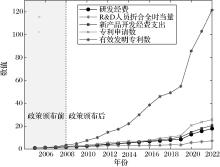
"
"
| 序号 | 研发经费 | R&D人员全时当量 | 新产品开发经费支出 | 专利申请数 | 有效发明专利数 | 虚拟变量 |
|---|---|---|---|---|---|---|
| 1 | 1.0000 | 1.0000 | 1.0000 | 1.0000 | 1.0000 | 0 |
| 2 | 1.2591 | 1.0919 | 1.2267 | 1.4445 | 1.2227 | 0 |
| …… | …… | …… | …… | …… | …… | …… |
| 18 | 17.9523 | 7.2486 | 20.6654 | 25.8003 | 121.6317 | 1 |
"
| 训练集数据 | |||||||||
| 1 | 1.0000 | 1.0000 | - | 1.0000 | - | 1.0000 | - | 1.0000 | - |
| 2 | 1.2591 | 0.7282 | 0.4216 | 0.8274 | 0.3429 | 1.3523 | 0.0740 | 1.2591 | 0.0000 |
| 3 | 1.5043 | 1.6153 | 0.0737 | 1.9246 | 0.2794 | 1.3331 | 0.1138 | 1.5404 | 0.0240 |
| 4 | 1.8074 | 2.1049 | 0.1646 | 2.0241 | 0.1199 | 1.7790 | 0.0157 | 1.6900 | 0.0650 |
| 5 | 2.1352 | 2.5924 | 0.2141 | 2.8115 | 0.3167 | 2.2855 | 0.0704 | 2.2580 | 0.0575 |
| 6 | 2.6698 | 2.9931 | 0.1211 | 3.4911 | 0.3076 | 2.6698 | 0.0000 | 2.6698 | 0.0000 |
| 7 | 3.4146 | 3.4556 | 0.0120 | 3.6667 | 0.0738 | 3.3024 | 0.0329 | 3.2666 | 0.0434 |
| 8 | 4.1145 | 4.3677 | 0.0615 | 4.9464 | 0.2022 | 4.2712 | 0.0381 | 4.2796 | 0.0401 |
| 9 | 4.7846 | 4.8109 | 0.0055 | 5.2898 | 0.1056 | 4.7713 | 0.0028 | 4.7925 | 0.0017 |
| 10 | 5.3026 | 5.3187 | 0.0030 | 5.8845 | 0.1097 | 5.1889 | 0.0215 | 5.2119 | 0.0171 |
| 11 | 6.1233 | 6.1044 | 0.0031 | 6.4759 | 0.0576 | 6.1150 | 0.0014 | 6.1205 | 0.0005 |
| 12 | 6.7244 | 6.8494 | 0.0186 | 7.1026 | 0.0562 | 6.7457 | 0.0032 | 6.7377 | 0.0020 |
| 13 | 7.2957 | 7.5804 | 0.0390 | 7.9548 | 0.0903 | 7.3130 | 0.0024 | 7.3020 | 0.0009 |
| 14 | 8.0345 | 8.2824 | 0.0309 | 8.8598 | 0.1027 | 8.0302 | 0.0005 | 8.0413 | 0.0009 |
| 15 | 8.4905 | 8.7951 | 0.0359 | 8.8538 | 0.0428 | 8.5674 | 0.0091 | 8.5217 | 0.0037 |
| 16 | 12.8251 | 13.3767 | 0.0430 | 15.8154 | 0.2332 | 12.7339 | 0.0071 | 12.7820 | 0.0034 |
| 测试集数据 | |||||||||
| 17 | 15.6817 | 15.7903 | 0.0069 | 17.9808 | 0.1466 | 15.1357 | 0.0348 | 15.2259 | 0.0291 |
| 18 | 17.9523 | 18.2677 | 0.0176 | 20.4782 | 0.1407 | 17.7214 | 0.0129 | 17.8292 | 0.0069 |
"
| 模型 | 训练集MAPE(%) | 预测集MAPE(%) | 综合RMSE | 综合R2 | 综合MAPE(%) |
|---|---|---|---|---|---|
| GM(1,N) | 8.32 | 1.22 | 0.29 | 0.9963 | 7.48 |
| DVCGM(1,N) | 16.27 | 14.37 | 1.213 | 0.9359 | 16.05 |
| NSGM(1,N) | 2.62 | 2.38 | 0.1677 | 0.9988 | 2.59 |
| DVSGM(1,N) | 1.73 | 1.8 | 0.1358 | 0.9992 | 1.74 |
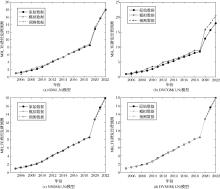
"
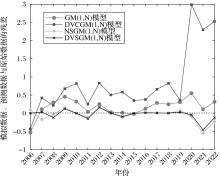
"
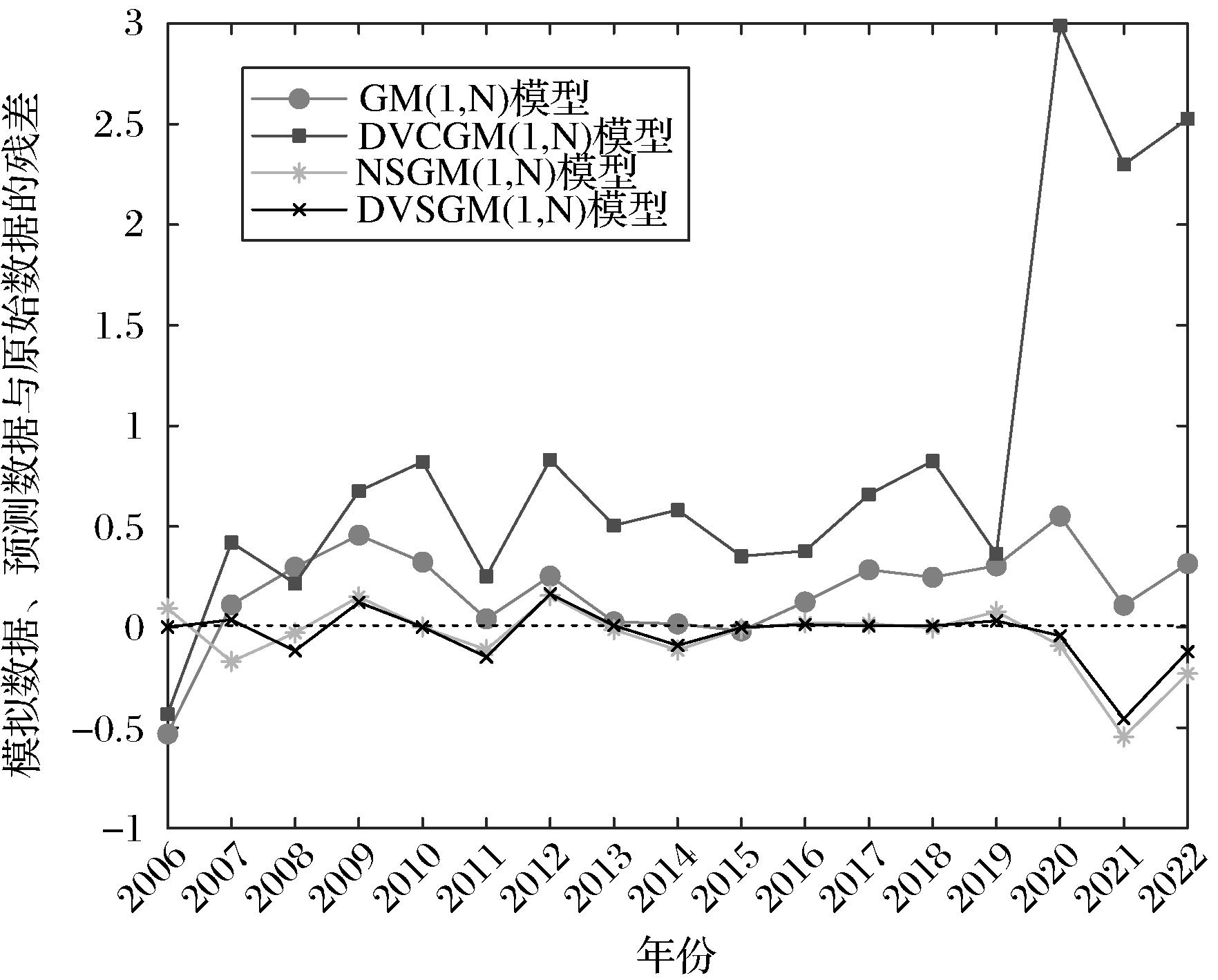
"
| 年份 | ||||||
|---|---|---|---|---|---|---|
| 2023 | 19.7824 | 6.5089 | 24.8669 | 29.4201 | 151.8813 | 1 |
| 2024 | 23.0226 | 7.0552 | 30.4110 | 36.3184 | 185.9386 | 1 |
| 2025 | 27.0495 | 7.6464 | 37.3478 | 45.0241 | 227.4617 | 1 |
| 2026 | 31.8847 | 8.2862 | 46.0382 | 56.0189 | 278.0885 | 1 |
| 2027 | 37.6805 | 8.9788 | 56.9361 | 69.9131 | 339.8161 | 1 |
| 2028 | 44.6388 | 9.7284 | 70.6133 | 87.4788 | 415.0798 | 1 |
| 2029 | 53.0081 | 10.5400 | 87.7890 | 109.6940 | 506.8487 | 1 |
| 2030 | 63.0916 | 11.4185 | 109.3685 | 137.7966 | 618.7437 | 1 |
| 2031 | 75.2592 | 12.3697 | 136.4915 | 173.3540 | 755.1795 | 1 |
| 2032 | 89.9624 | 13.3994 | 170.5920 | 218.3507 | 921.5392 | 1 |
"
| 年份 | 2023 | 2024 | 2025 | 2026 | 2027 | 2028 | 2029 | 2030 | 2031 | 2032 |
|---|---|---|---|---|---|---|---|---|---|---|
| 值(亿元) | 7171.14 | 8345.69 | 9805.44 | 11558.20 | 13659.18 | 16181.56 | 19215.45 | 22870.69 | 27281.48 | 32611.36 |
| [1] | 崔静波, 张学立, 庄子银, 等. 企业出口与创新驱动——来自中关村企业自主创新数据的证据[J]. 管理世界, 2021, 37(1): 76-87. |
| Cui J B, Zhang X L, Zhuang Z Y, et al. Firm exports and innovation: Evidence from Zhongguancun firm-level innovation data [J]. Journal of Management World, 2021, 37(1): 76-87. | |
| [2] | 刘飒, 万寿义. 高新技术企业研发成本的预测模型及方法探讨[J]. 大连理工大学学报(社会科学版), 2021, 42(2): 42-49. |
| Liu S, Wan S Y. The prediction model and method of R & D cost of high-tech enterprises[J]. Journal of Dalian University of Technology (Social Sciences), 2021, 42(2): 42-49. | |
| [3] | 朱丹, 陈国庆. 基于管理控制系统的高新技术企业研发预算管理及其创新绩效[J]. 管理世界, 2013, 29(3): 182-183. |
| Zhu D, Chen G Q. Research and development budget management and innovation performance of high-tech enterprises based on management control systems [J].Journal of Management World, 2013, 29(3): 182-183. | |
| [4] | Mehlman S, Innovation research interchange. 2024 R&D trends forecast: Results from the innovation research interchange’s annual survey[J]. Research-Technology Management, 2024, 67(1): 22-33. |
| [5] | Schuhmacher A, Wilisch L, Kuss M, et al. R&D efficiency of leading pharmaceutical companies–A 20-year analysis[J]. Drug Discovery Today, 2021, 26(8): 1784-1789. |
| [6] | Audretsch D B, Belitski M. The role of R&D and knowledge spillovers in innovation and productivity[J]. European Economic Review, 2020, 123: 103391. |
| [7] | Wei Q, Chen M, Ruan C Y. Research and development investment combination forecasting model of high-tech enterprises based on uncertain information[J]. Mathematical Problems in Engineering, 2021, 2021: 6684711. |
| [8] | 方宣文, 潘建华, 刘春玲. 我国“十二五”期间研发经费与强度预测研究[J]. 科技进步与对策, 2011, 28(24): 144-147. |
| Fang X W, Pan J H, Liu C L. Research on forecast of R&D expenditure and intensity during the twelfth Five-Year Plan period in China[J]. Science & Technology Progress and Policy, 2011, 28(24): 144-147. | |
| [9] | 曾波, 李树良, 孟伟. 灰色预测理论及其应用[M]. 北京: 科学出版社, 2020. |
| Zeng B, Li S L, Meng W. Grey prediction theory and its applications[M]. Beijing: Science Press, 2020. | |
| [10] | Tien T L. The indirect measurement of tensile strength of material by the grey prediction model GMC(1, n)[J]. Measurement Science and Technology, 2005, 16(6): 1322. |
| [11] | 叶莉莉, 谢乃明, 罗党. 累积时滞非线性ATNDGM(1, N)模型构建及应用[J]. 系统工程理论与实践, 2021, 41(9): 2414-2427. |
| Ye L L, Xie N M, Luo D. Construction of accumulative time-delay nonlinear ATNDGM(1, N) model and its application[J]. Systems Engineering-Theory & Practice, 2021, 41(9): 2414-2427. | |
| [12] | Li Y, Ren H, Yao S, et al. A novel DGM(1, N) model with interval grey action quantity and its application for forecasting hydroelectricity consumption of China[J]. Systems, 2023, 11(8): 394. |
| [13] | Zeng B, Duan H, Zhou Y. A new multivariable grey prediction model with structure compatibility[J]. Applied Mathematical Modelling, 2019, 75: 385-397. |
| [14] | Zhang M, Guo H, Sun M, et al. A novel flexible grey multivariable model and its application in forecasting energy consumption in China[J]. Energy, 2022, 239: 122441. |
| [15] | 李晔, 丁圆苹. 基于驱动因素控制的线性时变参数DLDGM(1, N)模型[J]. 中国管理科学, 2022, 30(3): 221-229. |
| Li Y, Ding Y P. Construction of linear time-varying parameters DLDGM(1, N) model based on driving factors control[J]. Chinese Journal of Management Science, 2022, 30(3): 221-229. | |
| [16] | Bao Y, Li J. Cross-border M&A, gender-equal culture, and board gender diversity[J]. Journal of Corporate Finance, 2024, 84: 102527. |
| [17] | 丁松, 党耀国, 徐宁. 基于虚拟变量控制的GM(1, N)模型构建及其应用[J].控制与决策,2018, 33(2): 309-315. |
| Ding S, Dang Y G, Xu N. Construction and application of GM(1, N) based on control of dummy variables[J]. Control and Decision, 2018, 33(2): 309-315. | |
| [18] | Wan G, Li X, Yin K, et al. Forecasting carbon emissions from energy consumption in Guangdong Province, China with a novel grey multivariate model[J]. Environmental Science and Pollution Research, 2022, 29(39): 59534-59546. |
| [19] | 苟小义, 米传民, 曾波, 等. 纵横维度视角下的新型季节离散灰色预测模型及其应用[J]. 中国管理科学, 2025, 33(7): 178-186. |
| Gou X Y, Mi C M, Zeng B, et al. A novel seasonal discrete grey forecasting model based on transverse and longitudinal dimensions and its application[J]. Chinese Journal of Management Science, 2025, 33(7): 178-186. | |
| [20] | Zeng B, Luo C, Liu S, et al. Development of an optimization method for the GM(1, N) model[J]. Engineering Applications of Artificial Intelligence, 2016, 55: 353-362. |
| [21] | 李惠, 曾波, 周文浩. 基于灰色参数组合优化新模型的生活垃圾清运量预测研究[J]. 中国管理科学, 2022, 30(4): 96-107. |
| Li H, Zeng B, Zhou W H. Forecasting domestic waste clearing and transporting volume by employing a new grey parameter combination optimization model[J]. Chinese Journal of Management Science, 2022, 30(4): 96-107. | |
| [22] | Yin F F, Bo Z, Yu L A, et al. Prediction of carbon dioxide emissions in China using a novel grey model with multi-parameter combination optimization[J]. Journal of Cleaner Production, 2023, 404: 136889. |
| [23] | Li C, Li Y, Xing J, et al. Multivariate grey prediction model application in civil aviation carbon emission based on fractional order accumulation and background value optimization[J]. Sustainability, 2023, 15(11): 9127. |
| [24] | Zeng B, Xia C, Yang Y. Forecasting the amount of domestic waste clearance in Shenzhen with an optimized grey model[J]. Stochastic Environmental Research and Risk Assessment, 2024, 38(7): 2711-2729. |
| [25] | 谢谦, 毕文静, 金才淇. 税收激励与企业创新——基于固定资产加速折旧政策的检验[J]. 南开管理评论, 2025, 28(6): 174-185+197. |
| Xie Q, Bi W J, Jin C Q. Tax incentives and firm innovation: Empirical evidence from the policy of accelerated depreciation of fixed assets[J]. Nankai Business Review, 2025, 28(6): 174-185+197. | |
| [26] | 王嘉鑫, 刘雪娜, 孔东民. 美国就业不确定性、人力资本跨境迁移与中国企业创新[J]. 经济管理, 2024, 46(3): 108-127. |
| Wang J X, Liu X N, Kong D M. Job uncertainty in the U.S., human capital cross-border migration and Chinese firms' innovation[J]. Business and Management Journal, 2024, 46(3): 108-127. | |
| [27] | Zeng B, Li H, Ma X. A novel multi-variable grey forecasting model and its application in forecasting the grain production in China[J]. Computers & Industrial Engineering, 2020, 150: 106915. |
| [28] | 中华人民共和国国家税务总局. 关于印发《企业研究开发费用税前扣除管理办法(试行)》的通知[EB/OL].(2008-12-10)[2026-02-27].. |
| State Taxation Administration of the People's Republic of China. Notice on issuing the measures for the administration of pre-tax deduction of enterprise research and development expenses (trial)[EB/OL].(2008-12-10)[2026-02-27].. | |
| [29] | 刘思峰. 灰色系统理论及其应用[M]. 9版. 北京: 科学出版社, 2021. |
| Liu S F. Grey system theory and its application[M]. 9th ed. Beijing: Science Press, 2021. | |
| [30] | 郑照宁, 武玉英, 包涵龄. GM模型的病态性问题[J]. 中国管理科学, 2001, 9(5): 39-45. |
| Zheng Z N, Wu Y Y, Bao H L. Morbidity problem in grey model[J]. Chinese Journal of Management Science, 2001, 9(5): 39-45. |
| [1] | Song Ding, Xingao Shen, Yaoguo Dang, Xupeng Guo. Modelling and Application of Economic Time Series Forecasting Considering Spatial Proximity Effect [J]. Chinese Journal of Management Science, 2026, 34(4): 34-46. |
| [2] | Yuanping Ding, Yaoguo Dang, Junjie Wang. Adaptive Multivariable Grey Prediction Model Driven by Euler Polynomials and Its Application [J]. Chinese Journal of Management Science, 2025, 33(12): 185-199. |
| [3] | Xiaoyi Gou, Chuanmin Mi, Bo Zeng, Mingzhu Li, Yingting Xu. A Novel Seasonal Discrete Grey Forecasting Model based on Transverse and Longitudinal Dimensions and Its Application [J]. Chinese Journal of Management Science, 2025, 33(7): 178-186. |
| [4] | Yunjie Mei,Xiangyan Zeng,Shuli Yan. A Matrix Autoregressive Time-delay Grey Multivariable Model for Three-parameter Interval Grey Number Sequences [J]. Chinese Journal of Management Science, 2024, 32(9): 48-58. |
| [5] | Shuliang Li,Shuangyi Yang,Bo Zeng,Wei Meng,Yun Bai. Unbiased and Adaptive of Discrete Grey Prediction Model and Its Application [J]. Chinese Journal of Management Science, 2024, 32(8): 149-158. |
| [6] | Lianyi Liu,Sifeng Liu,Lifeng Wu. New Energy Vehicle Sales Forecast Based on Siscrete Time Grey Power Model [J]. Chinese Journal of Management Science, 2024, 32(1): 106-114. |
| [7] | ZHOU Wei-jie, JIANG Hui-min, CHENG Yu-ke, DANG Yao-guo, DING Song. Forecasting Chinese Hydropower Consumption Forecasting by Using the Repeatability Fractional Grey Time Power Model [J]. Chinese Journal of Management Science, 2023, 31(5): 279-286. |
| [8] | ZENG Bo, GOU Xiao-yi, ZHANG Zhi-wei. Research on the Non-Uniqueness of Solutions of the Mean Difference GM(1,1) Model Based on Interval Grey Interaction [J]. Chinese Journal of Management Science, 2022, 30(10): 247-255. |
| [9] | XIONG Ping-ping, CHEN Shi-ting, ZHOU Yi-fan, LIU Yu-chun, DING Song. MGM (1, m, N) Model Based on the New Kernel and Degree of Greyness Sequences and Its Application [J]. Chinese Journal of Management Science, 2022, 30(7): 130-139. |
| [10] | LI Hui, ZENG Bo, ZHOU Wen-hao. Forecasting Domestic Waste Clearing and Transporting Volume by Employing A New Grey Parameter Combination Optimization Model [J]. Chinese Journal of Management Science, 2022, 30(4): 96-107. |
| [11] | LI Ye, DING Yuan-ping. Construction of Linear Time-varying Parameters DLDGM(1,N) Model Based on Driving Factors Control [J]. Chinese Journal of Management Science, 2022, 30(3): 221-229. |
| [12] | DUAN Hui-ming, XIAO Xin-ping. Research on Grey Inertial Model and Its Application Property [J]. Chinese Journal of Management Science, 2022, 30(3): 269-279. |
| [13] | XIA Jie, MA Xin, WU Wen-qing. The Improved FAGM(1, 1) Model Based on Simpson Formula and Its Applications [J]. Chinese Journal of Management Science, 2021, 29(5): 240-248. |
| [14] | QIAN Li-li, LIU Si-feng, DENG Gui-feng. Grey Off-target Deviation Degree Method for Group Decision-making with Regret Aversion [J]. Chinese Journal of Management Science, 2020, 28(6): 193-200. |
| [15] | ZENG Bo, LIU Si-feng, BAI Yun, ZHOU Meng. Grey System Modeling Technology for Early Prediction and Warning of Human Diseases [J]. Chinese Journal of Management Science, 2020, 28(1): 144-152. |
| Viewed | ||||||
|
Full text |
|
|||||
|
Abstract |
|
|||||
|
||
