
主管:中国科学院
主办:中国优选法统筹法与经济数学研究会
中国科学院科技战略咨询研究院
主办:中国优选法统筹法与经济数学研究会
中国科学院科技战略咨询研究院

Chinese Journal of Management Science ›› 2026, Vol. 34 ›› Issue (2): 133-144.doi: 10.16381/j.cnki.issn1003-207x.2023.1435
Previous Articles Next Articles
Yufeng Zhou, Zhibin Wu( ), Chuankai Xiang, Jiuping Xu
Received:2023-08-29
Revised:2023-12-21
Online:2026-02-25
Published:2026-02-04
Contact:
Zhibin Wu
E-mail:zhibinwu@scu.edu.cn
CLC Number:
Yufeng Zhou,Zhibin Wu,Chuankai Xiang, et al. A Collaborative Route Planning Model for Hiring and Crowdsourcing Vehicles with Split Delivery[J]. Chinese Journal of Management Science, 2026, 34(2): 133-144.
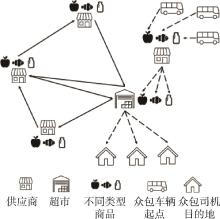
"


"
| 参考文献 | 需求拆分方式 | 车辆类型 | 众包配送模式 | 求解方法 | ||||||
|---|---|---|---|---|---|---|---|---|---|---|
| 任意拆分 | 部分拆分 | 不拆分 | 单车型 | 多车型 | 一对一 | 一对多 | 多对一 | 精确算法 | 启发式算法 | |
| He和Hao[ | √ | √ | √ | |||||||
| 揭婉晨等[ | √ | √ | √ | |||||||
| Archetti等[ | √ | √ | √ | √ | ||||||
| Boysen等[ | √ | √ | √ | √ | √ | |||||
| Wu等[ | √ | √ | √ | √ | ||||||
| Baller等[ | √ | √ | √ | √ | √ | |||||
| 本文 | √ | √ | √ | √ | √ | √ | ||||
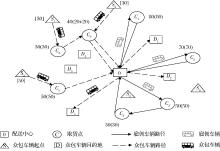
"

"
| 参数符号 | 含义 |
|---|---|
| 仓储中心集合, | |
| 客户集合,用 | |
| 仓储中心和客户集合 | |
| 众包车辆起始点集合,用 | |
| 众包车辆目的地集合,用 | |
| 雇佣车辆集合,用 | |
| 众包车辆集合,用 | |
| 雇佣车辆最大载重量,全为同型号车辆 | |
| 众包车辆最大载重量,不同型号的车辆, | |
| 雇佣车辆的固定成本 | |
| 节点 | |
| 众包车辆绕路行驶的补偿系数 | |
| 众包车辆 | |
| 客户 | |
| 从节点 | |
| 决策变量 | 含义 |
| 0-1决策变量,为1表示雇佣车辆 | |
| 0-1决策变量,为1表示众包车辆 | |
| 0-1决策变量,为1表示客户节点 | |
| 取货变量,雇佣车辆 | |
| 取货变量,众包车辆 | |
| 载重变量,车辆 |
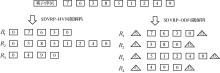
"

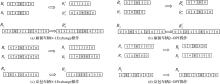
"

"
| 算例类型 | 算例编号 | 众包车辆编号 |
|---|---|---|
| A | A-n32-k5、A-n39-k6、A-n48-k7、A-n80-k10 | A-n80-k10 |
| B | B-n31-k5、B-n45-k5、B-n56-k7、B-n67-k10 | B-n78-k10 |
| P | P-n40-k5、P-n50-k10、P-n60-k10、P-n101-k14 | P-n101-k4 |
"
| 测试问题 | GA-Greedy | GA2-TNS | RSGA-TNS | |||||||||
|---|---|---|---|---|---|---|---|---|---|---|---|---|
| Best | Avg | Gap/% | Time/s | Best | Avg | Gap/% | Time/s | Best | Avg | Gap/% | Time/s | |
| A-n32-k5 | 2395.72 | 2484.92 | -10.29 | 1.32 | 2149.13 | 2244.47 | -0.00 | 368.23 | 2209.59 | 2262.92 | -2.74 | 689.30 |
| A-n39-k6 | 3044.99 | 3137.29 | -12.80 | 1.72 | 2655.26 | 2760.29 | -0.00 | 641.08 | 2692.62 | 2798.49 | -1.39 | 834.00 |
| A-n48-k7 | 3866.59 | 4046.58 | -15.55 | 2.06 | 3331.52 | 3408.51 | -1.98 | 1193.85 | 3265.50 | 3356.16 | 0.00 | 1013.16 |
| A-n80-k10 | 6279.28 | 6482.63 | -16.15 | 2.09 | 5529.02 | 5589.61 | -4.77 | 1549.46 | 5265.34 | 5302.11 | 0.00 | 1368.71 |
| B-n31-k5 | 1634.42 | 1670.23 | -0.00 | 1.40 | 1811.34 | 1828.66 | -9.77 | 715.98 | 1776.61 | 1818.42 | -8.00 | 867.18 |
| B-n45-k5 | 2697.91 | 2829.36 | -13.43 | 1.97 | 2539.15 | 2565.57 | -8.02 | 906.28 | 2335.46 | 2373.80 | 0.00 | 902.93 |
| B-n56-k7 | 3723.42 | 3887.75 | -17.74 | 1.47 | 3473.26 | 3602.10 | -11.82 | 958.91 | 3062.76 | 3135.36 | 0.00 | 902.86 |
| B-n67-k10 | 6320.59 | 6593.33 | -22.51 | 1.84 | 5913.64 | 5967.69 | -17.18 | 1082.05 | 4897.94 | 5221.66 | 0.00 | 1344.32 |
| P-n40-k5 | 2218.86 | 2329.80 | -4.49 | 1.51 | 2252.37 | 2299.39 | -5.91 | 557.62 | 2119.29 | 2198.33 | 0.00 | 707.90 |
| P-n50-k10 | 4240.81 | 4366.81 | -1.50 | 2.25 | 4444.81 | 4492.93 | -6.02 | 729.44 | 4177.08 | 4279.94 | 0.00 | 911.69 |
| P-n60-k10 | 4699.79 | 4866.13 | -10.64 | 1.67 | 4481.92 | 4511.40 | -6.30 | 694.84 | 4199.69 | 4366.41 | 0.00 | 659.14 |
| P-n101-k4 | 3578.19 | 3935.77 | -18.76 | 2.46 | 3609.40 | 3774.09 | -19.46 | 873.44 | 2906.83 | 3083.17 | 0.00 | 873.56 |
"

"
序号 A-n32-k5 | SDVRP-HV | SDVRP-OD | VRPHOD | SDVRPHOD | ||||||||
|---|---|---|---|---|---|---|---|---|---|---|---|---|
| L(LHV ) | KHV | T | L(LOD ) | KOD | T | L(LHV /LOD ) | KHV/KOD | T | L(LHV /LOD ) | KHV /KOD | T | |
| 1 | 991.28 | 5 | 991.28 | 632.94 | 33 | 632.94 | 241.78/249.02 | 1/19 | 490.80 | 390.61/231.07 | 2/20 | 621.68 |
| 2 | 972.73 | 5 | 972.73 | 716.43 | 35 | 716.43 | 264.73/165.54 | 1/18 | 430.27 | 328.55/269.86 | 2/20 | 598.41 |
| 3 | 1012.85 | 5 | 1012.85 | 590.80 | 30 | 590.80 | 309.41/152.26 | 1/19 | 461.67 | 255.43/360.15 | 1/23 | 615.68 |
| 4 | 987.68 | 5 | 987.68 | 578.95 | 33 | 578.95 | 271.42/234.43 | 1/20 | 505.84 | 318.99/301.71 | 1/21 | 620.70 |
| 5 | 997.93 | 5 | 997.93 | 724.58 | 30 | 724.58 | 269.99/149.48 | 1/21 | 419.47 | 337.62/258.52 | 1/22 | 596.14 |
| 6 | 979.68 | 5 | 979.68 | 762.38 | 32 | 762.38 | 329.81/257.85 | 1/21 | 587.67 | 251.82/380.04 | 1/24 | 631.86 |
| 7 | 993.72 | 5 | 993.72 | 647.33 | 28 | 647.33 | 298.89/139.91 | 1/19 | 438.80 | 381.57/254.96 | 2/18 | 636.54 |
| 8 | 975.10 | 5 | 975.10 | 733.09 | 32 | 733.09 | 288.07/175.13 | 1/19 | 463.20 | 318.46/260.21 | 2/19 | 578.67 |
| 9 | 1020.15 | 5 | 1020.15 | 748.82 | 30 | 748.82 | 264.51/146.67 | 1/19 | 411.18 | 507.26/156.32 | 2/17 | 663.58 |
| 10 | 992.33 | 5 | 992.33 | 679.60 | 30 | 679.60 | 286.31/125.98 | 1/19 | 412.29 | 343.35/292.33 | 2/20 | 635.68 |
| 平均值 | 992.35 | 5 | 992.35 | 681.49 | 31.3 | 681.49 | 282.49/179.63 | 1/19.4 | 462.12 | 343.37/276.52 | 1.6/20.4 | 619.88 |
| 最优解 | 972.73 | 5 | 972.73 | 578.95 | 28 | 578.95 | 241.78/125.98 | 1/18 | 411.18 | 251.82/156.32 | 1/17 | 578.67 |
| 最劣解 | 1020.15 | 5 | 1020.15 | 762.38 | 35 | 762.38 | 329.81/257.85 | 1/21 | 587.67 | 507.26/380.04 | 2/24 | 663.58 |
| 改进% | 37.53 | 9.04 | -34.14 | |||||||||
| [1] | 潘雯雯, 郭海湘, 周光勇, 等. 基于两阶段算法的需求可拆分多车型车辆路径问题[J]. 中国管理科学, 2016, 24(S1): 55-61. |
| Pan W W, Guo H X, Zhou G Y, et al. Research on split delivery andheterogeneous fleet vehicle routing problem based on two phase algorithm[J]. Chinese Journal of Management Science, 2016, 24(S1): 55-61. | |
| [2] | Henke T, Speranza M G, Wäscher G. A branch-and-cut algorithm for the multi-compartment vehicle routing problem with flexible compartment sizes[J]. Annals of Operations Research, 2019, 275(2): 321-338. |
| [3] | Miranda-de la Lama G C, Villarroel M, María G A. Livestock transport from the perspective of the pre-slaughter logistic chain: A review[J]. Meat Science, 2014, 98(1): 9-20. |
| [4] | Polat O, Topaloğlu D. Collection of different types of milk with multi-tank tankers under uncertainty: A real case study[J]. TOP, 2022, 30(1): 1-33. |
| [5] | Guo F, Huang Z, Huang W. Heuristic approaches for a vehicle routing problem with an incompatible loading constraint and splitting deliveries by order[J]. Computers & Operations Research, 2021, 134: 105379. |
| [6] | Dror M, Trudeau P. Split delivery routing[J]. Naval Research Logistics (NRL), 1990, 37(3): 383-402. |
| [7] | Claudia Archetti M W P S. Worst-case analysis for split delivery vehicle routing problems[J]. Transportation Science, 2006, 40(2): 226-234. |
| [8] | Ho S C, Haugland D. A tabu search heuristic for the vehicle routing problem with time windows and split deliveries[J]. Computers & Operations Research, 2004, 31(12): 1947-1964. |
| [9] | Mitra S. A parallel clustering technique for the vehicle routing problem with split deliveries and pickups[J]. Journal of the Operational Research Society, 2008, 59(11): 1532-1546. |
| [10] | Chen P, Golden B, Wang X, et al. A novel approach to solve the split delivery vehicle routing problem[J]. International Transactions in Operational Research, 2017, 24(1-2): 27-41. |
| [11] | He P, Hao J K. General edge assembly crossover-driven memetic search for split delivery vehicle routing[J]. Transportation Science, 2023, 57(2): 482-511. |
| [12] | 范厚明, 张轩, 任晓雪, 等. 多中心开放且需求可拆分的VRPSDP问题优化[J]. 系统工程理论与实践, 2021, 41(6): 1521-1534. |
| Fan H M, Zhang X, Ren X X, et al. Optimization of multi-depot open split delivery vehicle routing problem with simultaneous delivery and pick-up[J]. Systems Engineering-Theory & Practice, 2021, 41(6): 1521-1534. | |
| [13] | Desaulniers G. Branch-and-price-and-cut for the split-delivery vehicle routing problem with time windows[J].Operations Research, 2010,58(1): 179-192. |
| [14] | Bianchessi N, Drexl M, Irnich S. The split delivery vehicle routing problem with time windows and customer inconvenience constraints[J]. Transportation Science, 2019, 53(4): 1067-1084. |
| [15] | 揭婉晨, 侍颖, 杨, 等. 需求可拆分电动汽车车辆路径问题及其改进分支定价算法研究[J]. 管理学报, 2020, 17(12): 1873-1880. |
| Jie W C, Shi Y, Y, et al. Split delivery routing problem of electric vehicles and its modified branch-and-price algorithm[J]. Chinese Journal of Management, 2020, 17(12): 1873-1880. | |
| [16] | Archetti C, Savelsbergh M, Speranza M G. The vehicle routing problem with occasional drivers[J]. European Journal of Operational Research, 2016, 254(2): 472-480. |
| [17] | Devari A, Nikolaev A G, He Q. Crowdsourcing the last mile delivery of online orders by exploiting the social networks of retail store customers[J]. Transportation Research Part E: Logistics and Transportation Review, 2017, 105: 105-122. |
| [18] | Macrina G, Di Puglia Pugliese L, Guerriero F, et al. Crowd-shipping with time windows and transshipment nodes[J]. Computers & Operations Research, 2020, 113: 104806. |
| [19] | Kafle N, Zou B, Lin J. Design and modeling of a crowdsource-enabled system for urban parcel relay and delivery[J]. Transportation Research Part B: Methodological, 2017, 99: 62-82. |
| [20] | Behrend M, Meisel F, Fagerholt K, et al. An exact solution method for the capacitated item-sharing and crowdshipping problem[J]. European Journal of Operational Research, 2019, 279(2): 589-604. |
| [21] | Boysen N, Emde S, Schwerdfeger S. Crowdshipping by employees of distribution centers: Optimization approaches for matching supply and demand[J]. European Journal of Operational Research, 2022, 296(2): 539-556. |
| [22] | Macrina G, Di Puglia Pugliese L, Guerriero F, et al. The vehicle routing problem with occasional drivers and time windows[C]//Proceedings of Optimization and Decision Science: Methodologies and Applications, Cham, November 5, Springer, 2017: 577-587. |
| [23] | Wu S H, Zhan Z H, Zhang J. SAFE: Scale-adaptive fitness evaluation method for expensive optimization problems[J]. IEEE Transactions on Evolutionary Computation, 2021, 25(3): 478-491. |
| [24] | Baller A C, Dabia S, Dullaert W E H, et al. The vehicle routing problem with partial outsourcing[J]. Transportation Science, 2020, 54(4): 1034-1052. |
| [25] | Vidal T, Crainic T G, Gendreau M, et al. A hybrid genetic algorithm with adaptive diversity management for a large class of vehicle routing problems with time-windows[J]. Computers & Operations Research, 2013, 40(1): 475-489. |
| [26] | Hao H, Zhou A, Qian H, et al. Expensive multiobjective optimization by relation learning and prediction[J]. IEEE Transactions on Evolutionary Computation, 2022, 26(5): 1157-1170. |
| [27] | Jin Y, Wang H, Chugh T, et al. Data-driven evolutionary optimization: An overview and case studies[J]. IEEE Transactions on Evolutionary Computation, 2019, 23(3): 442-458. |
| [1] | Liping Liu, Rui Wang, Shilei Sun, Xiaofeng Gan, Tijun Fan. Transportation Network Optimization of Hazardous Chemicals Considering Risk Equity under Depot Disruptions [J]. Chinese Journal of Management Science, 2026, 34(6): 66-76. |
| [2] | Yulong Li, Han Su, Guobin Wu. The Construction and Optimization of a Drone Delivery System for Dual use of Usual and Emergency Situations [J]. Chinese Journal of Management Science, 2026, 34(6): 133-145. |
| [3] | Songqing Guo, Zhe Xu, Yixuan Su. Optimization of Multi Skill Project Group Scheduling Based on Global Idle Resource Reallocation [J]. Chinese Journal of Management Science, 2026, 34(6): 187-201. |
| [4] | Shang Gao, Jing Zhou, Ting Luo. Design and Selection of Incentive Contract for Crowdsourcing Contest Considering Fairness Concern and Altruistic Preference [J]. Chinese Journal of Management Science, 2025, 33(7): 284-293. |
| [5] | Sha Tao, Jing Jin, Jing Zhou. The Integrated Optimization Project Scheduling and Personnel Assignment Considering Online-Onsite Collaboration [J]. Chinese Journal of Management Science, 2025, 33(6): 85-95. |
| [6] | Song Xue, Xu Chen, Chao Li, Jingchun Feng. Research on Miniature Multi-Project Scheduling of Service Project Enterprises Considering the Evolution of Human Resources Skills [J]. Chinese Journal of Management Science, 2025, 33(6): 96-104. |
| [7] | Lili Zhang, Zhengrui Chen, Yang Yang, Shi Dan. One-to-many “Personnel-task” Assignment Method for Maintenance Project of Hazardous Chemicals Production Equipment Considering Complexity [J]. Chinese Journal of Management Science, 2025, 33(4): 175-184. |
| [8] | Keyi Zhang, Yong Shi, Haixiang Guo, Yongzheng Sun. Optimal Decision-Making for Dispatching Emergency Supplies for Natural Disasters in Mountainous Areas Based on Truck-Drone Collaboration [J]. Chinese Journal of Management Science, 2025, 33(2): 150-160. |
| [9] | Yuanyuan Jiang, He Luo, Zhiwei Wu, Zhiming Cai, Guoqiang Wang. Research on the Joint Optimization of Procurement Planning and Supplier Selection for the Overseas Base of Manufacturing Enterprises [J]. Chinese Journal of Management Science, 2025, 33(10): 126-137. |
| [10] | Tieke Li,Yixuan Su,Wenxin Zhang,Bailin Wang. Interval Multi-objective Optimal Scheduling for Steelmaking-continuous Casting with Processing Time Uncertainty [J]. Chinese Journal of Management Science, 2024, 32(8): 95-106. |
| [11] | Zihao Chu,Zhe Xu,Dongning Liu. Model and Algorithm on Stochastic Scheduling Problem with Activity Overlapping [J]. Chinese Journal of Management Science, 2024, 32(7): 84-94. |
| [12] | Zhengchi Liu,Bo Liang,Tao Ma. Reward Size, Ability Distribution and Incentive Effects of Crowdsourcing: A Model Analysis on All-Pay Auctions [J]. Chinese Journal of Management Science, 2024, 32(6): 13-21. |
| [13] | Xingguang Chen,Xinyu Li,Luqiang Cheng. Research on Optimization Strategy of Food Delivery Crowdsourcing Delivery Considering Order Preference [J]. Chinese Journal of Management Science, 2024, 32(6): 86-97. |
| [14] | Ling Zhang,Pengfei Gao,Lin Zhang. Research on Emergency Evacuation and Material Allocation Based on Deprivation Cost [J]. Chinese Journal of Management Science, 2024, 32(5): 187-195. |
| [15] | Xiuli Meng,Jing Yang,Bo Liu. Competition Strategy of Crowdsourcing Logistics Service Quality Based on Big Data Technology [J]. Chinese Journal of Management Science, 2024, 32(4): 130-140. |
| Viewed | ||||||
|
Full text |
|
|||||
|
Abstract |
|
|||||
|
||
